
Biermann Quarries (Bethel quarries; Codfish Hill Quarry), Bethel, Fairfield County, Connecticut, USAi
| Regional Level Types | |
|---|---|
| Biermann Quarries (Bethel quarries; Codfish Hill Quarry) | Quarry (Abandoned) |
| Bethel | - not defined - |
| Fairfield County | County |
| Connecticut | State |
| USA | Country |
This page is currently not sponsored. Click here to sponsor this page.


Latitude & Longitude (WGS84):
41° 21' 15'' North , 73° 21' 2'' West
Latitude & Longitude (decimal):
Type:
Quarry (Abandoned) - last checked 2023
Köppen climate type:
Nearest Settlements:
| Place | Population | Distance |
|---|---|---|
| Bethel | 9,549 (2017) | 5.6km |
| Newtown | 1,967 (2017) | 7.7km |
| Danbury | 84,657 (2017) | 9.7km |
| Easton | 7,625 (2017) | 12.1km |
| Georgetown | 1,805 (2017) | 13.0km |
Nearest Clubs:
Local clubs are the best way to get access to collecting localities
Local clubs are the best way to get access to collecting localities
| Club | Location | Distance |
|---|---|---|
| Danbury Mineralogical Society | Danbury, Connecticut | 10km |
| New Haven Mineral Club | New Haven, Connecticut | 36km |
| Stamford Mineralogical Society | Stamford, Connecticut | 37km |
| Bristol Gem & Mineral Club | Bristol, Connecticut | 49km |
| Lapidary and Mineral Society of Central Connecticut | Meriden, Connecticut | 50km |
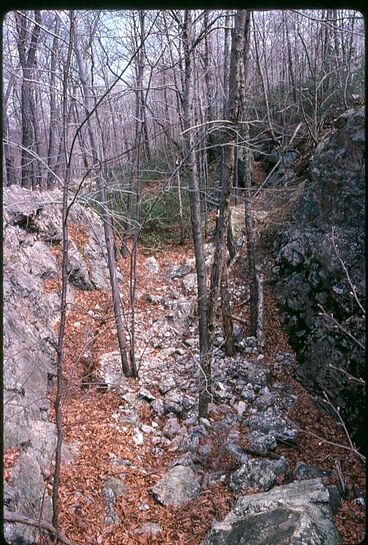
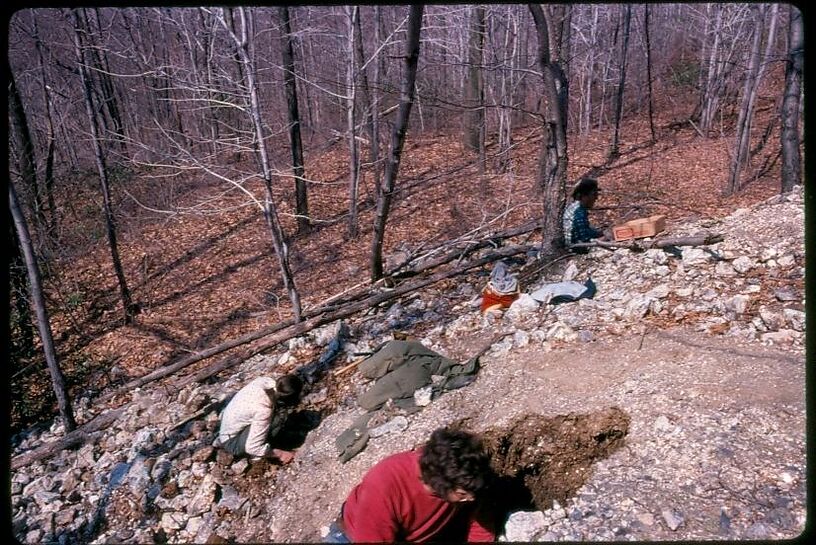
Two adjacent quarries in a granite pegmatite now well-known for its bertrandite crystals. Most references describe or list minerals but provide little history. Todd (1906) visited the "recently opened" quarry and reported that "This vein, we learned, is controlled jointly by the New Jersey Flint and Spar Company and the International Pottery, both of Trenton, New Jersey, and all its stone is shipped there." He mentions an immense tourmaline crystal measuring 3 feet by 18 inches that had been taken from the workings. The quarry apparently was not active during WWII because it does not appear in Cameron et al's (1954) Pegmatite Investigations 1942-45 New England. It may have been worked for beryl in the 1950s. Hiller (1982) claims it was worked in the 19th century for mica and in the early 20th century for mica and feldspar. He collected there after 1965 into the 1980s. It is located in Huntington State Park.
Some references such as Schooner (1961) refer to this quarry incorrectly as the Codfish Hill Quarry, though the minerals he describes are correct for Biermann.
This internally zoned pegmatite has small vugs and pockets in the albite-rich zone containing generally microcrystals of albite, muscovite, fluorapatite (white to pale blue), quartz, beryl (rarely), and lesser quantities of unusual (for a pegmatite) lead minerals like wulfenite, cerrusite and pyromorphite described by Januzzi (1959). Bertrandite microcrystals described by Hiller (1982) and Henderson (1975, 1995) made this pegmatite well-known among collectors. Many beryl crystals here are pseudomorphed by a dull-brown, fine-grained mixture of bertrandite, muscovite, adularia, quartz and albite.
Nearby tourmaline-rich ledges have a separate locality page:
https://www.mindat.org/loc-457625.html
Please post minerals from there to that mindat page.
NOTE: Into the 1980s, collecting permission could be obtained from the park ranger (Hiller, 1982). However, it is no longer allowed. All mineral collecting in Collis P. Huntington State Park is illegal and will be prosecuted.
Select Mineral List Type
Standard Detailed Gallery Strunz Chemical ElementsCommodity List
This is a list of exploitable or exploited mineral commodities recorded at this locality.Mineral List
24 valid minerals. 1 erroneous literature entry.
Detailed Mineral List:
| ⓘ Acanthite ? Formula: Ag2S Habit: massive Colour: black Description: Microscopic black masses with post-collecting crystal overgrowths. |
| ⓘ Albite Formula: Na(AlSi3O8) Habit: massive, tabular, blocky angular overgrowths Colour: white Description: Vast majority is massive primary pegmatite constituent. Secondary crystals occur as micro-overgrowths on walls of small voids and as part of a suite of micro-minerals pseudomorphing beryl. |
| ⓘ Almandine Formula: Fe2+3Al2(SiO4)3 Habit: trapezohedral Colour: maroon Description: Massive material, commonly with blue-green to white fluorapatite. References: |
| ⓘ Annite Formula: KFe2+3(AlSi3O10)(OH)2 Colour: black Description: minor accessory mineral |
| ✪ Bertrandite Formula: Be4(Si2O7)(OH)2 Habit: multiple forms, from simple to complex and as various twins. Usually flattened, elongated, or blocky. Colour: colorless Description: Micro-crystals and aggregates in voids left by dissolved beryl crystals. Also part of a suite of micro-minerals pseudomorphing beryl crystals. |
| ⓘ Beryl Formula: Be3Al2(Si6O18) Habit: Hexagonal prisms elongated along c axis. Commonly tapered. Colour: orange-yellow, pale yellow to pale green, brown when altered Description: Crystals can be large (over 60 cm), though typically subhedral, and multi-colored, and varying from partly gemmy to brown, opaque, and altered to a fine-grained mixture of bertrandite, muscovite, adularia, quartz and albite. Many crystals are found frozen in matrix in a subparallel arrangement with one end rooted in a layer mica. |
| ⓘ Bismutite Formula: (BiO)2CO3 Habit: earthy, as pseudomorphs after bismuthinite Colour: gray Description: earthy gray pseudomorphs after elongated, striated bismuthinite crystals up to a few cms. |
| ⓘ Cerussite Formula: PbCO3 Habit: equant, dipyramidal, pseudo-hexagonal Colour: Yellowish white Description: In addition to free-growing crystals, the cerussite is also found as megascopic and microscopic crystalline masses and grains associated with wulfenite and pyromorphite. |
| ⓘ 'Chlorite Group' Habit: massive and micaceous in the schist, pseudohexagonal in the pegmatite Colour: dark green in the schist, in the pegmatite as zoned nearly black interior and white exterior. Description: Abundant in the schist near the pegmatite. Also very rarely as tiny crystals and crusts in voids in the pegmatite. |
| ✪ 'Columbite-(Fe)-Columbite-(Mn) Series' Habit: flat, elongated prisms or subhedral masses Colour: black, with iridescence Description: Good prismatic crystals formed in quartz, also hand-sized subhedral masses with striations from neighboring muscovite. Januzzi (1976) reports that a beryl crystal with a large columbite crystal projecting from it was donated to the American Museum of Natural History in New York City. The ID is generic, at least one crystal was tested using Raman spectroscopy and the best match is tantalite-(Fe) (see entry). A crystal formerly in the Bill Shelton collection has a specific gravity of 6.7, making it clearly a columbite species. References: |
| ⓘ 'Cymatolite' ? Description: The complete absence of spodumene at Biermann makes the occurence of cymatolite here hightly unlikely. Quite possibly the reported find was a cymatolite found at the Fillow Quarry (not too far away) and discard by a collector at Biermann. |
| ⓘ 'Fergusonite' ? Colour: brownish yellow Description: reported by Januzzi (1976) as "a small, brownish yellow nodule in feldspar". No analysis reported, no other finds reported/confirmed. |
| ⓘ Fluorapatite Formula: Ca5(PO4)3F Habit: massive to subhedral tabular Colour: white to blue-green Fluorescence: yellow under SW UV Description: Typically massive and associated with maroon almandine. Color can vary between white and blue-green in the same chunk, with bright yellow SW UV fluorescence only from the white zones. References: |
| ⓘ 'Gummite' Description: Apparently an alteration of uraninite. |
| ⓘ Hematite Formula: Fe2O3 |
| ⓘ 'K Feldspar' Colour: white Description: See comments for adularia variety. References: |
| ⓘ 'K Feldspar var. Adularia' Formula: KAlSi3O8 Habit: rectangular with acute pinacoids to flat pseudo-rhombohedral Colour: white to pale pink Description: Part of a suite of microminerals pseudomorphing beryl: bertrandite, muscovite, albite, quartz. References: |
| ⓘ Meta-autunite Formula: Ca(UO2)2(PO4)2 · 6H2O Habit: square tabular Colour: yellow-green Fluorescence: bright green under SW UV Description: Secondary microcrystals from the alteration of primary uraninite. |
| ⓘ Microcline Formula: K(AlSi3O8) Colour: white to tan Description: Primary constituent of the pegmatite matrix, crystals rare and typically subhedral. |
| ⓘ Muscovite Formula: KAl2(AlSi3O10)(OH)2 Habit: tabular subhedral Colour: silvery to pale olive green Description: Major accessory pegmatite mineral, in books up to several 10s of cm, pseudmorphing schorl, or as part of a suite of microminerals pseudomorphing beryl: bertrandite, adularia, albite, quartz. |
| ⓘ Opal Formula: SiO2 · nH2O Habit: coatings Colour: colorless Fluorescence: bright green under SW UV Description: Minor coatings on fracture surfaces, nearly impossible to see without using a UV lamp. |
| ⓘ Opal var. Opal-AN Formula: SiO2 · nH2O Habit: coatings Colour: colorless Fluorescence: bright green under SW UV Description: Minor coatings on fracture surfaces, nearly impossible to see without using a UV lamp. |
| ⓘ Pyrite Formula: FeS2 |
| ⓘ Formula: Mn4+O2 Description: No pyrolusite dendrite or staining in the world has been verified as pyrolusite. The name was a mistake in the nineteenth century which has been widely publicized. |
| ⓘ Pyromorphite Formula: Pb5(PO4)3Cl Habit: micro-encrustations Colour: yellow-green Description: Associated with microcrystals of wulfenite and cerussite in vuggy albite. |
| ⓘ Quartz Formula: SiO2 Habit: elongated prismatic Colour: smoky to milky Description: The vast majority of material is a massive primary constituent of the pegmatite matrix. Small to microcrystals are secondary overgrowths lining small void or as part of a suite of microminerals pseudomorphing beryl: bertrandite, adularia, albite, muscovite. |
| ⓘ Schorl Formula: NaFe2+3Al6(Si6O18)(BO3)3(OH)3(OH) Habit: elongated trigonal prismatic Colour: black Description: An accessory mineral in the pegmatite, crystals up to 3 feet long and commonly tapered along their long axis. Many are partly or completely altered to muscovite. References: |
| ⓘ Spessartine Formula: Mn2+3Al2(SiO4)3 Habit: massive Colour: red Description: Massive material associated with blue-green fluorapatite in cleavelandite. References: |
| ⓘ Tantalite-(Fe) Formula: Fe2+Ta2O6 Description: At least one "columbite" from here was tested using Raman spectroscopy at the University of New Haven and best match is tantalite-(Fe). References: |
| ⓘ Uraninite Formula: UO2 Habit: octahedral Colour: black Description: Crystals typically small and subhedral. |
| ⓘ Uranophane Formula: Ca(UO2)2(SiO3OH)2 · 5H2O Description: Alteration of uraninite. |
| ⓘ Wulfenite Formula: Pb(MoO4) Habit: tabular, elongated prismatic bipyramidal Colour: orange Description: Microcrystals associated with equally small cerussite and pyromorphite crystals in vuggy albite. |
| ⓘ Zircon Formula: Zr(SiO4) References: |
| ⓘ Zircon var. Cyrtolite Formula: Zr[(SiO4),(OH)4] Habit: branching aggregates of prismatic crystals terminated by pyramids Colour: brown |
Gallery:

List of minerals arranged by Strunz 10th Edition classification
| Group 2 - Sulphides and Sulfosalts | |||
|---|---|---|---|
| ⓘ | Acanthite ? | 2.BA.35 | Ag2S |
| ⓘ | Pyrite | 2.EB.05a | FeS2 |
| Group 4 - Oxides and Hydroxides | |||
| ⓘ | Hematite | 4.CB.05 | Fe2O3 |
| ⓘ | Quartz | 4.DA.05 | SiO2 |
| ⓘ | Opal var. Opal-AN | 4.DA.10 | SiO2 · nH2O |
| ⓘ | 4.DA.10 | SiO2 · nH2O | |
| ⓘ | Pyrolusite ? | 4.DB.05 | Mn4+O2 |
| ⓘ | Tantalite-(Fe) | 4.DB.35 | Fe2+Ta2O6 |
| ⓘ | Uraninite | 4.DL.05 | UO2 |
| Group 5 - Nitrates and Carbonates | |||
| ⓘ | Cerussite | 5.AB.15 | PbCO3 |
| ⓘ | Bismutite | 5.BE.25 | (BiO)2CO3 |
| Group 7 - Sulphates, Chromates, Molybdates and Tungstates | |||
| ⓘ | Wulfenite | 7.GA.05 | Pb(MoO4) |
| Group 8 - Phosphates, Arsenates and Vanadates | |||
| ⓘ | Fluorapatite | 8.BN.05 | Ca5(PO4)3F |
| ⓘ | Pyromorphite | 8.BN.05 | Pb5(PO4)3Cl |
| ⓘ | Meta-autunite | 8.EB.10 | Ca(UO2)2(PO4)2 · 6H2O |
| Group 9 - Silicates | |||
| ⓘ | Almandine | 9.AD.25 | Fe2+3Al2(SiO4)3 |
| ⓘ | Spessartine | 9.AD.25 | Mn2+3Al2(SiO4)3 |
| ⓘ | Zircon | 9.AD.30 | Zr(SiO4) |
| ⓘ | var. Cyrtolite | 9.AD.30 | Zr[(SiO4),(OH)4] |
| ⓘ | Uranophane | 9.AK.15 | Ca(UO2)2(SiO3OH)2 · 5H2O |
| ⓘ | Bertrandite | 9.BD.05 | Be4(Si2O7)(OH)2 |
| ⓘ | Beryl | 9.CJ.05 | Be3Al2(Si6O18) |
| ⓘ | Schorl | 9.CK.05 | NaFe2+3Al6(Si6O18)(BO3)3(OH)3(OH) |
| ⓘ | Muscovite | 9.EC.15 | KAl2(AlSi3O10)(OH)2 |
| ⓘ | Annite | 9.EC.20 | KFe2+3(AlSi3O10)(OH)2 |
| ⓘ | Microcline | 9.FA.30 | K(AlSi3O8) |
| ⓘ | Albite | 9.FA.35 | Na(AlSi3O8) |
| Unclassified | |||
| ⓘ | 'K Feldspar var. Adularia' | - | KAlSi3O8 |
| ⓘ | 'Chlorite Group' | - | |
| ⓘ | 'Gummite' | - | |
| ⓘ | 'Cymatolite' ? | - | |
| ⓘ | 'Columbite-(Fe)-Columbite-(Mn) Series' | - | |
| ⓘ | 'K Feldspar' | - | |
| ⓘ | 'Fergusonite' ? | - | |
List of minerals for each chemical element
| H | Hydrogen | |
|---|---|---|
| H | ⓘ Annite | KFe32+(AlSi3O10)(OH)2 |
| H | ⓘ Bertrandite | Be4(Si2O7)(OH)2 |
| H | ⓘ Opal var. Opal-AN | SiO2 · nH2O |
| H | ⓘ Meta-autunite | Ca(UO2)2(PO4)2 · 6H2O |
| H | ⓘ Muscovite | KAl2(AlSi3O10)(OH)2 |
| H | ⓘ Opal | SiO2 · nH2O |
| H | ⓘ Schorl | NaFe32+Al6(Si6O18)(BO3)3(OH)3(OH) |
| H | ⓘ Uranophane | Ca(UO2)2(SiO3OH)2 · 5H2O |
| H | ⓘ Zircon var. Cyrtolite | Zr[(SiO4),(OH)4] |
| Be | Beryllium | |
| Be | ⓘ Bertrandite | Be4(Si2O7)(OH)2 |
| Be | ⓘ Beryl | Be3Al2(Si6O18) |
| B | Boron | |
| B | ⓘ Schorl | NaFe32+Al6(Si6O18)(BO3)3(OH)3(OH) |
| C | Carbon | |
| C | ⓘ Bismutite | (BiO)2CO3 |
| C | ⓘ Cerussite | PbCO3 |
| O | Oxygen | |
| O | ⓘ K Feldspar var. Adularia | KAlSi3O8 |
| O | ⓘ Albite | Na(AlSi3O8) |
| O | ⓘ Annite | KFe32+(AlSi3O10)(OH)2 |
| O | ⓘ Almandine | Fe32+Al2(SiO4)3 |
| O | ⓘ Bertrandite | Be4(Si2O7)(OH)2 |
| O | ⓘ Bismutite | (BiO)2CO3 |
| O | ⓘ Beryl | Be3Al2(Si6O18) |
| O | ⓘ Cerussite | PbCO3 |
| O | ⓘ Tantalite-(Fe) | Fe2+Ta2O6 |
| O | ⓘ Fluorapatite | Ca5(PO4)3F |
| O | ⓘ Hematite | Fe2O3 |
| O | ⓘ Opal var. Opal-AN | SiO2 · nH2O |
| O | ⓘ Meta-autunite | Ca(UO2)2(PO4)2 · 6H2O |
| O | ⓘ Microcline | K(AlSi3O8) |
| O | ⓘ Muscovite | KAl2(AlSi3O10)(OH)2 |
| O | ⓘ Opal | SiO2 · nH2O |
| O | ⓘ Pyrolusite | Mn4+O2 |
| O | ⓘ Pyromorphite | Pb5(PO4)3Cl |
| O | ⓘ Quartz | SiO2 |
| O | ⓘ Schorl | NaFe32+Al6(Si6O18)(BO3)3(OH)3(OH) |
| O | ⓘ Spessartine | Mn32+Al2(SiO4)3 |
| O | ⓘ Uraninite | UO2 |
| O | ⓘ Uranophane | Ca(UO2)2(SiO3OH)2 · 5H2O |
| O | ⓘ Wulfenite | Pb(MoO4) |
| O | ⓘ Zircon | Zr(SiO4) |
| O | ⓘ Zircon var. Cyrtolite | Zr[(SiO4),(OH)4] |
| O | ⓘ Columbite-(Fe)-Columbite-(Mn) Series | |
| F | Fluorine | |
| F | ⓘ Fluorapatite | Ca5(PO4)3F |
| Na | Sodium | |
| Na | ⓘ Albite | Na(AlSi3O8) |
| Na | ⓘ Schorl | NaFe32+Al6(Si6O18)(BO3)3(OH)3(OH) |
| Al | Aluminium | |
| Al | ⓘ K Feldspar var. Adularia | KAlSi3O8 |
| Al | ⓘ Albite | Na(AlSi3O8) |
| Al | ⓘ Annite | KFe32+(AlSi3O10)(OH)2 |
| Al | ⓘ Almandine | Fe32+Al2(SiO4)3 |
| Al | ⓘ Beryl | Be3Al2(Si6O18) |
| Al | ⓘ Microcline | K(AlSi3O8) |
| Al | ⓘ Muscovite | KAl2(AlSi3O10)(OH)2 |
| Al | ⓘ Schorl | NaFe32+Al6(Si6O18)(BO3)3(OH)3(OH) |
| Al | ⓘ Spessartine | Mn32+Al2(SiO4)3 |
| Si | Silicon | |
| Si | ⓘ K Feldspar var. Adularia | KAlSi3O8 |
| Si | ⓘ Albite | Na(AlSi3O8) |
| Si | ⓘ Annite | KFe32+(AlSi3O10)(OH)2 |
| Si | ⓘ Almandine | Fe32+Al2(SiO4)3 |
| Si | ⓘ Bertrandite | Be4(Si2O7)(OH)2 |
| Si | ⓘ Beryl | Be3Al2(Si6O18) |
| Si | ⓘ Opal var. Opal-AN | SiO2 · nH2O |
| Si | ⓘ Microcline | K(AlSi3O8) |
| Si | ⓘ Muscovite | KAl2(AlSi3O10)(OH)2 |
| Si | ⓘ Opal | SiO2 · nH2O |
| Si | ⓘ Quartz | SiO2 |
| Si | ⓘ Schorl | NaFe32+Al6(Si6O18)(BO3)3(OH)3(OH) |
| Si | ⓘ Spessartine | Mn32+Al2(SiO4)3 |
| Si | ⓘ Uranophane | Ca(UO2)2(SiO3OH)2 · 5H2O |
| Si | ⓘ Zircon | Zr(SiO4) |
| Si | ⓘ Zircon var. Cyrtolite | Zr[(SiO4),(OH)4] |
| P | Phosphorus | |
| P | ⓘ Fluorapatite | Ca5(PO4)3F |
| P | ⓘ Meta-autunite | Ca(UO2)2(PO4)2 · 6H2O |
| P | ⓘ Pyromorphite | Pb5(PO4)3Cl |
| S | Sulfur | |
| S | ⓘ Acanthite | Ag2S |
| S | ⓘ Pyrite | FeS2 |
| Cl | Chlorine | |
| Cl | ⓘ Pyromorphite | Pb5(PO4)3Cl |
| K | Potassium | |
| K | ⓘ K Feldspar var. Adularia | KAlSi3O8 |
| K | ⓘ Annite | KFe32+(AlSi3O10)(OH)2 |
| K | ⓘ Microcline | K(AlSi3O8) |
| K | ⓘ Muscovite | KAl2(AlSi3O10)(OH)2 |
| Ca | Calcium | |
| Ca | ⓘ Fluorapatite | Ca5(PO4)3F |
| Ca | ⓘ Meta-autunite | Ca(UO2)2(PO4)2 · 6H2O |
| Ca | ⓘ Uranophane | Ca(UO2)2(SiO3OH)2 · 5H2O |
| Mn | Manganese | |
| Mn | ⓘ Pyrolusite | Mn4+O2 |
| Mn | ⓘ Spessartine | Mn32+Al2(SiO4)3 |
| Mn | ⓘ Columbite-(Fe)-Columbite-(Mn) Series | |
| Fe | Iron | |
| Fe | ⓘ Annite | KFe32+(AlSi3O10)(OH)2 |
| Fe | ⓘ Almandine | Fe32+Al2(SiO4)3 |
| Fe | ⓘ Tantalite-(Fe) | Fe2+Ta2O6 |
| Fe | ⓘ Hematite | Fe2O3 |
| Fe | ⓘ Pyrite | FeS2 |
| Fe | ⓘ Schorl | NaFe32+Al6(Si6O18)(BO3)3(OH)3(OH) |
| Fe | ⓘ Columbite-(Fe)-Columbite-(Mn) Series | |
| Zr | Zirconium | |
| Zr | ⓘ Zircon | Zr(SiO4) |
| Zr | ⓘ Zircon var. Cyrtolite | Zr[(SiO4),(OH)4] |
| Nb | Niobium | |
| Nb | ⓘ Columbite-(Fe)-Columbite-(Mn) Series | |
| Mo | Molybdenum | |
| Mo | ⓘ Wulfenite | Pb(MoO4) |
| Ag | Silver | |
| Ag | ⓘ Acanthite | Ag2S |
| Ta | Tantalum | |
| Ta | ⓘ Tantalite-(Fe) | Fe2+Ta2O6 |
| Pb | Lead | |
| Pb | ⓘ Cerussite | PbCO3 |
| Pb | ⓘ Pyromorphite | Pb5(PO4)3Cl |
| Pb | ⓘ Wulfenite | Pb(MoO4) |
| Bi | Bismuth | |
| Bi | ⓘ Bismutite | (BiO)2CO3 |
| U | Uranium | |
| U | ⓘ Meta-autunite | Ca(UO2)2(PO4)2 · 6H2O |
| U | ⓘ Uraninite | UO2 |
| U | ⓘ Uranophane | Ca(UO2)2(SiO3OH)2 · 5H2O |
Other Regions, Features and Areas containing this locality
North AmericaContinent
North America PlateTectonic Plate
- Piedmontia DomainDomain
- Taconic ArcVolcanic Arc
This page contains all mineral locality references listed on mindat.org. This does not claim to be a complete list. If you know of more minerals from this site, please register so you can add to our database. This locality information is for reference purposes only. You should never attempt to
visit any sites listed in mindat.org without first ensuring that you have the permission of the land and/or mineral rights holders
for access and that you are aware of all safety precautions necessary.

Biermann Quarries, Bethel, Fairfield County, Connecticut, USA