
Gwalia Mine (Sons of Gwalia Gold Mine), Leonora, Leonora Shire, Western Australia, Australiai
| Regional Level Types | |
|---|---|
| Gwalia Mine (Sons of Gwalia Gold Mine) | Mine |
| Leonora | Town |
| Leonora Shire | Shire |
| Western Australia | State |
| Australia | Country |
This page is currently not sponsored. Contact us for sponsorship opportunities.


Latitude & Longitude (WGS84):
28° 55' 0'' South , 121° 20' 5'' East
Latitude & Longitude (decimal):
Type:
Köppen climate type:
Nearest Settlements:
| Place | Population | Distance |
|---|---|---|
| Leonora | 532 (2012) | 3.5km |
Owned/operated by:
A gold mine. Reopened 1984.
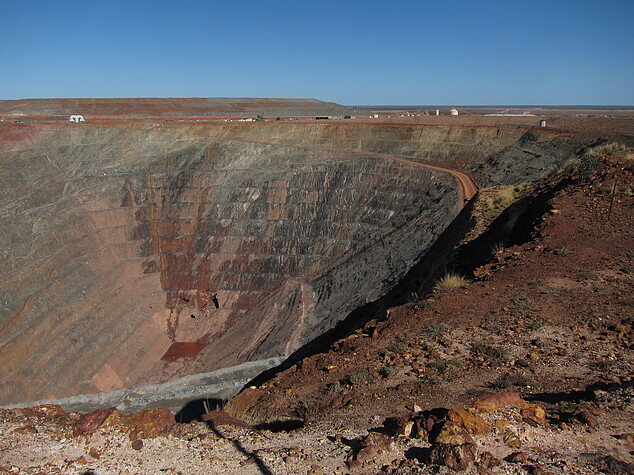
This historic mine is 235 kilometres north of Kalgoorlie and 5 kilometres south of Leonora. Next to the mine is the historic Gwalia township with the 1903 hotel, shopfronts, and miner's cottages. There is also a mining museum right next to the open pit, like any closer it would be in the pit. This has an extensive collection of mining memorabilia, machinery, old buildings, the Herbert Hoover House and head-frame (both pictured) designed by Herbert Hoover. The history of the town will be left to other websites, and we will concentrate on the mine.
The first lease at the site (1896) was applied for by Coolgardie store owner, Thomas Tobias. He named it Sons of Gwalia after his Welsh heritage, 'Gwalia' an ancient word for Wales. In 1897 the lease was sold to George Hall who approached London financiers, Bewick Moreing, to finance the development of a mine. They sent 23 year old engineer, Herbert Hoover, who convinced them to purchase the deposit later in 1897.
Herbert Hoover was to later become the United States 31th President. As mine manager at Sons of Gwalia, he introduced a number of cost saving measures onto the local workforce including single handed work, shift changes, stopped double time on sundays and bonuses for working wet ground. In an effort to side-step union action, he hired Italian immigrants, who to this day have been closely associated with the mine and Gwalia township.
He also oversaw the construction of staff and office buildings on a hill overlooking the mine including the mine managers house now called Hoover House. He lived in it briefly in 1898, before being sent to China by his employers.
Apart from a two year shut-down due to fire in 1921, the mine operated continuously till 1963, and was considered the largest gold producer in Western Australia outside of Kalgoorlie. Due to falling gold prices, the mine closed in 1963, and virtually overnight the Gwalia township declined from 1500 to 40 people. In its 65 years of operations it produced 2 500 000 ounces of gold.
In 1981 a new Sons of Gwalia company was formed by brothers Peter and Chris Lalor, descendants of Eureka Rebellion famed Peter Lalor. Initially the tailings were reworked, then a huge open pit developed, before converting to underground mining in 1999. Initially the company was hugely successful becoming Australia's third largest gold producer. However, unauthorised gold and exchange trading by the chief financial officer saw the company lose 190 million in 2000. The purchase of a number of smaller gold mining companies at inflated prices sealed Sons of Gwalia's fate, and the company went into administration in 2004. In 2008 the mine was sold to St Barbara Ltd, who has continued mining to this day.
The main underground ore shoots at the Sons of Gwalia Mine are Main Lode, West Lode, South Gwalia Series, Hangingwall Series, and South-West Branch. Gwalia has a 500 metre strike length to at least 1750 metres in depth. The open pit above exploited a horseshoe-shaped envelope above the high-grade lodes.
The deposit in this greenstone belt is on the western margins of the broad north-south trending Keith-Kilkenny Tectonic Zone. The deposit is a 120-150 metre thick zone of intensely sheared mafic volcanics with narrow muscovite and to a lesser degree chlorite-tourmaline bands, and wider zones of quartz-carbonate rocks.
Gold is found in partially silicified sericite-muscovite-chlorite schist with disseminated pyrite and traces of chalcopyrite and pyrrhotite, sulphide bearing quartz lenses and stringers in the higher grade zones.
Select Mineral List Type
Standard Detailed Gallery Strunz Chemical ElementsCommodity List
This is a list of exploitable or exploited mineral commodities recorded at this locality.Mineral List
16 valid minerals.
Rock Types Recorded
Note: data is currently VERY limited. Please bear with us while we work towards adding this information!
Select Rock List Type
Alphabetical List Tree DiagramDetailed Mineral List:
| ⓘ Actinolite Formula: ◻Ca2(Mg4.5-2.5Fe0.5-2.5)Si8O22(OH)2 |
| ⓘ Albite Formula: Na(AlSi3O8) |
| ⓘ Ankerite Formula: Ca(Fe2+,Mg)(CO3)2 |
| ⓘ Arsenopyrite Formula: FeAsS |
| ⓘ 'Biotite' Formula: K(Fe2+/Mg)2(Al/Fe3+/Mg/Ti)([Si/Al/Fe]2Si2O10)(OH/F)2 |
| ⓘ Calcite Formula: CaCO3 |
| ⓘ Chalcopyrite Formula: CuFeS2 |
| ⓘ 'Chlorite Group' |
| ⓘ Dolomite Formula: CaMg(CO3)2 |
| ⓘ Galena Formula: PbS |
| ⓘ 'Hornblende Root Name Group' Formula: ◻Ca2(Z2+4Z3+)(AlSi7O22)(OH,F,Cl)2 |
| ⓘ Muscovite Formula: KAl2(AlSi3O10)(OH)2 |
| ⓘ Muscovite var. Sericite Formula: KAl2(AlSi3O10)(OH)2 |
| ⓘ Native Gold Formula: Au |
| ⓘ Pyrite Formula: FeS2 |
| ⓘ Pyrrhotite Formula: Fe1-xS |
| ⓘ Quartz Formula: SiO2 |
| ⓘ Quartz var. Chalcedony Formula: SiO2 |
| ⓘ Rutile Formula: TiO2 |
| ⓘ Schorl Formula: NaFe2+3Al6(Si6O18)(BO3)3(OH)3(OH) |
| ⓘ Sphalerite Formula: ZnS |
| ⓘ 'Tourmaline' Formula: AD3G6(T6O18)(BO3)3X3Z |
Gallery:
List of minerals arranged by Strunz 10th Edition classification
| Group 1 - Elements | |||
|---|---|---|---|
| ⓘ | Native Gold | 1.AA.05 | Au |
| Group 2 - Sulphides and Sulfosalts | |||
| ⓘ | Sphalerite | 2.CB.05a | ZnS |
| ⓘ | Chalcopyrite | 2.CB.10a | CuFeS2 |
| ⓘ | Pyrrhotite | 2.CC.10 | Fe1-xS |
| ⓘ | Galena | 2.CD.10 | PbS |
| ⓘ | Pyrite | 2.EB.05a | FeS2 |
| ⓘ | Arsenopyrite | 2.EB.20 | FeAsS |
| Group 4 - Oxides and Hydroxides | |||
| ⓘ | Quartz var. Chalcedony | 4.DA.05 | SiO2 |
| ⓘ | 4.DA.05 | SiO2 | |
| ⓘ | Rutile | 4.DB.05 | TiO2 |
| Group 5 - Nitrates and Carbonates | |||
| ⓘ | Calcite | 5.AB.05 | CaCO3 |
| ⓘ | Ankerite | 5.AB.10 | Ca(Fe2+,Mg)(CO3)2 |
| ⓘ | Dolomite | 5.AB.10 | CaMg(CO3)2 |
| Group 9 - Silicates | |||
| ⓘ | Schorl | 9.CK.05 | NaFe2+3Al6(Si6O18)(BO3)3(OH)3(OH) |
| ⓘ | Actinolite | 9.DE.10 | ◻Ca2(Mg4.5-2.5Fe0.5-2.5)Si8O22(OH)2 |
| ⓘ | Muscovite | 9.EC.15 | KAl2(AlSi3O10)(OH)2 |
| ⓘ | var. Sericite | 9.EC.15 | KAl2(AlSi3O10)(OH)2 |
| ⓘ | Albite | 9.FA.35 | Na(AlSi3O8) |
| Unclassified | |||
| ⓘ | 'Biotite' | - | K(Fe2+/Mg)2(Al/Fe3+/Mg/Ti)([Si/Al/Fe]2Si2O10)(OH/F)2 |
| ⓘ | 'Chlorite Group' | - | |
| ⓘ | 'Tourmaline' | - | AD3G6(T6O18)(BO3)3X3Z |
| ⓘ | 'Hornblende Root Name Group' | - | ◻Ca2(Z2+4Z3+)(AlSi7O22)(OH,F,Cl)2 |
List of minerals for each chemical element
| H | Hydrogen | |
|---|---|---|
| H | ⓘ Actinolite | ◻Ca2(Mg4.5-2.5Fe0.5-2.5)Si8O22(OH)2 |
| H | ⓘ Biotite | K(Fe2+/Mg)2(Al/Fe3+/Mg/Ti)([Si/Al/Fe]2Si2O10)(OH/F)2 |
| H | ⓘ Muscovite | KAl2(AlSi3O10)(OH)2 |
| H | ⓘ Schorl | NaFe32+Al6(Si6O18)(BO3)3(OH)3(OH) |
| H | ⓘ Hornblende Root Name Group | ◻Ca2(Z42+Z3+)(AlSi7O22)(OH,F,Cl)2 |
| H | ⓘ Muscovite var. Sericite | KAl2(AlSi3O10)(OH)2 |
| B | Boron | |
| B | ⓘ Schorl | NaFe32+Al6(Si6O18)(BO3)3(OH)3(OH) |
| B | ⓘ Tourmaline | AD3G6(T6O18)(BO3)3X3Z |
| C | Carbon | |
| C | ⓘ Ankerite | Ca(Fe2+,Mg)(CO3)2 |
| C | ⓘ Calcite | CaCO3 |
| C | ⓘ Dolomite | CaMg(CO3)2 |
| O | Oxygen | |
| O | ⓘ Actinolite | ◻Ca2(Mg4.5-2.5Fe0.5-2.5)Si8O22(OH)2 |
| O | ⓘ Albite | Na(AlSi3O8) |
| O | ⓘ Ankerite | Ca(Fe2+,Mg)(CO3)2 |
| O | ⓘ Biotite | K(Fe2+/Mg)2(Al/Fe3+/Mg/Ti)([Si/Al/Fe]2Si2O10)(OH/F)2 |
| O | ⓘ Calcite | CaCO3 |
| O | ⓘ Quartz var. Chalcedony | SiO2 |
| O | ⓘ Dolomite | CaMg(CO3)2 |
| O | ⓘ Muscovite | KAl2(AlSi3O10)(OH)2 |
| O | ⓘ Quartz | SiO2 |
| O | ⓘ Rutile | TiO2 |
| O | ⓘ Schorl | NaFe32+Al6(Si6O18)(BO3)3(OH)3(OH) |
| O | ⓘ Tourmaline | AD3G6(T6O18)(BO3)3X3Z |
| O | ⓘ Hornblende Root Name Group | ◻Ca2(Z42+Z3+)(AlSi7O22)(OH,F,Cl)2 |
| O | ⓘ Muscovite var. Sericite | KAl2(AlSi3O10)(OH)2 |
| F | Fluorine | |
| F | ⓘ Biotite | K(Fe2+/Mg)2(Al/Fe3+/Mg/Ti)([Si/Al/Fe]2Si2O10)(OH/F)2 |
| F | ⓘ Hornblende Root Name Group | ◻Ca2(Z42+Z3+)(AlSi7O22)(OH,F,Cl)2 |
| Na | Sodium | |
| Na | ⓘ Albite | Na(AlSi3O8) |
| Na | ⓘ Schorl | NaFe32+Al6(Si6O18)(BO3)3(OH)3(OH) |
| Mg | Magnesium | |
| Mg | ⓘ Actinolite | ◻Ca2(Mg4.5-2.5Fe0.5-2.5)Si8O22(OH)2 |
| Mg | ⓘ Ankerite | Ca(Fe2+,Mg)(CO3)2 |
| Mg | ⓘ Biotite | K(Fe2+/Mg)2(Al/Fe3+/Mg/Ti)([Si/Al/Fe]2Si2O10)(OH/F)2 |
| Mg | ⓘ Dolomite | CaMg(CO3)2 |
| Al | Aluminium | |
| Al | ⓘ Albite | Na(AlSi3O8) |
| Al | ⓘ Biotite | K(Fe2+/Mg)2(Al/Fe3+/Mg/Ti)([Si/Al/Fe]2Si2O10)(OH/F)2 |
| Al | ⓘ Muscovite | KAl2(AlSi3O10)(OH)2 |
| Al | ⓘ Schorl | NaFe32+Al6(Si6O18)(BO3)3(OH)3(OH) |
| Al | ⓘ Hornblende Root Name Group | ◻Ca2(Z42+Z3+)(AlSi7O22)(OH,F,Cl)2 |
| Al | ⓘ Muscovite var. Sericite | KAl2(AlSi3O10)(OH)2 |
| Si | Silicon | |
| Si | ⓘ Actinolite | ◻Ca2(Mg4.5-2.5Fe0.5-2.5)Si8O22(OH)2 |
| Si | ⓘ Albite | Na(AlSi3O8) |
| Si | ⓘ Biotite | K(Fe2+/Mg)2(Al/Fe3+/Mg/Ti)([Si/Al/Fe]2Si2O10)(OH/F)2 |
| Si | ⓘ Quartz var. Chalcedony | SiO2 |
| Si | ⓘ Muscovite | KAl2(AlSi3O10)(OH)2 |
| Si | ⓘ Quartz | SiO2 |
| Si | ⓘ Schorl | NaFe32+Al6(Si6O18)(BO3)3(OH)3(OH) |
| Si | ⓘ Hornblende Root Name Group | ◻Ca2(Z42+Z3+)(AlSi7O22)(OH,F,Cl)2 |
| Si | ⓘ Muscovite var. Sericite | KAl2(AlSi3O10)(OH)2 |
| S | Sulfur | |
| S | ⓘ Arsenopyrite | FeAsS |
| S | ⓘ Chalcopyrite | CuFeS2 |
| S | ⓘ Galena | PbS |
| S | ⓘ Pyrite | FeS2 |
| S | ⓘ Pyrrhotite | Fe1-xS |
| S | ⓘ Sphalerite | ZnS |
| Cl | Chlorine | |
| Cl | ⓘ Hornblende Root Name Group | ◻Ca2(Z42+Z3+)(AlSi7O22)(OH,F,Cl)2 |
| K | Potassium | |
| K | ⓘ Biotite | K(Fe2+/Mg)2(Al/Fe3+/Mg/Ti)([Si/Al/Fe]2Si2O10)(OH/F)2 |
| K | ⓘ Muscovite | KAl2(AlSi3O10)(OH)2 |
| K | ⓘ Muscovite var. Sericite | KAl2(AlSi3O10)(OH)2 |
| Ca | Calcium | |
| Ca | ⓘ Actinolite | ◻Ca2(Mg4.5-2.5Fe0.5-2.5)Si8O22(OH)2 |
| Ca | ⓘ Ankerite | Ca(Fe2+,Mg)(CO3)2 |
| Ca | ⓘ Calcite | CaCO3 |
| Ca | ⓘ Dolomite | CaMg(CO3)2 |
| Ca | ⓘ Hornblende Root Name Group | ◻Ca2(Z42+Z3+)(AlSi7O22)(OH,F,Cl)2 |
| Ti | Titanium | |
| Ti | ⓘ Biotite | K(Fe2+/Mg)2(Al/Fe3+/Mg/Ti)([Si/Al/Fe]2Si2O10)(OH/F)2 |
| Ti | ⓘ Rutile | TiO2 |
| Fe | Iron | |
| Fe | ⓘ Actinolite | ◻Ca2(Mg4.5-2.5Fe0.5-2.5)Si8O22(OH)2 |
| Fe | ⓘ Ankerite | Ca(Fe2+,Mg)(CO3)2 |
| Fe | ⓘ Arsenopyrite | FeAsS |
| Fe | ⓘ Biotite | K(Fe2+/Mg)2(Al/Fe3+/Mg/Ti)([Si/Al/Fe]2Si2O10)(OH/F)2 |
| Fe | ⓘ Chalcopyrite | CuFeS2 |
| Fe | ⓘ Pyrite | FeS2 |
| Fe | ⓘ Pyrrhotite | Fe1-xS |
| Fe | ⓘ Schorl | NaFe32+Al6(Si6O18)(BO3)3(OH)3(OH) |
| Cu | Copper | |
| Cu | ⓘ Chalcopyrite | CuFeS2 |
| Zn | Zinc | |
| Zn | ⓘ Sphalerite | ZnS |
| As | Arsenic | |
| As | ⓘ Arsenopyrite | FeAsS |
| Au | Gold | |
| Au | ⓘ Native Gold | Au |
| Pb | Lead | |
| Pb | ⓘ Galena | PbS |
Other Regions, Features and Areas containing this locality
Australia
- Western Australia
- Mount Keith Nickel Metallogenic ProvinceGeologic Province
- West Australian ElementCraton
- Yilgarn CratonCraton
Australian PlateTectonic Plate
- West Australian Craton
- Eastern Yilgarn CratonCraton
This page contains all mineral locality references listed on mindat.org. This does not claim to be a complete list. If you know of more minerals from this site, please register so you can add to our database. This locality information is for reference purposes only. You should never attempt to
visit any sites listed in mindat.org without first ensuring that you have the permission of the land and/or mineral rights holders
for access and that you are aware of all safety precautions necessary.

Gwalia Mine, Leonora, Leonora Shire, Western Australia, Australia