
Wushan Spessartine Mine, Tongbei, Yunxiao Co., Zhangzhou, Fujian, Chinai
| Regional Level Types | |
|---|---|
| Wushan Spessartine Mine | Mine |
| Tongbei | Village |
| Yunxiao Co. | County |
| Zhangzhou | Prefecture-level City |
| Fujian | Province |
| China | Country |
This page is currently not sponsored. Click here to sponsor this page.


Latitude & Longitude (WGS84):
23° 54' 21'' North , 117° 11' 53'' East
Latitude & Longitude (decimal):
Type:
Köppen climate type:
Name(s) in local language(s):
乌山锰铝榴石矿, 通北, 云霄县, 漳州市, 福建省, 中国
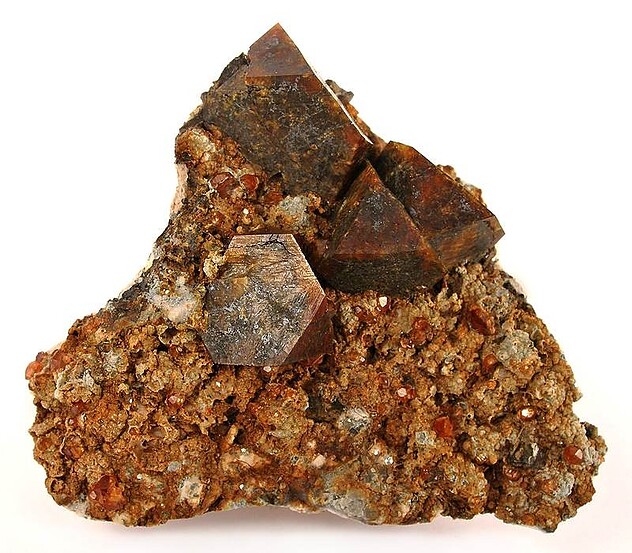
The first specimens of Chinese garnet associated with smoky quartz and feldspar appeared on the market in 1998. The locality cited was the city of Lechang, in Guangdong Province; only at the end of 2001, some dealers gave the province of Fujian as the true locality and Yunxiao as the nearest large city.
Samples come from two or three main collecting sites: the first lies near the village of Tongbei, southwest of Yunxiao; the second is at Yunling in Zhangpu County, about 30 km further northeast. At Tongbei, helvine and topaz occur, but no fluorite, which is present only at Yunling.
Guanghua Liu actually mentions three localities in his book “Fine minerals of China” on page 336: 1) Tonbei, Yunxiao Co.; 2) Shuijingping, Yunxiao Co.; and 3) Yunling, Shiliu, Zhangpu Co.
The discovery of these localities took place 15 years ago. Granitic rocks originated as intrusions during the late Mesozoic, as a result of the subduction of Paleo-Pacific Plate under the continental plate of southeastern China.
NOTE: The feldspar associated with the spessartine is microcline, not orthoclase as originally reported.
NOTE: According to B. Ottens there is no such thing as a "Spessartine Mine" at Wushan - this is a fiction of an Chinese dealer; the spessartines came from numerous small workings and quarries ...
"The name “Wushan” is a misnomer according to B. Ottens who has written that it was a name invented by a Chinese dealer so as to give a more precise locality to his spessartine specimens" (https://www.mindat.org/mesg-651608.html).
NOTE: This information is given from the Nanjing University:
There is an 800 km long Cretaceous granitic belt exposed in the southeastern coastal of China, it occurs from Guangdong through Fujian and extends to Zhejiang provinces. At this stage there are many locations that produces miarolitic cavities with different mineral specimens. There are over 20 different locations, and one third of them have spessartine. Most of the miarolitic cavity minerals were exposed by granite mining. Tongbei village represents the first place where people do systematic mining of the specimen, which is actually illegal unless you mine for granite building materials. A labelling as Tongbei-Wushan hill is OK, the Tongbei is the name of the village and the Wushan actually means Wu mountain. Wushan is now a protected national park so collecting minerals from the exposed granite is prohibited. As for the “Yunling village” - there is no such place and the description in Ottens’ book should be wrong, caused by incorrect information. However there are several locations between Yunxiao and Suian (location where Ottens describes as Yunling village) that produce miarolitic minerals and they belong to the Jingangshan granite pluton, a similar sized pluton to Wushan. It is complicated and there is no need to know because 99.9% of the spessartine-quartz specimens you can bought in the market came from Wushan pluton around Tongbei village.
Select Mineral List Type
Standard Detailed Gallery Strunz Chemical ElementsDetailed Mineral List:
| ⓘ Albite Formula: Na(AlSi3O8) References: |
| ⓘ Beryl Formula: Be3Al2(Si6O18) Colour: pale green Description: xls up to few mm long. |
| ⓘ Calcite Formula: CaCO3 |
| ⓘ Clinochlore Formula: Mg5Al(AlSi3O10)(OH)8 |
| ⓘ Fluorite Formula: CaF2 Habit: octahedral xls Colour: colorless, pale green, pale to dark blue |
| ⓘ Helvine Formula: Be3Mn2+4(SiO4)3S Habit: pseudo-octahedral xls Colour: yellow, with dark surface coatings Description: xls rest either on feldspar or on smoky quartz. Helvite xls were found at Tongbei at the end of 2001 and the first xls collected had a dark surface coatings. Helvite xls discovered at later times lack the dark surface coatings but it is suspected that such pieces have been treated in Tongbei with HCl. |
| ⓘ Hematite Formula: Fe2O3 Habit: tabular xls |
| ⓘ Manganite Formula: Mn3+O(OH) |
| ⓘ Microcline Formula: K(AlSi3O8) Description: Rarely Manebach twins have been observed and characteristic of microcline. Feldspar xls in near surface pockets are often seen to be in the process of kaolinization. References: |
| ⓘ Milarite Formula: K(◻H2O)Ca2(Be2Al)[Si12O30] Description: xls up to 0,5 mm. |
| ⓘ Molybdenite Formula: MoS2 References: |
| ⓘ Muscovite Formula: KAl2(AlSi3O10)(OH)2 References: |
| ⓘ Opal Formula: SiO2 · nH2O Colour: Whitish Fluorescence: Bright green (SW UV) Description: Thin whitish crusts on orthoclase crystals and spessartine crystals. |
| ⓘ Opal var. Opal-AN Formula: SiO2 · nH2O Colour: Whitish Fluorescence: Bright green (SW UV) Description: Thin whitish crusts on orthoclase crystals and spessartine crystals. |
| ⓘ Formula: K(AlSi3O8) Colour: cream colored |
| ⓘ Pyrite Formula: FeS2 Habit: cubic xls |
| ⓘ Quartz Formula: SiO2 References: |
| ⓘ Quartz var. Smoky Quartz Formula: SiO2 Description: xls up to 30 cm. |
| ⓘ Schorl Formula: NaFe2+3Al6(Si6O18)(BO3)3(OH)3(OH) |
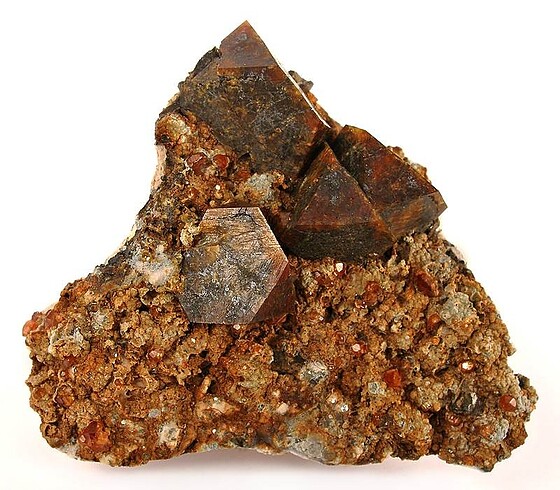
| ⓘ Spessartine Formula: Mn2+3Al2(SiO4)3 Habit: trapezohedric xls Colour: orange |
| ⓘ Topaz Formula: Al2(SiO4)(F,OH)2 |
Gallery:

List of minerals arranged by Strunz 10th Edition classification
| Group 2 - Sulphides and Sulfosalts | |||
|---|---|---|---|
| ⓘ | Molybdenite | 2.EA.30 | MoS2 |
| ⓘ | Pyrite | 2.EB.05a | FeS2 |
| Group 3 - Halides | |||
| ⓘ | Fluorite | 3.AB.25 | CaF2 |
| Group 4 - Oxides and Hydroxides | |||
| ⓘ | Hematite | 4.CB.05 | Fe2O3 |
| ⓘ | Quartz | 4.DA.05 | SiO2 |
| ⓘ | var. Smoky Quartz | 4.DA.05 | SiO2 |
| ⓘ | Opal var. Opal-AN | 4.DA.10 | SiO2 · nH2O |
| ⓘ | 4.DA.10 | SiO2 · nH2O | |
| ⓘ | Manganite | 4.FD.15 | Mn3+O(OH) |
| Group 5 - Nitrates and Carbonates | |||
| ⓘ | Calcite | 5.AB.05 | CaCO3 |
| Group 9 - Silicates | |||
| ⓘ | Spessartine | 9.AD.25 | Mn2+3Al2(SiO4)3 |
| ⓘ | Topaz | 9.AF.35 | Al2(SiO4)(F,OH)2 |
| ⓘ | Beryl | 9.CJ.05 | Be3Al2(Si6O18) |
| ⓘ | Schorl | 9.CK.05 | NaFe2+3Al6(Si6O18)(BO3)3(OH)3(OH) |
| ⓘ | Milarite | 9.CM.05 | K(◻H2O)Ca2(Be2Al)[Si12O30] |
| ⓘ | Muscovite | 9.EC.15 | KAl2(AlSi3O10)(OH)2 |
| ⓘ | Clinochlore | 9.EC.55 | Mg5Al(AlSi3O10)(OH)8 |
| ⓘ | Microcline | 9.FA.30 | K(AlSi3O8) |
| ⓘ | Orthoclase ? | 9.FA.30 | K(AlSi3O8) |
| ⓘ | Albite | 9.FA.35 | Na(AlSi3O8) |
| ⓘ | Helvine | 9.FB.10 | Be3Mn2+4(SiO4)3S |
List of minerals for each chemical element
| H | Hydrogen | |
|---|---|---|
| H | ⓘ Clinochlore | Mg5Al(AlSi3O10)(OH)8 |
| H | ⓘ Opal var. Opal-AN | SiO2 · nH2O |
| H | ⓘ Manganite | Mn3+O(OH) |
| H | ⓘ Milarite | K(◻H2O)Ca2(Be2Al)[Si12O30] |
| H | ⓘ Muscovite | KAl2(AlSi3O10)(OH)2 |
| H | ⓘ Opal | SiO2 · nH2O |
| H | ⓘ Schorl | NaFe32+Al6(Si6O18)(BO3)3(OH)3(OH) |
| H | ⓘ Topaz | Al2(SiO4)(F,OH)2 |
| Be | Beryllium | |
| Be | ⓘ Beryl | Be3Al2(Si6O18) |
| Be | ⓘ Helvine | Be3Mn42+(SiO4)3S |
| Be | ⓘ Milarite | K(◻H2O)Ca2(Be2Al)[Si12O30] |
| B | Boron | |
| B | ⓘ Schorl | NaFe32+Al6(Si6O18)(BO3)3(OH)3(OH) |
| C | Carbon | |
| C | ⓘ Calcite | CaCO3 |
| O | Oxygen | |
| O | ⓘ Albite | Na(AlSi3O8) |
| O | ⓘ Beryl | Be3Al2(Si6O18) |
| O | ⓘ Calcite | CaCO3 |
| O | ⓘ Clinochlore | Mg5Al(AlSi3O10)(OH)8 |
| O | ⓘ Helvine | Be3Mn42+(SiO4)3S |
| O | ⓘ Hematite | Fe2O3 |
| O | ⓘ Opal var. Opal-AN | SiO2 · nH2O |
| O | ⓘ Manganite | Mn3+O(OH) |
| O | ⓘ Microcline | K(AlSi3O8) |
| O | ⓘ Milarite | K(◻H2O)Ca2(Be2Al)[Si12O30] |
| O | ⓘ Muscovite | KAl2(AlSi3O10)(OH)2 |
| O | ⓘ Opal | SiO2 · nH2O |
| O | ⓘ Orthoclase | K(AlSi3O8) |
| O | ⓘ Quartz | SiO2 |
| O | ⓘ Schorl | NaFe32+Al6(Si6O18)(BO3)3(OH)3(OH) |
| O | ⓘ Quartz var. Smoky Quartz | SiO2 |
| O | ⓘ Spessartine | Mn32+Al2(SiO4)3 |
| O | ⓘ Topaz | Al2(SiO4)(F,OH)2 |
| F | Fluorine | |
| F | ⓘ Fluorite | CaF2 |
| F | ⓘ Topaz | Al2(SiO4)(F,OH)2 |
| Na | Sodium | |
| Na | ⓘ Albite | Na(AlSi3O8) |
| Na | ⓘ Schorl | NaFe32+Al6(Si6O18)(BO3)3(OH)3(OH) |
| Mg | Magnesium | |
| Mg | ⓘ Clinochlore | Mg5Al(AlSi3O10)(OH)8 |
| Al | Aluminium | |
| Al | ⓘ Albite | Na(AlSi3O8) |
| Al | ⓘ Beryl | Be3Al2(Si6O18) |
| Al | ⓘ Clinochlore | Mg5Al(AlSi3O10)(OH)8 |
| Al | ⓘ Microcline | K(AlSi3O8) |
| Al | ⓘ Milarite | K(◻H2O)Ca2(Be2Al)[Si12O30] |
| Al | ⓘ Muscovite | KAl2(AlSi3O10)(OH)2 |
| Al | ⓘ Orthoclase | K(AlSi3O8) |
| Al | ⓘ Schorl | NaFe32+Al6(Si6O18)(BO3)3(OH)3(OH) |
| Al | ⓘ Spessartine | Mn32+Al2(SiO4)3 |
| Al | ⓘ Topaz | Al2(SiO4)(F,OH)2 |
| Si | Silicon | |
| Si | ⓘ Albite | Na(AlSi3O8) |
| Si | ⓘ Beryl | Be3Al2(Si6O18) |
| Si | ⓘ Clinochlore | Mg5Al(AlSi3O10)(OH)8 |
| Si | ⓘ Helvine | Be3Mn42+(SiO4)3S |
| Si | ⓘ Opal var. Opal-AN | SiO2 · nH2O |
| Si | ⓘ Microcline | K(AlSi3O8) |
| Si | ⓘ Milarite | K(◻H2O)Ca2(Be2Al)[Si12O30] |
| Si | ⓘ Muscovite | KAl2(AlSi3O10)(OH)2 |
| Si | ⓘ Opal | SiO2 · nH2O |
| Si | ⓘ Orthoclase | K(AlSi3O8) |
| Si | ⓘ Quartz | SiO2 |
| Si | ⓘ Schorl | NaFe32+Al6(Si6O18)(BO3)3(OH)3(OH) |
| Si | ⓘ Quartz var. Smoky Quartz | SiO2 |
| Si | ⓘ Spessartine | Mn32+Al2(SiO4)3 |
| Si | ⓘ Topaz | Al2(SiO4)(F,OH)2 |
| S | Sulfur | |
| S | ⓘ Helvine | Be3Mn42+(SiO4)3S |
| S | ⓘ Molybdenite | MoS2 |
| S | ⓘ Pyrite | FeS2 |
| K | Potassium | |
| K | ⓘ Microcline | K(AlSi3O8) |
| K | ⓘ Milarite | K(◻H2O)Ca2(Be2Al)[Si12O30] |
| K | ⓘ Muscovite | KAl2(AlSi3O10)(OH)2 |
| K | ⓘ Orthoclase | K(AlSi3O8) |
| Ca | Calcium | |
| Ca | ⓘ Calcite | CaCO3 |
| Ca | ⓘ Fluorite | CaF2 |
| Ca | ⓘ Milarite | K(◻H2O)Ca2(Be2Al)[Si12O30] |
| Mn | Manganese | |
| Mn | ⓘ Helvine | Be3Mn42+(SiO4)3S |
| Mn | ⓘ Manganite | Mn3+O(OH) |
| Mn | ⓘ Spessartine | Mn32+Al2(SiO4)3 |
| Fe | Iron | |
| Fe | ⓘ Hematite | Fe2O3 |
| Fe | ⓘ Pyrite | FeS2 |
| Fe | ⓘ Schorl | NaFe32+Al6(Si6O18)(BO3)3(OH)3(OH) |
| Mo | Molybdenum | |
| Mo | ⓘ Molybdenite | MoS2 |
Other Regions, Features and Areas containing this locality
This page contains all mineral locality references listed on mindat.org. This does not claim to be a complete list. If you know of more minerals from this site, please register so you can add to our database. This locality information is for reference purposes only. You should never attempt to
visit any sites listed in mindat.org without first ensuring that you have the permission of the land and/or mineral rights holders
for access and that you are aware of all safety precautions necessary.

Wushan Spessartine Mine, Tongbei, Yunxiao Co., Zhangzhou, Fujian, China