
Alexandra, Central Otago District, Otago Region, New Zealandi
| Regional Level Types | |
|---|---|
| Alexandra | - not defined - |
| Central Otago District | District |
| Otago Region | Region |
| New Zealand | Country |
This page is currently not sponsored. Click here to sponsor this page.

Latitude & Longitude (WGS84):
45° 15' 14'' South , 169° 23' 33'' East
Latitude & Longitude (decimal):
Köppen climate type:
Aragonite listed on Mindat for Alexandra, relates to one specimen studied by the Otago University in 1937, although more of the species may occur in the area.
(Hutton, 1937) states: 'A specimen of a heavy carbonate mineral recently sent to the Geology Department of the University of Otago by Mr. Spain, has proved on analysis to be a strontium bearing variety of aragonite, such as was at one time called mossotite. The mineral was said to have been obtained in situ in a small vein cutting schist, one to two miles west of Alexandra'. Hutton further states the specimen is creamy white, with radiating fibres, a vitreous lustre, averaging 15 mms long.
Alexandra is 188 kilometres from Dunedin, with a population of 4800 (2013). It is a service centre for the surrounding stone fruit orchards, and viticulture. It is one of the worlds southern most wine producing regions. The area has extreme temperature variations. Despite its southerly latitude, summers can be hot (37.2 degrees 1971), and winters very cold (-11.2 degrees 2000).
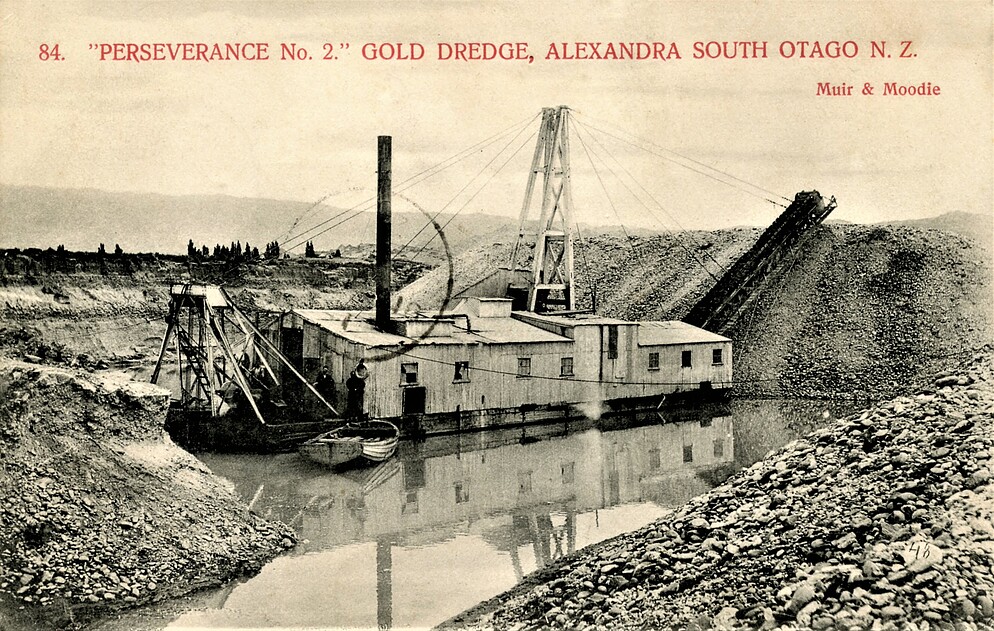
Alexandra caters for all the needs of a visitor, although a more atmospheric place is the old gold town of Clyde a few kilometres up the road to Cromwell, as it has retained many of its historic buildings. The area has an extensive network of cycleways, and walking paths, some visiting old gold mining locations. Nearby tiny Ophir and St. Bathans still retain much charm from their gold rush days.
American Horatio Hartley, and Irish born Christopher Reilly found gold in Cromwell Gorge worth in todays money 1.8 million dollars. They had met during the Californian gold rush, and travelled together to New Zealand. Having discovered gold along the banks of the then remote Clutha River in 1862, they worked in secret obtaining as much gold as they could from the beaches along the gorge. They eventually announced the site to obtain the government's reward on offer for gold discoveries.
Soon 2000 miners were at the location with little in the way of food or equipment. Wood was in short supply and conditions were grim. Neither were they experienced miners, and by the time Hartley arrived back there was a near riot. Hartley calmly washed some sand, and to their astonishment, several ounces of gold was revealed.
Clyde was established first, and later Alexandra, but historically Clyde was bigger. It was the scene for drunken brawls, gambling, prostitutes, theft, and murders. Many crimes went unsolved due to the lack of policing. Bodies were said to have been regularly seen floating down the Clutha River, with skulls broken with a pick axe. Local lore states gold from heists may still be buried in the hills surrounding the town.
The area also had a substantial Chinese miner population, figures place it at over half the overall miners. They were known to be industrious, hard working, and frugal, although some had a liking for gambling, and opium smoking. All were Cantonese. They often took over abandoned European claims, finding much gold, leading to resentment. Reports at times, show houses being pelted with rocks, windows smashed, verbal and physical assaults against the Chinese in Alexandra during the gold rushes.
Horatio Hartley prospected various areas around New Zealand after 1862, then had retuned to the United States by 1869 settling at Olympia, Washington State. He owned multiple properties, and was known as being eccentric. He died 21 January 1903, giving his fortune to local schools. However his will was successfully challenged by his surviving wife. Christopher Reilly was found in Tasmania in 1863, then was back in Dunedin by 1873. Nothing more was heard from him, although it is said he died in 1887 in Dublin.
Select Mineral List Type
Standard Detailed Gallery Strunz Chemical ElementsMineral List
Mineral list contains entries from the region specified including sub-localities6 valid minerals.
Rock Types Recorded
Note: data is currently VERY limited. Please bear with us while we work towards adding this information!
Rock list contains entries from the region specified including sub-localities
Select Rock List Type
Alphabetical List Tree DiagramDetailed Mineral List:
| ⓘ Aragonite Formula: CaCO3 References: |
| ⓘ Cervantite Formula: Sb3+Sb5+O4 |
| ⓘ Native Gold Formula: Au Localities: Reported from at least 17 localities in this region. |
| ⓘ Quartz Formula: SiO2 |
| ⓘ Stibnite Formula: Sb2S3 |
| ⓘ Valentinite Formula: Sb2O3 |
Gallery:
List of minerals arranged by Strunz 10th Edition classification
| Group 1 - Elements | |||
|---|---|---|---|
| ⓘ | Native Gold | 1.AA.05 | Au |
| Group 2 - Sulphides and Sulfosalts | |||
| ⓘ | Stibnite | 2.DB.05 | Sb2S3 |
| Group 4 - Oxides and Hydroxides | |||
| ⓘ | Valentinite | 4.CB.55 | Sb2O3 |
| ⓘ | Quartz | 4.DA.05 | SiO2 |
| ⓘ | Cervantite | 4.DE.30 | Sb3+Sb5+O4 |
| Group 5 - Nitrates and Carbonates | |||
| ⓘ | Aragonite | 5.AB.15 | CaCO3 |
List of minerals for each chemical element
| C | Carbon | |
|---|---|---|
| C | ⓘ Aragonite | CaCO3 |
| O | Oxygen | |
| O | ⓘ Aragonite | CaCO3 |
| O | ⓘ Cervantite | Sb3+Sb5+O4 |
| O | ⓘ Quartz | SiO2 |
| O | ⓘ Valentinite | Sb2O3 |
| Si | Silicon | |
| Si | ⓘ Quartz | SiO2 |
| S | Sulfur | |
| S | ⓘ Stibnite | Sb2S3 |
| Ca | Calcium | |
| Ca | ⓘ Aragonite | CaCO3 |
| Sb | Antimony | |
| Sb | ⓘ Cervantite | Sb3+Sb5+O4 |
| Sb | ⓘ Stibnite | Sb2S3 |
| Sb | ⓘ Valentinite | Sb2O3 |
| Au | Gold | |
| Au | ⓘ Native Gold | Au |
Localities in this Region
- Otago Region
Other Regions, Features and Areas containing this locality
Australian Plate
- Haast SchistAccretionary Complex
New Zealand
- South IslandIsland
- Southern AlpsMountain Range
Pacific PlateTectonic Plate
This page contains all mineral locality references listed on mindat.org. This does not claim to be a complete list. If you know of more minerals from this site, please register so you can add to our database. This locality information is for reference purposes only. You should never attempt to
visit any sites listed in mindat.org without first ensuring that you have the permission of the land and/or mineral rights holders
for access and that you are aware of all safety precautions necessary.
References

Alexandra, Central Otago District, Otago Region, New Zealand