
Bismutostibiconite
A valid IMA mineral species - questionable
This page is currently not sponsored. Click here to sponsor this page.


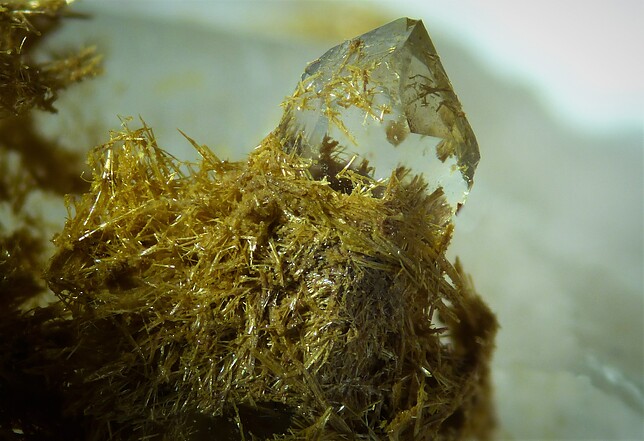
About Bismutostibiconite
Formula:
(Bi,Fe3+,◻)2Sb5+2O7
Colour:
Yellow to yellow-brown, rarely greenish; brownish in transmitted light
Hardness:
4 - 5
Specific Gravity:
7.38 (Calculated)
Crystal System:
Isometric
Member of:
Name:
Named as a bismuth-containing member of the stibiconite group.
Originally described by Walenta (1983). The chemical data are considered inadequate owing to a standardless energy-dispersion spectroscopy (EDS), with all Sb assumed to be pentavalent, and results of the analysis normalised to 100%. It probably is “bismutoroméite”.
The type material is in need of a chemical and structural investigation.
The type material is in need of a chemical and structural investigation.
Unique Identifiers
Mindat ID:
659
Long-form identifier:
mindat:1:1:659:6
IMA Classification of Bismutostibiconite
Approved, Questionable
Classification of Bismutostibiconite
4.00.
4 : OXIDES (Hydroxides, V[5,6] vanadates, arsenites, antimonites, bismuthites, sulfites, selenites, tellurites, iodates)
0 :
0 :
4 : OXIDES (Hydroxides, V[5,6] vanadates, arsenites, antimonites, bismuthites, sulfites, selenites, tellurites, iodates)
0 :
0 :
44.1.1.6
44 : ANTIMONATES
1 : A2X2O6(O,OH,F)
44 : ANTIMONATES
1 : A2X2O6(O,OH,F)
7.13.9
7 : Oxides and Hydroxides
13 : Oxides of As, Sb and Bi
7 : Oxides and Hydroxides
13 : Oxides of As, Sb and Bi
Mineral Symbols
As of 2021 there are now IMA–CNMNC approved mineral symbols (abbreviations) for each mineral species, useful for tables and diagrams.
| Symbol | Source | Reference for Standard |
|---|---|---|
| Bsbc | IMA–CNMNC | Warr, L.N. (2021). IMA–CNMNC approved mineral symbols. Mineralogical Magazine, 85(3), 291-320. doi:10.1180/mgm.2021.43 |
Pronunciation of Bismutostibiconite
Pronunciation:
| Play | Recorded by | Country |
|---|---|---|
| Jolyon Ralph | United Kingdom |
Physical Properties of Bismutostibiconite
Transparency:
Transparent, Opaque
Colour:
Yellow to yellow-brown, rarely greenish; brownish in transmitted light
Hardness:
4 - 5 on Mohs scale
Density:
7.38 g/cm3 (Calculated)
Optical Data of Bismutostibiconite
Type:
Isotropic
RI values:
n = 2.09
Surface Relief:
Very High (positive)
Relative to Canada balsam mounting medium (n ≈ 1.537).
Relative to Canada balsam mounting medium (n ≈ 1.537).
This shows the grain boundary and Becke line effect under plane-polarised
light, based on the contrast between this mineral's average refractive
index and the mounting medium. It does not take into account mineral
colouration.
In focus
Chemistry of Bismutostibiconite
Mindat Formula:
(Bi,Fe3+,◻)2Sb5+2O7
Element Weights:
Elements listed:
Crystallography of Bismutostibiconite
Crystal System:
Isometric
Class (H-M):
m3m(4/m32/m) - Hexoctahedral
Space Group:
Fd3m
Cell Parameters:
a = 10.38 Å
Unit Cell V:
1,118.39 ų (Calculated from Unit Cell)
Z:
8
Morphology:
Always anhedral, forming earthy crusts
Geological Environment
Paragenetic Mode(s):
| Paragenetic Mode | Earliest Age (Ga) |
|---|---|
| Stage 7: Great Oxidation Event | <2.4 |
| 47d : [Arsenates, antimonates, selenates, bismuthinates] | |
| 47h : [Near-surface oxidized, dehydrated minerals] |
Type Occurrence of Bismutostibiconite
Co-Type Localities:
General Appearance of Type Material:
Earthy crusts
Geological Setting of Type Material:
Alteration product of bismuthian fahlore
Associated Minerals at Type Locality:
Synonyms of Bismutostibiconite
Other Language Names for Bismutostibiconite
Relationship of Bismutostibiconite to other Species
Member of:
Other Members of Roméite Group:
| 'Cuproroméite' | Cu2Sb2(O,OH)7 | Iso. |
| Fluorcalcioroméite | (Ca,Na,◻)2Sb5+2(O,OH)6F | Iso. m3m(4/m32/m) : Fd3m |
| Hydroxycalcioroméite | (Ca,Sb3+)2(Sb5+,Ti)2O6(OH) | Iso. m3m(4/m32/m) : Fd3m |
| Hydroxyferroroméite | (Fe2+1.5◻0.5)Sb5+2O6(OH) | Iso. m3m(4/m32/m) : Fd3m |
| Oxycalcioroméite | Ca2Sb2O6O | Iso. m3m(4/m32/m) : Fd3m |
| Oxyplumboroméite | Pb2Sb2O6O | Iso. m3m(4/m32/m) : Fd3m |
| Stibiconite | Sb3+Sb5+2O6(OH) | Iso. m3m(4/m32/m) |
Common Associates
Associations Based on Photo Data:
| 3 photos of Bismutostibiconite associated with Clinobisvanite | Bi(VO4) |
| 2 photos of Bismutostibiconite associated with Bismoclite | BiOCl |
| 1 photo of Bismutostibiconite associated with Quartz | SiO2 |
Related Minerals - Strunz-mindat Grouping
| 4.00. | Ferrotaaffeite-6N'3S | (Be,Zn,Mg)FeAl4O8 |
| 4.00. | Mapiquiroite | (Sr,Pb)(U,Y)Fe2(Ti,Fe3+,Cr3+)18O38 |
| 4.00. | 'UM2004-19-O:AlCeGdZr' | (Gd,Ce)4Al2Zr4O17 |
| 4.00. | Almeidaite | PbZn2(Mn,Y)(Ti,Fe3+)18O37(OH,O) |
| 4.00. | Vapnikite | Ca2CaUO6 |
| 4.00. | Microlite Group | A2-mTa2X6-wZ1-n |
| 4.00. | 'UM2004-21-O:CaFeGdZr' | Ca2Gd4Fe5ZrO15 |
| 4.00. | 'UM2004-27-O:GdTi' | Gd2Ti4O11 |
| 4.00. | Písekite-(Y) | (Y,As,Ca,Fe,U)(Nb,Ti,Ta)O4 |
| 4.00. | Pyrochlore Group | A2Nb2(O,OH)6Z |
| 4.00.20 | Yttrotungstite-(Nd) | NdW2O7(OH) · H2O |
| 4.00.25 | Heisenbergite | U6+O2(OH)2 · H2O |
Other Information
Health Risks:
No information on health risks for this material has been entered into the database. You should always treat mineral specimens with care.
Internet Links for Bismutostibiconite
mindat.org URL:
https://www.mindat.org/min-659.html
Please feel free to link to this page.
Please feel free to link to this page.
Search Engines:
External Links:
Mineral Dealers:
References for Bismutostibiconite
Localities for Bismutostibiconite
Showing 13 localities.
 symbol to view information about a locality.
The
symbol to view information about a locality.
The Locality List
 - This locality has map coordinates listed.
- This locality has estimated coordinates.
ⓘ - Click for references and further information on this occurrence.
? - Indicates mineral may be doubtful at this locality.
- This locality has map coordinates listed.
- This locality has estimated coordinates.
ⓘ - Click for references and further information on this occurrence.
? - Indicates mineral may be doubtful at this locality.
 - Good crystals or important locality for species.
 - World class for species or very significant.
(TL) - Type Locality for a valid mineral species.
(FRL) - First Recorded Locality for everything else (eg varieties).
- World class for species or very significant.
(TL) - Type Locality for a valid mineral species.
(FRL) - First Recorded Locality for everything else (eg varieties).
All localities listed without proper references should be considered as questionable.
Australia | |
| Rankin et al. (2002) |
| Sharpe et al. (2004) |
Chile | |
| Gerhard Möhn Collection |
Germany | |
| Anthony (1997) |
| Walenta (1983) +1 other reference |
| Walenta (1992) |
| Walenta (1991) |
| Dunn et al. (1984) |
| www.mineralienatlas.de (2025) |
Greece | |
| Rieck et al. (2018) |
Mozambique | |
| Gomes et al. (2022) |
Spain | |
| Sainz de Baranda Graf et al. (2023) |
USA | |
| Dunning et al. (1998) |
Quick NavTopAbout BismutostibiconiteUnique IdentifiersIMA Classification Classification Mineral SymbolsPronunciation Physical Properties Optical Data Chemistry Crystallography Geological EnvironmentType Occurrence SynonymsOther LanguagesRelationshipsCommon AssociatesStrunz-MindatOther InformationInternet Links References Localities Locality List

Clara Mine, Oberwolfach, Ortenaukreis, Freiburg Region, Baden-Württemberg, Germany