
Barysilite
A valid IMA mineral species - grandfathered
This page is currently not sponsored. Click here to sponsor this page.

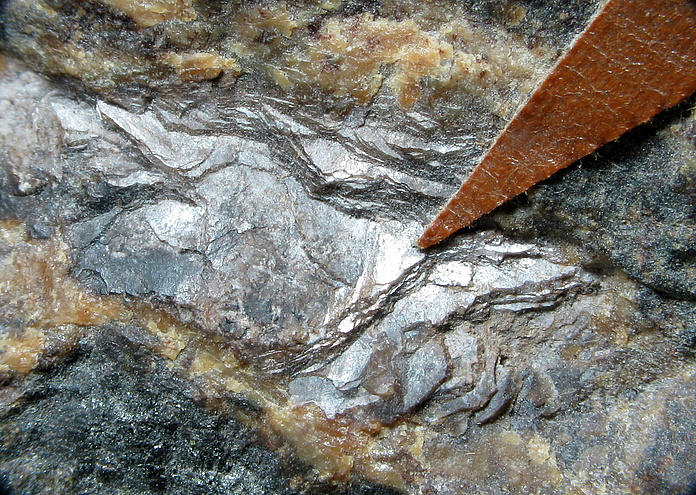


About Barysilite
Formula:
Pb8Mn2+[Si2O7]3
Colour:
White, pink to colorless; tarnishes on exposure
Lustre:
Pearly
Hardness:
3
Specific Gravity:
6.55 - 6.71
Crystal System:
Trigonal
Name:
Named in 1888 by Stens Anders Hjalmar Sjögren and Carl Herman Lundström from the Greek βαρύς for "heavy" in allusion to its density and for containing silicon (sil).
Barysilite belongs to a family of compounds with the general formula MPb8(Si207)3, where M = Mg, Zn, Cu, Co, Ni, Cd, Ca, Be, Sr and Ba (Lajzérowicz, 1966).
Unique Identifiers
Mindat ID:
546
Long-form identifier:
mindat:1:1:546:3
Similar Names
| Brazilite (of Hussak) | A variety of Baddeleyite |
| Brazilite (oil shale) | A rock subtype |
IMA Classification of Barysilite
Approved, 'Grandfathered' (first described prior to 1959)
IMA Formula:
Pb2+8Mn2+(Si2O7)3
First published:
1888
Classification of Barysilite
9.BC.20
9 : SILICATES (Germanates)
B : Sorosilicates
C : Si2O7 groups, without non-tetrahedral anions; cations in octahedral [6] and greater coordination
9 : SILICATES (Germanates)
B : Sorosilicates
C : Si2O7 groups, without non-tetrahedral anions; cations in octahedral [6] and greater coordination
55.2.3.1
55 : SOROSILICATES Si2O7 Groups,Generally with no Additional Anions
2 : Si2O7 Groups, Generally with no Additional Anions with cations in [6] coordination
55 : SOROSILICATES Si2O7 Groups,Generally with no Additional Anions
2 : Si2O7 Groups, Generally with no Additional Anions with cations in [6] coordination
14.13.8
14 : Silicates not Containing Aluminum
13 : Silicates of Pb
14 : Silicates not Containing Aluminum
13 : Silicates of Pb
Mineral Symbols
As of 2021 there are now IMA–CNMNC approved mineral symbols (abbreviations) for each mineral species, useful for tables and diagrams.
Please only use the official IMA–CNMNC symbol. Older variants are listed for historical use only.
Please only use the official IMA–CNMNC symbol. Older variants are listed for historical use only.
| Symbol | Source | Reference for Standard |
|---|---|---|
| Bsl | IMA–CNMNC | Warr, L.N. (2021). IMA–CNMNC approved mineral symbols. Mineralogical Magazine, 85(3), 291-320. doi:10.1180/mgm.2021.43 |
| Bsl | The Canadian Mineralogist (2019) | The Canadian Mineralogist (2019) The Canadian Mineralogist list of symbols for rock- and ore-forming minerals (December 30, 2019). download |
Pronunciation of Barysilite
Pronunciation:
| Play | Recorded by | Country |
|---|---|---|
| Jolyon Ralph | United Kingdom |
Physical Properties of Barysilite
Pearly
Transparency:
Translucent
Comment:
Pearly on cleavage.
Colour:
White, pink to colorless; tarnishes on exposure
Hardness:
3 on Mohs scale
Tenacity:
Brittle
Cleavage:
Perfect
{0001}
{0001}
Fracture:
Irregular/Uneven
Density:
6.55 - 6.71 g/cm3 (Measured) 6.54 g/cm3 (Calculated)
Optical Data of Barysilite
Type:
Uniaxial (-)
RI values:
nω = 2.033 - 2.07 nε = 2.015 - 2.05
Max. Birefringence:
δ = 0.018 - 0.020
Based on recorded range of RI values above.
Based on recorded range of RI values above.
Interference Colours:
The colours simulate birefringence patterns seen in thin section under crossed polars. They do not take into account mineral colouration or opacity.
Michel-Levy Bar The default colours simulate the birefringence range for a 30 µm thin-section thickness. Adjust the slider to simulate a different thickness.
Grain Simulation You can rotate the grain simulation to show how this range might look as you rotated a sample under crossed polars. Each grain retains its interference colour (retardation) while its brightness falls to black at extinction and reaches a maximum between extinction positions.
The colours simulate birefringence patterns seen in thin section under crossed polars. They do not take into account mineral colouration or opacity.
Michel-Levy Bar The default colours simulate the birefringence range for a 30 µm thin-section thickness. Adjust the slider to simulate a different thickness.
Grain Simulation You can rotate the grain simulation to show how this range might look as you rotated a sample under crossed polars. Each grain retains its interference colour (retardation) while its brightness falls to black at extinction and reaches a maximum between extinction positions.
Surface Relief:
Very High (positive)
Relative to Canada balsam mounting medium (n ≈ 1.537).
Relative to Canada balsam mounting medium (n ≈ 1.537).
This shows the grain boundary and Becke line effect under plane-polarised
light, based on the contrast between this mineral's average refractive
index and the mounting medium. It does not take into account mineral
colouration.
In focus
Interference Figure:
This shows the idealized uniaxial interference figure - the conoscopic
(convergent-light, Bertrand-lens-in) view, for a grain cut with the optic axis
centred and vertical. The coloured rings are isochromatics, computed with the
same physics as the Michel-Lévy bar above; the dark cross is the isogyre.
For a genuinely uniaxial mineral viewed this way, that cross stays perfectly stationary if you rotate the stage - unlike a biaxial mineral, where it splits apart on rotation. That invariance is itself the standard diagnostic test for telling uniaxial and biaxial minerals apart at the microscope.
For a genuinely uniaxial mineral viewed this way, that cross stays perfectly stationary if you rotate the stage - unlike a biaxial mineral, where it splits apart on rotation. That invariance is itself the standard diagnostic test for telling uniaxial and biaxial minerals apart at the microscope.
Chemistry of Barysilite
Mindat Formula:
Pb8Mn2+[Si2O7]3
Element Weights:
Elements listed:
Common Impurities:
Al,Fe,Zn,Mg,Ca
Crystallography of Barysilite
Crystal System:
Trigonal
Class (H-M):
3m(32/m) - Hexagonal Scalenohedral
Space Group:
R3c
Setting:
R3c
Cell Parameters:
a = 9.821 Å, c = 38.35 Å
Ratio:
a:c = 1 : 3.905
Unit Cell V:
3,203.37 ų (Calculated from Unit Cell)
Z:
6
Morphology:
As platy, subparallel crystals in lamellar and ball-like aggregates, to 3 mm; granular, massive.
Crystal Structure
Load
Unit Cell | Unit Cell Packed
2x2x2 | 3x3x3 | 4x4x4
Unit Cell | Unit Cell Packed
2x2x2 | 3x3x3 | 4x4x4
Show
Big Balls | Small Balls | Just Balls | Spacefill
Polyhedra Off | Si Polyhedra | All Polyhedra
Remove metal-metal sticks
Big Balls | Small Balls | Just Balls | Spacefill
Polyhedra Off | Si Polyhedra | All Polyhedra
Remove metal-metal sticks
Display Options
Black Background | White Background
Perspective On | Perspective Off
2D | Stereo | Red-Blue | Red-Cyan
Black Background | White Background
Perspective On | Perspective Off
2D | Stereo | Red-Blue | Red-Cyan
View
CIF File Best | x | y | z | a | b | c
CIF File Best | x | y | z | a | b | c
Rotation
Stop | Start
Stop | Start
Labels
Console Off | On | Grey | Yellow
Console Off | On | Grey | Yellow
Data courtesy of the American Mineralogist Crystal Structure Database. Click on an AMCSD ID to view structure
| ID | Species | Reference | Link | Year | Locality | Pressure (GPa) | Temp (K) |
|---|---|---|---|---|---|---|---|
| 0014563 | Barysilite | Kolitsch U, Holtstam D (2002) Barysilite from Garpenberg Norra, Dalarna, Sweden: occurrence and crystal structure refinement Mineralogical Magazine 66 353-363 |  | 2002 | Garpenberg Nora mine, Dalarna, Sweden | 0 | 293 |
| 0009300 | Barysilite | Lajzerowicz J (1965) Etude par diffraction des rayons X et absorption infra-rouge de la barysilite, MnPb8.3Si2O7, et de composes isomorphes Acta Crystallographica 20 357-363 |  | 1965 | 0 | 293 |
CIF Raw Data - click here to close
X-Ray Powder Diffraction
Loading XRD data...
Data courtesy of RRUFF project at University of Arizona, used with permission.
Powder Diffraction Data:
| d-spacing | Intensity |
|---|---|
| 2.957 Å | (100) |
| 2.765 Å | (80) |
| 2.675 Å | (80) |
| 3.88 Å | (60) |
| 3.16 Å | (60) |
| 4.57 Å | (50) |
| 3.22 Å | (50) |
Comments:
Långban district, Sweden.
Geological Environment
Paragenetic Mode(s):
| Paragenetic Mode | Earliest Age (Ga) |
|---|---|
| High-? alteration and/or metamorphism | |
| 32 : Ba/Mn/Pb/Zn deposits, including metamorphic deposits | |
| Stage 5: Initiation of plate tectonics | <3.5-2.5 |
| 40 : Regional metamorphism (greenschist, amphibolite, granulite facies) |
Type Occurrence of Barysilite
Place of Conservation of Type Material:
Swedish Museum of Natural History, Stockholm, Sweden, number g14843 (holotype).
Harvard University, Cambridge, Massachusetts, USA, 114630.
Harvard University, Cambridge, Massachusetts, USA, 114630.
Geological Setting of Type Material:
Iron ores.
Associated Minerals at Type Locality:
Synonyms of Barysilite
Other Language Names for Barysilite
Common Associates
Associations Based on Photo Data:
| 17 photos of Barysilite associated with Andradite | Ca3Fe3+2(SiO4)3 |
| 10 photos of Barysilite associated with Calcite | CaCO3 |
| 9 photos of Barysilite associated with Margarosanite | Ca2PbSi3O9 |
| 7 photos of Barysilite associated with Axinite-(Mn) | Ca2Mn2+Al2BSi4O15(OH) |
| 6 photos of Barysilite associated with Baryte | BaSO4 |
| 5 photos of Barysilite associated with Garnet Group | X3Z2(SiO4)3 |
| 4 photos of Barysilite associated with Nasonite | Pb6Ca4(Si2O7)3Cl2 |
| 4 photos of Barysilite associated with Svabite | Ca5(AsO4)3F |
| 4 photos of Barysilite associated with Willemite | Zn2SiO4 |
| 4 photos of Barysilite associated with 'Caswellite' |
Related Minerals - Strunz-mindat Grouping
| 9.BC. | Anorthoyttrialite-(Y) | Y4(SiO4)(Si3O10) |
| 9.BC. | Kozłowskiite | Ca4(Fe2+Sn3)[Si2O7]2[Si2O6OH]2 |
| 9.BC.05 | Yttrialite-(Y) | (Y,Th)2Si2O7 |
| 9.BC.05 | Thortveitite | Sc2Si2O7 |
| 9.BC.05 | Keiviite-(Y) | Y2Si2O7 |
| 9.BC.05 | Keiviite-(Yb) | Yb2Si2O7 |
| 9.BC.05 | Gittinsite | CaZrSi2O7 |
| 9.BC.10 | Parakeldyshite | Na2ZrSi2O7 |
| 9.BC.10 | Keldyshite | (Na,H)2ZrSi2O7 |
| 9.BC.10 | Khibinskite | K2ZrSi2O7 |
| 9.BC.10 | Brunovskyite | NaZrSi2O6(OH) |
| 9.BC.15 | Rankinite | Ca3Si2O7 |
| 9.BC.25 | Edgarbaileyite | [Hg2]2+3[Si2O7] |
| 9.BC.30 | Kristiansenite | Ca4(Sc2Sn2)[Si2O7]2[Si2O6OH]2 |
| 9.BC.30 | Nybergite | Ca4Sc3Sn(Si2O7)(Si2O6OH)3 |
| 9.BC.30 | Silesiaite | Ca4(Fe3+2Sn2)[Si2O7]2[Si2O6OH]2 |
| 9.BC.35 | Percleveite-(Ce) | Ce2Si2O7 |
| 9.BC.35 | Percleveite-(La) | La2Si2O7 |
| 9.BC.40 | Scottyite | BaCu2Si2O7 |
Other Information
Health Risks:
No information on health risks for this material has been entered into the database. You should always treat mineral specimens with care.
Internet Links for Barysilite
mindat.org URL:
https://www.mindat.org/min-546.html
Please feel free to link to this page.
Please feel free to link to this page.
Search Engines:
External Links:
Mineral Dealers:
References for Barysilite
Reference List:
Shannon, Earl V., Berman, H. (1926) Barysilite from Franklin Furnace, N. J. American Mineralogist, 11 (5). 130-132
Lajzérowicz, J. (1966) Etude par diffraction des rayons X et absorption infra-rouge de la barysilite, MnPb8,3Si2O7, et de composés isomorphes. Acta Crystallographica, 20 (3). 357-363 doi:10.1107/s0365110x66000847
Ito, Jun, Frondel, Clifford (1967) Syntheses of lead silicates: larsenite, barysilite and related phases. American Mineralogist, 52 (7-8) 1077-1084
Billhardt, H. W. (1969) Synthesis of lead pyrosilicate and other barysilite-like compounds. American Mineralogist, 54 (3-4) 510-521
Bordeaux-Juglaret, Denise, Lajzerowicz-Bonneteau, Janine (1969) Synthèse de la barysilite Pb3Si2O7. Bulletin de Minéralogie, 92 (4) 383-385 doi:10.3406/bulmi.1969.6380
Billhardt, H. W. (1969) Synthesis of lead pyrosilicate and other barysilite-like compounds. American Mineralogist, 54 (3-4) 510-521
Petter, W., Harnik, A. B., Keppler, U. (1971) Die Kristallstruktur von Blei-Barysilit, Pb3Si2O7. Zeitschrift für Kristallographie, 133 (133). 445-458 doi:10.1524/zkri.1971.133.133.445
Harnik, A. B. (1972) Structural chemistry of barysilite-type compounds XY2(Pb2Si2O7)3. American Mineralogist, 57 (1-2) 277-280
Harnik, A. B. (1972) XO6 coordination polyhedra in the barysilite-type series XY2(Pb2Si2O7)3. Die Naturwissenschaften, 59 (1). 35 doi:10.1007/bf00594622
Localities for Barysilite
Showing 13 localities.
 symbol to view information about a locality.
The
symbol to view information about a locality.
The Locality List
 - This locality has map coordinates listed.
- This locality has estimated coordinates.
ⓘ - Click for references and further information on this occurrence.
? - Indicates mineral may be doubtful at this locality.
- This locality has map coordinates listed.
- This locality has estimated coordinates.
ⓘ - Click for references and further information on this occurrence.
? - Indicates mineral may be doubtful at this locality.
 - Good crystals or important locality for species.
 - World class for species or very significant.
(TL) - Type Locality for a valid mineral species.
(FRL) - First Recorded Locality for everything else (eg varieties).
- World class for species or very significant.
(TL) - Type Locality for a valid mineral species.
(FRL) - First Recorded Locality for everything else (eg varieties).
All localities listed without proper references should be considered as questionable.
Germany | |
| Schellhorn (1987) +1 other reference |
Namibia | |
| Dunn (1991) |
Sweden | |
| Kolitsch et al. (2002) |
| Ulf Nyberg collection and photo. ... |
| Gatedal (n.d.) +1 other reference |
| Holtstam et al. (1999) | |
| Holtstam et al. (1999) | |
| Holtstam et al. (1999) | |
| Flink (1916) +3 other references |
| Sjögren et al. (1888) +2 other references |
USA | |
| Castor et al. (2004) |
| Palache (1935) +1 other reference |
| Palache (1935) +1 other reference |
Quick NavTopAbout BarysiliteUnique IdentifiersSimilar NamesIMA Classification Classification Mineral SymbolsPronunciation Physical Properties Optical Data Chemistry Crystallography Crystal StructureX-Ray Powder DiffractionGeological EnvironmentType Occurrence SynonymsOther LanguagesCommon AssociatesStrunz-MindatOther InformationInternet Links References Localities Locality List

Harstigen Mine, Pajsberg, Persberg ore district, Filipstad, Värmland County, Sweden