
Balkanite
A valid IMA mineral species
This page is currently not sponsored. Click here to sponsor this page.


About Balkanite
Formula:
Cu9Ag5HgS8
alternatively (Cu9−xMe2+x)Ag5−xHgS8 (x = 0.3) (Biagioni & Bindi, 2017)
Colour:
Steel Grey
Lustre:
Metallic
Hardness:
3½
Specific Gravity:
6.318
Crystal System:
Monoclinic
Name:
For the medieval and popular name of the Stara Planina (Balkan Mountains), the type locality.
Type Locality:
Compare danielsite.
Balkanite's structure is not layered, but may be desribed by (1) alternation (along a) of Cu-rich and Ag-rich layers or (2) as the one based on two alternating atomic (010) layers: [Cu4Ag3HgS4]+ and [Cu5Ag2S4]−, or (3) alternation of two polyhedral layers: [Cu7Ag3S4]2+ and [Cu2Ag2HgS4]2−. Coordination of Hg is linear, Ag - tetrahedral or a distorted octahedral, and that of Cu - linear or planar triangular.
Balkanite's structure is not layered, but may be desribed by (1) alternation (along a) of Cu-rich and Ag-rich layers or (2) as the one based on two alternating atomic (010) layers: [Cu4Ag3HgS4]+ and [Cu5Ag2S4]−, or (3) alternation of two polyhedral layers: [Cu7Ag3S4]2+ and [Cu2Ag2HgS4]2−. Coordination of Hg is linear, Ag - tetrahedral or a distorted octahedral, and that of Cu - linear or planar triangular.
Unique Identifiers
Mindat ID:
496
Long-form identifier:
mindat:1:1:496:9
IMA Classification of Balkanite
Classification of Balkanite
2.BD.15
2 : SULFIDES and SULFOSALTS (sulfides, selenides, tellurides; arsenides, antimonides, bismuthides; sulfarsenites, sulfantimonites, sulfbismuthites, etc.)
B : Metal Sulfides, M: S > 1: 1 (mainly 2: 1)
D : With Hg, Tl
2 : SULFIDES and SULFOSALTS (sulfides, selenides, tellurides; arsenides, antimonides, bismuthides; sulfarsenites, sulfantimonites, sulfbismuthites, etc.)
B : Metal Sulfides, M: S > 1: 1 (mainly 2: 1)
D : With Hg, Tl
2.16.7.1
2 : SULFIDES
16 : Miscellaneous
2 : SULFIDES
16 : Miscellaneous
3.5.6
3 : Sulphides, Selenides, Tellurides, Arsenides and Bismuthides (except the arsenides, antimonides and bismuthides of Cu, Ag and Au, which are included in Section 1)
5 : Sulphides etc. of Hg and Tl
3 : Sulphides, Selenides, Tellurides, Arsenides and Bismuthides (except the arsenides, antimonides and bismuthides of Cu, Ag and Au, which are included in Section 1)
5 : Sulphides etc. of Hg and Tl
Mineral Symbols
As of 2021 there are now IMA–CNMNC approved mineral symbols (abbreviations) for each mineral species, useful for tables and diagrams.
| Symbol | Source | Reference for Standard |
|---|---|---|
| Bkn | IMA–CNMNC | Warr, L.N. (2021). IMA–CNMNC approved mineral symbols. Mineralogical Magazine, 85(3), 291-320. doi:10.1180/mgm.2021.43 |
Physical Properties of Balkanite
Metallic
Transparency:
Opaque
Colour:
Steel Grey
Hardness:
3½ on Mohs scale
Hardness:
VHN100=79.4 - 91.6 kg/mm2 - Vickers
Density:
6.318 g/cm3 (Measured) 6.421 g/cm3 (Calculated)
Comment:
Measured on synthetic material
Optical Data of Balkanite
Anisotropism:
Strong
Reflectivity:
| Wavelength | R1 (%) | R2 (%) |
|---|---|---|
| 440nm | 35.4% | 30.6% |
| 460nm | 35.6% | 31.0% |
| 480nm | 35.4% | 31.0% |
| 500nm | 35.0% | 30.2% |
| 520nm | 34.0% | 28.9% |
| 540nm | 34.0% | 28.0% |
| 560nm | 33.4% | 27.2% |
| 580nm | 32.8% | 26.5% |
| 600nm | 32.4% | 26.0% |
| 620nm | 32.1% | 25.6% |
| 640nm | 31.8% | 25.1% |
| 660nm | 31.5% | 24.9% |
Graph shows reflectance levels at different wavelengths (in nm). Peak reflectance is 35.6%.
R1 shown in black, R2 shown in red
Colour in reflected light:
White-grey
Chemistry of Balkanite
Mindat Formula:
Cu9Ag5HgS8
alternatively (Cu9−xMe2+x)Ag5−xHgS8 (x = 0.3) (Biagioni & Bindi, 2017)
alternatively (Cu9−xMe2+x)Ag5−xHgS8 (x = 0.3) (Biagioni & Bindi, 2017)
Element Weights:
Elements listed:
Crystallography of Balkanite
Crystal System:
Monoclinic
Class (H-M):
2/m - Prismatic
Space Group:
P2/m
Setting:
P2/m
Cell Parameters:
a = 9.5539(11) Å, b = 3.9150(4) Å, c = 10.6424(12) Å
β = 90.047(9)°
β = 90.047(9)°
Ratio:
a:b:c = 2.44 : 1 : 2.718
Unit Cell V:
398.06 ų
Morphology:
Rod-like prismatic crystals.
Twinning:
Lamellar in several directions
Comment:
Pseudo-orthorhombic. Originall assumed to be orthorhombic, with space group P222, Pmm2 or Pmmm.
X-Ray Powder Diffraction
Powder Diffraction Data:
| d-spacing | Intensity |
|---|---|
| 3.09 Å | (7) |
| 2.98 Å | (10) |
| 2.61 Å | (8) |
| 2.55 Å | (10) |
| 2.45 Å | (8) |
| 1.985 Å | (8) |
| 1.955 Å | (9) |
Comments:
Sedmochislenitsi deposit, Bulgaria.
Geological Environment
Paragenetic Mode(s):
| Paragenetic Mode | Earliest Age (Ga) |
|---|---|
| High-? alteration and/or metamorphism | |
| 33 : Minerals deposited by hydrothermal metal-rich fluids (see also [#12]) |
Type Occurrence of Balkanite
Place of Conservation of Type Material:
Mineralogical Museum of the Higher Institute of Mining and Geology, 619; Museum of the University of Sofia “Kliment Ohridsky”, Sofia, 1351; National Museum of Natural History, Sofia, Bulgaria, 2339.
Geological Setting of Type Material:
High-grade copper ores in stratiform deposit.
Synonyms of Balkanite
Other Language Names for Balkanite
Common Associates
Associations Based on Photo Data:
| 2 photos of Balkanite associated with Azurite | Cu3(CO3)2(OH)2 |
| 2 photos of Balkanite associated with Stromeyerite | AgCuS |
| 2 photos of Balkanite associated with Mckinstryite | Ag5-xCu3+xS4 |
| 2 photos of Balkanite associated with Plumbogummite | PbAl3(PO4)(PO3OH)(OH)6 |
| 2 photos of Balkanite associated with Chalcopyrite | CuFeS2 |
| 1 photo of Balkanite associated with Dolomite | CaMg(CO3)2 |
Related Minerals - Strunz-mindat Grouping
| 2.BD. | Vrančiceite | Cu10Hg3S8 |
| 2.BD. | 'UM2004-33-S:AgCuHgSe' | (Ag,Cu)8Hg3(S,Se)7 |
| 2.BD.05 | Imiterite | Ag2HgS2 |
| 2.BD.10 | Gortdrumite | Cu24Fe2Hg9S23 |
| 2.BD.15 | Danielsite | (Cu,Ag)14HgS8 |
| 2.BD.20 | Donharrisite | Ni3HgS3 |
| 2.BD.25 | Carlinite | Tl2S |
| 2.BD.30 | Bukovite | (Cu3Fe)Σ4Tl2Se4 |
| 2.BD.30 | Thalcusite | Tl2Cu3FeS4 |
| 2.BD.30 | Murunskite | K2(Cu,Fe)4S4 |
| 2.BD.35 | Rohaite | (Tl,Pb,K)2Cu8.7Sb2S4 |
| 2.BD.40 | Chalcothallite | Tl2(Cu,Fe)6SbS4 |
| 2.BD.45 | Sabatierite | TlCu6Se4 |
| 2.BD.50 | Crookesite | Cu7(Tl, Ag)Se4 |
| 2.BD.55 | Brodtkorbite | Cu2HgSe2 |
Other Information
Health Risks:
No information on health risks for this material has been entered into the database. You should always treat mineral specimens with care.
Internet Links for Balkanite
mindat.org URL:
https://www.mindat.org/min-496.html
Please feel free to link to this page.
Please feel free to link to this page.
Search Engines:
External Links:
Mineral Dealers:
References for Balkanite
Reference List:
Atanassov, Vasil A., Kirov, and Georgi N. (1973) Balkanite, Cu9Ag5HgS8, a new mineral from the Sedmochislenitsi mine, Bulgaria. American Mineralogist, 58 (1-2) 11-15
Localities for Balkanite
Showing 17 localities.
 symbol to view information about a locality.
The
symbol to view information about a locality.
The Locality List
 - This locality has map coordinates listed.
- This locality has estimated coordinates.
ⓘ - Click for references and further information on this occurrence.
? - Indicates mineral may be doubtful at this locality.
- This locality has map coordinates listed.
- This locality has estimated coordinates.
ⓘ - Click for references and further information on this occurrence.
? - Indicates mineral may be doubtful at this locality.
 - Good crystals or important locality for species.
 - World class for species or very significant.
(TL) - Type Locality for a valid mineral species.
(FRL) - First Recorded Locality for everything else (eg varieties).
- World class for species or very significant.
(TL) - Type Locality for a valid mineral species.
(FRL) - First Recorded Locality for everything else (eg varieties).
All localities listed without proper references should be considered as questionable.
Australia | |
| Analysed at Australian Museum |
Austria | |
| Paar et al. (1985) +1 other reference |
| CD with abstracts +3 other references |
Belgium | |
| perso.infonie.be (2004) |
China | |
| Lin Niu (1994) |
Czech Republic | |
| Pažout et al. (2026) |
| Sejkora et al. (2022) |
| Dolníček et al. (2024) |
Europe (TL) | |
| ATANASSOVA +2 other references | |
Italy | |
| Orlandi et al. (2005) |
Mexico | |
| Mineralogical Society of America - ... |
| Mineralogical Society of America - ... |
Morocco | |
| D. Topa |
Poland | |
| Kozłowski et al. (2022) |
Russia | |
| Zaykov et al. (2017) |
| Novoselov et al. (2020) |
USA | |
| Castor et al. (2004) |
Quick NavTopAbout BalkaniteUnique IdentifiersIMA Classification Classification Mineral SymbolsPhysical Properties Optical Data Chemistry Crystallography X-Ray Powder DiffractionGeological EnvironmentType Occurrence SynonymsOther LanguagesCommon AssociatesStrunz-MindatOther InformationInternet Links References Localities Locality List

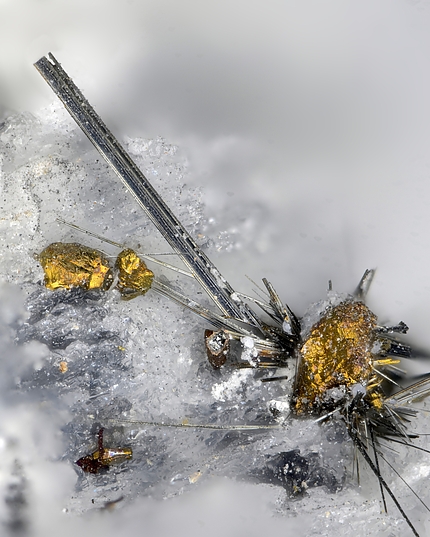
Vein No. 53, Aït Ahmane, Tansifte Caïdat, Agdz Cercle, Zagora Province, Drâa-Tafilalet Region, Morocco