
Agardite-(Ce)
A valid IMA mineral species
This page is currently not sponsored. Click here to sponsor this page.

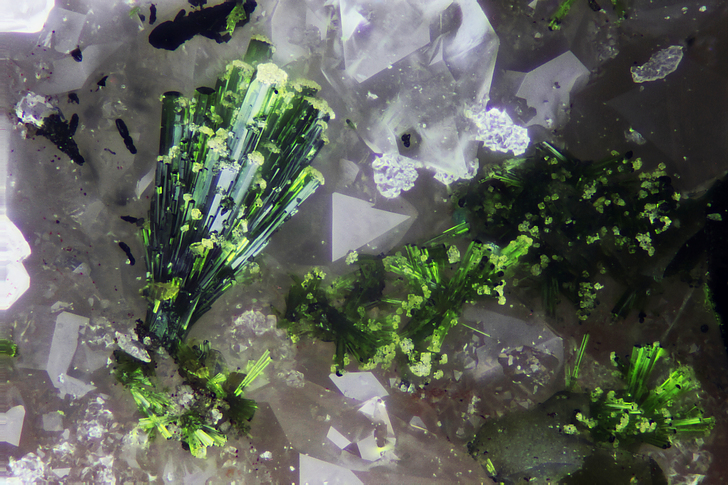


About Agardite-(Ce)
Formula:
CeCu6(AsO4)3(OH)6 · 3H2O
Colour:
Light green, yellowish green
Lustre:
Sub-Vitreous, Resinous, Silky
Hardness:
3 - 4
Specific Gravity:
3.7
Crystal System:
Hexagonal
Member of:
Name:
Named by Kurt Walenta and Thomas Theye in 2003 for its relationship to the other Agardite series species.
Unique Identifiers
Mindat ID:
48
Long-form identifier:
mindat:1:1:48:8
Similar Names
| Agardite | A synonym | |
| Agardite-(Ca) | A synonym of Zálesíite | |
| Agardite-(Dy) | (Dy,La)Cu6(AsO4)3(OH)6 · 3H2O | |
| Agardite-(La) | A valid IMA mineral species | LaCu6(AsO4)3(OH)6 · 3H2O |
| Agardite-(Nd) | A valid IMA mineral species | NdCu6(AsO4)3(OH)6 · 3H2O |
| Agardite-(Y) | A valid IMA mineral species | YCu6(AsO4)3(OH)6 · 3H2O |
IMA Classification of Agardite-(Ce)
Approved
IMA Formula:
Cu2+6Ce3+(As5+O4)3(OH)6·3H2O
Approval year:
2003
First published:
1970
Classification of Agardite-(Ce)
8.DL.15
8 : PHOSPHATES, ARSENATES, VANADATES
D : Phosphates, etc. with additional anions, with H2O
L : With large and medium-sized cations, (OH, etc.):RO4 = 2:1
8 : PHOSPHATES, ARSENATES, VANADATES
D : Phosphates, etc. with additional anions, with H2O
L : With large and medium-sized cations, (OH, etc.):RO4 = 2:1
Mineral Symbols
As of 2021 there are now IMA–CNMNC approved mineral symbols (abbreviations) for each mineral species, useful for tables and diagrams.
| Symbol | Source | Reference for Standard |
|---|---|---|
| Agr-Ce | IMA–CNMNC | Warr, L.N. (2021). IMA–CNMNC approved mineral symbols. Mineralogical Magazine, 85(3), 291-320. doi:10.1180/mgm.2021.43 |
Pronunciation of Agardite-(Ce)
Pronunciation:
| Play | Recorded by | Country |
|---|---|---|
| Jolyon Ralph | United Kingdom |
Physical Properties of Agardite-(Ce)
Sub-Vitreous, Resinous, Silky
Transparency:
Transparent, Translucent
Colour:
Light green, yellowish green
Streak:
Greenish white
Hardness:
3 - 4 on Mohs scale
Hardness Data:
Measured
Tenacity:
Brittle
Cleavage:
None Observed
Fracture:
Conchoidal
Density:
3.7 g/cm3 (Measured) 3.775 g/cm3 (Calculated)
Optical Data of Agardite-(Ce)
Type:
Uniaxial (+)
RI values:
nω = 1.725 nε = 1.81
Max. Birefringence:
δ = 0.085
Based on recorded range of RI values above.
Based on recorded range of RI values above.
Interference Colours:
The colours simulate birefringence patterns seen in thin section under crossed polars. They do not take into account mineral colouration or opacity.
Michel-Levy Bar The default colours simulate the birefringence range for a 30 µm thin-section thickness. Adjust the slider to simulate a different thickness.
Grain Simulation You can rotate the grain simulation to show how this range might look as you rotated a sample under crossed polars. Each grain retains its interference colour (retardation) while its brightness falls to black at extinction and reaches a maximum between extinction positions.
The colours simulate birefringence patterns seen in thin section under crossed polars. They do not take into account mineral colouration or opacity.
Michel-Levy Bar The default colours simulate the birefringence range for a 30 µm thin-section thickness. Adjust the slider to simulate a different thickness.
Grain Simulation You can rotate the grain simulation to show how this range might look as you rotated a sample under crossed polars. Each grain retains its interference colour (retardation) while its brightness falls to black at extinction and reaches a maximum between extinction positions.
Surface Relief:
Very High (positive)
Relative to Canada balsam mounting medium (n ≈ 1.537).
Relative to Canada balsam mounting medium (n ≈ 1.537).
This shows the grain boundary and Becke line effect under plane-polarised
light, based on the contrast between this mineral's average refractive
index and the mounting medium. It does not take into account mineral
colouration.
In focus
Interference Figure:
This shows the idealized uniaxial interference figure - the conoscopic
(convergent-light, Bertrand-lens-in) view, for a grain cut with the optic axis
centred and vertical. The coloured rings are isochromatics, computed with the
same physics as the Michel-Lévy bar above; the dark cross is the isogyre.
For a genuinely uniaxial mineral viewed this way, that cross stays perfectly stationary if you rotate the stage - unlike a biaxial mineral, where it splits apart on rotation. That invariance is itself the standard diagnostic test for telling uniaxial and biaxial minerals apart at the microscope.
For a genuinely uniaxial mineral viewed this way, that cross stays perfectly stationary if you rotate the stage - unlike a biaxial mineral, where it splits apart on rotation. That invariance is itself the standard diagnostic test for telling uniaxial and biaxial minerals apart at the microscope.
Chemistry of Agardite-(Ce)
Mindat Formula:
CeCu6(AsO4)3(OH)6 · 3H2O
Element Weights:
Crystallography of Agardite-(Ce)
Crystal System:
Hexagonal
Class (H-M):
6/m - Dipyramidal
Space Group:
P63/m
Setting:
P63/m
Cell Parameters:
a = 13.59 Å, c = 5.89 Å
Ratio:
a:c = 1 : 0.433
Unit Cell V:
942.1 ų
Z:
2
Crystal Structure
Load
Unit Cell | Unit Cell Packed
2x2x2 | 3x3x3 | 4x4x4
Unit Cell | Unit Cell Packed
2x2x2 | 3x3x3 | 4x4x4
Show
Big Balls | Small Balls | Just Balls | Spacefill
Polyhedra Off | Si Polyhedra | All Polyhedra
Remove metal-metal sticks
Big Balls | Small Balls | Just Balls | Spacefill
Polyhedra Off | Si Polyhedra | All Polyhedra
Remove metal-metal sticks
Display Options
Black Background | White Background
Perspective On | Perspective Off
2D | Stereo | Red-Blue | Red-Cyan
Black Background | White Background
Perspective On | Perspective Off
2D | Stereo | Red-Blue | Red-Cyan
View
CIF File Best | x | y | z | a | b | c
CIF File Best | x | y | z | a | b | c
Rotation
Stop | Start
Stop | Start
Labels
Console Off | On | Grey | Yellow
Console Off | On | Grey | Yellow
Data courtesy of the American Mineralogist Crystal Structure Database. Click on an AMCSD ID to view structure
| ID | Species | Reference | Link | Year | Locality | Pressure (GPa) | Temp (K) |
|---|---|---|---|---|---|---|---|
| 0014774 | Agardite-(Ce) | Hess H (1983) Die kristallstruktur des chlorotils, SECu6(AsO4)3(OH)6*3H2O (SE = seltene erdmetalle) Neues Jahrbuch fur Mineralogie, Monatshefte 1983 385-392 | 1983 | Clara mine, Black Forest, Baden-Wurttemberg, Germany | 0 | 293 |
CIF Raw Data - click here to close
X-Ray Powder Diffraction
Powder Diffraction Data:
| d-spacing | Intensity |
|---|---|
| 11.88 Å | (100) |
| 4.47 Å | (80) |
| 3.56 Å | (80) |
| 3.26 Å | (50) |
| 2.95 Å | (80) |
| 2.70 Å | (50) |
| 2.57 Å | (50) |
| 2.46 Å | (90) |
Comments:
Clara mine, Germany. Data from the type description.
Geological Environment
Paragenetic Mode(s):
| Paragenetic Mode | Earliest Age (Ga) |
|---|---|
| Stage 7: Great Oxidation Event | <2.4 |
| 47a : [Near-surface hydration of prior minerals] | |
| 47d : [Arsenates, antimonates, selenates, bismuthinates] |
Type Occurrence of Agardite-(Ce)
General Appearance of Type Material:
Acicular crystals up to 0.5 mm long and 0.01 mm thick. commonly in radiating aggregates.
Place of Conservation of Type Material:
Institut für Mineralogie und Kristallchemie, Stuttgart, Germany (holotype).
Geological Setting of Type Material:
Secondary, oxidation zone.
Associated Minerals at Type Locality:
Synonyms of Agardite-(Ce)
Other Language Names for Agardite-(Ce)
Czech:Agardit-(Ce)
Dutch:Agardiet-(Ce)
French:Agardite-(Ce)
German:Agardit-(Ce)
Italian:Agardite-(Ce)
Japanese:セリウムアガアド石
Latvian:Agardīts-(Ce)
Norwegian:Agarditt-(Ce)
Russian:Агардит-(Ce)
Simplified Chinese:砷铈铜石
Traditional Chinese:砷鈰銅石
Relationship of Agardite-(Ce) to other Species
Member of:
Other Members of Mixite Group:
| Agardite-(La) | LaCu6(AsO4)3(OH)6 · 3H2O | Hex. 6/m : P63/m |
| Agardite-(Nd) | NdCu6(AsO4)3(OH)6 · 3H2O | Hex. 6/m : P63/m |
| Agardite-(Y) | YCu6(AsO4)3(OH)6 · 3H2O | Hex. 6/m : P63/m |
| Calciopetersite | CaCu6(PO4)2(PO3OH)(OH)6 · 3H2O | Hex. 6/m : P63/m |
| Goudeyite | AlCu6(AsO4)3(OH)6 · 3H2O | Hex. |
| Mixite | BiCu6(AsO4)3(OH)6 · 3H2O | Hex. 6/m : P63/m |
| Petersite-(Ce) | CeCu6(PO4)3(OH)6 · 3H2O | Hex. 6/m : P63/m |
| Petersite-(La) | LaCu6(PO4)3(OH)6 · 3H2O | Hex. 6/m : P63/m |
| Petersite-(Y) | YCu6(PO4)3(OH)6 · 3H2O | Hex. |
| Plumboagardite | PbCu6(AsO4)2(AsO3OH)(OH)6 · 3H2O | Hex. 6/m : P63/m |
| Zálesíite | CaCu6(AsO4)2(AsO3OH)(OH)6 · 3H2O | Hex. 6/m : P63/m |
Common Associates
Associations Based on Photo Data:
| 67 photos of Agardite-(Ce) associated with Cornwallite | Cu5(AsO4)2(OH)4 |
| 56 photos of Agardite-(Ce) associated with Quartz | SiO2 |
| 49 photos of Agardite-(Ce) associated with Olivenite | Cu2(AsO4)(OH) |
| 37 photos of Agardite-(Ce) associated with Fluorite | CaF2 |
| 35 photos of Agardite-(Ce) associated with Baryte | BaSO4 |
| 22 photos of Agardite-(Ce) associated with Malachite | Cu2(CO3)(OH)2 |
| 10 photos of Agardite-(Ce) associated with Bariopharmacosiderite | Ba0.5Fe3+4(AsO4)3(OH)4 · 5H2O |
| 9 photos of Agardite-(Ce) associated with Arseniosiderite | Ca2Fe3+3(AsO4)3O2 · 3H2O |
| 8 photos of Agardite-(Ce) associated with Hematite | Fe2O3 |
| 7 photos of Agardite-(Ce) associated with Goethite | Fe3+O(OH) |
Related Minerals - Strunz-mindat Grouping
| 8.DL.05 | Foggite | CaAl(PO4)(OH)2 · H2O |
| 8.DL.10 | Fluorowardite | NaAl3(PO4)2F2(OH)2(H2O)2 |
| 8.DL.10 | Wardite | NaAl3(PO4)2(OH)4 · 2H2O |
| 8.DL.10 | Millisite | (Na,K)CaAl6(PO4)4(OH)9 · 3H2O |
| 8.DL.10 | Cyrilovite | NaFe3+3(PO4)2(OH)4 · 2H2O |
| 8.DL.15 | Petersite-(Ce) | CeCu6(PO4)3(OH)6 · 3H2O |
| 8.DL.15 | Agardite-(Nd) | NdCu6(AsO4)3(OH)6 · 3H2O |
| 8.DL.15 | Agardite-(Y) | YCu6(AsO4)3(OH)6 · 3H2O |
| 8.DL.15 | 'Agardite-(Dy)' | (Dy,La)Cu6(AsO4)3(OH)6 · 3H2O |
| 8.DL.15 | Agardite-(La) | LaCu6(AsO4)3(OH)6 · 3H2O |
| 8.DL.15 | Petersite-(Y) | YCu6(PO4)3(OH)6 · 3H2O |
| 8.DL.15 | Zálesíite | CaCu6(AsO4)2(AsO3OH)(OH)6 · 3H2O |
| 8.DL.15 | Mixite | BiCu6(AsO4)3(OH)6 · 3H2O |
| 8.DL.15 | Petersite-(La) | LaCu6(PO4)3(OH)6 · 3H2O |
| 8.DL.15 | Goudeyite | AlCu6(AsO4)3(OH)6 · 3H2O |
| 8.DL.15 | Calciopetersite | CaCu6(PO4)2(PO3OH)(OH)6 · 3H2O |
| 8.DL.15 | Plumboagardite | PbCu6(AsO4)2(AsO3OH)(OH)6 · 3H2O |
| 8.DL.20 | Dugganite | Pb3Zn3(AsO4)2(TeO6) |
| 8.DL.20 | Wallkilldellite | Ca2Mn2+3(AsO4)2(OH)4 · 9H2O |
| 8.DL.20 | Wallkilldellite-(Fe) | (Ca,Cu)4Fe2+6(AsO4,SiO4)4(OH,O)8 · 18H2O |
| 8.DL.20 | Cheremnykhite | Pb3Zn3(VO4)2(TeO6) |
| 8.DL.20 | Kuksite | Pb3Zn3(PO4)2(TeO6) |
| 8.DL.25 | Angastonite | CaMgAl2(PO4)2(OH)4 · 7H2O |
| 8.DL.30 | Långbanshyttanite | Pb2Mn2Mg(AsO4)2(OH)4 · 6H2O |
Fluorescence of Agardite-(Ce)
Not fluorescent
Other Information
Health Risks:
No information on health risks for this material has been entered into the database. You should always treat mineral specimens with care.
Internet Links for Agardite-(Ce)
mindat.org URL:
https://www.mindat.org/min-48.html
Please feel free to link to this page.
Please feel free to link to this page.
Search Engines:
External Links:
Mineral Dealers:
References for Agardite-(Ce)
Reference List:
Jambor, John L.; Grew, Edward J.; Roberts, Andrew C. (2004) New Mineral Names. American Mineralogist, 89 (10). 1574-1578
Mandarino, Joseph A. (2004) New minerals. The Canadian Mineralogist, 42 (6) 1901-1927 doi:10.2113/gscanmin.42.6.1901
Aksenov, Sergey M., Chukanov, Nikita V., Göttlicher, Jörg, Möckel, Steffen, Varlamov, Dmitriy, Van, Konstantin V., Rastsvetaeva, Ramiza K. (2018) New insights into the crystal chemistry of agardite-(Ce): refinement of the crystal structure, hydrogen bonding, and epitaxial intergrowths with the Sb-analogue of auriacusite. Physics and Chemistry of Minerals, 45 (1) 39-50 doi:10.1007/s00269-017-0899-9
Localities for Agardite-(Ce)
Showing 56 localities.
 symbol to view information about a locality.
The
symbol to view information about a locality.
The Locality List
 - This locality has map coordinates listed.
- This locality has estimated coordinates.
ⓘ - Click for references and further information on this occurrence.
? - Indicates mineral may be doubtful at this locality.
- This locality has map coordinates listed.
- This locality has estimated coordinates.
ⓘ - Click for references and further information on this occurrence.
? - Indicates mineral may be doubtful at this locality.
 - Good crystals or important locality for species.
 - World class for species or very significant.
(TL) - Type Locality for a valid mineral species.
(FRL) - First Recorded Locality for everything else (eg varieties).
- World class for species or very significant.
(TL) - Type Locality for a valid mineral species.
(FRL) - First Recorded Locality for everything else (eg varieties).
All localities listed without proper references should be considered as questionable.
Australia | |
| Ex Jim Sharpe Collection |
| |
| Downes et al. (2006) |
Austria | |
| Kolitsch (2014) +1 other reference |
| Auer (2025) |
| Jakely (2008) |
Czech Republic | |
| Sejkora et al. (2008) +1 other reference |
| Sejkora et al. (2008) | |
France | |
| Kolitsch (1997) |
| N. Meisser2001 and 2002 Analysis |
| G. Parodi analysis (MNHNP) |
| Escande et al. (1973) +6 other references |
| Escande et al. (1973) +6 other references | |
| Lheur (2023) |
| Favreau et al. (2010) |
| Marcel Valladares collection; EDX ... |
Germany | |
| Gröbner (2017) |
| Gröbner (2017) |
| Walenta et al. (2004) +2 other references |
| Walenta (1992) |
| Steen (2013) |
| Walenta (1992) |
| Gröbner (2017) |
| Gröbner (2017) |
| Gröbner (2017) |
| Belendorff (2021) |
| Lorenz (1998) |
| Belendorff (2021) |
| |
| Schnorrer (1995) +1 other reference |
| Martin et al. (1994) |
Greece | |
| |
| Rieck et al. (1999) +1 other reference | |
| |
| Rieck (n.d.) | |
Italy | |
| Balestra-Vignola |
| Guastoni et al. (2017) |
| Stara et al. (1996) |
| Giovanni Fraccaro collection | |
| Caboni et al. (2018) |
| Sabelli (2000) | |
| Ferretti et al. (2018) |
| Gasparetto et al. (2014) |
| Senesi et al. (1999) |
Mexico | |
| Gerhard Möhn Collection Analyzed by ... |
Morocco | |
| Witzke et al. (2006) |
Namibia | |
| Gebhard (1995) +1 other reference |
Russia | |
| Vladimir Yu. Karpenko data |
Spain | |
| Minerales y Minas de España et al. (2015) |
| Abella i Creus (2018) |
UK | |
| Golley et al. (1995) |
| Golley et al. (1995) |
| Golley et al. (1995) |
USA | |
| Holmwood (2023) |
| - (n.d.) +1 other reference |
Quick NavTopAbout Agardite-(Ce)Unique IdentifiersSimilar NamesIMA Classification Classification Mineral SymbolsPronunciation Physical Properties Optical Data Chemistry Crystallography Crystal StructureX-Ray Powder DiffractionGeological EnvironmentType Occurrence SynonymsOther LanguagesRelationshipsCommon AssociatesStrunz-MindatFluorescence Other InformationInternet Links References Localities Locality List

Clara Mine, Oberwolfach, Ortenaukreis, Freiburg Region, Baden-Württemberg, Germany