
Karibibite
A valid IMA mineral species
This page is currently not sponsored. Click here to sponsor this page.



About Karibibite

Formula:
Fe3+3(As3+O2)4(As3+2O5)(OH)
Formerly given as Fe2As4O9.
Specific Gravity:
4.07
Crystal System:
Orthorhombic
Name:
Named for the type locality.
Type Locality:
A rare iron arsenite originally described from the "Karibib pegmatite area". So far, it always originated as a weathering product of löllingite.
Visually similar to ludlockite.
Compare also 'UM1971-02-AsO:Fe'.
The structure seems to have been solved just recently (Mugnaioli, 2016; Colombo et al., 2017). The mineral is unique in being the only arsenite with structurally different anions (chains and dimers simultaneously), and is a representative of a small class of diarsenates(III) (or diarsenites).
Structure details:
(1) Fe3+O6 octahedra form bands along a; the bands are made of ribbons built of 3 edge-sharing octahedra, and the ribbons are joined via apices to give a kinked bond along a;
(2) the above bands are surrounded by (a) chains comprising AsO3 trigonal pyramids, and (b) As2O5 dimers;
(3) the dimers are connected by the O(3) atoms, thus giving zig-zag chains of the (As3+O2)-n stoichiometry.
Visually similar to ludlockite.
Compare also 'UM1971-02-AsO:Fe'.
The structure seems to have been solved just recently (Mugnaioli, 2016; Colombo et al., 2017). The mineral is unique in being the only arsenite with structurally different anions (chains and dimers simultaneously), and is a representative of a small class of diarsenates(III) (or diarsenites).
Structure details:
(1) Fe3+O6 octahedra form bands along a; the bands are made of ribbons built of 3 edge-sharing octahedra, and the ribbons are joined via apices to give a kinked bond along a;
(2) the above bands are surrounded by (a) chains comprising AsO3 trigonal pyramids, and (b) As2O5 dimers;
(3) the dimers are connected by the O(3) atoms, thus giving zig-zag chains of the (As3+O2)-n stoichiometry.
Unique Identifiers
Mindat ID:
2159
Long-form identifier:
mindat:1:1:2159:9
IMA Classification of Karibibite
Approved
Approval year:
1973
First published:
1973
Classification of Karibibite
4.JA.15
4 : OXIDES (Hydroxides, V[5,6] vanadates, arsenites, antimonites, bismuthites, sulfites, selenites, tellurites, iodates)
J : Arsenites, antimonites, bismuthites, sulfites, selenites, tellurites; iodates
A : Arsenites, antimonites, bismuthites; without additional anions, without H2O
4 : OXIDES (Hydroxides, V[5,6] vanadates, arsenites, antimonites, bismuthites, sulfites, selenites, tellurites, iodates)
J : Arsenites, antimonites, bismuthites, sulfites, selenites, tellurites; iodates
A : Arsenites, antimonites, bismuthites; without additional anions, without H2O
7.10.2.1
7 : MULTIPLE OXIDES
10 : AB4X9
7 : MULTIPLE OXIDES
10 : AB4X9
23.18
23 : Arsenites
23 : Arsenites
Mineral Symbols
As of 2021 there are now IMA–CNMNC approved mineral symbols (abbreviations) for each mineral species, useful for tables and diagrams.
| Symbol | Source | Reference for Standard |
|---|---|---|
| Kab | IMA–CNMNC | Warr, L.N. (2021). IMA–CNMNC approved mineral symbols. Mineralogical Magazine, 85(3), 291-320. doi:10.1180/mgm.2021.43 |
Pronunciation of Karibibite
Pronunciation:
| Play | Recorded by | Country |
|---|---|---|
| Debbie Woolf | United Kingdom |
Physical Properties of Karibibite
Hardness Data:
Could not be measured
Tenacity:
Flexible
Density:
4.07(1) g/cm3 (Measured)
Comment:
Measured with a Berman balance
Optical Data of Karibibite
Type:
Biaxial (-)
RI values:
nα = 1.96 nβ = 2.1 nγ = 2.1
Max. Birefringence:
δ = 0.140
Based on recorded range of RI values above.
Based on recorded range of RI values above.
Interference Colours:
The colours simulate birefringence patterns seen in thin section under crossed polars. They do not take into account mineral colouration or opacity.
Michel-Levy Bar The default colours simulate the birefringence range for a 30 µm thin-section thickness. Adjust the slider to simulate a different thickness.
Grain Simulation You can rotate the grain simulation to show how this range might look as you rotated a sample under crossed polars. Each grain retains its interference colour (retardation) while its brightness falls to black at extinction and reaches a maximum between extinction positions.
The colours simulate birefringence patterns seen in thin section under crossed polars. They do not take into account mineral colouration or opacity.
Michel-Levy Bar The default colours simulate the birefringence range for a 30 µm thin-section thickness. Adjust the slider to simulate a different thickness.
Grain Simulation You can rotate the grain simulation to show how this range might look as you rotated a sample under crossed polars. Each grain retains its interference colour (retardation) while its brightness falls to black at extinction and reaches a maximum between extinction positions.
Surface Relief:
Very High (positive)
Relative to Canada balsam mounting medium (n ≈ 1.537).
Relative to Canada balsam mounting medium (n ≈ 1.537).
This shows the grain boundary and Becke line effect under plane-polarised
light, based on the contrast between this mineral's average refractive
index and the mounting medium. It does not take into account mineral
colouration.
In focus
Interference Figure:
This shows the idealized biaxial acute bisectrix (Bxa) interference figure
- the conoscopic view for a grain cut perpendicular to the acute bisectrix, using
this mineral's 2V. The two small white dots mark the melatopes - the points
where the two optic axes emerge - and are shown only when they fall within the
field of view. The coloured bands are isochromatics, and the dark bands are
isogyres.
Rotate the stage: at 0°/90° the isogyres form a cross through the melatopes; at 45° they pull apart into curved hyperbolas. That splitting on rotation - absent in a uniaxial figure - is the standard diagnostic test for telling biaxial minerals from uniaxial ones. If 2V is large, the melatopes may fall outside the field of view, as they often do at the microscope too.
No measured or calculated 2V is on file for this mineral, so the value used here (-0°) is estimated from its recorded refractive indices and optic sign, not from a direct 2V measurement.
Rotate the stage: at 0°/90° the isogyres form a cross through the melatopes; at 45° they pull apart into curved hyperbolas. That splitting on rotation - absent in a uniaxial figure - is the standard diagnostic test for telling biaxial minerals from uniaxial ones. If 2V is large, the melatopes may fall outside the field of view, as they often do at the microscope too.
No measured or calculated 2V is on file for this mineral, so the value used here (-0°) is estimated from its recorded refractive indices and optic sign, not from a direct 2V measurement.
Dispersion:
strong
Pleochroism:
Weak
Comments:
Absorption parallel to the fiber axis is slightly higher (light brownish yellow) than perpendicular to it (straw yellow). The optic axial plane and γ-direction are parallel to the fiber axis.
Chemistry of Karibibite
Mindat Formula:
Fe3+3(As3+O2)4(As3+2O5)(OH)
Formerly given as Fe2As4O9.
Formerly given as Fe2As4O9.
Element Weights:
Elements listed:
Crystallography of Karibibite
Crystal System:
Orthorhombic
Class (H-M):
mmm(2/m2/m2/m) - Dipyramidal
Space Group:
Pnma
Setting:
Pnma
Cell Parameters:
a = 7.2558(3) Å, b = 27.992(1) Å, c = 6.5243(3) Å
Ratio:
a:b:c = 0.259 : 1 : 0.233
Unit Cell V:
1325.1 ų
Z:
8
X-Ray Powder Diffraction
Powder Diffraction Data:
| d-spacing | Intensity |
|---|---|
| 6.96 Å | (5) |
| 6.35 Å | (40) |
| 5.35 Å | (30) |
| 4.76 Å | (20) |
| 4.65 Å | (30) |
| 3.496 Å | (50) |
| 3.377 Å | (20b) |
| 3.262 Å | (25) |
| 3.176 Å | (80) |
| 3.088 Å | (70) |
| 3.040 Å | (30) |
| 2.968 Å | (5) |
| 2.910 Å | (5) |
| 2.802 Å | (80) |
| 2.672 Å | (45) |
| 2.384 Å | (100) |
| 2.110 Å | (15b) |
| 1.748 Å | (30b) |
| 1.729 Å | (15b) |
| 1.556 Å | (30) |
| 1.438 Å | (20) |
Comments:
ICDD 25-1405.
Geological Environment
Paragenetic Mode(s):
| Paragenetic Mode | Earliest Age (Ga) |
|---|---|
| Stage 7: Great Oxidation Event | <2.4 |
| 47a : [Near-surface hydration of prior minerals] | |
| 47d : [Arsenates, antimonates, selenates, bismuthinates] |
Type Occurrence of Karibibite
General Appearance of Type Material:
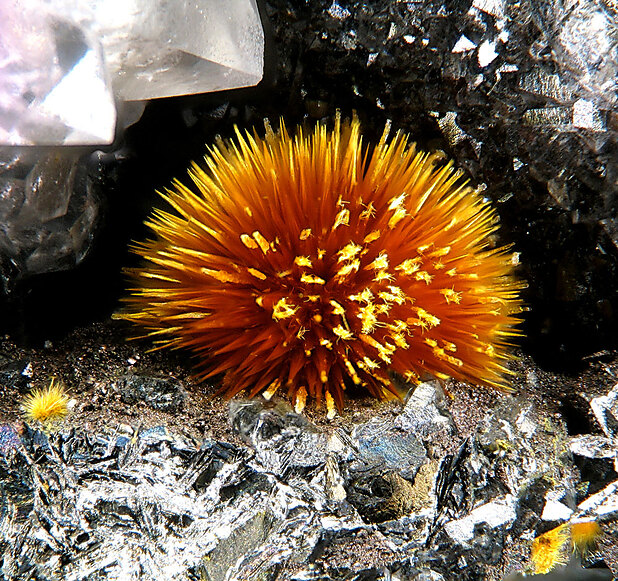
Radiating groups of sharply pointed, spindle-shaped bundles of fibers up to 1 mm in length.
Place of Conservation of Type Material:
1) Department of Earth Sciences, University of Leeds, Leeds, England.
2) Department of Geology, University of Helsinki, Helsinki, Finland.
2) Department of Geology, University of Helsinki, Helsinki, Finland.
Geological Setting of Type Material:
Pegmatite, secondary after loellingite
Associated Minerals at Type Locality:
Synonyms of Karibibite
Other Language Names for Karibibite
Common Associates
Associations Based on Photo Data:
| 37 photos of Karibibite associated with Löllingite | FeAs2 |
| 30 photos of Karibibite associated with Schneiderhöhnite | Fe2+Fe3+3As3+5O13 |
| 23 photos of Karibibite associated with Scorodite | Fe3+AsO4 · 2H2O |
| 12 photos of Karibibite associated with Erythrite | Co3(AsO4)2 · 8H2O |
| 9 photos of Karibibite associated with Pharmacosiderite | KFe3+4(AsO4)3(OH)4 · 6-7H2O |
| 5 photos of Karibibite associated with Yukonite | Ca3Fe3+(AsO4)2(OH)3 · 5H2O |
| 5 photos of Karibibite associated with Parasymplesite | Fe2+3(AsO4)2 · 8H2O |
| 4 photos of Karibibite associated with Quartz | SiO2 |
| 2 photos of Karibibite associated with Halilsarpite | [Mg(H2O)6][CaAs3+2(Fe3+2.67Mo6+0.33)(AsO4)2O7] |
| 2 photos of Karibibite associated with Fluorite | CaF2 |
Related Minerals - Strunz-mindat Grouping
| 4.JA.05 | Leiteite | Zn(As2O4) |
| 4.JA.10 | Reinerite | Zn3(AsO3)2 |
| 4.JA.20 | Manganoschafarzikite | MnSb2O4 |
| 4.JA.20 | Trippkeite | Cu2+As3+2O4 |
| 4.JA.20 | Schafarzikite | Fe2+Sb3+2O4 |
| 4.JA.20 | Kusachiite | CuBi2O4 |
| 4.JA.20 | Igelströmite | Fe3+(Sb3+Pb2+)O4 |
| 4.JA.25 | Apuanite | Fe2+Fe3+4Sb3+4O12S |
| 4.JA.30 | Versiliaite | Fe2Fe4Sb6O16S |
| 4.JA.35 | Schneiderhöhnite | Fe2+Fe3+3As3+5O13 |
| 4.JA.40 | Zimbabweite | (Na,K)2PbAs4(Ta,Nb,Ti)4O18 |
| 4.JA.45 | Ludlockite | PbFe3+4As3+10O22 |
| 4.JA.50 | Paulmooreite | Pb2[As2O5] |
| 4.JA.55 | Stibivanite | Sb2VO5 |
| 4.JA.60 | Chadwickite | (UO2)[HAsO3] |
Fluorescence of Karibibite
Fluorescent yellow under 253 nm excitation
Other Information
Notes:
Easily soluble in dilute acids and in dilute alkali hydroxide solution.
Health Risks:
No information on health risks for this material has been entered into the database. You should always treat mineral specimens with care.
Internet Links for Karibibite
mindat.org URL:
https://www.mindat.org/min-2159.html
Please feel free to link to this page.
Please feel free to link to this page.
Search Engines:
External Links:
Mineral Dealers:
References for Karibibite
Reference List:
Knorring, Oleg V, Sahama, Th.G, Rehtijärvi, Pentti (1973) Karibibite, a new FeAs mineral from South West Africa. Lithos, 6 (3) 265-271 doi:10.1016/0024-4937(73)90087-x
Fleischer, Michael; Mandarino, Joseph A (1974) New mineral names. American Mineralogist, 59 (3-4). 381-384 p.382
Anthony, John W., Bideaux, Richard A., Bladh, Kenneth W., Nichols, Monte C. - Eds. (2016) Handbook of Mineralogy. https://www.handbookofmineralogy.org/
Localities for Karibibite
Showing 26 localities.
 symbol to view information about a locality.
The
symbol to view information about a locality.
The Locality List
 - This locality has map coordinates listed.
- This locality has estimated coordinates.
ⓘ - Click for references and further information on this occurrence.
? - Indicates mineral may be doubtful at this locality.
- This locality has map coordinates listed.
- This locality has estimated coordinates.
ⓘ - Click for references and further information on this occurrence.
? - Indicates mineral may be doubtful at this locality.
 - Good crystals or important locality for species.
 - World class for species or very significant.
(TL) - Type Locality for a valid mineral species.
(FRL) - First Recorded Locality for everything else (eg varieties).
- World class for species or very significant.
(TL) - Type Locality for a valid mineral species.
(FRL) - First Recorded Locality for everything else (eg varieties).
All localities listed without proper references should be considered as questionable.
Brazil | |
| Atencio et al. (2004) |
| Physics Dep. - UFMG - Brazil |
| Sergio Varvello collection | |
| Luis Menezes |
Chile | |
| Kampf et al. (2013) +1 other reference |
| Arturo Molina collection (Jochen Schlüter ID) | |
France | |
| Queneau (n.d.) |
Indonesia | |
| Scotney et al. (2005) |
Japan | |
| Minato et al (1973) |
| Uehara et al. (2014) | |
| OHNISHI et al. (2013) +1 other reference | |
Kazakhstan | |
| Voloshin A.V. et al. (1989) |
Morocco | |
| Favreau et al. (2006) +1 other reference |
| Favreau et al. (2006) +1 other reference |
| Favreau et al. (2007) | |
| Favreau et al. (2006) +1 other reference |
| Favreau (n.d.) | |
| Favreau et al. (2006) |
| Favreau et al. (2006) |
Namibia (TL) | |
| Knorring et al. (1973) |
| Mineralogical Museum Universität Hamburg collection (SEM-EDS- and PXRD-analysed) |
Norway | |
| Larsen et al. (2020) |
| Larsen (2013) |
Russia | |
| Alekseev et al. (2015) |
Spain | |
| Rewitzer et al. (2016) +2 other references |
USA | |
| My personal collection |
Quick NavTopAbout KaribibiteUnique IdentifiersIMA Classification Classification Mineral SymbolsPronunciation Physical Properties Optical Data Chemistry Crystallography X-Ray Powder DiffractionGeological EnvironmentType Occurrence SynonymsOther LanguagesCommon AssociatesStrunz-MindatFluorescence Other InformationInternet Links References Localities Locality List

White Elephant Mine, Cicero Peak, Pringle, Custer Mining District, Custer County, South Dakota, USA