
Hellandite-(Y)
A valid IMA mineral species
This page is currently not sponsored. Click here to sponsor this page.


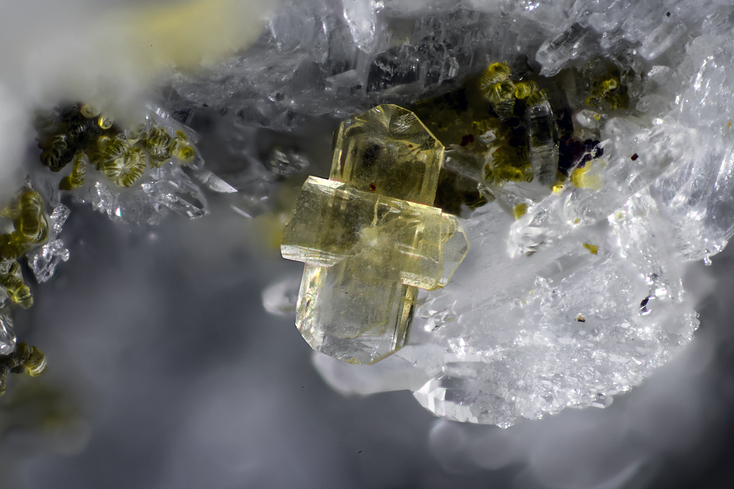

About Hellandite-(Y)
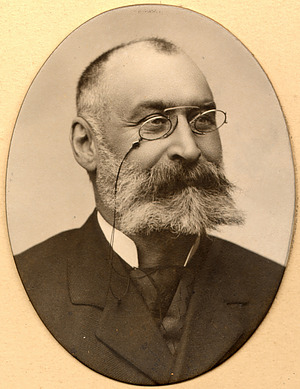
Amund T. Helland
Formula:
(Ca,REE)4Y2Al◻2(B4Si4O22) (OH)2
In the IMA approved report on hellandites [Am. Mineral.,87 (2002), 745–752], the occupancy at the T sites was given as (Be,Li)2–x, however the value of x was not specified. Actually, it is always x > 1, therefore the T site is vacant in the ideal formula of hellandite-(Y).
Colour:
Nut-brown, brownish red, black, gray, green, yellow, cream, pinkish
Lustre:
Vitreous, Dull
Hardness:
4½ - 6½
Specific Gravity:
2.95 - 3.63
Crystal System:
Monoclinic
Member of:
Name:
Named in 1903 by Waldemar Christofer Brøgger in honour of Amund Theodor Helland (11 October 1846, Bergen, Norway - 15 November 1918, Kristiania (now Oslo), Norway), professor of geology and geography at the Royal Frederick University (University of Oslo). It was renamed in 1987, but the renaming was not approved until 2002 (IMA Case 00-F). The suffix/modifier indicates the dominant essential REE.
Unique Identifiers
Mindat ID:
1852
Long-form identifier:
mindat:1:1:1852:0
Similar Names
| Hellandite | ||
| Hellandite-(Ce) | A valid IMA mineral species | (Ca,REE)4Ce2Al◻2(B4Si4O22) (OH)2 |
| Hellandite-(Yb) | (Ca,Y)4(Yb,Y)2(Al,Fe3+,Ti4+)(Be,Li)2[B4Si4O22](O,F,OH)2 | |
| Heulandit | A synonym of Heulandite Subgroup | |
| Hollandite | A valid IMA mineral species - grandfathered | Ba(Mn64+Mn23+)O16 |
IMA Classification of Hellandite-(Y)
Approved
IMA status notes:
Redefined by the IMA
IMA Formula:
(Ca,REE)4Y2Al◻2(B4Si4O22)(OH)2
Approval year:
2000
Approval history:
Redefined as hellandite-(Y) by IMA in 2000 (special procedure IMA code 00-F).
Revision of formula: IMA 2017 (CNMNC Newsletter No. 37).
Revision of formula: IMA 2017 (CNMNC Newsletter No. 37).
Classification of Hellandite-(Y)
9.DK.20
9 : SILICATES (Germanates)
D : Inosilicates
K : Inosilicates with 5-periodic single chains
9 : SILICATES (Germanates)
D : Inosilicates
K : Inosilicates with 5-periodic single chains
54.2.2.1
54 : NESOSILICATES Borosilicates and Some Beryllosilicates
2 : Borosilicates and Some Beryllosilicates with B in [4] coordination
54 : NESOSILICATES Borosilicates and Some Beryllosilicates
2 : Borosilicates and Some Beryllosilicates with B in [4] coordination
17.5.51
17 : Silicates Containing other Anions
5 : Borosilicates
17 : Silicates Containing other Anions
5 : Borosilicates
Mineral Symbols
As of 2021 there are now IMA–CNMNC approved mineral symbols (abbreviations) for each mineral species, useful for tables and diagrams.
| Symbol | Source | Reference for Standard |
|---|---|---|
| Hld-Y | IMA–CNMNC | Warr, L.N. (2021). IMA–CNMNC approved mineral symbols. Mineralogical Magazine, 85(3), 291-320. doi:10.1180/mgm.2021.43 |
Physical Properties of Hellandite-(Y)
Vitreous, Dull
Transparency:
Translucent
Colour:
Nut-brown, brownish red, black, gray, green, yellow, cream, pinkish
Hardness:
4½ - 6½ on Mohs scale
Cleavage:
Poor/Indistinct
Poor on {100}, {010}.
Poor on {100}, {010}.
Density:
2.95 - 3.63 g/cm3 (Measured) 3.5(5) g/cm3 (Calculated)
Optical Data of Hellandite-(Y)
Type:
Biaxial (+)
RI values:
nα = 1.64 nβ = 1.65 nγ = 1.66
2V:
Measured: 48° to 86°, Calculated: 88°
Max. Birefringence:
δ = 0.020
Based on recorded range of RI values above.
Based on recorded range of RI values above.
Interference Colours:
The colours simulate birefringence patterns seen in thin section under crossed polars. They do not take into account mineral colouration or opacity.
Michel-Levy Bar The default colours simulate the birefringence range for a 30 µm thin-section thickness. Adjust the slider to simulate a different thickness.
Grain Simulation You can rotate the grain simulation to show how this range might look as you rotated a sample under crossed polars. Each grain retains its interference colour (retardation) while its brightness falls to black at extinction and reaches a maximum between extinction positions.
The colours simulate birefringence patterns seen in thin section under crossed polars. They do not take into account mineral colouration or opacity.
Michel-Levy Bar The default colours simulate the birefringence range for a 30 µm thin-section thickness. Adjust the slider to simulate a different thickness.
Grain Simulation You can rotate the grain simulation to show how this range might look as you rotated a sample under crossed polars. Each grain retains its interference colour (retardation) while its brightness falls to black at extinction and reaches a maximum between extinction positions.
Surface Relief:
High (positive)
Relative to Canada balsam mounting medium (n ≈ 1.537).
Relative to Canada balsam mounting medium (n ≈ 1.537).
This shows the grain boundary and Becke line effect under plane-polarised
light, based on the contrast between this mineral's average refractive
index and the mounting medium. It does not take into account mineral
colouration.
In focus
Interference Figure:
This shows the idealized biaxial acute bisectrix (Bxa) interference figure
- the conoscopic view for a grain cut perpendicular to the acute bisectrix, using
this mineral's 2V. The two small white dots mark the melatopes - the points
where the two optic axes emerge - and are shown only when they fall within the
field of view. The coloured bands are isochromatics, and the dark bands are
isogyres.
Rotate the stage: at 0°/90° the isogyres form a cross through the melatopes; at 45° they pull apart into curved hyperbolas. That splitting on rotation - absent in a uniaxial figure - is the standard diagnostic test for telling biaxial minerals from uniaxial ones. If 2V is large, the melatopes may fall outside the field of view, as they often do at the microscope too.
Rotate the stage: at 0°/90° the isogyres form a cross through the melatopes; at 45° they pull apart into curved hyperbolas. That splitting on rotation - absent in a uniaxial figure - is the standard diagnostic test for telling biaxial minerals from uniaxial ones. If 2V is large, the melatopes may fall outside the field of view, as they often do at the microscope too.
Dispersion:
relatively weak
Chemistry of Hellandite-(Y)
Mindat Formula:
(Ca,REE)4Y2Al◻2(B4Si4O22) (OH)2
In the IMA approved report on hellandites [Am. Mineral.,87 (2002), 745–752], the occupancy at the T sites was given as (Be,Li)2–x, however the value of x was not specified. Actually, it is always x > 1, therefore the T site is vacant in the ideal formula of hellandite-(Y).
In the IMA approved report on hellandites [Am. Mineral.,87 (2002), 745–752], the occupancy at the T sites was given as (Be,Li)2–x, however the value of x was not specified. Actually, it is always x > 1, therefore the T site is vacant in the ideal formula of hellandite-(Y).
Element Weights:
Chemical Analysis
Oxide wt%:
| 1 | |
|---|---|
| CaO | 7.65 % |
| MnO | 7.71 % |
| Y2O3 | 31.60 % |
| La2O3 | 0.04 % |
| Ce2O3 | 0.29 % |
| Nd2O3 | 0.37 % |
| Sm2O3 | 0.25 % |
| Gd2O3 | 0.19 % |
| Dy2O3 | 0.90 % |
| Er2O3 | 0.93 % |
| Yb2O3 | 2.99 % |
| Al2O3 | 4.85 % |
| Fe2O3 | 0.62 % |
| SiO2 | 24.35 % |
| B2O3 | 15.32 % |
| ThO2 | 0.09 % |
| H20 (calc) | 1.83 % |
| Total: | 99.98 % |
Empirical formulas:
| Sample ID | Empirical Formula |
|---|---|
| 1 | Ca1.34Mn1.07Y2.75Ce0.02Nd0.02Sm0.01Gd0.01Dy0.05Er0.05Yb0.15Al0.94Fe0.08Si3.99B4.33O22.00(OH)2.00 |
Sample references:
| ID | Locality | Reference | Notes |
|---|---|---|---|
| 1 | Heftetjern pegmatite, Tørdal, Drangedal, Telemark, Norway | Empirical formula calculted on the basis of Al + Fe + Si = 5 and 24 anions per formula unit. Chemical analysis : EDS mean of 6 analyzed spots. |
Crystallography of Hellandite-(Y)
Crystal System:
Monoclinic
Class (H-M):
2/m - Prismatic
Space Group:
P2/b
Setting:
P2/a
Cell Parameters:
a = 18.99(1) Å, b = 7.715(5) Å, c = 10.30(1) Å
β = 111.4(1)°
β = 111.4(1)°
Ratio:
a:b:c = 2.461 : 1 : 1.335
Unit Cell V:
1,404.99 ų (Calculated from Unit Cell)
Z:
2
Twinning:
Contact and polysynthetic, parallel to {001} and {100}.
Crystal Structure
Load
Unit Cell | Unit Cell Packed
2x2x2 | 3x3x3 | 4x4x4
Unit Cell | Unit Cell Packed
2x2x2 | 3x3x3 | 4x4x4
Show
Big Balls | Small Balls | Just Balls | Spacefill
Polyhedra Off | Si Polyhedra | All Polyhedra
Remove metal-metal sticks
Big Balls | Small Balls | Just Balls | Spacefill
Polyhedra Off | Si Polyhedra | All Polyhedra
Remove metal-metal sticks
Display Options
Black Background | White Background
Perspective On | Perspective Off
2D | Stereo | Red-Blue | Red-Cyan
Black Background | White Background
Perspective On | Perspective Off
2D | Stereo | Red-Blue | Red-Cyan
View
CIF File Best | x | y | z | a | b | c
CIF File Best | x | y | z | a | b | c
Rotation
Stop | Start
Stop | Start
Labels
Console Off | On | Grey | Yellow
Console Off | On | Grey | Yellow
Data courtesy of the American Mineralogist Crystal Structure Database. Click on an AMCSD ID to view structure
| ID | Species | Reference | Link | Year | Locality | Pressure (GPa) | Temp (K) |
|---|---|---|---|---|---|---|---|
| 0020232 | Hellandite-(Y) | Miyawaki R, Momma K, Yokoyama K, Shigeoka M, Matsubara S, Ito M, Nakai I, Kristiansen R (2015) Mn-bearing hellandite-(Y) from the Heftetjern pegmatite, Tordal, Norway The Canadian Mineralogist 53 345-356 | 2015 | Heftetjern, Tordal, Telemark, Norway | 0 | 293 | |
| 0000557 | Hellandite-(Y) | Mellini M, Merlino S (1977) Hellandite: a new type of silicoborate chain American Mineralogist 62 89-99 |  | 1977 | 0 | 293 |
CIF Raw Data - click here to close
X-Ray Powder Diffraction
Powder Diffraction Data:
| d-spacing | Intensity |
|---|---|
| 2.812 Å | (100) |
| 4.69 Å | (80) |
| 2.635 Å | (80) |
| 2.603 Å | (80) |
| 3.436 Å | (70) |
| 3.198 Å | (70) |
| 3.068 Å | (70) |
Geological Environment
Paragenetic Mode(s):
| Paragenetic Mode | Earliest Age (Ga) |
|---|---|
| Stage 4b: Highly evolved igneous rocks | >3.0 |
| 34 : Complex granite pegmatites |
Type Occurrence of Hellandite-(Y)
Place of Conservation of Type Material:
Mineralogical-Geological Museum, University of Oslo, Oslo, Norway, numbers 21846, various (cotype).
Muséum Nationale d’Histoire Naturelle, Paris, France, number 109732 (type).
Muséum Nationale d’Histoire Naturelle, Paris, France, number 109732 (type).
Associated Minerals at Type Locality:
Synonyms of Hellandite-(Y)
Hellandite (in part)
Other Language Names for Hellandite-(Y)
Dutch:Hellandiet-(Y)
German:Hellandit-(Y)
Russian:Гелландит-(Y)
Simplified Chinese:硼硅钇钙石
Traditional Chinese:硼矽釔鈣石
Varieties of Hellandite-(Y)
| Manganese-bearing Hellandite-(Y) | A hellandite-(Y) with greater than 1 apfu Mn. Described from the Sc-rich granite pegmatite at Heftetjern, Tørdal, Telemark, Norway where it occurs as tiny pinkish yellow granular crystals (Miyawaki et al., 2015). It varies from hellandite-(Y) in that Mn... |
Relationship of Hellandite-(Y) to other Species
Member of:
Other Members of Hellandite Group:
| Ciprianiite | Ca4[(Th,U),Ca]Σ2Al(Be0.5◻1.5)Σ2[B4Si4O22](OH)2 | Mon. 2/m : P2/b |
| Ferri-hellandite-(Ce) | (Ca3Ce)Ce2Fe3+◻2B4Si4O22(OH)2 | Mon. 2/m : P2/b |
| Ferri-mottanaite-(Ce) | Ca4Ce2Fe3+(Be1.5◻0.5)[Si4B4O22]O2 | Mon. 2/m : P2/b |
| Hellandite-(Ce) | (Ca,REE)4Ce2Al◻2(B4Si4O22) (OH)2 | Mon. 2/m |
| Mottanaite-(Ce) | Ca4(Ce,REE)Σ2Al(Be1.5◻0.5)Σ2[B4Si4O22]O2 | Mon. 2/m |
| Tadzhikite-(Ce) | Ca4Ce3+2Ti◻2(B4Si4O22)(OH)2 | Mon. 2/m : P2/b |
Structurally related to group(s):
| Hellandite Group | X4Y2ZT2[B4Si4O22]W2 |
Common Associates
Associations Based on Photo Data:
| 12 photos of Hellandite-(Y) associated with Chamosite | Fe2+5Al(AlSi3O10)(OH)8 |
| 8 photos of Hellandite-(Y) associated with Quartz | SiO2 |
| 8 photos of Hellandite-(Y) associated with Albite | Na(AlSi3O8) |
| 6 photos of Hellandite-(Y) associated with Schorl | NaFe2+3Al6(Si6O18)(BO3)3(OH)3(OH) |
| 3 photos of Hellandite-(Y) associated with Gadolinite-(Y) | Y2Fe2+Be2Si2O10 |
| 3 photos of Hellandite-(Y) associated with Kainosite-(Y) | Ca2Y2(SiO3)4(CO3) · H2O |
| 3 photos of Hellandite-(Y) associated with Fergusonite-(Y) | YNbO4 |
| 2 photos of Hellandite-(Y) associated with Lokkaite-(Y) | Ca(Y,Gd,Nd,Dy)4(CO3)7 · 9H2O |
| 2 photos of Hellandite-(Y) associated with Tengerite-(Y) | Y2(CO3)3 · 2-3H2O |
| 2 photos of Hellandite-(Y) associated with Hingganite-(Y) | (Y,REE,Ca)2(◻,Fe2+)Be2[SiO4]2(OH)2 |
Related Minerals - Strunz-mindat Grouping
| 9.DK. | Ferrorhodonite | CaMn3Fe[Si5O15] |
| 9.DK. | Vittinkiite | MnMn3Mn[Si5O15] |
| 9.DK. | Ferri-hellandite-(Ce) | (Ca3Ce)Ce2Fe3+◻2B4Si4O22(OH)2 |
| 9.DK. | Shijiangshanite | Pb3CaAl(Si5O14)(OH)3 · 3H2O |
| 9.DK.05 | Nambulite | LiMn2+4Si5O14(OH) |
| 9.DK.05 | Marsturite | NaCaMn3Si5O14(OH) |
| 9.DK.05 | Natronambulite | (Na,Li)(Mn,Ca)4Si5O14OH |
| 9.DK.05 | Rhodonite | CaMn3Mn[Si5O15] |
| 9.DK.05 | Scandiobabingtonite | (Ca,Na)2(Fe2+,Mn)(Sc,Fe3+)Si5O14(OH) |
| 9.DK.05 | Lithiomarsturite | LiCaMn3Si5O14(OH) |
| 9.DK.05 | Manganbabingtonite | Ca2Mn2+Fe3+Si5O14(OH) |
| 9.DK.05 | Fowlerite | (Mn2+,Zn,Ca)SiO3 |
| 9.DK.05 | Babingtonite | Ca2Fe2+Fe3+Si5O14(OH) |
| 9.DK.10 | Santaclaraite | CaMn4[Si5O14OH](OH) · H2O |
| 9.DK.15 | Saneroite | NaMn2+5[Si5O14(OH)](VO3)(OH) |
| 9.DK.20 | Ferri-mottanaite-(Ce) | Ca4Ce2Fe3+(Be1.5◻0.5)[Si4B4O22]O2 |
| 9.DK.20 | Tadzhikite-(Ce) | Ca4Ce3+2Ti◻2(B4Si4O22)(OH)2 |
| 9.DK.20 | 'Hellandite-(Yb)' | (Ca,Y)4(Yb,Y)2(Al,Fe3+,Ti4+)(Be,Li)2[B4Si4O22](O,F,OH)2 |
| 9.DK.20 | Mottanaite-(Ce) | Ca4(Ce,REE)Σ2Al(Be1.5◻0.5)Σ2[B4Si4O22]O2 |
| 9.DK.20 | Ciprianiite | Ca4[(Th,U),Ca]Σ2Al(Be0.5◻1.5)Σ2[B4Si4O22](OH)2 |
| 9.DK.20 | Hellandite-(Ce) | (Ca,REE)4Ce2Al◻2(B4Si4O22) (OH)2 |
Other Information
Health Risks:
No information on health risks for this material has been entered into the database. You should always treat mineral specimens with care.
Internet Links for Hellandite-(Y)
mindat.org URL:
https://www.mindat.org/min-1852.html
Please feel free to link to this page.
Please feel free to link to this page.
Search Engines:
External Links:
Mineral Dealers:
References for Hellandite-(Y)
Reference List:
Brögger, W. C. (1907) Hellandit von Lindvikskollen bei Kragerö, Norwegen. Zeitschrift für Kristallographie und Mineralogie, 42 (1-6). 417-439 doi:10.1524/zkri.1907.42.1.417
Oftedal, Ivar (1964) Contributions to the mineralogy of Norway. No. 24. On the chemical composition of Hellandite. Norsk Geologisk Tidsskrift [Norwegian Journal of Geology], 44 (1). 35-37
Oftedal, Ivar (1965) Über den Hellandit [About Hellandite]. Tschermaks Mineralogische und Petrographische Mitteilungen, 10 (1). 125-129 doi:10.1007/bf01128621
Hogarth, D. D., Chao, G. Y., Harris, D. C. (1972) New data on hellandite. The Canadian Mineralogist, 11 (4) 760-776
Mellini, Marcello, Merlino, Stefano (1977) Hellandite: a new type of silicoborate chain. American Mineralogist, 62 (1-2) 89-99
Oberti, Roberta, Ventura, Giancarlo Della, Ottolini, Luisa, Hawthorne, Frank C., Bonazzi, Paola (2002) Re-definition, nomenclature and crystal-chemistry of the hellandite group. American Mineralogist, 87 (5) 745-752 doi:10.2138/am-2002-5-618
Grice, J. D.; Ferraris, G. (2003) New minerals approved in 2002 and nomenclature modifications approved in 1998-2002 by the Commission on the New Minerals and Mineral Names, International Mineralogical Association. The Canadian Mineralogist, 41 (3). 795-802 doi:10.2113/gscanmin.41.3.795
Miyawaki, Ritsuro, Momma, Koichi, Yokoyama, Kazumi, Shigeoka, Masako, Matsubara, Satoshi, Ito, Miku, Nakai, Izumi, Kristiansen, Roy (2015) Mn-bearing hellandite-(Y) from Heftetjern pegmatite, Tørdal, Norway. The Canadian Mineralogist, 53 (2) 345-356 doi:10.3749/canmin.1400068
Hålenius, U., Hatert, F., Pasero, M., Mills, S. J. (2017) New minerals and nomenclature modifications approved in 2017, CNMNC Newsletter No 37. Mineralogical Magazine, 81 (3) 737-742 doi:10.1180/minmag.2017.081.039
Ondrejka, Martin, Molnárová, Alexandra, Putiš, Marián, Bačík, Peter, Uher, Pavel, Voleková, Bronislava, Milovská, Stanislava, Mikuš, Tomáš, Pukančík, Libor (2022) Hellandite-(Y)–hingganite-(Y)–fluorapatite retrograde coronae: a novel type of fluid-induced dissolution–reprecipitation breakdown of xenotime-(Y) in the metagranites of Fabova Hoľa, Western Carpathians, Slovakia. Mineralogical Magazine, 86 (4) 586-605 doi:10.1180/mgm.2022.7
Localities for Hellandite-(Y)
Showing 24 localities.
 symbol to view information about a locality.
The
symbol to view information about a locality.
The Locality List
 - This locality has map coordinates listed.
- This locality has estimated coordinates.
ⓘ - Click for references and further information on this occurrence.
? - Indicates mineral may be doubtful at this locality.
- This locality has map coordinates listed.
- This locality has estimated coordinates.
ⓘ - Click for references and further information on this occurrence.
? - Indicates mineral may be doubtful at this locality.
 - Good crystals or important locality for species.
 - World class for species or very significant.
(TL) - Type Locality for a valid mineral species.
(FRL) - First Recorded Locality for everything else (eg varieties).
- World class for species or very significant.
(TL) - Type Locality for a valid mineral species.
(FRL) - First Recorded Locality for everything else (eg varieties).
All localities listed without proper references should be considered as questionable.
Canada | |
| Reiner Mielke 2013 |
| PAN et al. (1994) +1 other reference |
| Hogarth et al. (1972) +1 other reference |
China | |
| Dizhi Xuebao +2 other references |
France | |
| Gatel (1990) |
| Ragu et al. (2025) |
Italy | |
| Flavio G. Taricco collection - Analized by SIUK AMI (Associazione Micromineralogica Italiana) |
| Flavio G. Taricco collection (material analized by AMI SIUK) | |
| Finello et al. (2007) |
| Sergio Varvello collection |
| Gamboni (2003) |
Japan | |
| Miyawaki (1987) +2 other references |
| Okada (2011) |
Norway | |
| Müller et al. (2012) |
| Husdal (2023) |
| Larsen et al. (2016) |
| [var: Manganese-bearing Hellandite-(Y)] Raade et al. (2000) +2 other references |
| Brøgger (1903) +3 other references |
Poland | |
| Pieczka et al. (2015) +1 other reference |
Slovakia | |
| Ondrejka et al. (2022) |
Spain | |
| Calvo Rebollar et al. (2022) |
Tajikistan | |
| Pavel M. Kartashov (n.d.) |
USA | |
| John Cianciulli +1 other reference |
Quick NavTopAbout Hellandite-(Y)Unique IdentifiersSimilar NamesIMA Classification Classification Mineral SymbolsPhysical Properties Optical Data Chemistry Chemical AnalysisCrystallography Crystal StructureX-Ray Powder DiffractionGeological EnvironmentType Occurrence SynonymsOther LanguagesVarietiesRelationshipsCommon AssociatesStrunz-MindatOther InformationInternet Links References Localities Locality List

Lindvikskollen Quarry, Lindvikskollen-Kalstadgangen pegmatite, Kragerø, Telemark, Norway