
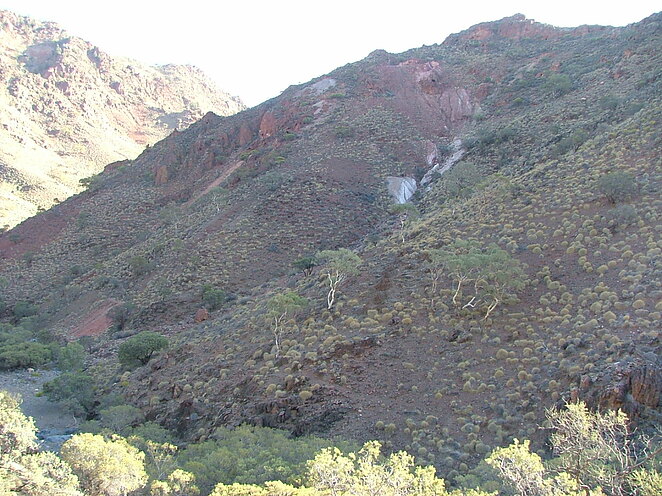
Sir Dominick Mine, Daly gorge, Yudnamutana District, Arkaroola (Arkaroola Wilderness Sanctuary; Arkaroola Station), Pastoral Unincorporated Area, South Australia, Australiai
This page is currently not sponsored. Click here to sponsor this page.


Latitude & Longitude (WGS84):
30° 9' 21'' South , 139° 20' 47'' East
Latitude & Longitude (decimal):
Type:
Mine (Abandoned) - last checked 2025
Köppen climate type:
Other/historical names associated with this locality:
Sir Dominic Mine; Sir Domonic Mine
Copley: H54-9/Umberatana SH5409
Record of mines - Summary Card No: 277
"Name: Sir Dominick Mine"
"Alternative names: No: 8 Yudnamutana Group"
"Location: On western bank of Daly Creek, 3/4 mile southeast of the Daly Mine."
"History: It was opened up in 1862 by the Northern Minerals Association and from 1866 to 1868 was one of the properties of the Daly-Stanley Mining Company. At a later date it was held by the Tasmanian Copper Company, and subsequently by tributors.
Further exploration was carried out about 1910 and in 1914 the mine was taken over by the Flinders Copper Mining Company, being known as the No: 8 Workings. (Jones 1910, p.24) A small amount of ore was produced in 1918, and work finally ceased in 1920 then the field was abandoned. W.C. 5174 (M.R. 573) of about 40 acres round the mine was taken up on October 9th, 1967 by Kennecott Explorations (Aust.) Pty. Ltd."
Above is an excerpt from the Record of Mines - Mines Summary Card
(Spelling and grammar may differ from present standards.)

Sir Dominick Daly
The Daly Mine, the Sir Dominick Mine, and the nearby Daly Bore were all named after Sir Dominick Daly - the former governor of South Australia (1862–1868). He also served as governor of Prince Edward Island, Canada (1854-1859). Born on 11 August 1798 at Ardfry, Ireland; Died 19 February 1868, Adelaide, South Australia, Australia. His nephew (and namesake) Dominick Daly became a government surveyor for the state of South Australia with G. G. McLachlan's No. 6 Party with Goyder's Expedition of 1869.
The alternative mine names would appear to be simply misspelled names and not official names for the mine. It is believed people often, while looking for the Sir Dominick Mine, come across the Daly first without realizing that there are in fact two mines in close proximity. It is interesting to note that there is quite a marked difference in the matrix and geology of the two mines. This was even noted by H.Y.L. Brown in 'The Record of Mines of South Australia - 1908'. To add to the confusion, there is only ¾ mile or 1.2 km (1.7 km by track) between these mines, and the official northern boundary of Sir Dominick is the southern boundary of Daly.
The Sir Dominick mine is reached by following the track past the Daly mine and continuing along the creek another 1.7 km; the last 500 m is cut into the side of the hill and is not recommended due to steep washouts. Heavy rains in January 2011 washed away whole sections of the access track along the creek from the Daly mine onward.
The mine is best known for specimens of malachite pseudomorphs after azurite, with some clusters found up to 10 cm across and single crystals 2-3 cm across. These have formed in a kaolinized matrix, which is often found in various earthy shades, and show no points of attachment. A small arsenate zone has been identified in the uppermost adit, producing specimens of olivenite with malachite, cornwallite, and cornubite.
There are a number of other mines in the vicinity that also contain copper arsenate minerals, so care should be taken when recording locality information.
Select Mineral List Type
Standard Detailed Gallery Strunz Chemical ElementsCommodity List
This is a list of exploitable or exploited mineral commodities recorded at this locality.Mineral List
12 valid minerals.
Rock Types Recorded
Select Rock List Type
Alphabetical List Tree DiagramDetailed Mineral List:
| ⓘ 'Agardite' References: Peter ElliottIdentification: SEM-EDS |
| ⓘ Azurite Formula: Cu3(CO3)2(OH)2 Description: England (1980): "Isolated pockets of unaltered azurite crystals occur throughout the workings but these crystals rarely exceed 1/2 inch in diameter. An interesting occurrence in the walls of the open cut above No. 2 adit is the presence of azurite crystals with malachite-replaced centers. This would indicate an apparent additional short period of azurite growth after replacement of the original azurite crystals. Perhaps this was favored by a recent lack of groundwater movement in some sections of the deposit. The azurite usually occurs as single isolated crystals or small groups. In the open cut above No. 2 adit, exceptionally fine chain-like groups of prismatic crystals were found in a soft claystone in a small and apparently unique pocket. Cleaning of these specimens required several hours painstaking work and in many cases careful repair was essential to preserve these unusual groups intact." References: |
| ⓘ Chrysocolla Formula: Cu2-xAlx(H2-xSi2O5)(OH)4 · nH2O, x < 1 References: |
| ⓘ Conichalcite Formula: CaCu(AsO4)(OH) References: |
| ⓘ Cornubite Formula: Cu5(AsO4)2(OH)4 References: |
| ⓘ Cornwallite Formula: Cu5(AsO4)2(OH)4 References: |
| ⓘ Cuprite Formula: Cu2O |
| ⓘ Hematite Formula: Fe2O3 |
| ⓘ Kaolinite Formula: Al2(Si2O5)(OH)4 |
| ⓘ Malachite Formula: Cu2(CO3)(OH)2 Habit: England (1980, on malachite pseudomorphs): "There are three major morphological types, showing sharply defined crystal faces. All have an internal radiating fibrous structure.
(a) single crystals
The single crystals from the Sir Dominick mine show distinct monoclinic symmetry and vary in habit from thin tabular to prismatic barrel-shaped crystals, both types consisting of simple combinations of hemi-prism and basal pinacoid faces. The convex appearance of the prismatic crystals is due to the presence of quite prominent hemi-pyramid faces (h). Most single crystals actually comprise a number of individuals in parallel growth, made evident by the presence of multiple termination faces. Many of the tabular crystals show unaltered azurite centers.
(b) rosette groups
Tabular crystals commonly occur in sub-parallel to divergent groups, giving the appearance of malachite rosettes, ranging from 1/4 inch to almost 2 inches in diameter.
(c) spherical aggregates
These are probably the most common of the pseudomorph types. Specimens comprise irregular to spherical aggregates of prismatic to tabular crystals occasionally exceeding 4 inches in diameter. Individual crystals in the aggregates range up to 3/4 inch in diameter." Description: England (1980): "Isolated, small, vuggy dark gray quartz pods in the kaolinitic crush zones, particularly in the open cut above No. 2 adit, contain tufted groups of acicular malachite crystals to 1/4 inch long. These provide exceptional micromounts." References: |
| ⓘ Olivenite Formula: Cu2(AsO4)(OH) References: |
| ⓘ Quartz Formula: SiO2 Colour: white; dark gray |
| ⓘ Tremolite Formula: ◻Ca2Mg5(Si8O22)(OH)2 |

List of minerals arranged by Strunz 10th Edition classification
| Group 4 - Oxides and Hydroxides | |||
|---|---|---|---|
| ⓘ | Cuprite | 4.AA.10 | Cu2O |
| ⓘ | Hematite | 4.CB.05 | Fe2O3 |
| ⓘ | Quartz | 4.DA.05 | SiO2 |
| Group 5 - Nitrates and Carbonates | |||
| ⓘ | Azurite | 5.BA.05 | Cu3(CO3)2(OH)2 |
| ⓘ | Malachite | 5.BA.10 | Cu2(CO3)(OH)2 |
| Group 8 - Phosphates, Arsenates and Vanadates | |||
| ⓘ | Olivenite | 8.BB.30 | Cu2(AsO4)(OH) |
| ⓘ | Cornwallite | 8.BD.05 | Cu5(AsO4)2(OH)4 |
| ⓘ | Cornubite | 8.BD.30 | Cu5(AsO4)2(OH)4 |
| ⓘ | Conichalcite | 8.BH.35 | CaCu(AsO4)(OH) |
| Group 9 - Silicates | |||
| ⓘ | Tremolite | 9.DE.10 | ◻Ca2Mg5(Si8O22)(OH)2 |
| ⓘ | Kaolinite | 9.ED.05 | Al2(Si2O5)(OH)4 |
| ⓘ | Chrysocolla | 9.ED.20 | Cu2-xAlx(H2-xSi2O5)(OH)4 · nH2O, x < 1 |
| Unclassified | |||
| ⓘ | 'Agardite' | - | |
List of minerals for each chemical element
| H | Hydrogen | |
|---|---|---|
| H | ⓘ Azurite | Cu3(CO3)2(OH)2 |
| H | ⓘ Chrysocolla | Cu2-xAlx(H2-xSi2O5)(OH)4 · nH2O, x < 1 |
| H | ⓘ Conichalcite | CaCu(AsO4)(OH) |
| H | ⓘ Cornubite | Cu5(AsO4)2(OH)4 |
| H | ⓘ Cornwallite | Cu5(AsO4)2(OH)4 |
| H | ⓘ Kaolinite | Al2(Si2O5)(OH)4 |
| H | ⓘ Malachite | Cu2(CO3)(OH)2 |
| H | ⓘ Olivenite | Cu2(AsO4)(OH) |
| H | ⓘ Tremolite | ◻Ca2Mg5(Si8O22)(OH)2 |
| C | Carbon | |
| C | ⓘ Azurite | Cu3(CO3)2(OH)2 |
| C | ⓘ Malachite | Cu2(CO3)(OH)2 |
| O | Oxygen | |
| O | ⓘ Azurite | Cu3(CO3)2(OH)2 |
| O | ⓘ Chrysocolla | Cu2-xAlx(H2-xSi2O5)(OH)4 · nH2O, x < 1 |
| O | ⓘ Conichalcite | CaCu(AsO4)(OH) |
| O | ⓘ Cornubite | Cu5(AsO4)2(OH)4 |
| O | ⓘ Cornwallite | Cu5(AsO4)2(OH)4 |
| O | ⓘ Cuprite | Cu2O |
| O | ⓘ Hematite | Fe2O3 |
| O | ⓘ Kaolinite | Al2(Si2O5)(OH)4 |
| O | ⓘ Malachite | Cu2(CO3)(OH)2 |
| O | ⓘ Olivenite | Cu2(AsO4)(OH) |
| O | ⓘ Quartz | SiO2 |
| O | ⓘ Tremolite | ◻Ca2Mg5(Si8O22)(OH)2 |
| Mg | Magnesium | |
| Mg | ⓘ Tremolite | ◻Ca2Mg5(Si8O22)(OH)2 |
| Al | Aluminium | |
| Al | ⓘ Chrysocolla | Cu2-xAlx(H2-xSi2O5)(OH)4 · nH2O, x < 1 |
| Al | ⓘ Kaolinite | Al2(Si2O5)(OH)4 |
| Si | Silicon | |
| Si | ⓘ Chrysocolla | Cu2-xAlx(H2-xSi2O5)(OH)4 · nH2O, x < 1 |
| Si | ⓘ Kaolinite | Al2(Si2O5)(OH)4 |
| Si | ⓘ Quartz | SiO2 |
| Si | ⓘ Tremolite | ◻Ca2Mg5(Si8O22)(OH)2 |
| Ca | Calcium | |
| Ca | ⓘ Conichalcite | CaCu(AsO4)(OH) |
| Ca | ⓘ Tremolite | ◻Ca2Mg5(Si8O22)(OH)2 |
| Fe | Iron | |
| Fe | ⓘ Hematite | Fe2O3 |
| Cu | Copper | |
| Cu | ⓘ Azurite | Cu3(CO3)2(OH)2 |
| Cu | ⓘ Chrysocolla | Cu2-xAlx(H2-xSi2O5)(OH)4 · nH2O, x < 1 |
| Cu | ⓘ Conichalcite | CaCu(AsO4)(OH) |
| Cu | ⓘ Cornubite | Cu5(AsO4)2(OH)4 |
| Cu | ⓘ Cornwallite | Cu5(AsO4)2(OH)4 |
| Cu | ⓘ Cuprite | Cu2O |
| Cu | ⓘ Malachite | Cu2(CO3)(OH)2 |
| Cu | ⓘ Olivenite | Cu2(AsO4)(OH) |
| As | Arsenic | |
| As | ⓘ Conichalcite | CaCu(AsO4)(OH) |
| As | ⓘ Cornubite | Cu5(AsO4)2(OH)4 |
| As | ⓘ Cornwallite | Cu5(AsO4)2(OH)4 |
| As | ⓘ Olivenite | Cu2(AsO4)(OH) |
Other Regions, Features and Areas containing this locality
Australia
- Adelaide SuperbasinBasin
- Curnamona ProvinceGeologic Province
- North South Australia
- South Australia
- Arkaroola Protection AreaProtected Area
- Flinders RangesMountain Range
Australian PlateTectonic Plate
- South Australian Craton
- Curnamona ProvinceShield
This page contains all mineral locality references listed on mindat.org. This does not claim to be a complete list. If you know of more minerals from this site, please register so you can add to our database. This locality information is for reference purposes only. You should never attempt to
visit any sites listed in mindat.org without first ensuring that you have the permission of the land and/or mineral rights holders
for access and that you are aware of all safety precautions necessary.

Sir Dominick Mine, Daly gorge, Yudnamutana District, Arkaroola, Pastoral Unincorporated Area, South Australia, Australia