
Scapolite
A solid-solution series between two end-member minerals
This page is currently not sponsored. Click here to sponsor this page.
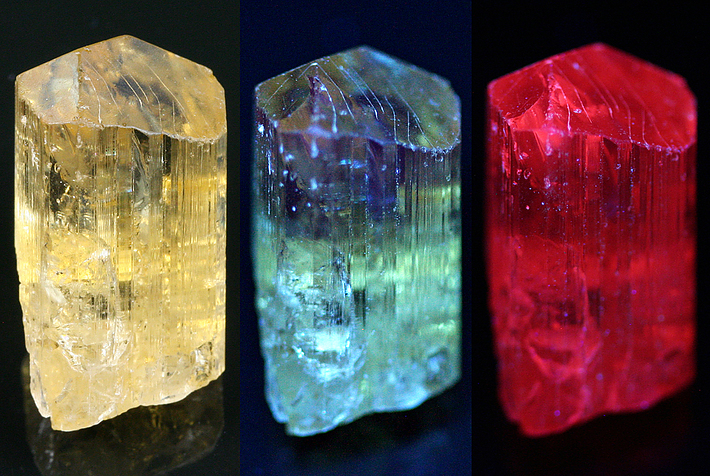
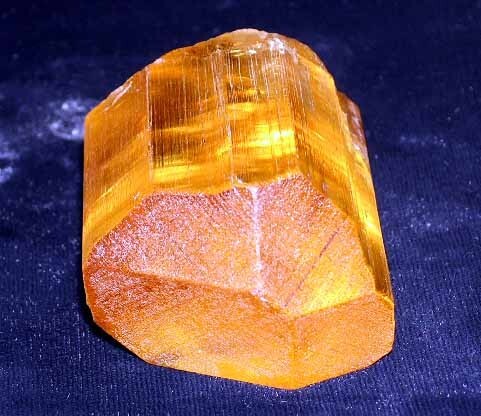
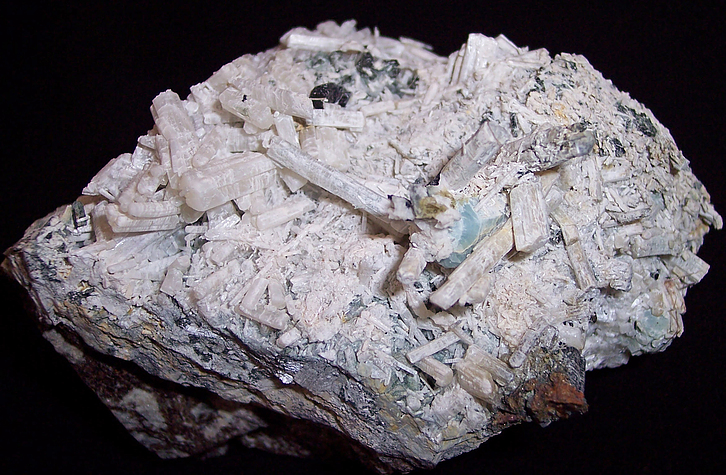
About Scapolite
Crystal System:
Tetragonal
Member of:
Name:
Named in 1800 by José Bonifácio de Andrada e Silva from the Greek ζκαποζ meaning "a shaft" in allusion to the long prismatic habit of the crystals.
This term generally refers to just the marialite-meionite series, not the full scapolite group, so excludes the sulphate-bearing group member silvialite. Used as a generic term when the exact chemical composition in the solid solution series has not been determined.
The meionite component increases with metamorphic grade, and typical samples of high-pressure scapolite are Ca-rich (Teertstra and Sherriff, 1996). Intermediate members with an Al/Si ratio of 1/2 are the lowest temperature form and appear in areas with argillaceous carbonates and evaporites which have been subjected to progressive metamorphism (Oterdoom and Wenk, 1983).
"Wernerite" is an intermediate member of the marialite-meionite series, which may be deserving of species status (see Dana, 8th Ed.).
May be altered into pinite.
 Visit gemdat.org for gemological information about Scapolite.
The meionite component increases with metamorphic grade, and typical samples of high-pressure scapolite are Ca-rich (Teertstra and Sherriff, 1996). Intermediate members with an Al/Si ratio of 1/2 are the lowest temperature form and appear in areas with argillaceous carbonates and evaporites which have been subjected to progressive metamorphism (Oterdoom and Wenk, 1983).
"Wernerite" is an intermediate member of the marialite-meionite series, which may be deserving of species status (see Dana, 8th Ed.).
May be altered into pinite.
Visit gemdat.org for gemological information about Scapolite.Unique Identifiers
Mindat ID:
8778
Long-form identifier:
mindat:1:1:8778:6
Mineral Symbols
As of 2021 there are now IMA–CNMNC approved mineral symbols (abbreviations) for each mineral species, useful for tables and diagrams.
Please only use the official IMA–CNMNC symbol. Older variants are listed for historical use only.
Please only use the official IMA–CNMNC symbol. Older variants are listed for historical use only.
| Symbol | Source | Reference for Standard |
|---|---|---|
| Scp | IMA–CNMNC | Warr, L.N. (2021). IMA–CNMNC approved mineral symbols. Mineralogical Magazine, 85(3), 291-320. doi:10.1180/mgm.2021.43 |
| Scp | Kretz (1983) | Kretz, R. (1983) Symbols of rock-forming minerals. American Mineralogist, 68, 277–279. |
| Scp | Siivolam & Schmid (2007) | Siivolam, J. and Schmid, R. (2007) Recommendations by the IUGS Subcommission on the Systematics of Metamorphic Rocks: List of mineral abbreviations. Web-version 01.02.07. IUGS Commission on the Systematics in Petrology. download |
| Scp | Whitney & Evans (2010) | Whitney, D.L. and Evans, B.W. (2010) Abbreviations for names of rock-forming minerals. American Mineralogist, 95, 185–187 doi:10.2138/am.2010.3371 |
| Scp | The Canadian Mineralogist (2019) | The Canadian Mineralogist (2019) The Canadian Mineralogist list of symbols for rock- and ore-forming minerals (December 30, 2019). download |
Pronunciation of Scapolite
Pronunciation:
| Play | Recorded by | Country |
|---|---|---|
| Jolyon Ralph | United Kingdom |
Crystallography of Scapolite
Crystal System:
Tetragonal
Crystallographic forms of Scapolite
Crystal Atlas:
Image Loading
Click on an icon to view

Scapolite no.30 - {100} - Goldschmidt (1913-1926)
Scapolite no.32 - {110} - Goldschmidt (1913-1926)
3d models and HTML5 code kindly provided by
www.smorf.nl.
Toggle
Edge Lines | Miller Indices | Axes
Transparency
Opaque | Translucent | Transparent
View
Along a-axis | Along b-axis | Along c-axis | Start rotation | Stop rotation
Edge Lines | Miller Indices | Axes
Transparency
Opaque | Translucent | Transparent
View
Along a-axis | Along b-axis | Along c-axis | Start rotation | Stop rotation
Geological Environment
Paragenetic Mode(s):
| Paragenetic Mode | Earliest Age (Ga) |
|---|---|
| Stage 2: Planetesimal differentiation and alteration | 4.566-4.550 |
| 6 : Secondary asteroid phases | 4.566-4.560 |
| Stage 3a: Earth’s earliest Hadean crust | >4.50 |
| 9 : Lava/xenolith minerals (hornfels, sanidinite facies) | |
| 10 : Basalt-hosted zeolite minerals | |
| Stage 3b: Earth’s earliest hydrosphere | >4.45 |
| 16 : Low-? aqueous alteration of Hadean subaerial lithologies (see also #23) | |
| Near-surface Processes | |
| 23 : Subaerial aqueous alteration by non-redox-sensitive fluids (see also #47) | |
| 25 : Evaporites (prebiotic) | |
| High-? alteration and/or metamorphism | |
| 31 : Thermally altered carbonate, phosphate, and iron formations | |
| Stage 4b: Highly evolved igneous rocks | >3.0 |
| 34 : Complex granite pegmatites | |
| Stage 5: Initiation of plate tectonics | <3.5-2.5 |
| 40 : Regional metamorphism (greenschist, amphibolite, granulite facies) |
Synonyms of Scapolite
Other Language Names for Scapolite
Varieties of Scapolite
| Nuttalite | "A variety of scapolite with a gray color (and possibly a tint of purple or blue) with slight chatoyancy." |
| Petschite | A trade name for purple scapolite from Tanzania. |
| Wernerite | Scapolite Group. Obsolete name for an intermediate member which covers the Meionite:Marialite range from Me:Ma 3:1 to 1:2. |
Relationship of Scapolite to other Species
Member of:
Other Members of Scapolite Group:
| Marialite | Na4Al3Si9O24Cl | Tet. 4/m : I4/m |
| Meionite | Ca4Al6Si6O24CO3 | Tet. 4/m : I4/m |
| Silvialite | (Ca,Na)4(Al6Si6O24)(SO4,CO3) | Tet. 4/m : I4/m |
Common Associates
Associations Based on Photo Data:
| 133 photos of Scapolite associated with Calcite | CaCO3 |
| 93 photos of Scapolite associated with Diopside | CaMgSi2O6 |
| 77 photos of Scapolite associated with Titanite | CaTiO(SiO4) |
| 54 photos of Scapolite associated with Quartz | SiO2 |
| 34 photos of Scapolite associated with Pyrite | FeS2 |
| 33 photos of Scapolite associated with Augite | (CaxMgyFez)(Mgy1Fez1)Si2O6 |
| 29 photos of Scapolite associated with Phlogopite | KMg3(AlSi3O10)(OH)2 |
| 26 photos of Scapolite associated with Johachidolite | CaAlB3O7 |
| 24 photos of Scapolite associated with 'Hackmanite' | Na8Al6Si6O24Cl2 |
| 24 photos of Scapolite associated with Feldspar Group |
Other Information
Health Risks:
No information on health risks for this material has been entered into the database. You should always treat mineral specimens with care.
Scapolite in petrology
An essential component of rock names highlighted in red, an accessory component in rock names highlighted in green.
Internet Links for Scapolite
mindat.org URL:
https://www.mindat.org/min-8778.html
Please feel free to link to this page.
Please feel free to link to this page.
Search Engines:
Mineral Dealers:
References for Scapolite
Reference List:
Ekström, Tom K. (1972) Coexisting scapolite and plagioclase from two iron formations in northern Sweden. Lithos, 5 (2) 175-185 doi:10.1016/0024-4937(72)90068-0
Ekström, Tom K. (1973) The distribution of calcium and sodium between co-existing scapolite and plagioclase. Geologiska Föreningen i Stockholm Förhandlingar, 95 (3) 349-351 doi:10.1080/11035897309454240
Levien, Louse, Papike, J. J. (1976) Scapolite crystal chemistry: aluminum-silicon distributions, carbonate group disorder, and thermal expansion. American Mineralogist, 61 (9-10) 864-877
Goldsmith, Julian R., Newton, Robert C. (1977) Scapolite-plagioclase stability relations at high pressures and temperatures in the system NaAlSi3O8-CaAl2Si2O8-CaCO3-CaSO4. American Mineralogist, 62 (11-12) 1063-1081
Dunn, Pete J., Nelen, Joseph E., Norbert, Julie (1978) On the Composition of Gem Scapolites. The Journal of Gemmology, 16 (1) 4-10 doi:10.15506/jog.1978.16.1.4
Oterdoom, W. Heiko, Wenk, Hans-Rudolf (1983) Ordering and composition of scapolite: Field observations and structural interpretations. Contributions to Mineralogy and Petrology, 83 (3) 330-341 doi:10.1007/bf00371201
Oliver, Nicholas H. S., Wall, Victor J., Cartwright, Ian (1992) Internal control of fluid compositions in amphibolite-facies scapolitic calc-silicates, Mary Kathleen, Australia. Contributions to Mineralogy and Petrology, 111 (1) 94-112 doi:10.1007/bf00296581
Teertstra, David K., Sherriff, Barbara L. (1996) Scapolite cell-parameter trends along the solid-solution series. American Mineralogist, 81 (1) 169-180 doi:10.2138/am-1996-1-221
Rebbert, Carolyn Rose; Rice, Jack M. (1997) Scapolite-plagioclase exchange: Cl-CO3 scapolite solution chemistry and implications for peristerite plagioclase. Geochimica et Cosmochimica Acta, 61 (3). p.555-567. doi:10.1016/s0016-7037(96)00362-6
Seto, Yusuke; Shimobayashi, Norimasa; Miyake, Akira; Kitamura, Masao (2004) Composition and I4/m-P42/n phase transition in scapolite solid solutions. American Mineralogist, 89 (2-3). 257-265 doi:10.2138/am-2004-2-301
Christy, A. G., Gatedal, K. (2005) Extremely Pb-rich rock-forming silicates including a beryllian scapolite and associated minerals in a skarn from Långban, Värmland, Sweden. Mineralogical Magazine, 69 (6) 995-1018 doi:10.1180/0026461056960304
Antao, S. M.; Hassan, I. (2008) Increase in Al-Si and Na-Ca disorder with temperature in scapolite Me32.9. The Canadian Mineralogist, 46 (6). 1577-1591 doi:10.3749/canmin.46.5.1577
Sokolova, E., Hawthorne, F. C. (2008) The Crystal Chemistry of the Scapolite-Group Minerals. i. Crystal Structure and Long-Range Order. The Canadian Mineralogist, 46 (6) 1527-1554 doi:10.3749/canmin.46.6.1527
Hawthorne, F. C., Sokolova, E. (2008) The Crystal Chemistry of the Scapolite-Group Minerals. Ii. the Origin of the I4/M P42/N Phase Transition and the Nonlinear Variations in Chemical Composition. The Canadian Mineralogist, 46 (6) 1555-1575 doi:10.3749/canmin.46.6.1555
(2011) The structures of marialite (Me6) and meionite (Me93) in space groups P42/n and I4/m, and the absence of phase transitions in the scapolite series. Powder Diffraction, 26 (2) 119-125 doi:10.1154/1.3582802
Antao, S. M., Hassan, I. (2011) Complete Al-Si order in scapolite Me37.5, ideally Ca3Na5[Al8Si16O48]Cl(CO3), and implications for antiphase domain boundaries (APBs) The Canadian Mineralogist, 49 (2) 581-586 doi:10.3749/canmin.49.2.581
Zeng, Li-Ping, Zhao, Xin-Fu, Hammerli, Johannes, Fan, Tian-Wei-Teng, Spandler, Carl (2020) Tracking fluid sources for skarn formation using scapolite geochemistry: an example from the Jinshandian iron skarn deposit, Eastern China. Mineralium Deposita, 55 (5). 1029-1046 doi:10.1007/s00126-019-00914-3
Colinet, Pauline; Byron, Hannah; Vuori, Sami; Lehtiö, Juha-Pekka; Laukkanen, Pekka; Van Goethem, Ludo; Lastusaari, Mika; Le Bahers, Tangui (2022) The structural origin of the efficient photochromism in natural minerals. Proceedings of the National Academy of Sciences, 119 (23). e2202487119 doi:10.1073/pnas.2202487119
Rao, Yinghua, Guo, Qingfeng, Zhang, Sixue, Liao, Libing (2023) Comparative Study on Gemmological Characteristics and Luminescence of Colorless and Yellow Scapolites. Crystals, 13 (3) 462 doi:10.3390/cryst13030462
Rao, Yinghua; Guo, Qingfeng; Zhang, Sixue; Liao, Libing (2023) Relationship between the Coloration Mechanism and Gemological Properties of Purple Scapolite. Crystals, 13 (8). 1207 doi:10.3390/cryst13081207
Kostov-Kytin, Vladislav; Kadiyski, Milen; Nikolova, Rositsa (2024) Further on the Choice of Space Group for Scapolite Group Members and Genetic Considerations about the Si-Al Ordering in Their Framework Construction. Minerals, 14 (6). 556 doi:10.3390/min14060556
Antao, Sytle M. (2024) Al-Si Order and Chemical Composition Model across Scapolite Solid Solutions with Evidence from Rietveld Structure Refinements. Minerals, 14 (8) doi:10.3390/min14080812
Lotti, Paolo, Gatta, G. Diego, Gigli, Lara, Krüger, Hannes, Kahlenberg, Volker, Meven, Martin, Comboni, Davide, Milani, Sula, Merlini, Marco, Liermann, Hanns-Peter (2024) Thermal and combined high-temperature and high-pressure behavior of a natural intermediate scapolite. American Mineralogist, 109 (2) 243-254 doi:10.2138/am-2023-8962
Localities for Scapolite
Showing 1,469 localities.
 symbol to view information about a locality.
The
symbol to view information about a locality.
The Locality List
 - This locality has map coordinates listed.
- This locality has estimated coordinates.
ⓘ - Click for references and further information on this occurrence.
? - Indicates mineral may be doubtful at this locality.
- This locality has map coordinates listed.
- This locality has estimated coordinates.
ⓘ - Click for references and further information on this occurrence.
? - Indicates mineral may be doubtful at this locality.
 - Good crystals or important locality for species.
 - World class for species or very significant.
(TL) - Type Locality for a valid mineral species.
(FRL) - First Recorded Locality for everything else (eg varieties).
- World class for species or very significant.
(TL) - Type Locality for a valid mineral species.
(FRL) - First Recorded Locality for everything else (eg varieties).
All localities listed without proper references should be considered as questionable.

Marble occurrence, Morogoro Rural District, Morogoro Region, Tanzania