
Sapphire
A variety of Corundum
This page is currently not sponsored. Click here to sponsor this page.


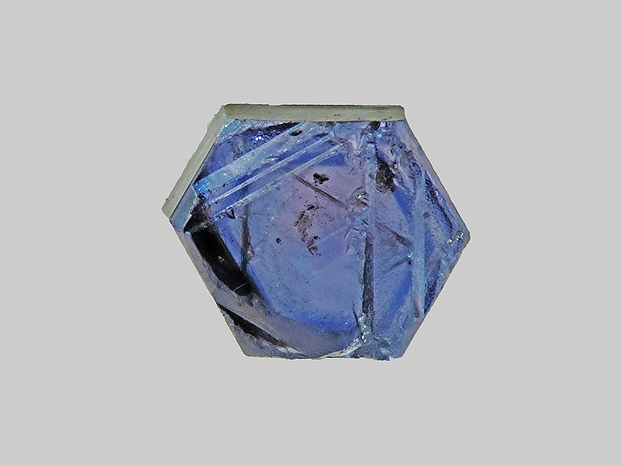

About Sapphire
Formula:
Al2O3
Colour:
blue, yellow, green, brown, pink, purple
Name:
According to Wikipedia: "Etymologically, the English word "sapphire" derives from French saphir, from Latin sapphirus, sappirus from Greek σαπφειρος (sappheiros) from Hebrew סַפִּיר (sapir), a term that probably originally referred to lapis lazuli, as sapphires were only discovered in Roman times. The term is believed to derive from the root סָפַר (sāp̄ar), meaning "to score with a mark," presumably because gemstones can be used to scratch stone surfaces due to their high hardness".
Most commonly refers to a blue gem variety of corundum, but other coloured varieties of corundum are also described as sapphire, except red corundum, which is better known as ruby.
The dehydration of diaspore in corundum occurs between 525 and 550 °C, whereas goethite transforms to hematite between 300 and 325 °C. As both diaspore and goethite may be present as inclusions in rubies, sapphires, and other corundum varieties (e.g., pink sapphires, padparadscha), these dehydration reactions and phase transformations can be considered important criteria to separate unheated from heated stones, specifically in cases in which other methods (e.g., microscopy, FTIR) are unsuccessful.
 Visit gemdat.org for gemological information about Sapphire.
The dehydration of diaspore in corundum occurs between 525 and 550 °C, whereas goethite transforms to hematite between 300 and 325 °C. As both diaspore and goethite may be present as inclusions in rubies, sapphires, and other corundum varieties (e.g., pink sapphires, padparadscha), these dehydration reactions and phase transformations can be considered important criteria to separate unheated from heated stones, specifically in cases in which other methods (e.g., microscopy, FTIR) are unsuccessful.
Visit gemdat.org for gemological information about Sapphire.Unique Identifiers
Mindat ID:
3529 (as Sapphire)
1136 (as Corundum)
1136 (as Corundum)
Long-form identifier:
mindat:1:1:3529:9 (as Sapphire)
mindat:1:1:1136:1 (as Corundum)
mindat:1:1:1136:1 (as Corundum)
Similar Names
Pronunciation of Sapphire
Pronunciation:
| Play | Recorded by | Country |
|---|---|---|
| Jolyon Ralph | United Kingdom |
Physical Properties of Sapphire
Transparency:
Transparent
Colour:
Blue, yellow, green, brown, pink, purple
Comment:
The color of sapphire is highly varied. The color origin analysis reveals that the absorption peaks of the ultraviolet spec trum caused by Cr3+ in the yellow-green and blue-purple regions account for the pink color of the Vietnamese and Madagascan samples. The lower UV wavelength position of the two main peaks in the Madagascan samples, as compared to the Vietnamese ones, indicates that Fe3+ d–d transitions, as well as transitions between Fe2+—Ti4+ and Fe3+—Ti3+ ions, enhance blue light transmission and cause the samples to tend towards a purple hue. Compared with the pink-red corundum of the same marble type (Myanmar and Yunnan, China), the Vietnamese samples have lower V, Mg, and Ga contents and a higher Fe content. Compared with the pink-red corundum of the high-iron type (Thailand, Cambodia, and Tanzania), the Madagascan samples have lower Fe and higher Ga contents overall.
It can be concluded that the blue color mechanism in sapphires before and after heating under different atmospheric environments can be explained by an energy-band model involving the presence or absence of Fe3+-Ti4+ mixed acceptor states, as well as a hole color center within the energy band gap. Furthermore, after heating at 1300 °C and 1500 °C in a reducing environment, the oxidation state of Fe gradually decreases from 3+ to 2+. The samples turn black upon heating to 1500 °C, indicating that Fe2+-Ti4+ is responsible for the black color rather than the blue observed in sapphires.
It can be concluded that the blue color mechanism in sapphires before and after heating under different atmospheric environments can be explained by an energy-band model involving the presence or absence of Fe3+-Ti4+ mixed acceptor states, as well as a hole color center within the energy band gap. Furthermore, after heating at 1300 °C and 1500 °C in a reducing environment, the oxidation state of Fe gradually decreases from 3+ to 2+. The samples turn black upon heating to 1500 °C, indicating that Fe2+-Ti4+ is responsible for the black color rather than the blue observed in sapphires.
Chemistry of Sapphire
Mindat Formula:
Al2O3
Elements listed:
Geological Environment
Geological Setting:
basaltic or metamorphic localities and alluvials derived from them.
Synonyms of Sapphire
Other Language Names for Sapphire
Arabic:Jacut
Basque:Zafiro
Bulgarian:Сапфир
Czech:Safír
Danish:Safir
Dutch:Saffier
Esperanto:Safiro
Estonian:Safiir
Finnish:Safiiri
French:Saphir
Greek:Ζαφείρι
Hebrew:ספיר
Hindi:नीलम
Indonesian:Safir
Italian:Zaffiro
Japanese:サファイア
Latin:Sapphirus
Carbunculus (in part)
Carbunculus (in part)
Latvian:Safīrs
Lithuanian:Safyras
Norwegian:Safir
Polish:Szafir
Portuguese:Safira
Romanian:Safir
Russian:Сапфир
Simplified Chinese:蓝宝石
Slovak:Zafír
Slovenian:Safir
Swedish:Safir
Telugu:నీలమణి
Turkish:Safir
Ukrainian:Сапфір
Vietnamese:Xa-phia
Varieties of Sapphire
| "Kashmir" Sapphire | "Kashmir" sapphire is a trade term for the sapphire of violetish blue to pure blue hue with strong to vivid saturation and medium-dark tone. The stones have a velvety lustre due to minute inclusions. The colour is also known as "cornflower blue". "Kashmir... |
| Asteriated Sapphire | A variety of Sapphire exhibiting the property of asterism. |
| Cat Sapphire | Oriental sapphires of some value but not of the characteristic colour. |
| Padparadscha | A salmon-pink coloured gem sapphire. It is GIA's opinion that this color range should be limited to light to medium tones of pinkish orange to orange-pink hues. Lacking delicacy, the dark brownish orange or even medium brownish orange tones of corundum f... |
| Star Sapphire | A variety of sapphire that exhibits a star pattern when viewed down the c axis. The chatoyance is due to oriented microscopic inclusions (nanorods) of diaspore (Nadin, 2007). The Star of India is the largest star sapphire in the world (563 carats or 113 ... |
Common Associates
Associations Based on Photo Data:
| 36 photos of Sapphire associated with Corundum | Al2O3 |
| 32 photos of Sapphire associated with 'Ruby' | Al2O3 |
| 17 photos of Sapphire associated with Biotite | K(Fe2+/Mg)2(Al/Fe3+/Mg/Ti)([Si/Al/Fe]2Si2O10)(OH/F)2 |
| 16 photos of Sapphire associated with Muscovite | KAl2(AlSi3O10)(OH)2 |
| 14 photos of Sapphire associated with Phlogopite | KMg3(AlSi3O10)(OH)2 |
| 11 photos of Sapphire associated with Zircon | Zr(SiO4) |
| 11 photos of Sapphire associated with Mica Group | |
| 10 photos of Sapphire associated with Calcite | CaCO3 |
| 10 photos of Sapphire associated with Dravite | NaMg3Al6(Si6O18)(BO3)3(OH)3(OH) |
| 9 photos of Sapphire associated with Quartz | SiO2 |
Other Information
Health Risks:
No information on health risks for this material has been entered into the database. You should always treat mineral specimens with care.
Industrial Uses:
gemstones
Internet Links for Sapphire
mindat.org URL:
https://www.mindat.org/min-3529.html
Please feel free to link to this page.
Please feel free to link to this page.
Search Engines:
Mineral Dealers:
References for Sapphire
Reference List:
WIEDERHORN, S. M. (1969) Fracture of Sapphire. Journal of the American Ceramic Society, 52 (9). 485-491 doi:10.1111/j.1151-2916.1969.tb09199.x
Giuliani, Gaston, Fallick, Anthony E., Garnier, Virginie, France-Lanord, Christian, Ohnenstetter, Daniel, Schwarz, Dietmar (2005) Oxygen isotope composition as a tracer for the origins of rubies and sapphires. Geology, 33 (4) 249 doi:10.1130/g21261.1
Palke, Aaron C.; Saeseaw, Sudarat; Renfro, Nathan D.; Sun, Ziyin; McClure, Shane F. (2019) Geographic Origin Determination of Blue Sapphire. Gems & Gemology, 55 (4). 536-579 doi:10.5741/gems.55.4.536
Huang, Shizhan, Lin, Jiaming, Wang, Ningchang, Guo, Bicheng, Jiang, Feng, Wen, Qiuling, Lu, Xizhao (2021) Fracture Behavior of Single-Crystal Sapphire in Different Crystal Orientations. Crystals, 11 (8) 930pp. doi:10.3390/cryst11080930
Wang, Guang-Ya, Yu, Xiao-Yan, Liu, Fei (2022) Genesis of Color Zonation and Chemical Composition of Penglai Sapphire in Hainan Province, China. Minerals, 12 (7) 832 doi:10.3390/min12070832
Yang, Yunqi, Wang, Chaowen, Wang, Chengsi, Shen, Xibing, Yin, Ke, Chen, Tao, Shen, Andy Hsitien, Algeo, Thomas J., Hong, Hanlie (2023) The Covariation of Color and Orange Fluorescence Instabilities in Yellow Sapphires. Minerals, 13 (5) 663 doi:10.3390/min13050663
[1]Krzemnicki, Michael S., Lefèvre, Pierre, Zhou, Wei, Braun, Judith, Spiekermann, Georg (2023) Dehydration of Diaspore and Goethite during Low-Temperature Heating as Criterion to Separate Unheated from Heated Rubies and Sapphires. Minerals, 13 (12) doi:10.3390/min13121557
[2]Amphon, Ratthaphon, Chankhantha, Chawalit, Srimuang, Chanisara, Vongsetskul, Suchinda, Intarasiri, Saweat, Shen, Andy H. (2024) Changes in Blue Color of Sapphire Compared with Oxidation State Changes. Minerals, 14 (4) doi:10.3390/min14040333
Eßl, Werner, Reiss, Georg, Trasca, Raluca Andreea, Sistaninia, Masoud, Raninger, Peter, Lohrasbi, Sina (2024) The Melt–Crystal Interface in the Production of Monocrystalline Sapphire via Heat Exchanger Method—Numerical Simulation Aspects. Crystals, 14 (12). doi:10.3390/cryst14121036
[3]Guo, Qiurong, Li, Pengyu, Wang, Mingying, Zhao, Siyi, Yang, Sichun, Shi, Guanghai (2025) Color Mechanism Analysis and Origin Comparison of Pink-Purple Sapphires from Vietnam and Madagascar. Crystals, 15 (3). doi:10.3390/cryst15030229
Localities for Sapphire
Showing 777 localities.
 symbol to view information about a locality.
The
symbol to view information about a locality.
The Locality List
 - This locality has map coordinates listed.
- This locality has estimated coordinates.
ⓘ - Click for references and further information on this occurrence.
? - Indicates mineral may be doubtful at this locality.
- This locality has map coordinates listed.
- This locality has estimated coordinates.
ⓘ - Click for references and further information on this occurrence.
? - Indicates mineral may be doubtful at this locality.
 - Good crystals or important locality for species.
 - World class for species or very significant.
(TL) - Type Locality for a valid mineral species.
(FRL) - First Recorded Locality for everything else (eg varieties).
- World class for species or very significant.
(TL) - Type Locality for a valid mineral species.
(FRL) - First Recorded Locality for everything else (eg varieties).
All localities listed without proper references should be considered as questionable.

Ratnapura, Ratnapura District, Sabaragamuwa Province, Sri Lanka