
Graftonite
A valid IMA mineral species - grandfathered
This page is currently not sponsored. Click here to sponsor this page.


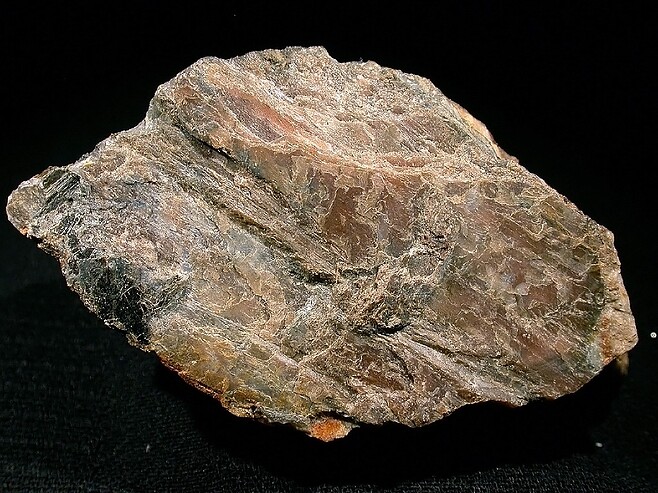

About Graftonite

Grafton, New Hampshire, USA
Formula:
Fe2+Fe2+2(PO4)2
Colour:
Usually reddish brown, occasionally light brown, rarely salmon-pink; nearly colorless in transmitted light.
Lustre:
Sub-Vitreous, Resinous, Greasy
Hardness:
5
Specific Gravity:
3.67 - 3.79
Crystal System:
Monoclinic
Member of:
Name:
Named by Samuel L. Penfield in 1900 for the town of Grafton, Grafton County, New Hampshire, USA, about 8 km east of the type locality on Melvin Mountain.
Beusite-Graftonite Series.
A primary phosphate mineral found in complex granitic pegmatites.
Chemically related to sarcopside.
Tait et al. (2013) observed that Ca may be dominant at M(1) in graftonite-like compositions and suggested a possible new member; this was later confirmed and the species named graftonite-(Ca) (IMA CNMMN 2017 redefinition).
A primary phosphate mineral found in complex granitic pegmatites.
Chemically related to sarcopside.
Tait et al. (2013) observed that Ca may be dominant at M(1) in graftonite-like compositions and suggested a possible new member; this was later confirmed and the species named graftonite-(Ca) (IMA CNMMN 2017 redefinition).
Unique Identifiers
Mindat ID:
1735
Long-form identifier:
mindat:1:1:1735:6
Similar Names
| Graftonite-(Ca) | A valid IMA mineral species | CaFe22+(PO4)2 |
| Graftonite-(Mn) | A valid IMA mineral species | MnFe22+(PO4)2 |
| Gratonite | A valid IMA mineral species - grandfathered | Pb9As4S15 |
IMA Classification of Graftonite
Approved, 'Grandfathered' (first described prior to 1959)
IMA status notes:
Redefined by the IMA
First published:
1900
Approval history:
Redefined by IMA in February 2017 as Fe2+Fe2+2(PO4)2.
Classification of Graftonite
8.AB.20
8 : PHOSPHATES, ARSENATES, VANADATES
A : Phosphates, etc. without additional anions, without H2O
B : With medium-sized cations
8 : PHOSPHATES, ARSENATES, VANADATES
A : Phosphates, etc. without additional anions, without H2O
B : With medium-sized cations
38.3.3.1
38 : ANHYDROUS NORMAL PHOSPHATES, ARSENATES, AND VANADATES
3 : (AB)3(XO4)2
38 : ANHYDROUS NORMAL PHOSPHATES, ARSENATES, AND VANADATES
3 : (AB)3(XO4)2
19.12.36
19 : Phosphates
12 : Phosphates of Mn
19 : Phosphates
12 : Phosphates of Mn
Mineral Symbols
As of 2021 there are now IMA–CNMNC approved mineral symbols (abbreviations) for each mineral species, useful for tables and diagrams.
Please only use the official IMA–CNMNC symbol. Older variants are listed for historical use only.
Please only use the official IMA–CNMNC symbol. Older variants are listed for historical use only.
| Symbol | Source | Reference for Standard |
|---|---|---|
| Gft | IMA–CNMNC | Warr, L.N. (2021). IMA–CNMNC approved mineral symbols. Mineralogical Magazine, 85(3), 291-320. doi:10.1180/mgm.2021.43 |
| Gft | The Canadian Mineralogist (2019) | The Canadian Mineralogist (2019) The Canadian Mineralogist list of symbols for rock- and ore-forming minerals (December 30, 2019). download |
Physical Properties of Graftonite
Sub-Vitreous, Resinous, Greasy
Transparency:
Translucent
Colour:
Usually reddish brown, occasionally light brown, rarely salmon-pink; nearly colorless in transmitted light.
Comment:
May be dark brown due to alteration.
Streak:
White to faintly pink, when unaltered.
Hardness:
5 on Mohs scale
Tenacity:
Brittle
Cleavage:
Distinct/Good
On {010}, good; on {100}, poor, but not eaily observed.
On {010}, good; on {100}, poor, but not eaily observed.
Fracture:
Irregular/Uneven, Sub-Conchoidal
Density:
3.67 - 3.79 g/cm3 (Measured) 3.95 g/cm3 (Calculated)
Comment:
Measured values vary with the ratio of Fe:Mn:Ca. 3.775 = measured (from Nickel Plate Mine, SD, USA).
Optical Data of Graftonite
Type:
Biaxial (+)
RI values:
nα = 1.695 - 1.709 nβ = 1.699 - 1.714 nγ = 1.719 - 1.736
2V:
Measured: 20° to 60°, Calculated: 56°
Birefringence:
0.026
Max. Birefringence:
δ = 0.024 - 0.027
Based on recorded range of RI values above.
Based on recorded range of RI values above.
Interference Colours:
The colours simulate birefringence patterns seen in thin section under crossed polars. They do not take into account mineral colouration or opacity.
Michel-Levy Bar The default colours simulate the birefringence range for a 30 µm thin-section thickness. Adjust the slider to simulate a different thickness.
Grain Simulation You can rotate the grain simulation to show how this range might look as you rotated a sample under crossed polars. Each grain retains its interference colour (retardation) while its brightness falls to black at extinction and reaches a maximum between extinction positions.
The colours simulate birefringence patterns seen in thin section under crossed polars. They do not take into account mineral colouration or opacity.
Michel-Levy Bar The default colours simulate the birefringence range for a 30 µm thin-section thickness. Adjust the slider to simulate a different thickness.
Grain Simulation You can rotate the grain simulation to show how this range might look as you rotated a sample under crossed polars. Each grain retains its interference colour (retardation) while its brightness falls to black at extinction and reaches a maximum between extinction positions.
Surface Relief:
Moderate
Dispersion:
relatively weak to r>>v
Optical Extinction:
X = b, Z ∧ c = 36°.
Pleochroism:
Weak
Comments:
X = Colourless
Y = Colourless
Z = Pink
Y = Colourless
Z = Pink
Chemistry of Graftonite
Mindat Formula:
Fe2+Fe2+2(PO4)2
Element Weights:
Elements listed:
Crystallography of Graftonite
Crystal System:
Monoclinic
Class (H-M):
2/m - Prismatic
Space Group:
P21/b
Cell Parameters:
a = 8.87 Å, b = 11.57 Å, c = 6.17 Å
β = 99.2°
β = 99.2°
Ratio:
a:b:c = 0.767 : 1 : 0.533
Unit Cell V:
625.06 ų (Calculated from Unit Cell)
Z:
4
Morphology:
Generally found as parallel lamellae in triphylite or occasionally with other primary phosphates in granite pegmatite. Morphological "crystals" are essentially unknown. Pseudomorphs of heterosite after graftonite "crystals" are stout prismatic; also occurs as rough composite crystals of graftonite in triphylite.
Comment:
American Mineralogist 67:826 (1982) structure; Neutron diffraction indicates three distinct cation sites
Crystal Structure
Load
Unit Cell | Unit Cell Packed
2x2x2 | 3x3x3 | 4x4x4
Unit Cell | Unit Cell Packed
2x2x2 | 3x3x3 | 4x4x4
Show
Big Balls | Small Balls | Just Balls | Spacefill
Polyhedra Off | Si Polyhedra | All Polyhedra
Remove metal-metal sticks
Big Balls | Small Balls | Just Balls | Spacefill
Polyhedra Off | Si Polyhedra | All Polyhedra
Remove metal-metal sticks
Display Options
Black Background | White Background
Perspective On | Perspective Off
2D | Stereo | Red-Blue | Red-Cyan
Black Background | White Background
Perspective On | Perspective Off
2D | Stereo | Red-Blue | Red-Cyan
View
CIF File Best | x | y | z | a | b | c
CIF File Best | x | y | z | a | b | c
Rotation
Stop | Start
Stop | Start
Labels
Console Off | On | Grey | Yellow
Console Off | On | Grey | Yellow
Data courtesy of the American Mineralogist Crystal Structure Database. Click on an AMCSD ID to view structure
| ID | Species | Reference | Link | Year | Locality | Pressure (GPa) | Temp (K) |
|---|---|---|---|---|---|---|---|
| 0020205 | Graftonite | Tait K T, Hawthorne F C, Wise M A (2013) The crystal chemistry of the graftonite-beusite minerals Notes: Sample B7 The Canadian Mineralogist 51 653-662 | 2013 | East Alstead, New Hampshire, USA | 0 | 293 | |
| 0020204 | Graftonite | Tait K T, Hawthorne F C, Wise M A (2013) The crystal chemistry of the graftonite-beusite minerals Notes: Sample B6 The Canadian Mineralogist 51 653-662 | 2013 | Mwami district, Hurungwe, Zimbabwe | 0 | 293 | |
| 0020203 | Graftonite | Tait K T, Hawthorne F C, Wise M A (2013) The crystal chemistry of the graftonite-beusite minerals Notes: Sample B5 The Canadian Mineralogist 51 653-662 | 2013 | Palermo mine, Grafton Co., New Hampshire, USA | 0 | 293 | |
| 0020199 | Graftonite | Tait K T, Hawthorne F C, Wise M A (2013) The crystal chemistry of the graftonite-beusite minerals Notes: Sample B1 The Canadian Mineralogist 51 653-662 | 2013 | Lollington beryl mine, Karoi, Hurungwe, Zimbabwe | 0 | 293 | |
| 0000872 | Graftonite | Nord A G, Ericsson T (1982) The cation distribution in synthetic (Fe,Mn)3(PO4)2 graftonite-type solid solutions American Mineralogist 67 826-832 |  | 1982 | 0 | 293 | |
| 0000170 | Graftonite | Calvo C (1968) The crystal structure of graftonite American Mineralogist 53 742-750 | | 1968 | 0 | 293 |
CIF Raw Data - click here to close
Epitaxial Relationships of Graftonite
Epitaxial Minerals:
| 'Triphylite' | LiFe2+PO4 |
Epitaxy Comments:
As coarsely laminated intergrowths with Triphylite, both phases mutually oriented with graftonite {010} [100] parallel to triphylite {102} [010].
X-Ray Powder Diffraction
Powder Diffraction Data:
| d-spacing | Intensity |
|---|---|
| 3.42 Å | (100) |
| 3.02 Å | (50) |
| 2.92 Å | (50) |
| 2.91 Å | (40) |
| 2.84 Å | (80) |
| 2.83 Å | (70) |
| 2.79 Å | (30) |
| 2.73 Å | (60) |
Comments:
ICDD 27-250
Geological Environment
Paragenetic Mode(s):
| Paragenetic Mode | Earliest Age (Ga) |
|---|---|
| Stage 2: Planetesimal differentiation and alteration | 4.566-4.550 |
| 5 : Primary asteroid phases | 4.566–4.560 |
| Stage 4b: Highly evolved igneous rocks | >3.0 |
| 34 : Complex granite pegmatites | |
| Stage 10a: Neoproterozoic oxygenation/terrestrial biosphere | <0.6 |
| 50 : Coal and/or oil shale minerals | <0.36 |
| Stage 10b: Anthropogenic minerals | <10 Ka |
| 54 : Coal and other mine fire minerals (see also #51 and #56) |
Geological Setting:
Complex granitic pegmatites.
Type Occurrence of Graftonite
General Appearance of Type Material:
Crystals and fragments, displaying a weathered appearance and consisting of alternating layers of dark and light material - the light material being graftonite and the dark being triphylite.
Place of Conservation of Type Material:
Yale University, New Haven, Connecticut, USA, number 3.2345.
National Museum of Natural History, Washington, D.C., USA, numbers C4037, R5183.
National Museum of Natural History, Washington, D.C., USA, numbers C4037, R5183.
Geological Setting of Type Material:
Complex granite pegmatite.
Associated Minerals at Type Locality:
Synonyms of Graftonite
Other Language Names for Graftonite
Varieties of Graftonite
| Calcium-bearing Graftonite | Associated with maneckiite in a pegmatite. |
Relationship of Graftonite to other Species
Member of:
Other Members of Graftonite Group:
| Beusite | Mn2+Mn2+2 (PO4)2 | Mon. 2/m : P21/b |
| Beusite-(Ca) | CaMn2+2(PO4)2 | Mon. 2/m : P21/b |
| Graftonite-(Ca) | CaFe2+2(PO4)2 | Mon. 2/m : P21/b |
| Graftonite-(Mn) | MnFe2+2(PO4)2 | Mon. 2/m : P21/b |
Forms a series with:
Common Associates
Associations Based on Photo Data:
| 24 photos of Graftonite associated with Triphylite | LiFe2+PO4 |
| 11 photos of Graftonite associated with Sarcopside | Fe2+3(PO4)2 |
| 4 photos of Graftonite associated with Quartz | SiO2 |
| 4 photos of Graftonite associated with Vivianite | Fe2+Fe2+2(PO4)2 · 8H2O |
| 3 photos of Graftonite associated with Muscovite | KAl2(AlSi3O10)(OH)2 |
| 3 photos of Graftonite associated with Alluaudite Group | |
| 2 photos of Graftonite associated with Karenwebberite | NaFe2+PO4 |
| 2 photos of Graftonite associated with Arsenopyrite | FeAsS |
| 2 photos of Graftonite associated with Albite | Na(AlSi3O8) |
| 2 photos of Graftonite associated with Mitridatite | Ca2Fe3+3(PO4)3O2 · 3H2O |
Related Minerals - Strunz-mindat Grouping
| 8.AB. | Kryzaite | Na4(MgCr)(PO4)3 |
| 8.AB. | Niasite | Ni2+4.5(AsO4)3 |
| 8.AB. | Johanngeorgenstadtite | Ni2+4.5(AsO4)3 |
| 8.AB. | Rodolicoite | Fe3+PO4 |
| 8.AB. | Karwowskiite | Ca9Mg(Fe2+0.5◻0.5)(PO4)7 |
| 8.AB. | Olsenite | KFe4(PO4)3 |
| 8.AB. | Borisenkoite | Cu3[(V,As)O4]2 |
| 8.AB.05 | Farringtonite | Mg3(PO4)2 |
| 8.AB.10 | Natrophilite | NaMn2+PO4 |
| 8.AB.10 | 'Sicklerite' | Li1-x(Mn3+xMn2+1-x)PO4 |
| 8.AB.10 | Simferite | LiMg(PO4) |
| 8.AB.10 | Heterosite | Fe3+(PO4) |
| 8.AB.10 | Lithiophilite | LiMn2+PO4 |
| 8.AB.10 | Karenwebberite | NaFe2+PO4 |
| 8.AB.10 | Triphylite | LiFe2+PO4 |
| 8.AB.10 | 'Ferrisicklerite' | Li1-x(Fe3+xFe2+1-x)PO4 |
| 8.AB.10 | Purpurite | Mn3+(PO4) |
| 8.AB.15 | Zavalíaite | Mn2+3(PO4)2 |
| 8.AB.15 | Chopinite | Mg3(PO4)2 |
| 8.AB.15 | Sarcopside | Fe2+3(PO4)2 |
| 8.AB.20 | Beusite | Mn2+Mn2+2 (PO4)2 |
| 8.AB.20 | Graftonite-(Ca) | CaFe2+2(PO4)2 |
| 8.AB.20 | Graftonite-(Mn) | MnFe2+2(PO4)2 |
| 8.AB.20 | Beusite-(Ca) | CaMn2+2(PO4)2 |
| 8.AB.25 | Xanthiosite | Ni3(AsO4)2 |
| 8.AB.30 | Lammerite | Cu3(AsO4)2 |
| 8.AB.30 | Paralammerite | Cu3(AsO4)2 |
| 8.AB.35 | Mcbirneyite | Cu3(VO4)2 |
| 8.AB.35 | Pseudolyonsite | Cu3(VO4)2 |
| 8.AB.35 | Stranskiite | Zn2Cu(AsO4)2 |
| 8.AB.40 | Michalskiite | Fe3+1.33Cu2+2(MgFe3+)2(VO4)6 |
| 8.AB.40 | Lyonsite | Cu3Fe4(VO4)6 |
Fluorescence of Graftonite
Not fluorescent.
Other Information
Notes:
Readily soluble in acids.
In a closed tube, only traces of water is given off; at full red heat the material shows signs of fusion.
With a blowpipe, it darkens and fuses at about 2 to a globule which is slightly magnetic. Continued heating on charcoal yields a more magnetic globule. Fusion colors the flame a pale bluish-green indicating phosphate.
In a closed tube, only traces of water is given off; at full red heat the material shows signs of fusion.
With a blowpipe, it darkens and fuses at about 2 to a globule which is slightly magnetic. Continued heating on charcoal yields a more magnetic globule. Fusion colors the flame a pale bluish-green indicating phosphate.
Health Risks:
No information on health risks for this material has been entered into the database. You should always treat mineral specimens with care.
Internet Links for Graftonite
mindat.org URL:
https://www.mindat.org/min-1735.html
Please feel free to link to this page.
Please feel free to link to this page.
Search Engines:
External Links:
Mineral Dealers:
References for Graftonite
Reference List:
Larsen, Esper S. (1921) The microscopic determination of the nonopaque minerals. Bulletin 679. US Geological Survey doi:10.3133/b679 p.81
Berman, Harry (1927) Graftonite from a new locality in New Hampshire. American Mineralogist, 12 (4) 170-172
Glass, Jewell J., Fahey, Joseph J. (1937) Graftonite from Greenwood, Maine. American Mineralogist, 22 (10) 1035-1039
Switzer, George (1938) The paragenesis of the Center Strafford, New Hampshire, pegmatite. American Mineralogist, 23 (11) 811-820 p.814
Frondel, Clifford (1941) Whitlockite: a new calcium phosphate, Ca3(PO4)2. American Mineralogist, 26 (3) 145-152
Lindberg, Marie Louise (1950) Arrojadite, hühnerkobelite, and graftonite. American Mineralogist, 35 (1-2) 59-76
Hurlbut, C. S., Aristarain, and L. F. (1968) Beusite, a new mineral from Argentina, and the graftonite-beusite series. American Mineralogist, 53 (11-12) 1799-1814
Mattievich, E., Danon, J. (1977) Hydrothermal synthesis and Mössbauer studies of ferrous phosphates of the homologous series Fe32+(PO4)2(H2O)n. Journal of Inorganic and Nuclear Chemistry, 39 (4) 569-580 doi:10.1016/0022-1902(77)80567-8
Fransolet, André-Mathieu (1977) Intercroissances et inclusions dans les associations graftonite-sarcopside-triphylite. Bulletin de Minéralogie, 100 (3). 198-207 doi:10.3406/bulmi.1977.7137
Nord, A. G., Ericsson, T. (1982) The cation distribution in (Fe,Mn)3(PO4)2 graftonite-type solid solutions. American Mineralogist, 67 (7-8) 826-832
Łodziński, M., Sitarz, M. (2009) Chemical and spectroscopic characterization of some phosphate accessory minerals from pegmatites of the Sowie Góry Mts, SW Poland. Journal of Molecular Structure, 924-926. 442-447 doi:10.1016/j.molstruc.2008.11.019
Tait, Kimberly T., Hawthorne, Frank C., Wise, Michael A. (2013) The crystal chemistry of the graftonite-beusite minerals. The Canadian Mineralogist, 51 (4) 653-662 doi:10.3749/canmin.51.4.653
Dyar, M. D., Jawin, E. R., Breves, E., Marchand, G., Nelms, M., Lane, M. D., Mertzman, S. A., Bish, D. L., Bishop, J. L. (2014) Mössbauer parameters of iron in phosphate minerals: Implications for interpretation of martian data. American Mineralogist, 99 (5) 914-942 doi:10.2138/am.2014.4701
Roda-Robles, Encarnación, Pesquera, Alfonso, García De Madinabeitia, Sonia, Gil Ibarguchi, José-Ignacio, Nizamoff, Jim, Simmons, William, Falster, Alexander, Galliski, Miguel Angel (2014) On the geochemical character of primary Fe-Mn phosphates belonging to the triphylite-lithiophilite, graftonite-beusite, and triplite-zwieselite series: first results and implications for pegmatite petrogenesis. The Canadian Mineralogist, 52 (2). 321-335 doi:10.3749/canmin.52.2.321
Hålenius, U., Hatert, F., Pasero, M., Mills, S. J. (2017) New minerals and nomenclature modifications approved in 2017. CNMNC Newsletter No 36. Mineralogical Magazine, 81 (2) 403-409 doi:10.1180/minmag.2017.081.022
Localities for Graftonite
Showing 140 localities.
 symbol to view information about a locality.
The
symbol to view information about a locality.
The Locality List
 - This locality has map coordinates listed.
- This locality has estimated coordinates.
ⓘ - Click for references and further information on this occurrence.
? - Indicates mineral may be doubtful at this locality.
- This locality has map coordinates listed.
- This locality has estimated coordinates.
ⓘ - Click for references and further information on this occurrence.
? - Indicates mineral may be doubtful at this locality.
 - Good crystals or important locality for species.
 - World class for species or very significant.
(TL) - Type Locality for a valid mineral species.
(FRL) - First Recorded Locality for everything else (eg varieties).
- World class for species or very significant.
(TL) - Type Locality for a valid mineral species.
(FRL) - First Recorded Locality for everything else (eg varieties).
All localities listed without proper references should be considered as questionable.
Quick NavTopAbout GraftoniteUnique IdentifiersSimilar NamesIMA Classification Classification Mineral SymbolsPhysical Properties Optical Data Chemistry Crystallography Crystal StructureEpitaxial Relationships X-Ray Powder DiffractionGeological EnvironmentType Occurrence SynonymsOther LanguagesVarietiesRelationshipsCommon AssociatesStrunz-MindatFluorescence Other InformationInternet Links References Localities Locality List

Parker Mountain Mine, Strafford, Strafford County, New Hampshire, USA