
Native Titanium
A valid IMA mineral species
This page is currently not sponsored. Click here to sponsor this page.



About Native Titanium
Formula:
Ti
Colour:
Silver-grey
Lustre:
Metallic
Hardness:
4
Specific Gravity:
4.503 (Calculated)
Crystal System:
Hexagonal
Name:
Titanium, the metallic element, was named in 1795 by Prussian Chemist Klaproth after the Titans of Greek mythology, having investigated titanium oxide from rutile.
As is the habit with most native elements, the mineral name is shared with the element.
As is the habit with most native elements, the mineral name is shared with the element.
Type Locality:
Dimorph of:
Two forms of native titanium have been found - one, found in granite, crystallizes in the hexagonal system, the other as minute inclusions in garnet from an ultrahigh-pressure metamorphic complex crystallizes in the tetragonal system (see Tetragonal Titanium).
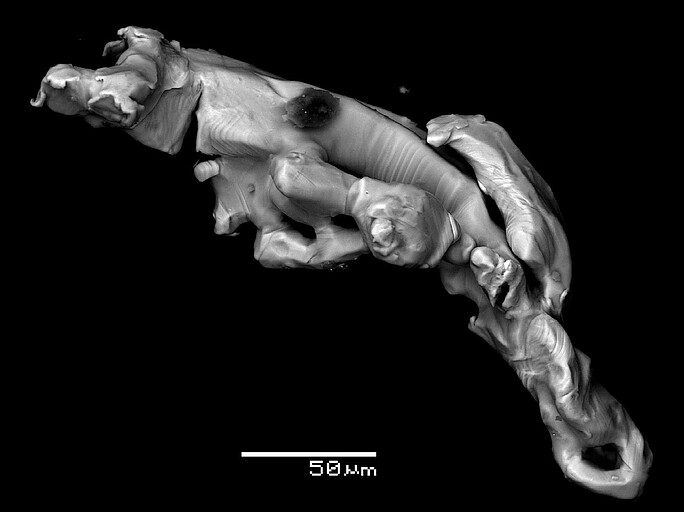
Hexagonal α-Titanium was described from fumaroles of the Northern Break of Great Fissure Tolbachik Eruption of 1975 in 1992.
Considered doubtful for a longer time, finally approved in 2010 (IMA 2010-044).
Hexagonal α-Titanium was described from fumaroles of the Northern Break of Great Fissure Tolbachik Eruption of 1975 in 1992.
Considered doubtful for a longer time, finally approved in 2010 (IMA 2010-044).
Unique Identifiers
Mindat ID:
7339
Long-form identifier:
mindat:1:1:7339:0
IMA Classification of Native Titanium
Approved
Approval year:
2010
First published:
2013
Classification of Native Titanium
1.AB.05
1 : ELEMENTS (Metals and intermetallic alloys; metalloids and nonmetals; carbides, silicides, nitrides, phosphides)
A : Metals and Intermetallic Alloys
B : Zinc-brass family
1 : ELEMENTS (Metals and intermetallic alloys; metalloids and nonmetals; carbides, silicides, nitrides, phosphides)
A : Metals and Intermetallic Alloys
B : Zinc-brass family
Dana 7th ed.:
1.1.36.1
Mineral Symbols
As of 2021 there are now IMA–CNMNC approved mineral symbols (abbreviations) for each mineral species, useful for tables and diagrams.
| Symbol | Source | Reference for Standard |
|---|---|---|
| Ti | IMA–CNMNC | Warr, L.N. (2021). IMA–CNMNC approved mineral symbols. Mineralogical Magazine, 85(3), 291-320. doi:10.1180/mgm.2021.43 |
Physical Properties of Native Titanium
Metallic
Transparency:
Opaque
Colour:
Silver-grey
Streak:
Grayish black
Hardness:
4 on Mohs scale
Comment:
Estimated
Tenacity:
Malleable
Cleavage:
None Observed
No apparent cleavage.
No apparent cleavage.
Fracture:
Hackly
Density:
4.503 g/cm3 (Calculated)
Comment:
The elemental density is 4.54
Optical Data of Native Titanium
Reflectivity:
| Wavelength | R1 (%) |
|---|---|
| 400nm | 33.8% |
| 420nm | 36.4% |
| 440nm | 38.1% |
| 460nm | 40.6% |
| 470nm | 40.3% |
| 500nm | 41.4% |
| 520nm | 41.8% |
| 540nm | 45.1% |
| 546nm | 45.2% |
| 560nm | 48.5% |
| 580nm | 48.6% |
| 589nm | 48.1% |
| 600nm | 48.1% |
| 620nm | 52.1% |
| 640nm | 50.7% |
| 650nm | 50.4% |
| 660nm | 50.0% |
| 680nm | 51.2% |
| 700nm | 51.1% |
Graph shows reflectance levels at different wavelengths (in nm). Peak reflectance is 52.1%.
Chemistry of Native Titanium
Mindat Formula:
Ti
Element Weights:
| Element | % weight |
|---|---|
| Ti | 100.000 % |
Calculated from ideal end-member formula.
Elements listed:
Crystallography of Native Titanium
Crystal System:
Hexagonal
Class (H-M):
6/mmm(6/m2/m2/m) - Dihexagonal Dipyramidal
Space Group:
P63/mmc
Setting:
P63/mmc
Cell Parameters:
a = 2.950(2) Å, c = 4.686(1) Å
Ratio:
a:c = 1 : 1.588
Unit Cell V:
35.32 ų
Z:
2
Crystal Structure
Load
Unit Cell | Unit Cell Packed
2x2x2 | 3x3x3 | 4x4x4
Unit Cell | Unit Cell Packed
2x2x2 | 3x3x3 | 4x4x4
Show
Big Balls | Small Balls | Just Balls | Spacefill
Polyhedra Off | Si Polyhedra | All Polyhedra
Remove metal-metal sticks
Big Balls | Small Balls | Just Balls | Spacefill
Polyhedra Off | Si Polyhedra | All Polyhedra
Remove metal-metal sticks
Display Options
Black Background | White Background
Perspective On | Perspective Off
2D | Stereo | Red-Blue | Red-Cyan
Black Background | White Background
Perspective On | Perspective Off
2D | Stereo | Red-Blue | Red-Cyan
View
CIF File Best | x | y | z | a | b | c
CIF File Best | x | y | z | a | b | c
Rotation
Stop | Start
Stop | Start
Labels
Console Off | On | Grey | Yellow
Console Off | On | Grey | Yellow
Data courtesy of the American Mineralogist Crystal Structure Database. Click on an AMCSD ID to view structure
| ID | Species | Reference | Link | Year | Locality | Pressure (GPa) | Temp (K) |
|---|---|---|---|---|---|---|---|
| 0013128 | Native Titanium | Levinger B W (1953) Lattice parameters of beta titanium at room temperature Journal of Metals 5 195-195 | 1953 | synthetic | 0 | 298 | |
| 0020263 | Native Titanium | Fang Q, Bai W, Yang J, Rong H, Shi N, Li G, Xiong M, Ma Z (2013) Titanium, Ti, a new mineral species from Luobusha, Tibet, China Acta Geologica Sinica 87 1275-1280 | 2013 | Harzburgite formation, Luobusha ophiolite, Indus-Yarlong suture zone, China | 0 | 293 | |
| 0018800 | Native Titanium | Glavatskikh S F, Gorshkov A I (1992) Natural analog of alpha-titanium in the exhalation products of the Great Tolbachik Fissure Eruption (Kamchatka) Doklady Akademii Nauk SSSR 327 123-127 | 1992 | Great Tolbachik Fissure Eruption (Kamchatka) | 0 | 293 | |
| 0015116 | Native Titanium | Hull A W (1921) Crystal structure of titanium, zirconium, cerium, thorium and osmium Physical Review 18 88-89 | 1921 | synthetic, known as the alpha phase | 0 | 293 | |
| 0012644 | Native Titanium | Chebotareva E S, Nuzhdina S G (1973) Observation of omega-titanium in a composite hard facing alloy based on fine-grain diamonds Fizika Metallov i Metallovedenie 36 200-202 | 1973 | synthetic | 4 | 293 | |
| 0011195 | Native Titanium | Wyckoff R W G (1963) Second edition. Interscience Publishers, New York, New York Hexagonal closest packed, hcp, structure Crystal Structures 1 7-83 | 1963 | 0 | 293 | ||
| 0011232 | Native Titanium | Wyckoff R W G (1963) Second edition. Interscience Publishers, New York, New York Body centered cubic, bcc, structure Crystal Structures 1 7-83 | 1963 | 0 | 1173 |
CIF Raw Data - click here to close
X-Ray Powder Diffraction
Powder Diffraction Data:
| d-spacing | Intensity |
|---|---|
| 2.569 Å | (32) |
| 2.254 Å | (100) |
| 1.730 Å | (16) |
| 1.478 Å | (21) |
| 0.989 Å | (5) |
| 0.9464 Å | (8) |
| 0.9172 Å | (4) |
| 0.8214 Å | (4) |
Geological Environment
Paragenetic Mode(s):
| Paragenetic Mode | Earliest Age (Ga) |
|---|---|
| Stage 3a: Earth’s earliest Hadean crust | >4.50 |
| 7 : Ultramafic igneous rocks | |
| 11 : Volcanic fumarole minerals; reduced phases (see also #45) | |
| Stage 4b: Highly evolved igneous rocks | >3.0 |
| 36 : Carbonatites, kimberlites, and related igneous rocks |
Type Occurrence of Native Titanium
General Appearance of Type Material:
As irregular crystals from 0.1 to 0.6 mm in diameter and form an intergrowth with coesite and kyanite.
Place of Conservation of Type Material:
Institute of Geology, Chinese Academy of Geological Sciences, Beijing, People's Republic of China, catalogue number 74-3.
Geological Setting of Type Material:
In podiform chromitites.
Associated Minerals at Type Locality:
Synonyms of Native Titanium
Other Language Names for Native Titanium
Varieties of Native Titanium
| Tetragonal Titanium | A high-pressure tetragonal 'variety' (modification?) of Titanium. Originally reported from Yingshan, Yingshan Co., Huanggang Prefecture, Hubei Province, China. |
Common Associates
Associations Based on Photo Data:
| 3 photos of Native Titanium associated with Yarlongite | Cr4Fe4NiC4 |
Related Minerals - Strunz-mindat Grouping
| 1.AB. | 'Native Magnesium' | Mg |
| 1.AB.05 | Native Zinc | Zn |
| 1.AB.05 | 'Native Rhenium' | Re |
| 1.AB.05 | Native Cadmium | Cd |
| 1.AB.10a | 'Zinccopperite' | Cu7Zn4 (?) |
| 1.AB.10a | Zhanghengite | CuZn |
| 1.AB.10 | 'UM1980-01-E:CuZn' | Cu3Zn |
| 1.AB.10 | 'UM1980-02-E:CuZn' | Cu4.45Zn |
| 1.AB.10 | 'UM2003-03-E:AgAuCuZn' | (Cu,Au,Ag)4Zn |
| 1.AB.10b | 'Tongxinite' | Cu2Zn |
| 1.AB.10a | 'α-Brass' | Cu3Zn |
| 1.AB.10b | Danbaite | CuZn2 |
Fluorescence of Native Titanium
Non-fluorescent.
Other Information
Health Risks:
No information on health risks for this material has been entered into the database. You should always treat mineral specimens with care.
Internet Links for Native Titanium
mindat.org URL:
https://www.mindat.org/min-7339.html
Please feel free to link to this page.
Please feel free to link to this page.
Search Engines:
External Links:
Mineral Dealers:
References for Native Titanium
Reference List:
Jambor, John L., Vanko, David A. (1991) New Mineral Names. American Mineralogist, 76 (7-8) 1434-1440
Glavatskih, S.F., Gorshkov, A.I. (1992) Natural analogue of α-Titanium in exhalations products of Big Fissure Tolbachik Eruption (Kamchatka). Doklady Rossijskoj akademii nauk. Nauki o Zemle, 327 (1). 126-130
Chen, Jing, Li, Jiliang, Wu, Jun (2000) Native titanium inclusions in the coesite eclogites from Dabieshan, China. Earth and Planetary Science Letters, 177 (3) 237-240 doi:10.1016/s0012-821x(00)00057-1
Trinkle, D. R., Jones, M. D., Hennig, R. G., Rudin, S. P., Albers, R. C., Wilkins, J. W. (2006) Empirical tight-binding model for titanium phase transformations. Physical Review B, 73 (9). 094123 doi:10.1103/physrevb.73.094123
Hennig, R. G., Lenosky, T. J., Trinkle, D. R., Rudin, S. P., Wilkins, J. W. (2008) Classical potential describes martensitic phase transformations between the α, β, and ω titanium phases. Physical Review B, 78 (5). 054121 doi:10.1103/physrevb.78.054121
Williams, P. A., Hatert, F., Pasero, M., Mills, S. J. (2011) New minerals and nomenclature modifications approved in 2010, CNMNC Newsletter No 7. Mineralogical Magazine, 75 (1) 27-31 doi:10.1180/minmag.2011.075.1.27
Localities for Native Titanium
Showing 15 localities.
 symbol to view information about a locality.
The
symbol to view information about a locality.
The Locality List
 - This locality has map coordinates listed.
- This locality has estimated coordinates.
ⓘ - Click for references and further information on this occurrence.
? - Indicates mineral may be doubtful at this locality.
- This locality has map coordinates listed.
- This locality has estimated coordinates.
ⓘ - Click for references and further information on this occurrence.
? - Indicates mineral may be doubtful at this locality.
 - Good crystals or important locality for species.
 - World class for species or very significant.
(TL) - Type Locality for a valid mineral species.
(FRL) - First Recorded Locality for everything else (eg varieties).
- World class for species or very significant.
(TL) - Type Locality for a valid mineral species.
(FRL) - First Recorded Locality for everything else (eg varieties).
All localities listed without proper references should be considered as questionable.
Australia | |
| ... |
China | |
| [var: Tetragonal Titanium] [AmMin 65:198] |
| Wenji Bai et al. (2004) |
| Xiangzhen Xu et al. (2013) | |
| Williams et al. (2011) +2 other references |
New Zealand | |
| Newman (2015) |
Pacific Ocean | |
| Astakhova et al. (2014) |
| Astakhova et al. (2014) | |
Russia | |
| Sklyarov et al. (2016) |
| Keren Tan (1998) +1 other reference |
| Glavatskih et al. (1992) |
| Pavel Kartashov Analysis | |
| S. ISHIMARU (2009) |
| maurice.strahlen.org (2004) |
Quick NavTopAbout Native TitaniumUnique IdentifiersIMA Classification Classification Mineral SymbolsPhysical Properties Optical Data Chemistry Crystallography Crystal StructureX-Ray Powder DiffractionGeological EnvironmentType Occurrence SynonymsOther LanguagesVarietiesCommon AssociatesStrunz-MindatFluorescence Other InformationInternet Links References Localities Locality List

Second scoria cone, Northern Breakthrough, Great Fissure eruption, Tolbachik Volcanic field, Milkovsky District, Kamchatka Krai, Russia