
Stannopalladinite
A valid IMA mineral species - grandfathered
This page is currently not sponsored. Click here to sponsor this page.


About Stannopalladinite
Formula:
(Pd,Cu)3Sn
Formula according to reinvestigation by Kasatkin et al. (2023); formally accepted in IMA Newsletter 76. Also previously given as (Pd,Cu)3Sn2.
Colour:
dark grey, brown-rose, light brownish red
Lustre:
Metallic
Hardness:
4½ - 5
Specific Gravity:
9.781 (Calculated)
Crystal System:
Orthorhombic
Name:
The name reflects its composition: tin (latin "stannum") plus palladium.
Unique Identifiers
Mindat ID:
3750
Long-form identifier:
mindat:1:1:3750:7
IMA Classification of Stannopalladinite
Approved, 'Grandfathered' (first described prior to 1959)
Classification of Stannopalladinite
1.AG.25
1 : ELEMENTS (Metals and intermetallic alloys; metalloids and nonmetals; carbides, silicides, nitrides, phosphides)
A : Metals and Intermetallic Alloys
G : PGE-metal alloys
1 : ELEMENTS (Metals and intermetallic alloys; metalloids and nonmetals; carbides, silicides, nitrides, phosphides)
A : Metals and Intermetallic Alloys
G : PGE-metal alloys
Dana 7th ed.:
1.2.12.1
1.2.9.1
1 : NATIVE ELEMENTS AND ALLOYS
2 : Platinum Group Metals and Alloys
1 : NATIVE ELEMENTS AND ALLOYS
2 : Platinum Group Metals and Alloys
1.69
1 : Elements and Alloys (including the arsenides, antimonides and bismuthides of Cu, Ag and Au)
1 : Elements and Alloys (including the arsenides, antimonides and bismuthides of Cu, Ag and Au)
Mineral Symbols
As of 2021 there are now IMA–CNMNC approved mineral symbols (abbreviations) for each mineral species, useful for tables and diagrams.
| Symbol | Source | Reference for Standard |
|---|---|---|
| Spdn | IMA–CNMNC | Warr, L.N. (2021). IMA–CNMNC approved mineral symbols. Mineralogical Magazine, 85(3), 291-320. doi:10.1180/mgm.2021.43 |
Physical Properties of Stannopalladinite
Metallic
Transparency:
Opaque
Colour:
Dark grey, brown-rose, light brownish red
Hardness:
4½ - 5 on Mohs scale
Hardness:
VHN30=233 - 266 kg/mm2 - Vickers
Comment:
avg. VHN: 244
Density:
9.781 g/cm3 (Calculated)
Optical Data of Stannopalladinite
Anisotropism:
Strong, lilac-red to gray-blue
Bireflectance:
bireflectance is noticeable only in oil immersion.
Reflectivity:
| Wavelength | R1 (%) | R2 (%) |
|---|---|---|
| 460nm | 46.2% | 48.5% |
| 500nm | 50.3% | 51.5% |
| 540nm | 53.0% | 54.0% |
| 580nm | 54.0% | 55.5% |
| 620nm | 56.0% | 57.8% |
| 660nm | 57.0% | 60.0% |
| 700nm | 57.0% | 61.0% |
Graph shows reflectance levels at different wavelengths (in nm). Peak reflectance is 61.0%.
R1 shown in black, R2 shown in red
Colour in reflected light:
pale pink
Chemistry of Stannopalladinite
Mindat Formula:
(Pd,Cu)3Sn
Formula according to reinvestigation by Kasatkin et al. (2023); formally accepted in IMA Newsletter 76. Also previously given as (Pd,Cu)3Sn2.
Formula according to reinvestigation by Kasatkin et al. (2023); formally accepted in IMA Newsletter 76. Also previously given as (Pd,Cu)3Sn2.
Elements listed:
Common Impurities:
Pt,Fe,Ni
Chemical Analysis
Oxide wt%:
| 1 | |
|---|---|
| Cu | 8.48 % |
| Pd | 61.21 % |
| Pt | 0.89 % |
| Sn | 25.87 % |
| Pb | 3.70 % |
| Total | 100.15 % |
| Total: | 200.3 % |
Empirical formulas:
| Sample ID | Empirical Formula |
|---|---|
| 1 | (Pd2.42Cu0.56Pt0.02)Σ3.00(Sn0.92Pb0.08)Σ1.00 |
Sample references:
| ID | Locality | Reference | Notes |
|---|---|---|---|
| 1 | Ugol'nyi Ruchei Mine, Noril'sk Cu-Ni deposit, Norilsk-Talnakh Mining Region, Taimyr Peninsula, Taymyrskiy Autonomous Okrug, Krasnoyarsk Krai, Russia | via EPMA; empirical formula basis: 4 atoms pfu is |
Crystallography of Stannopalladinite
Crystal System:
Orthorhombic
Cell Parameters:
a = 14.634(2) Å, b = 8.5253(6) Å, c = 4.5946(3) Å
Ratio:
a:b:c = 1.717 : 1 : 0.539
Unit Cell V:
573.22 ų (Calculated from Unit Cell)
Z:
8
Morphology:
Twinning:
Occasionally exhibited polysynthetically.
Comment:
Point Group: n.d.; Space Group: n.d. (Pmmm?) Since the structure of stannopalladinite cannot be refined due to the poor quality of the studied material
X-Ray Powder Diffraction
Powder Diffraction Data:
| d-spacing | Intensity |
|---|---|
| 2.27 Å | (100) |
| 2.20 Å | (100) |
| 1.58 Å | (70) |
| 1.28 Å | (70) |
| 1.19 Å | (70) |
| 0.834 Å | (70) |
| 0.830 Å | (70) |
Comments:
Synthetic material, JCPDS 4-801
Geological Environment
Paragenetic Mode(s):
| Paragenetic Mode | Earliest Age (Ga) |
|---|---|
| High-? alteration and/or metamorphism | |
| 33 : Minerals deposited by hydrothermal metal-rich fluids (see also [#12]) | |
| Stage 4b: Highly evolved igneous rocks | >3.0 |
| 37 : Layered igneous intrusions and related PGE minerals |
Type Occurrence of Stannopalladinite
General Appearance of Type Material:
spherical and ovoid-shaped grains up to 0.08 mm, closely intergrown with tetraferroplatinum as part of flattened, prismatic crystals up to 6 mm long
Place of Conservation of Type Material:
sample 41647 from the Platinum Placer of Ugol’nyi Ruchei, Norilsk Cu-Ni deposit, Russia, stored in the systematic collection of the Fersman Mineralogical Museum,
Associated Minerals at Type Locality:
Other Language Names for Stannopalladinite
Dutch:Stannopalladiniet
German:Stannopalladinit
Simplified Chinese:锡钯矿
Spanish:Stannopalladinita
Traditional Chinese:錫鈀礦
Common Associates
Associations Based on Photo Data:
| 9 photos of Stannopalladinite associated with Chalcopyrite | CuFeS2 |
| 8 photos of Stannopalladinite associated with Sperrylite | PtAs2 |
| 8 photos of Stannopalladinite associated with Tetraferroplatinum | PtFe |
| 4 photos of Stannopalladinite associated with Polarite | Pd(Bi,Pb) |
| 4 photos of Stannopalladinite associated with Atokite | (Pd,Pt)3Sn |
| 4 photos of Stannopalladinite associated with Niggliite | PtSn |
| 3 photos of Stannopalladinite associated with Sobolevskite | PdBi |
| 3 photos of Stannopalladinite associated with Paolovite | Pd2Sn |
| 3 photos of Stannopalladinite associated with Native Silver | Ag |
| 2 photos of Stannopalladinite associated with 'Küstelite' | Ag |
Related Minerals - Strunz-mindat Grouping
| 1.AG. | Sluzhenikinite | Pd15(Sb7-xSnx) |
| 1.AG. | Palladothallite | Pd3Tl |
| 1.AG. | Driekopite | PtBi |
| 1.AG. | Sidorovite | Fe3Pt |
| 1.AG. | Michitoshiite-(Cu) | Rh(Cu1-xGex) |
| 1.AG.05 | Hexaferrum | (Fe,Os,Ru,Ir) |
| 1.AG.05 | Garutiite | (Ni,Fe,Ir) |
| 1.AG.10 | Zvyagintsevite | Pd3Pb |
| 1.AG.10 | Rustenburgite | (Pt,Pd)3Sn |
| 1.AG.10 | Atokite | (Pd,Pt)3Sn |
| 1.AG.15 | Taimyrite | (Pd,Cu,Pt)3Sn |
| 1.AG.15 | Tatyanaite | (Pt,Pd,Cu)9Cu3Sn4 |
| 1.AG.20 | Paolovite | Pd2Sn |
| 1.AG.25 | Plumbopalladinite | Pd3Pb2 |
| 1.AG.30 | Cabriite | Pd2CuSn |
| 1.AG.35 | Isoferroplatinum | Pt3Fe |
| 1.AG.35 | Chengdeite | Ir3Fe |
| 1.AG.40 | Tetraferroplatinum | PtFe |
| 1.AG.40 | Tulameenite | Pt2CuFe |
| 1.AG.40 | Ferronickelplatinum | Pt2FeNi |
| 1.AG.45 | Skaergaardite | PdCu |
| 1.AG.45 | Hongshiite | PtCu |
| 1.AG.50 | Yixunite | Pt3In |
| 1.AG.55 | Damiaoite | PtIn2 |
| 1.AG.60 | Niggliite | PtSn |
| 1.AG.65 | Bortnikovite | Pd4Cu3Zn |
| 1.AG.70 | Nielsenite | PdCu3 |
| 1.AG.75 | Norilskite | (Pd,Ag)2xPb (x = 0.08 - 0.11) |
Other Information
Health Risks:
No information on health risks for this material has been entered into the database. You should always treat mineral specimens with care.
Internet Links for Stannopalladinite
mindat.org URL:
https://www.mindat.org/min-3750.html
Please feel free to link to this page.
Please feel free to link to this page.
Search Engines:
External Links:
Mineral Dealers:
References for Stannopalladinite
Reference List:
Localities for Stannopalladinite
Showing 20 localities.
 symbol to view information about a locality.
The
symbol to view information about a locality.
The Locality List
 - This locality has map coordinates listed.
- This locality has estimated coordinates.
ⓘ - Click for references and further information on this occurrence.
? - Indicates mineral may be doubtful at this locality.
- This locality has map coordinates listed.
- This locality has estimated coordinates.
ⓘ - Click for references and further information on this occurrence.
? - Indicates mineral may be doubtful at this locality.
 - Good crystals or important locality for species.
 - World class for species or very significant.
(TL) - Type Locality for a valid mineral species.
(FRL) - First Recorded Locality for everything else (eg varieties).
- World class for species or very significant.
(TL) - Type Locality for a valid mineral species.
(FRL) - First Recorded Locality for everything else (eg varieties).
All localities listed without proper references should be considered as questionable.
Canada | |
| Ames et al. (2003) |
China | |
| Min Liu (2002) |
Finland | |
| Pelayo Barrón Francisco (2020) |
Russia | |
| Orsoev (2019) |
| Kislov +2 other references | |
| Spiridonov et al. (2015) |
| Maslenitzky et al. (1947) +1 other reference |
| Pekov (1998) +1 other reference |
| Pavel M. Kartashov analytical data 1989 | |
| 2014 Ultramafic-mafic intrusions | |
| Chashchin et al. (2018) |
| Grokhovskaya et al. (2009) | |
| Yury L. Voytekhovsky (2008) | |
| Grokhovskaya et al. (2003) |
| Serov et al. (2024) |
| Barkov et al. (2004) |
South Africa | |
| Anthony et al. (1990) |
| Holwell et al. (2006) +1 other reference |
USA | |
| Alaska Div. Geological & Geophysical ... |
| Bart Cannon (Cannon Microprobe) |
Quick NavTopAbout StannopalladiniteUnique IdentifiersIMA Classification Classification Mineral SymbolsPhysical Properties Optical Data Chemistry Chemical AnalysisCrystallography X-Ray Powder DiffractionGeological EnvironmentType Occurrence Other LanguagesCommon AssociatesStrunz-MindatOther InformationInternet Links References Localities Locality List

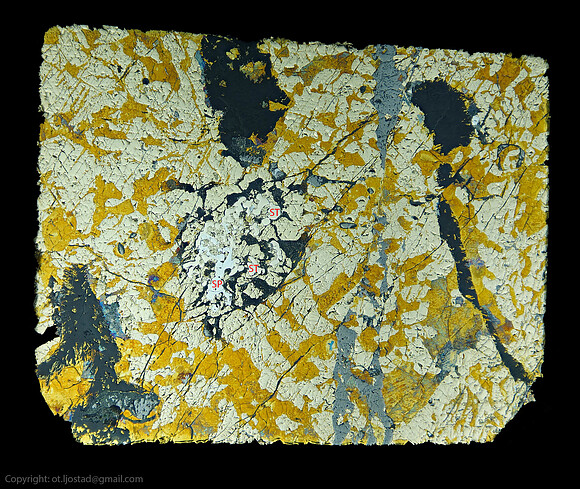
Mayak Mine, Talnakh Cu-Ni Deposit, Norilsk-Talnakh Mining Region, Taimyr Peninsula, Taymyrskiy Autonomous Okrug, Krasnoyarsk Krai, Russia