
Pyroxmangite
A valid IMA mineral species - grandfathered
This page is currently not sponsored. Click here to sponsor this page.


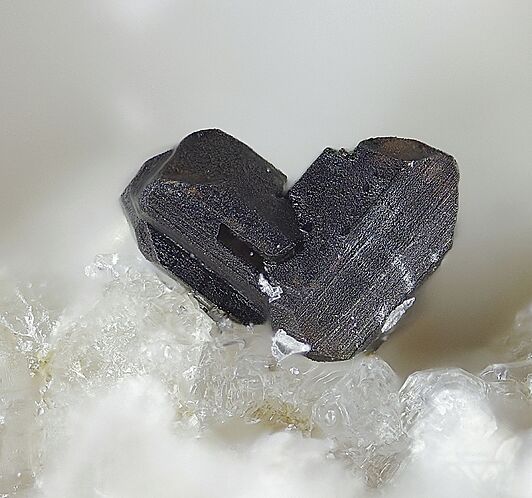
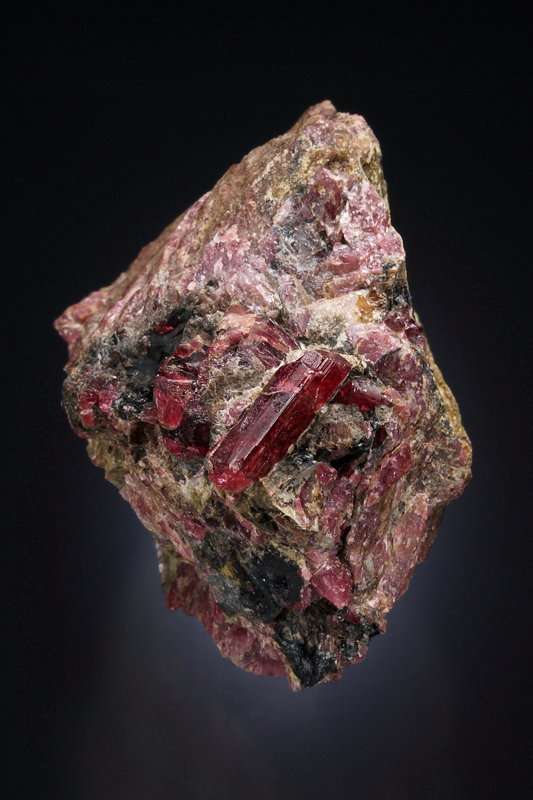
About Pyroxmangite
Formula:
Mn2+SiO3
Colour:
Pink, red, brown
Lustre:
Vitreous, Pearly
Hardness:
5½ - 6
Specific Gravity:
3.61 - 3.80
Crystal System:
Triclinic
Name:
Named in 1913 by William E. Ford and W. M. Bradley from PYROXene and MANGanese, in allusion to its structure and content of Manganese.
Polymorph of:
Pyroxferroite-Pyroxmangite Series.
Easily confused with rhodonite or vittinkiite; however, pyroxmangite is a high-temperature environment mineral and syntheses have shown that pyroxmangite of MnSiO3 composition is the high-pressure, low-temperature polymorph with respect to rhodonite of the same composition (Maresch & Mottana, 1976).
Both pyroxmangite and rhodonite may occur together (Sterling Mine, NJ, USA).
Compare mendigite and UM1975-18-SiO:Mn - the unnamed α-MnSiO3 phase from limestones of Polish Tatra Mts.
Note: "Type material" from Iva, South Carolina, USA, has been redefined as pyroxferroite, as it has Fe > Mn.
 Visit gemdat.org for gemological information about Pyroxmangite.
Easily confused with rhodonite or vittinkiite; however, pyroxmangite is a high-temperature environment mineral and syntheses have shown that pyroxmangite of MnSiO3 composition is the high-pressure, low-temperature polymorph with respect to rhodonite of the same composition (Maresch & Mottana, 1976).
Both pyroxmangite and rhodonite may occur together (Sterling Mine, NJ, USA).
Compare mendigite and UM1975-18-SiO:Mn - the unnamed α-MnSiO3 phase from limestones of Polish Tatra Mts.
Note: "Type material" from Iva, South Carolina, USA, has been redefined as pyroxferroite, as it has Fe > Mn.
Visit gemdat.org for gemological information about Pyroxmangite.Unique Identifiers
Mindat ID:
3327
Long-form identifier:
mindat:1:1:3327:1
IMA Classification of Pyroxmangite
Approved, 'Grandfathered' (first described prior to 1959)
Classification of Pyroxmangite
9.DO.05
9 : SILICATES (Germanates)
D : Inosilicates
O : Inosilicates with 7-, 8-, 10-, 12- and 14-periodic chains
9 : SILICATES (Germanates)
D : Inosilicates
O : Inosilicates with 7-, 8-, 10-, 12- and 14-periodic chains
65.6.1.1
65 : INOSILICATES Single-Width,Unbranched Chains,(W=1)
6 : Single-Width Unbranched Chains, W=1 with chains P=7
65 : INOSILICATES Single-Width,Unbranched Chains,(W=1)
6 : Single-Width Unbranched Chains, W=1 with chains P=7
14.18.35
14 : Silicates not Containing Aluminum
18 : Silicates of Mn and Na, K, Mg, Ca or Fe
14 : Silicates not Containing Aluminum
18 : Silicates of Mn and Na, K, Mg, Ca or Fe
Mineral Symbols
As of 2021 there are now IMA–CNMNC approved mineral symbols (abbreviations) for each mineral species, useful for tables and diagrams.
Please only use the official IMA–CNMNC symbol. Older variants are listed for historical use only.
Please only use the official IMA–CNMNC symbol. Older variants are listed for historical use only.
| Symbol | Source | Reference for Standard |
|---|---|---|
| Pxm | IMA–CNMNC | Warr, L.N. (2021). IMA–CNMNC approved mineral symbols. Mineralogical Magazine, 85(3), 291-320. doi:10.1180/mgm.2021.43 |
| Pxm | Whitney & Evans (2010) | Whitney, D.L. and Evans, B.W. (2010) Abbreviations for names of rock-forming minerals. American Mineralogist, 95, 185–187 doi:10.2138/am.2010.3371 |
| Pxm | The Canadian Mineralogist (2019) | The Canadian Mineralogist (2019) The Canadian Mineralogist list of symbols for rock- and ore-forming minerals (December 30, 2019). download |
Physical Properties of Pyroxmangite
Vitreous, Pearly
Transparency:
Transparent, Translucent
Colour:
Pink, red, brown
Hardness:
5½ - 6 on Mohs scale
Cleavage:
Perfect
On {110}, {110}, (110) ^ (110) = 92° perfect; on {010}, {001} poor.
On {110}, {110}, (110) ^ (110) = 92° perfect; on {010}, {001} poor.
Density:
3.61 - 3.80 g/cm3 (Measured) 3.75 g/cm3 (Calculated)
Optical Data of Pyroxmangite
Type:
Biaxial (+)
RI values:
nα = 1.728 - 1.748 nβ = 1.730 - 1.742 nγ = 1.746 - 1.758
2V:
Measured: 37° to 46°, Calculated: 40° to 42°
Max. Birefringence:
δ = 0.010 - 0.018
Based on recorded range of RI values above.
Based on recorded range of RI values above.
Interference Colours:
The colours simulate birefringence patterns seen in thin section under crossed polars. They do not take into account mineral colouration or opacity.
Michel-Levy Bar The default colours simulate the birefringence range for a 30 µm thin-section thickness. Adjust the slider to simulate a different thickness.
Grain Simulation You can rotate the grain simulation to show how this range might look as you rotated a sample under crossed polars. Each grain retains its interference colour (retardation) while its brightness falls to black at extinction and reaches a maximum between extinction positions.
The colours simulate birefringence patterns seen in thin section under crossed polars. They do not take into account mineral colouration or opacity.
Michel-Levy Bar The default colours simulate the birefringence range for a 30 µm thin-section thickness. Adjust the slider to simulate a different thickness.
Grain Simulation You can rotate the grain simulation to show how this range might look as you rotated a sample under crossed polars. Each grain retains its interference colour (retardation) while its brightness falls to black at extinction and reaches a maximum between extinction positions.
Surface Relief:
Very High (positive)
Relative to Canada balsam mounting medium (n ≈ 1.537).
Relative to Canada balsam mounting medium (n ≈ 1.537).
This shows the grain boundary and Becke line effect under plane-polarised
light, based on the contrast between this mineral's average refractive
index and the mounting medium. It does not take into account mineral
colouration.
In focus
Interference Figure:
This shows the idealized biaxial acute bisectrix (Bxa) interference figure
- the conoscopic view for a grain cut perpendicular to the acute bisectrix, using
this mineral's 2V. The two small white dots mark the melatopes - the points
where the two optic axes emerge - and are shown only when they fall within the
field of view. The coloured bands are isochromatics, and the dark bands are
isogyres.
Rotate the stage: at 0°/90° the isogyres form a cross through the melatopes; at 45° they pull apart into curved hyperbolas. That splitting on rotation - absent in a uniaxial figure - is the standard diagnostic test for telling biaxial minerals from uniaxial ones. If 2V is large, the melatopes may fall outside the field of view, as they often do at the microscope too.
Rotate the stage: at 0°/90° the isogyres form a cross through the melatopes; at 45° they pull apart into curved hyperbolas. That splitting on rotation - absent in a uniaxial figure - is the standard diagnostic test for telling biaxial minerals from uniaxial ones. If 2V is large, the melatopes may fall outside the field of view, as they often do at the microscope too.
Dispersion:
r > v moderate
Chemistry of Pyroxmangite
Mindat Formula:
Mn2+SiO3
Element Weights:
Elements listed:
Common Impurities:
Al,Fe,Mg,Ca,Na,K,H2O
Crystallography of Pyroxmangite
Crystal System:
Triclinic
Class (H-M):
1 - Pinacoidal
Space Group:
P1
Cell Parameters:
a = 9.690 Å, b = 10.505 Å, c = 17.391 Å
α = 112.17°, β = 102.85°, γ = 82.93°
α = 112.17°, β = 102.85°, γ = 82.93°
Ratio:
a:b:c = 0.922 : 1 : 1.655
Unit Cell V:
1,596.85 ų (Calculated from Unit Cell)
Z:
14
Morphology:
Crystals commonly tabular on {001}; porphyroblastic; granular massive.
Twinning:
On {010} lamellar; on {001} simple, uncommon.
Comment:
Non-standard cell setting. Reduced cell is: a = 6.721, b = 7.603, c = 16.064 Å, α = 92.62, β = 96.43, γ = 94.13° (calculated from non-standard cell given by Narita et al., 1977). Reduced cell of sample structurally characterised by Pertlik (2000): a = 6.716, b = 7.603, c = 15.919 Å, α = 91.92, β = 96.13, γ = 94.70°.
Crystal Structure
Load
Unit Cell | Unit Cell Packed
2x2x2 | 3x3x3 | 4x4x4
Unit Cell | Unit Cell Packed
2x2x2 | 3x3x3 | 4x4x4
Show
Big Balls | Small Balls | Just Balls | Spacefill
Polyhedra Off | Si Polyhedra | All Polyhedra
Remove metal-metal sticks
Big Balls | Small Balls | Just Balls | Spacefill
Polyhedra Off | Si Polyhedra | All Polyhedra
Remove metal-metal sticks
Display Options
Black Background | White Background
Perspective On | Perspective Off
2D | Stereo | Red-Blue | Red-Cyan
Black Background | White Background
Perspective On | Perspective Off
2D | Stereo | Red-Blue | Red-Cyan
View
CIF File Best | x | y | z | a | b | c
CIF File Best | x | y | z | a | b | c
Rotation
Stop | Start
Stop | Start
Labels
Console Off | On | Grey | Yellow
Console Off | On | Grey | Yellow
Data courtesy of the American Mineralogist Crystal Structure Database. Click on an AMCSD ID to view structure
| ID | Species | Reference | Link | Year | Locality | Pressure (GPa) | Temp (K) |
|---|---|---|---|---|---|---|---|
| 0004772 | Pyroxmangite | Zanazzi P F, Nestola F, Nazzareni S, Comodi P (2008) Pyroxmangite: A high pressure single-crystal study Pressure = 3.57 GPa American Mineralogist 93 1921-1928 |  | 2008 | Yokone-Yama, Awano Town, Tochigi Prefecture, Japan | 0 | 293 |
| 0004771 | Pyroxmangite | Zanazzi P F, Nestola F, Nazzareni S, Comodi P (2008) Pyroxmangite: A high pressure single-crystal study Pressure = 1.24 GPa American Mineralogist 93 1921-1928 | | 2008 | Yokone-Yama, Awano Town, Tochigi Prefecture, Japan | 0 | 293 |
| 0001171 | Pyroxmangite | Pinckney L R, Burnham C W (1988) High-temperature crystal structure of pyrxomangite American Mineralogist 73 809-817 | | 1988 | 0 | 293 | |
| 0001170 | Pyroxmangite | Pinckney L R, Burnham C W (1988) High-temperature crystal structure of pyroxmangite American Mineralogist 73 809-817 | | 1988 | 0 | 293 | |
| 0001169 | Pyroxmangite | Pinckney L R, Burnham C W (1988) High-temperature crystal structure of pyroxmangite American Mineralogist 73 809-817 | | 1988 | 0 | 293 | |
| 0001168 | Pyroxmangite | Pinckney L R, Burnham C W (1988) High-temperature crystal structure of pyroxmangite American Mineralogist 73 809-817 | | 1988 | 0 | 293 |
CIF Raw Data - click here to close
X-Ray Powder Diffraction
Powder Diffraction Data:
| d-spacing | Intensity |
|---|---|
| 2.967 Å | (100) |
| 2.188 Å | (45) |
| 4.73 Å | (35) |
| 2.680 Å | (35) |
| 1.422 Å | (30) |
| 3.47 Å | (25) |
| 3.04 Å | (25) |
Geological Environment
Paragenetic Mode(s):
| Paragenetic Mode | Earliest Age (Ga) |
|---|---|
| Near-surface Processes | |
| 22 : Hydration and low-? subsurface aqueous alteration (see also #23) | |
| High-? alteration and/or metamorphism | |
| 32 : Ba/Mn/Pb/Zn deposits, including metamorphic deposits | |
| Stage 4b: Highly evolved igneous rocks | >3.0 |
| 34 : Complex granite pegmatites |
Synonyms of Pyroxmangite
Other Language Names for Pyroxmangite
Dutch:Pyroxmangiet
German:Pyroxmangit
Sobralit
Sobralit
Japanese:パイロクスマンガン石
Russian:Пироксмангит
Spanish:Piroxmangita
Sobralita
Sobralita
Relationship of Pyroxmangite to other Species
Forms a series with:
Common Associates
Associations Based on Photo Data:
| 32 photos of Pyroxmangite associated with Spessartine | Mn2+3Al2(SiO4)3 |
| 27 photos of Pyroxmangite associated with Quartz | SiO2 |
| 19 photos of Pyroxmangite associated with Rhodochrosite | MnCO3 |
| 17 photos of Pyroxmangite associated with Rhodonite | CaMn3Mn[Si5O15] |
| 15 photos of Pyroxmangite associated with Sphalerite | ZnS |
| 15 photos of Pyroxmangite associated with Aegirine | NaFe3+Si2O6 |
| 12 photos of Pyroxmangite associated with Native Gold | Au |
| 11 photos of Pyroxmangite associated with Galena | PbS |
| 9 photos of Pyroxmangite associated with Calcite | CaCO3 |
| 6 photos of Pyroxmangite associated with Pyrite | FeS2 |
Related Minerals - Strunz-mindat Grouping
| 9.DO. | Braccoite | NaMn2+5[Si5As5+O17(OH)](OH) |
| 9.DO. | Illoqite-(Ce) | Na2NaBaCeZnSi6O17 |
| 9.DO.05 | Pyroxferroite | (Fe,Mn,Ca)SiO3 |
| 9.DO.10 | Pellyite | Ba2CaFe2+2Si6O17 |
| 9.DO.15 | Manganonordite-(Ce) | Na3SrCeMn2+Si6O17 |
| 9.DO.15 | Ferronordite-(Ce) | Na3SrCeFe2+Si6O17 |
| 9.DO.15 | Nordite-(Ce) | (Ce,La)(Sr,Ca)Na2(Na,Mn)(Zn,Mg)Si6O17 |
| 9.DO.15 | Nordite-(La) | (La,Ce)(Sr,Ca)Na2(Na,Mn)(Zn,Mg)Si6O17 |
| 9.DO.15 | Ferronordite-(La) | Na3Sr(La,Ce)FeSi6O17 |
| 9.DO.15 | Meieranite | Na2Sr3MgSi6O17 |
| 9.DO.20 | Alamosite | PbSiO3 |
| 9.DO.25 | Liebauite | Ca3Cu5Si9O26 |
| 9.DO.30 | Vladykinite | Na3Sr4(Fe2+Fe3+)Si8O24 |
| 9.DO.30 | Rundqvistite-(Ce) | Na3(Sr3Ce)[Zn2Si8O24] |
Other Information
Health Risks:
No information on health risks for this material has been entered into the database. You should always treat mineral specimens with care.
Internet Links for Pyroxmangite
mindat.org URL:
https://www.mindat.org/min-3327.html
Please feel free to link to this page.
Please feel free to link to this page.
Search Engines:
External Links:
Mineral Dealers:
References for Pyroxmangite
Reference List:
Ford W E, Bradley W M (1913) Pyroxmangite, a new member of the pyroxene group and its alteration product, skemmatite. American Journal of Science 186, 169-174.(now identified as pyroxferroite)
Ford, W. E.; Bradley, W. M. (1914) Pyroxmangit, ein neues Glied der Pyroxengruppe, und sein Zersetzungsprodukt: Skemmatit. Zeitschrift für Kristallographie, 53 (1-6). 225-230 doi:10.1524/zkri.1914.53.1.225
Henderson, E. P.; Glass, Jewell J. (1936) Pyroxmangite, new locality: Identity of sobralite and pyroxmangite. American Mineralogist, 21 (5). 273-294
Liebau, F. (1959) Über die Kristallstruktur des Pyroxmangits (Mn,Fe,Ca,Mg)SiO3. Acta Crystallographica, 12 (3) 177-181 doi:10.1107/s0365110x59000536
Liebau, F., Hilmer, W., Lindemann, G. (1962) Über die Kristallstruktur des Pyroxmangits (Mn,Fe,Ca,Mg)SiO3 und des Rhondonits (Mn,Ca)SiO3. Acta Crystallographica, 15 (6) 622 doi:10.1107/s0365110x62001668
Manning, P. G. (1968) Absorption spectra of the manganese-bearing chain silicates pyroxmangite, rhodonite, bustamite and serandite. The Canadian Mineralogist, 9 (3) 348-357
Maresch, W. V., Mottana, A. (1976) The pyroxmangite-rhodonite transformation for the MnSiO3 composition. Contributions to Mineralogy and Petrology, 55 (1) 69-79 doi:10.1007/bf00372755
Narita, Hajime, Koto, Kichiro, Morimoto, Nobuo (1977) The crystal structures of MnSiO3 polymorphs (rhodonite- and pyroxmangite-type) Mineralogical Journal, 8 (6) 329-342 doi:10.2465/minerj.8.329
Pinckney, Linda R., Burnham, Charles W. (1988) Effects of compositional variation on the crystal structures of pyroxmangite and rhodonite. American Mineralogist, 73 (7-8) 798-808
Localities for Pyroxmangite
Showing 191 localities.
 symbol to view information about a locality.
The
symbol to view information about a locality.
The Locality List
 - This locality has map coordinates listed.
- This locality has estimated coordinates.
ⓘ - Click for references and further information on this occurrence.
? - Indicates mineral may be doubtful at this locality.
- This locality has map coordinates listed.
- This locality has estimated coordinates.
ⓘ - Click for references and further information on this occurrence.
? - Indicates mineral may be doubtful at this locality.
 - Good crystals or important locality for species.
 - World class for species or very significant.
(TL) - Type Locality for a valid mineral species.
(FRL) - First Recorded Locality for everything else (eg varieties).
- World class for species or very significant.
(TL) - Type Locality for a valid mineral species.
(FRL) - First Recorded Locality for everything else (eg varieties).
All localities listed without proper references should be considered as questionable.
Australia | |
| Brown et al. (1992) |
| Brown et al. (1992) |
| Worner et al. (1982) |
| Birch (1999) |
| ... +2 other references |
Austria | |
| Taucher (1994) +1 other reference |
| Münichsdorfer (1989) |
| Exel (1993) |
| - (n.d.) |
| Niedermayr et al. (1995) |
| Koritnig (1972) |
| Walter (1992) |
| Franz Bernhard |
| Kolitsch et al. (2015) +1 other reference |
| www.franzbernhard.x10hosting.com (2016) |
| Postl W. et al. (1998) | |
| Exel (1993) |
| Postl (1988) +1 other reference | |
| Praetzel (1985) +1 other reference |
| Abrecht (1990) |
Brazil | |
| Bello |
| Uchôa Filho et al. (2025) |
| Mineral Label +1 other reference |
| acd.ufrj.br (2002) | |
Canada | |
| personal correspondence with Giles Peatfield (see comments in description) |
China | |
| Nanlai Zheng et al. (1986) |
| Yiming Zhao et al. (1982) |
| Yiming Zhao et al. (1982) |
| Fan Delian et al. (1992) |
| Zhao et al. (2003) |
| Zhao et al. (2003) | |
| Zhao et al. (2003) | |
| Zhao et al. (2003) | |
| Xue-Hui Xia et al. (1999) +1 other reference | |
| Yiming Zhao et al. (2013) |
| |
Czech Republic | |
| Prachař +8 other references |
DR Congo | |
| De Putter et al. (2018) |
Egypt | |
| Fathy et al. (2025) |
Finland | |
| Heikkilä +1 other reference |
France | |
| Chopin (1978) |
| Chopin (1978) |
| Chauris (2014) |
| De Ascenção Guedes et al. (2002) |
| European J. Mineralogy |
Germany | |
| Hentschel (1987) |
| Hentschel (1987) | |
| Hentschel (1987) |
| Hentschel (1987) |
| Blaß et al. (1994) |
Ghana | |
| Dzigbodi-Adjimah (2004) |
Greece | |
| Stouraiti et al. (2022) |
| Michailidis et al. (2010) |
India | |
| Sivaprakash (1981) |
| Sivaprakash (1980) | |
| Dasgupta et al. (1987) |
| Mohapatra et al. (2003) |
Italy | |
| Piccoli et al. (2007) |
| 415. +1 other reference |
| Pipino (1984) |
| Castellaro et al. (2023) |
| Ciriotti et al. (2011) |
| Castellaro et al. (2011) |
| Castellaro-Kampf |
| Bedognè et al. (1993) +1 other reference |
| doi.org (n.d.) +2 other references |
| Ciriotti et al. (2011) |
| Ambrino (Piero) |
| Bertolani (1976) |
| Piccoli et al. (2007) |
| Peters et al. (1978) +1 other reference |
| Dini A. et al. (2013) |
| Capitani et al. (2003) | |
| Di Sabatino (1967) +1 other reference |
| Boscardin et al. (2011) |
Japan | |
| - (innumerable specimens widely distributed in japanese collections) |
| Donald E. Lee (1955) +1 other reference |
| Donald E. Lee (1955) | |
| FUKUOKA et al. (1977) |
| FUKUOKA et al. (1977) +1 other reference |
| FUKUOKA et al. (1977) | |
| - (n.d.) | |
| - (n.d.) |
| Kobayashi H (1977) |
| N. Aikawa (1987) | |
| Fukuoka (1981) |
| Haruna et al. (2002) |
| Fukuoka (1981) |
| Watanabe (1959) |
| - (n.d.) |
| - (n.d.) |
| - (n.d.) |
| - (n.d.) | |
| Petrov (n.d.) |
| - (n.d.) +1 other reference |
| - (n.d.) | |
| Omori et al. (1956) | |
| Petrov (n.d.) +1 other reference |
| Yoshimura et al. (1958) |
| - (n.d.) |
| Masutomi Museum specimens |
| Yoshinaga (1963) |
| Akira Kato (2011) |
| Akira Kato (2011) | |
| H. Momoi (1964) | |
| Yoshinaga (1959) |
| Petrov (n.d.) +1 other reference |
| Fukuoka (1981) | |
| [AmMin 84:196] +1 other reference |
| Yamada (2004) | |
| Akira Kato (undated manuscript) | |
| N. Aikawa (1987) |
| Yamada (2004) |
| Fukuoka (1981) |
| Lee (1955) +1 other reference |
| Fukuoka (1981) | |
| Lee (1955) +2 other references | |
| Lee (1955) | |
| H. Momoi (1964) | |
| H. Momoi (1964) | |
| Fukuoka (1981) | |
Mexico | |
| Megaw (2023) |
New Zealand | |
| Read et al. (1971) +1 other reference |
Peru | |
| Gibson (1992) |
| Hyrśl (2012) |
Romania | |
| Hîrtopanu et al. (2003) | |
| Hîrtopanu et al. (2003) |
| Ciobanu et al. (2004) |
| Udubasa et al. (1996) +3 other references |
| Hârtopanu et al. (1996) +1 other reference |
| Munteanu (1993) +1 other reference |
| minerals-of-the-carpathians.eu (2008) |
| Hîrtopanu (1997) +1 other reference |
Russia | |
| Brusnitsyn (2006) |
| Pavel M. Kartashov (n.d.) |
| Brusnitsyn et al. (2019) |
| Старикова (2011) | |
| Kazachenko et al. (2006) | |
| Dobovol'skaya et al. (1990) |
| Ratkin et al. (2021) | |
| Kazachenko et al. (2006, July) | |
| Kazachenko et al. (1979) | |
| Brusnitsyn A.I. (2000) |
| Brusnitsyn et al. (2017) |
Saudi Arabia | |
| Gahlan et al. (2021) |
Slovakia | |
| Rojkovič (2001) |
| Martin Števko-unpublished +1 other reference |
| Radvanec M. and Gonda S. (2020) +1 other reference |
| Mikuš et al. (2026) |
South Africa | |
| R. Liferovich -L. Horváth p.c. 2004 |
| Rudnick et al. (2013) +1 other reference |
| Rozendaal et al. (2017) | |
South Korea | |
| Chil-Sup et al. (1993) |
Spain | |
| Calvo Rebollar (2025) |
| Dill et al. (2023) |
| Calvo Rebollar (2018) |
Sweden | |
| Grensman et al. (2001) +1 other reference |
| |
| Natural History Museum | |
| Natural History Museum ( item # 19980372) | |
| |
| |
| |
Switzerland | |
| Lareida (1989) +1 other reference |
| Stalder et al. (1998) | |
| Brugger J. (1996) |
| Stalder et al. (1998) |
UK | |
| [Specimen in the Natural History Museum |
| Cotterell (2006) |
USA | |
| USGS OFR 2004-1200 (Hawley,2004) |
| - (2008) |
| Hewett et al. (1961) +3 other references |
| Eckel et al. (1997) |
| Econ Geol (1980) +1 other reference | |
| Foley +4 other references |
| Rocks & Min.:59:34 & 64:144. +1 other reference |
| Rocks & Min.:62:9 +3 other references |
| Eckhard D. Stuart +1 other reference |
| Rosemeyer (1988) |
| Ransome (1901) | |
| Schooner (circa 1980s) |
| Heinrich et al. (2004) |
| Dunn (1995) |
| - (2010, Spring) | |
| Dunn (1995) | |
| Dunn (1995) |
| Northrop et al. (1996) |
| NY State Museum spec. no. 12688 |
| Chamberlain et al. (2023) | |
| Rocks & Min.: 60:130-135. |
| "Type material" of "pyroxmangite" from ... |
Quick NavTopAbout PyroxmangiteUnique IdentifiersIMA Classification Classification Mineral SymbolsPhysical Properties Optical Data Chemistry Crystallography Crystal StructureX-Ray Powder DiffractionGeological EnvironmentSynonymsOther LanguagesRelationshipsCommon AssociatesStrunz-MindatOther InformationInternet Links References Localities Locality List

Caspar quarry, Ettringen, Vordereifel, Mayen-Koblenz, Rhineland-Palatinate, Germany