
Pyroxferroite
A valid IMA mineral species
This page is currently not sponsored. Click here to sponsor this page.


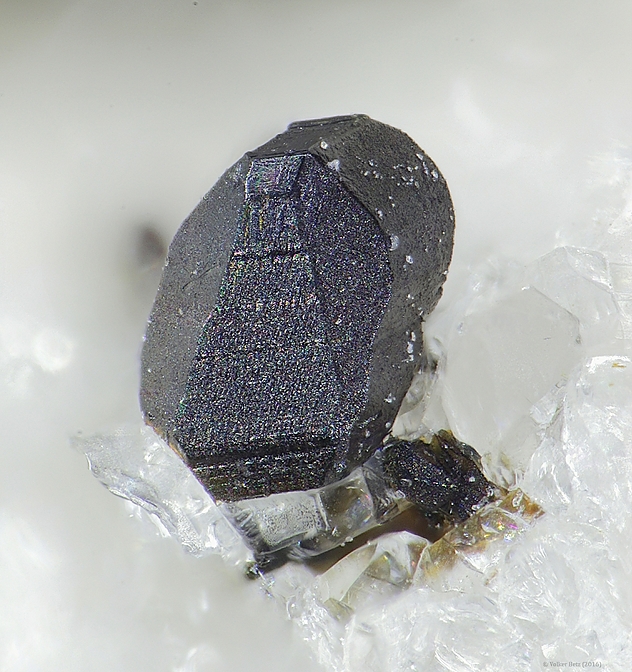

About Pyroxferroite
Formula:
(Fe,Mn,Ca)SiO3
Colour:
Pale yellow, orange-yellow, yellow, light brown
Hardness:
4½ - 5½
Specific Gravity:
3.68 - 3.76
Crystal System:
Triclinic
Name:
Named in 1970 by Edward Ching-Te Chao, Jean A. Minkin, Clifford Frondel, Cornelius Klein, Jr., John C. Drake, Louis H. Fuchs, B. Tani, Joseph V. Smith, A. T. Anderson, Paul B. Moore, G. R. Zechman, Jr., Robert James Traill, A. G. Plant, J. A. V. Douglas, and Michael R. Dence for the mineral's iron-rich relationship to pyroxmangite.
Type Locality:
Polymorph of:
Isostructural with:
Unique Identifiers
Mindat ID:
3326
Long-form identifier:
mindat:1:1:3326:4
IMA Classification of Pyroxferroite
Approved
IMA Formula:
Fe2+SiO3
Approval year:
1970
Type description reference:
Chao, E.C.T., Minkin, J.A., Frondel, C., Klein, C., Drake, J.C., Fuchs, L., Tani, B., Smith, J.V., Anderson, A.T., Moore, P.B., Zechman, G.R., Traill, R.J., Plant, A.G., Douglas, J.A.V., Dence, M.R. (1970) Pyroxferroite, a new calcium-bearing iron silicate from Tranquillity Base. Geochimica et Cosmochimica Acta, 34. Elsevier BV. 65-79 doi:10.1016/0016-7037(70)90170-5
Classification of Pyroxferroite
9.DO.05
9 : SILICATES (Germanates)
D : Inosilicates
O : Inosilicates with 7-, 8-, 10-, 12- and 14-periodic chains
9 : SILICATES (Germanates)
D : Inosilicates
O : Inosilicates with 7-, 8-, 10-, 12- and 14-periodic chains
65.6.1.2
65 : INOSILICATES Single-Width,Unbranched Chains,(W=1)
6 : Single-Width Unbranched Chains, W=1 with chains P=7
65 : INOSILICATES Single-Width,Unbranched Chains,(W=1)
6 : Single-Width Unbranched Chains, W=1 with chains P=7
14.22.2
14 : Silicates not Containing Aluminum
22 : Silicates of Fe and Ca
14 : Silicates not Containing Aluminum
22 : Silicates of Fe and Ca
Mineral Symbols
As of 2021 there are now IMA–CNMNC approved mineral symbols (abbreviations) for each mineral species, useful for tables and diagrams.
Please only use the official IMA–CNMNC symbol. Older variants are listed for historical use only.
Please only use the official IMA–CNMNC symbol. Older variants are listed for historical use only.
| Symbol | Source | Reference for Standard |
|---|---|---|
| Pxf | IMA–CNMNC | Warr, L.N. (2021). IMA–CNMNC approved mineral symbols. Mineralogical Magazine, 85(3), 291-320. doi:10.1180/mgm.2021.43 |
| Pxf | Whitney & Evans (2010) | Whitney, D.L. and Evans, B.W. (2010) Abbreviations for names of rock-forming minerals. American Mineralogist, 95, 185–187 doi:10.2138/am.2010.3371 |
Physical Properties of Pyroxferroite
Transparency:
Translucent
Colour:
Pale yellow, orange-yellow, yellow, light brown
Hardness:
4½ - 5½ on Mohs scale
Cleavage:
Distinct/Good
Good on {010}, poor on {001}
Good on {010}, poor on {001}
Density:
3.68 - 3.76 g/cm3 (Measured) 3.82 g/cm3 (Calculated)
Optical Data of Pyroxferroite
Type:
Biaxial (+)
RI values:
nα = 1.748 - 1.756 nβ = 1.750 - 1.758 nγ = 1.767 - 1.768
2V:
Measured: 34° to 40°, Calculated: 50° to 58°
Max. Birefringence:
δ = 0.012 - 0.019
Based on recorded range of RI values above.
Based on recorded range of RI values above.
Interference Colours:
The colours simulate birefringence patterns seen in thin section under crossed polars. They do not take into account mineral colouration or opacity.
Michel-Levy Bar The default colours simulate the birefringence range for a 30 µm thin-section thickness. Adjust the slider to simulate a different thickness.
Grain Simulation You can rotate the grain simulation to show how this range might look as you rotated a sample under crossed polars. Each grain retains its interference colour (retardation) while its brightness falls to black at extinction and reaches a maximum between extinction positions.
The colours simulate birefringence patterns seen in thin section under crossed polars. They do not take into account mineral colouration or opacity.
Michel-Levy Bar The default colours simulate the birefringence range for a 30 µm thin-section thickness. Adjust the slider to simulate a different thickness.
Grain Simulation You can rotate the grain simulation to show how this range might look as you rotated a sample under crossed polars. Each grain retains its interference colour (retardation) while its brightness falls to black at extinction and reaches a maximum between extinction positions.
Surface Relief:
Very High (positive)
Relative to Canada balsam mounting medium (n ≈ 1.537).
Relative to Canada balsam mounting medium (n ≈ 1.537).
This shows the grain boundary and Becke line effect under plane-polarised
light, based on the contrast between this mineral's average refractive
index and the mounting medium. It does not take into account mineral
colouration.
In focus
Interference Figure:
This shows the idealized biaxial acute bisectrix (Bxa) interference figure
- the conoscopic view for a grain cut perpendicular to the acute bisectrix, using
this mineral's 2V. The two small white dots mark the melatopes - the points
where the two optic axes emerge - and are shown only when they fall within the
field of view. The coloured bands are isochromatics, and the dark bands are
isogyres.
Rotate the stage: at 0°/90° the isogyres form a cross through the melatopes; at 45° they pull apart into curved hyperbolas. That splitting on rotation - absent in a uniaxial figure - is the standard diagnostic test for telling biaxial minerals from uniaxial ones. If 2V is large, the melatopes may fall outside the field of view, as they often do at the microscope too.
Rotate the stage: at 0°/90° the isogyres form a cross through the melatopes; at 45° they pull apart into curved hyperbolas. That splitting on rotation - absent in a uniaxial figure - is the standard diagnostic test for telling biaxial minerals from uniaxial ones. If 2V is large, the melatopes may fall outside the field of view, as they often do at the microscope too.
Dispersion:
r < v marked
Pleochroism:
Weak
Comments:
pale yellow to yellow-orange.
Chemistry of Pyroxferroite
Mindat Formula:
(Fe,Mn,Ca)SiO3
Element Weights:
Common Impurities:
Ti,Al,Mg,Na
Chemical Analysis
Oxide wt%:
| 1 | |
|---|---|
| SiO2 | 42.80 % |
| FeO | 25.84 % |
| MgO | 0.97 % |
| CaO | 0.95 % |
| MnO | 14.38 % |
| Total: | 84.94 % |
Sample references:
| ID | Locality | Reference | Notes |
|---|---|---|---|
| 1 | Garbham deposit, Vizianagaram District, Andhra Pradesh, India | Micro-probe analysis carried out by Prof. D. Ackermand at Kiel University, W. Germany using a .. wavelength dispersive microprobe (Siemens Elmisonde) equipped with two fully focussed spectrometers. T |
Crystallography of Pyroxferroite
Crystal System:
Triclinic
Cell Parameters:
a = 6.6213 Å, b = 7.5506 Å, c = 17.3806 Å
α = 144.267°, β = 82.684°, γ = 94.756°
α = 144.267°, β = 82.684°, γ = 94.756°
Ratio:
a:b:c = 0.877 : 1 : 2.302
Unit Cell V:
503.02 ų (Calculated from Unit Cell)
Z:
14
Comment:
Point Group: 1 or 1; Space Group: P1 or P1.
Crystal Structure
Load
Unit Cell | Unit Cell Packed
2x2x2 | 3x3x3 | 4x4x4
Unit Cell | Unit Cell Packed
2x2x2 | 3x3x3 | 4x4x4
Show
Big Balls | Small Balls | Just Balls | Spacefill
Polyhedra Off | Si Polyhedra | All Polyhedra
Remove metal-metal sticks
Big Balls | Small Balls | Just Balls | Spacefill
Polyhedra Off | Si Polyhedra | All Polyhedra
Remove metal-metal sticks
Display Options
Black Background | White Background
Perspective On | Perspective Off
2D | Stereo | Red-Blue | Red-Cyan
Black Background | White Background
Perspective On | Perspective Off
2D | Stereo | Red-Blue | Red-Cyan
View
CIF File Best | x | y | z | a | b | c
CIF File Best | x | y | z | a | b | c
Rotation
Stop | Start
Stop | Start
Labels
Console Off | On | Grey | Yellow
Console Off | On | Grey | Yellow
Data courtesy of the American Mineralogist Crystal Structure Database. Click on an AMCSD ID to view structure
| ID | Species | Reference | Link | Year | Locality | Pressure (GPa) | Temp (K) |
|---|---|---|---|---|---|---|---|
| 0015363 | Pyroxferroite | Burnham C W (1971) The crystal structure of pyroxferroite from Mare Tranquillitatis Proceedings of the Second Lunar Science Conference 1 47-57 | 1971 | Apollo 11 microgabbro sample 10047, Mare Tranquillitatis, Moon | 0 | 293 |
CIF Raw Data - click here to close
X-Ray Powder Diffraction
Powder Diffraction Data:
| d-spacing | Intensity |
|---|---|
| 2.934 Å | (100) |
| 2.674 Å | (60) |
| 3.09 Å | (45) |
| 4.68 Å | (40) |
| 2.156 Å | (40) |
| 2.579 Å | (35) |
| 1.410 Å | (35) |
Type Occurrence of Pyroxferroite
General Appearance of Type Material:
discrete grains
Place of Conservation of Type Material:
Lunar Science Institute, Houston, Texas, USA
Associated Minerals at Type Locality:
Reference:
Chao, E.C.T., Minkin, J.A., Frondel, C., Klein, C., Drake, J.C., Fuchs, L., Tani, B., Smith, J.V., Anderson, A.T., Moore, P.B., Zechman, G.R., Traill, R.J., Plant, A.G., Douglas, J.A.V., Dence, M.R. (1970) Pyroxferroite, a new calcium-bearing iron silicate from Tranquillity Base. Geochimica et Cosmochimica Acta, 34. Elsevier BV. 65-79 doi:10.1016/0016-7037(70)90170-5
Synonyms of Pyroxferroite
Other Language Names for Pyroxferroite
Relationship of Pyroxferroite to other Species
Forms a series with:
Common Associates
Associations Based on Photo Data:
Related Minerals - Strunz-mindat Grouping
| 9.DO. | Braccoite | NaMn2+5[Si5As5+O17(OH)](OH) |
| 9.DO. | Illoqite-(Ce) | Na2NaBaCeZnSi6O17 |
| 9.DO.05 | Pyroxmangite | Mn2+SiO3 |
| 9.DO.10 | Pellyite | Ba2CaFe2+2Si6O17 |
| 9.DO.15 | Manganonordite-(Ce) | Na3SrCeMn2+Si6O17 |
| 9.DO.15 | Ferronordite-(Ce) | Na3SrCeFe2+Si6O17 |
| 9.DO.15 | Nordite-(Ce) | (Ce,La)(Sr,Ca)Na2(Na,Mn)(Zn,Mg)Si6O17 |
| 9.DO.15 | Nordite-(La) | (La,Ce)(Sr,Ca)Na2(Na,Mn)(Zn,Mg)Si6O17 |
| 9.DO.15 | Ferronordite-(La) | Na3Sr(La,Ce)FeSi6O17 |
| 9.DO.15 | Meieranite | Na2Sr3MgSi6O17 |
| 9.DO.20 | Alamosite | PbSiO3 |
| 9.DO.25 | Liebauite | Ca3Cu5Si9O26 |
| 9.DO.30 | Vladykinite | Na3Sr4(Fe2+Fe3+)Si8O24 |
| 9.DO.30 | Rundqvistite-(Ce) | Na3(Sr3Ce)[Zn2Si8O24] |
Other Information
Health Risks:
No information on health risks for this material has been entered into the database. You should always treat mineral specimens with care.
Internet Links for Pyroxferroite
mindat.org URL:
https://www.mindat.org/min-3326.html
Please feel free to link to this page.
Please feel free to link to this page.
Search Engines:
External Links:
Mineral Dealers:
References for Pyroxferroite
Reference List:
Chao, E.C.T., Minkin, J.A., Frondel, C., Klein, C., Drake, J.C., Fuchs, L., Tani, B., Smith, J.V., Anderson, A.T., Moore, P.B., Zechman, G.R., Traill, R.J., Plant, A.G., Douglas, J.A.V., Dence, M.R. (1970) Pyroxferroite, a new calcium-bearing iron silicate from Tranquillity Base. Geochimica et Cosmochimica Acta, 34. Elsevier BV. 65-79 doi:10.1016/0016-7037(70)90170-5
Chao, E.C.T., Minkin, J.A., Frondel, C., Klein, C., Drake, J.C., Fuchs, L., Tani, B., Smith, J.V., Anderson, A.T., Moore, P.B., Zechman, G.R., Traill, R.J., Plant, A.G., Douglas, J.A.V., Dence, M.R. (1970) Pyroxferroite, a new calcium-bearing iron silicate from Tranquillity Base. Geochimica et Cosmochimica Acta, 34. Elsevier BV. 65-79 doi:10.1016/0016-7037(70)90170-5
Localities for Pyroxferroite
Showing 23 localities.
 symbol to view information about a locality.
The
symbol to view information about a locality.
The Locality List
 - This locality has map coordinates listed.
- This locality has estimated coordinates.
ⓘ - Click for references and further information on this occurrence.
? - Indicates mineral may be doubtful at this locality.
- This locality has map coordinates listed.
- This locality has estimated coordinates.
ⓘ - Click for references and further information on this occurrence.
? - Indicates mineral may be doubtful at this locality.
 - Good crystals or important locality for species.
 - World class for species or very significant.
(TL) - Type Locality for a valid mineral species.
(FRL) - First Recorded Locality for everything else (eg varieties).
- World class for species or very significant.
(TL) - Type Locality for a valid mineral species.
(FRL) - First Recorded Locality for everything else (eg varieties).
All localities listed without proper references should be considered as questionable.
Algeria | |
| Seddiki et al. (2013) |
Antarctica | |
| McSween Jr. et al. (1998) |
| McSween Jr. et al. (1998) +1 other reference |
Australia | |
| Singer et al. (2009) |
Finland | |
| Ahven (2012) |
| Bulletin de la Commission Geologique de ... +1 other reference |
| Heikkilä +1 other reference |
Germany | |
| Blass et al. (1998) +1 other reference |
India | |
| Bhattacharyya (1985) |
Japan | |
| Petrov (n.d.) |
| Masutomi Museum specimens | |
| Yamada et al. (1980) |
Oman | |
| Taylor et al. (2001) |
| Yukio et al. (2006) | |
Romania | |
| Hîrtopanu (2006) +3 other references |
Spain | |
| Dill et al. (2023) |
Sweden | |
| Holtstam (2001) |
USA | |
| Nikischer et al. (2007) |
| - (2010, Spring) | |
| Nikischer et al. (2007) |
The Moon (TL) | |
| Chao et al. (1970) | |
| Vol.2: Chemical Isotope Analyses +2 other references | |
| Longhi et al. (1974) |
Quick NavTopAbout PyroxferroiteUnique IdentifiersIMA Classification Classification Mineral SymbolsPhysical Properties Optical Data Chemistry Chemical AnalysisCrystallography Crystal StructureX-Ray Powder DiffractionType Occurrence SynonymsOther LanguagesRelationshipsCommon AssociatesStrunz-MindatOther InformationInternet Links References Localities Locality List

Caspar quarry, Ettringen, Vordereifel, Mayen-Koblenz, Rhineland-Palatinate, Germany