
Hatchite
A valid IMA mineral species - grandfathered
This page is currently not sponsored. Click here to sponsor this page.

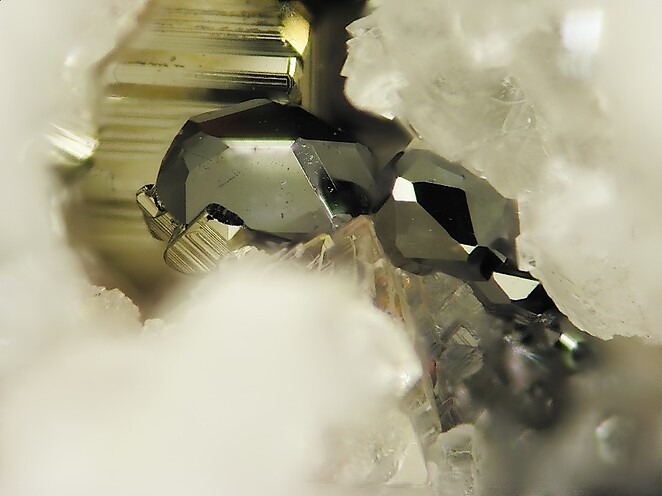


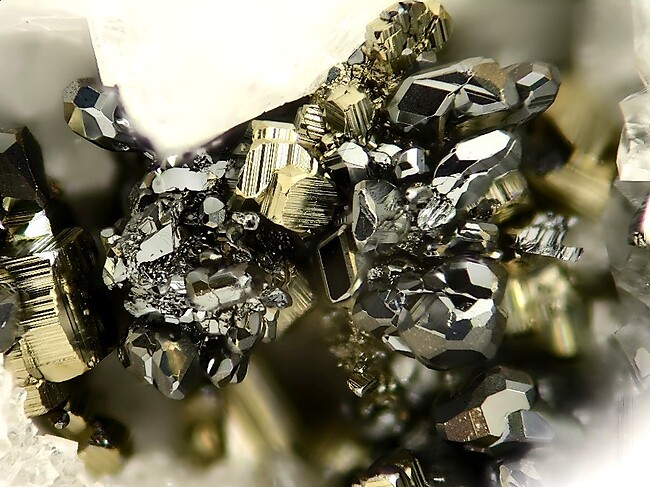
About Hatchite
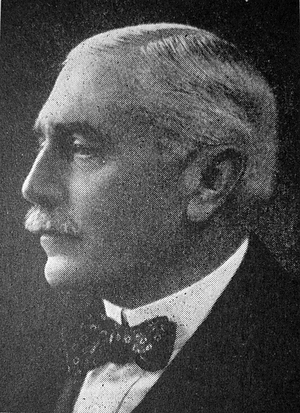
Frederick Henry Hatch
Formula:
AgTlPbAs2S5
Colour:
Lead-gray
Lustre:
Metallic
Specific Gravity:
5.81 (Calculated)
Crystal System:
Triclinic
Name:
Named by Richard Harrison Solly and G. F. Herbert Smith in 1912 after Dr. Frederick Henry Hatch (1864 London, England - September 22, 1932 London, England), mining engineer and geologist with the (British) Geological Survey.
Type Locality:
Isostructural with:
Unique Identifiers
Mindat ID:
1827
Long-form identifier:
mindat:1:1:1827:8
IMA Classification of Hatchite
Approved, 'Grandfathered' (first described prior to 1959)
IMA Formula:
Ag1+Pb2+Tl1+As3+2S2-5
First published:
1912
Classification of Hatchite
2.GC.05
2 : SULFIDES and SULFOSALTS (sulfides, selenides, tellurides; arsenides, antimonides, bismuthides; sulfarsenites, sulfantimonites, sulfbismuthites, etc.)
G : Sulfarsenites, sulfantimonites, sulfbismuthites
C : Poly-sulfarsenites
2 : SULFIDES and SULFOSALTS (sulfides, selenides, tellurides; arsenides, antimonides, bismuthides; sulfarsenites, sulfantimonites, sulfbismuthites, etc.)
G : Sulfarsenites, sulfantimonites, sulfbismuthites
C : Poly-sulfarsenites
3.5.8.2
3 : SULFOSALTS
5 : 2.5 < ø < 3
3 : SULFOSALTS
5 : 2.5 < ø < 3
5.7.48
5 : Sulphosalts - Sulpharsenites and Sulphobismuthites (those containing Sn, Ge,or V are in Section 6)
7 : Sulpharsenites etc. of Pb and other metals
5 : Sulphosalts - Sulpharsenites and Sulphobismuthites (those containing Sn, Ge,or V are in Section 6)
7 : Sulpharsenites etc. of Pb and other metals
Mineral Symbols
As of 2021 there are now IMA–CNMNC approved mineral symbols (abbreviations) for each mineral species, useful for tables and diagrams.
| Symbol | Source | Reference for Standard |
|---|---|---|
| Hat | IMA–CNMNC | Warr, L.N. (2021). IMA–CNMNC approved mineral symbols. Mineralogical Magazine, 85(3), 291-320. doi:10.1180/mgm.2021.43 |
Physical Properties of Hatchite
Metallic
Transparency:
Opaque
Colour:
Lead-gray
Streak:
Chocolate-brown
Cleavage:
None Observed
Density:
5.81 g/cm3 (Calculated)
Chemistry of Hatchite
Mindat Formula:
AgTlPbAs2S5
Element Weights:
Common Impurities:
Cu,Sb
Crystallography of Hatchite
Crystal System:
Triclinic
Class (H-M):
1 - Pinacoidal
Space Group:
P1
Cell Parameters:
a = 8.038 Å, b = 9.167 Å, c = 7.807 Å
α = 105.23°, β = 113.62°, γ = 64.82°
α = 105.23°, β = 113.62°, γ = 64.82°
Ratio:
a:b:c = 0.877 : 1 : 0.852
Unit Cell V:
474.02 ų (Calculated from Unit Cell)
Morphology:
Equant complex crystals
Crystal Structure
Load
Unit Cell | Unit Cell Packed
2x2x2 | 3x3x3 | 4x4x4
Unit Cell | Unit Cell Packed
2x2x2 | 3x3x3 | 4x4x4
Show
Big Balls | Small Balls | Just Balls | Spacefill
Polyhedra Off | Si Polyhedra | All Polyhedra
Remove metal-metal sticks
Big Balls | Small Balls | Just Balls | Spacefill
Polyhedra Off | Si Polyhedra | All Polyhedra
Remove metal-metal sticks
Display Options
Black Background | White Background
Perspective On | Perspective Off
2D | Stereo | Red-Blue | Red-Cyan
Black Background | White Background
Perspective On | Perspective Off
2D | Stereo | Red-Blue | Red-Cyan
View
CIF File Best | x | y | z | a | b | c
CIF File Best | x | y | z | a | b | c
Rotation
Stop | Start
Stop | Start
Labels
Console Off | On | Grey | Yellow
Console Off | On | Grey | Yellow
Data courtesy of the American Mineralogist Crystal Structure Database. Click on an AMCSD ID to view structure
| ID | Species | Reference | Link | Year | Locality | Pressure (GPa) | Temp (K) |
|---|---|---|---|---|---|---|---|
| 0010647 | Hatchite | Marumo F, Nowacki W (1967) The crystal structure of hatchite, PbTlAgAs2S5 Zeitschrift fur Kristallographie 125 249-265 |  | 1967 | Lengenbach quarry, Binnatal, Switzerland | 0 | 293 |
CIF Raw Data - click here to close
X-Ray Powder Diffraction
Powder Diffraction Data:
| d-spacing | Intensity |
|---|---|
| 4.54 Å | (30) |
| 4.28 Å | (30) |
| 3.75 Å | (20) |
| 3.68 Å | (20) |
| 3.57 Å | (40) |
| 3.40 Å | (80) |
| 3.31 Å | (100) |
| 2.86 Å | (90) |
Comments:
25-0463
Geological Environment
Paragenetic Mode(s):
| Paragenetic Mode | Earliest Age (Ga) |
|---|---|
| High-? alteration and/or metamorphism | |
| 33 : Minerals deposited by hydrothermal metal-rich fluids (see also [#12]) |
Type Occurrence of Hatchite
Geological Setting of Type Material:
In granular dolomite mineralized with sulphosalts
Associated Minerals at Type Locality:
Other Language Names for Hatchite
Relationship of Hatchite to other Species
Forms a series with:
Common Associates
Associations Based on Photo Data:
| 9 photos of Hatchite associated with Dolomite | CaMg(CO3)2 |
| 6 photos of Hatchite associated with Realgar | As4S4 |
| 6 photos of Hatchite associated with Pyrite | FeS2 |
| 5 photos of Hatchite associated with Wallisite | (Cu,Ag)TlPbAs2S5 |
| 4 photos of Hatchite associated with Hutchinsonite | TlPbAs5S9 |
| 3 photos of Hatchite associated with Erniggliite | Tl2SnAs2S6 |
| 2 photos of Hatchite associated with Jordanite | Pb14As6S23 |
| 2 photos of Hatchite associated with Smithite | AgAsS2 |
| 2 photos of Hatchite associated with Tennantite Subgroup | Cu6(Cu4C2+2)As4S12S |
| 2 photos of Hatchite associated with Trechmannite | AgAsS2 |
Related Minerals - Strunz-mindat Grouping
| 2.GC.05 | Wallisite | (Cu,Ag)TlPbAs2S5 |
| 2.GC.10 | Sinnerite | Cu6As4S9 |
| 2.GC.15 | Watanabeite | Cu4(As,Sb)2S5 |
| 2.GC.20 | Simonite | TlHgAs3S6 |
| 2.GC.25 | Quadratite | Ag(Cd,Pb)AsS3 |
| 2.GC.25 | Manganoquadratite | AgMnAsS3 |
| 2.GC.30 | Smithite | AgAsS2 |
| 2.GC.35 | Trechmannite | AgAsS2 |
| 2.GC.35 | Debattistiite | Ag9Hg0.5As6S12Te2 |
| 2.GC.40a | Aleksite | PbBi2Te2S2 |
| 2.GC.40d | Saddlebackite | Pb2Bi2Te2S3 |
| 2.GC.40c | Rucklidgeite | PbBi2Te4 |
| 2.GC.40 | Clogauite | PbBi4Te4S3 |
| 2.GC.40e | Babkinite | Pb2Bi2(S,Se)3 |
| 2.GC.40b | Kochkarite | PbBi4Te7 |
| 2.GC.40c | Poubaite | PbBi2(Se,Te,S)4 |
| 2.GC.45 | Tvalchrelidzeite | Hg3SbAsS3 |
| 2.GC.50 | Mutnovskite | Pb4As2S6ICl |
Other Information
Health Risks:
No information on health risks for this material has been entered into the database. You should always treat mineral specimens with care.
Internet Links for Hatchite
mindat.org URL:
https://www.mindat.org/min-1827.html
Please feel free to link to this page.
Please feel free to link to this page.
Search Engines:
External Links:
Mineral Dealers:
References for Hatchite
Reference List:
Solly, R. H., Herbert Smith, G. F. (1912) Hatchite, a new (anorthic) mineral from the Binnenthal. Mineralogical Magazine and Journal of the Mineralogical Society, 16 (76) 287-289 doi:10.1180/minmag.1912.016.76.06
Marumo, F.; Nowacki, W. (1967) The crystal structure of hatchite, PbTlAgAs2S5. Zeitschrift für Kristallographie, 125 (125). 249-265 doi:10.1524/zkri.1967.125.125.249
Takéuchi, Y.; Ohmasa, M.; Nowacki, W. (1968) The crystal structure of wallisite, PbTlCuAs2S5, the Cu analogue of hatchite, PbTlAgAs2S5. Zeitschrift für Kristallographie, 127 (5-6). 349-365 doi:10.1524/zkri.1968.127.5-6.349
Localities for Hatchite
Showing 1 localities.
 symbol to view information about a locality.
The
symbol to view information about a locality.
The Locality List
 - This locality has map coordinates listed.
- This locality has estimated coordinates.
ⓘ - Click for references and further information on this occurrence.
? - Indicates mineral may be doubtful at this locality.
- This locality has map coordinates listed.
- This locality has estimated coordinates.
ⓘ - Click for references and further information on this occurrence.
? - Indicates mineral may be doubtful at this locality.
 - Good crystals or important locality for species.
 - World class for species or very significant.
(TL) - Type Locality for a valid mineral species.
(FRL) - First Recorded Locality for everything else (eg varieties).
- World class for species or very significant.
(TL) - Type Locality for a valid mineral species.
(FRL) - First Recorded Locality for everything else (eg varieties).
All localities listed without proper references should be considered as questionable.
Switzerland (TL) | |
| Solly et al. (1912) +1 other reference |
Quick NavTopAbout HatchiteUnique IdentifiersIMA Classification Classification Mineral SymbolsPhysical Properties Chemistry Crystallography Crystal StructureX-Ray Powder DiffractionGeological EnvironmentType Occurrence Other LanguagesRelationshipsCommon AssociatesStrunz-MindatOther InformationInternet Links References Localities Locality List

Lengenbach Quarry, Fäld, Binn, Goms, Valais, Switzerland