
Elpasolite
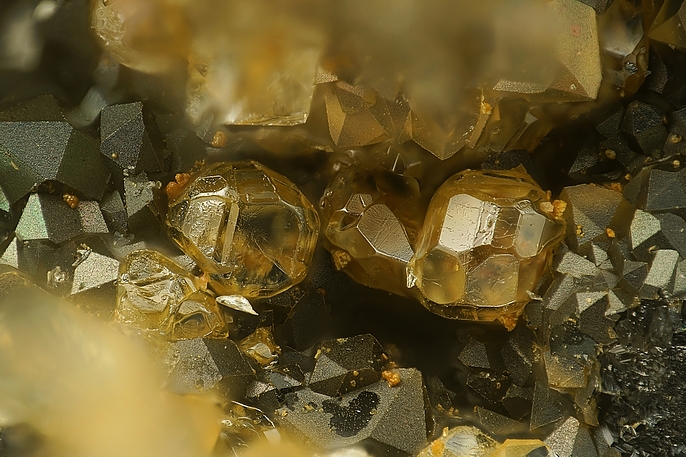

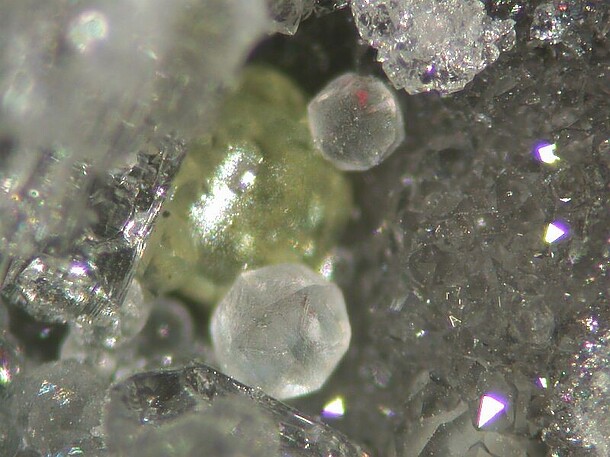

About Elpasolite
Unique Identifiers
IMA Classification of Elpasolite
Classification of Elpasolite
3 : HALIDES
C : Complex halides
B : Neso-aluminofluorides
11 : HALIDE COMPLEXES
6 : Aluminofluorides - Isolated Octahedra
8 : Halides - Fluorides, Chlorides, Bromides and Iodides; also Fluoborates and Fluosilicates
6 : Halides of Al
Mineral Symbols
| Symbol | Source | Reference for Standard |
|---|---|---|
| Elp | IMA–CNMNC | Warr, L.N. (2021). IMA–CNMNC approved mineral symbols. Mineralogical Magazine, 85(3), 291-320. doi:10.1180/mgm.2021.43 |
Physical Properties of Elpasolite
Chemistry of Elpasolite
Crystallography of Elpasolite
Crystal Structure
Unit Cell | Unit Cell Packed
2x2x2 | 3x3x3 | 4x4x4
Big Balls | Small Balls | Just Balls | Spacefill
Polyhedra Off | Si Polyhedra | All Polyhedra
Remove metal-metal sticks
Black Background | White Background
Perspective On | Perspective Off
2D | Stereo | Red-Blue | Red-Cyan
CIF File Best | x | y | z | a | b | c
Stop | Start
Console Off | On | Grey | Yellow
| ID | Species | Reference | Link | Year | Locality | Pressure (GPa) | Temp (K) |
|---|---|---|---|---|---|---|---|
| 0014819 | Elpasolite | Sabelli C (1987) Structure refinement of elpasolite from Cetine mine, Tuscany, Italy Neues Jahrbuch fur Mineralogie, Monatshefte 1987 481-487 | 1987 | Cetine mine, Tuscany, Italy | 0 | 293 | |
| 0017967 | Elpasolite | Menzer G (1932) Ueber die Kristallstrukturen der Kryolithgruppe _cod_database_code 1011068 Fortschritte der Mineralogie 17 61-61 | 1932 | 0 | 293 |
X-Ray Powder Diffraction
| d-spacing | Intensity |
|---|---|
| 2.863 Å | (100) |
| 2.024 Å | (100) |
| 2.336 Å | (80) |
| 1.428 Å | (60) |
| 0.795 Å | (60) |
| 0.905 Å | (50) |
| 1.650 Å | (40) |
Geological Environment
| Paragenetic Mode | Earliest Age (Ga) |
|---|---|
| Near-surface Processes | |
| 22 : Hydration and low-? subsurface aqueous alteration (see also #23) |
Type Occurrence of Elpasolite
Other Language Names for Elpasolite
Relationship of Elpasolite to other Species
| Cryolite | Na2NaAlF6 | Mon. 2/m |
| Simmonsite | Na2LiAlF6 | Mon. |
Common Associates
| 13 photos of Elpasolite associated with 'Amazonite' | K(AlSi3O8) |
| 12 photos of Elpasolite associated with Cryolite | Na2NaAlF6 |
| 8 photos of Elpasolite associated with Prosopite | CaAl2F4[(OH)4-xFx] |
| 7 photos of Elpasolite associated with Hydrokenoralstonite | Na0.5(Al,Mg)2(F,OH)6 · H2O |
| 6 photos of Elpasolite associated with Thomsenolite | NaCa[AlF6] · H2O |
| 3 photos of Elpasolite associated with Native Sulphur | S8 |
| 3 photos of Elpasolite associated with Gypsum | CaSO4 · 2H2O |
| 2 photos of Elpasolite associated with Fluorite | CaF2 |
| 2 photos of Elpasolite associated with Weberite | Na2Mg[AlF6]F |
| 2 photos of Elpasolite associated with Gearksutite | Ca[Al(F,OH)5(H2O)] |
Related Minerals - Strunz-mindat Grouping
| 3.CB.05 | Cryolithionite | Na3Al2(LiF4)3 |
| 3.CB.15 | Simmonsite | Na2LiAlF6 |
| 3.CB.15 | Cryolite | Na2NaAlF6 |
| 3.CB.20 | Colquiriite | CaLi[AlF6] |
| 3.CB.25 | Leonardsenite | MgAlF5 · 2H2O |
| 3.CB.25 | Weberite | Na2Mg[AlF6]F |
| 3.CB.30 | Karasugite | SrCa[Al(F,OH)7] |
| 3.CB.35 | Usovite | Ba2CaMgAl2F14 |
| 3.CB.40 | Thomsenolite | NaCa[AlF6] · H2O |
| 3.CB.40 | Pachnolite | NaCa[AlF6] · H2O |
| 3.CB.45 | Carlhintzeite | Ca2[AlF6]F · H2O |
| 3.CB.50 | Yaroslavite | Ca3Al2F10(OH)2 · H2O |
| 3.CB.55 | Sbacchiite | Ca2AlF7 |
| 3.CB.60 | Verneite | Na2Ca3Al2F14 |
Radioactivity
| Element | % Content | Activity (Bq/kg) | Radiation Type |
|---|---|---|---|
| Uranium (U) | 0.0000% | 0 | α, β, γ |
| Thorium (Th) | 0.0000% | 0 | α, β, γ |
| Potassium (K) | 32.2915% | 10,010 | β, γ |
For comparison:
- Banana: ~15 Bq per fruit
- Granite: 1,000–3,000 Bq/kg
- EU exemption limit: 10,000 Bq/kg
Note: Risk is shown relative to daily recommended maximum exposure to non-background radiation of 1000 µSv/year. Note that natural background radiation averages around 2400 µSv/year so in reality these risks are probably extremely overstated! With infrequent handling and safe storage natural radioactive minerals do not usually pose much risk.
Note: The mass selector refers to the mass of radioactive mineral present, not the full specimen, also be aware that the matrix may also be radioactive, possibly more radioactive than this mineral!
Activity: –
| Distance | Dose rate | Risk |
|---|---|---|
| 1 cm | ||
| 10 cm | ||
| 1 m |
The external dose rate (D) from a radioactive mineral is estimated by summing the gamma radiation contributions from its Uranium, Thorium, and Potassium content, disregarding daughter-product which may have a significant effect in some cases (eg 'pitchblende'). This involves multiplying the activity (A, in Bq) of each element by its specific gamma ray constant (Γ), which accounts for its unique gamma emissions. The total unshielded dose at 1 cm is then scaled by the square of the distance (r, in cm) and multiplied by a shielding factor (μshield). This calculation provides a 'worst-case' or 'maximum risk' estimate because it assumes the sample is a point source and entirely neglects any self-shielding where radiation is absorbed within the mineral itself, meaning actual doses will typically be lower. The resulting dose rate (D) is expressed in microsieverts per hour (μSv/h).
D = ((AU × ΓU) + (ATh × ΓTh) + (AK × ΓK)) / r2 × μshield
Fluorescence of Elpasolite
Other Information
Internet Links for Elpasolite
Please feel free to link to this page.
References for Elpasolite
Localities for Elpasolite
Showing 21 localities.
 symbol to view information about a locality.
The
symbol to view information about a locality.
The Locality List
 - This locality has map coordinates listed.
- This locality has estimated coordinates.
ⓘ - Click for references and further information on this occurrence.
? - Indicates mineral may be doubtful at this locality.
- This locality has map coordinates listed.
- This locality has estimated coordinates.
ⓘ - Click for references and further information on this occurrence.
? - Indicates mineral may be doubtful at this locality.
 - Good crystals or important locality for species.
 - World class for species or very significant.
(TL) - Type Locality for a valid mineral species.
(FRL) - First Recorded Locality for everything else (eg varieties).
- World class for species or very significant.
(TL) - Type Locality for a valid mineral species.
(FRL) - First Recorded Locality for everything else (eg varieties).
All localities listed without proper references should be considered as questionable.
Antarctica | |
| Kammerer (2011) |
Canada | |
| Peatfield (n.d.) |
Czech Republic | |
| Matýsek et al. (2022) |
DR Congo | |
| Bailey (1980) |
Greenland | |
| Pauly (1979) +1 other reference |
Italy | |
| Balassone et al. (2019) |
| Sabelli C. (1987) +1 other reference |
Russia | |
| Galina Gubko (2009) |
| Polyakov (1985) | |
| Pekov et al. (2008) |
| Pakhomovsky et al. (2014) |
| Pekov et al. (2008) | |
| Victor V. Sharygin analytycal data (2013) +2 other references |
Ukraine | |
| Yurk Yu.Yu. et al. (1973) +1 other reference |
| Kalyuzhnyi V.A. (1958) +2 other references |
USA (TL) | |
| Cross et al. (1883) +1 other reference |
| Gross et al. (1966) | |
| Eckel et al. (1997) |
| Foord et al. (1999) |
| O'Neill (2014) |
| Kearns (1995) +1 other reference |

Le Cetine di Cotorniano mine, Chiusdino, Siena Province, Tuscany, Italy