
Wealth of Nations Gold Mine, Dunnsville, Dunnsville-Jaurdi Hills Goldfield (Dunnsville-Jourdie Hills), Coolgardie Shire, Western Australia, Australiai
This page is currently not sponsored. Click here to sponsor this page.

Latitude & Longitude (WGS84):
30° 38' 3'' South , 120° 51' 56'' East
Latitude & Longitude (decimal):
Type:
Köppen climate type:
Nearest Settlements:
| Place | Population | Distance |
|---|---|---|
| Coolgardie | 802 (2016) | 45.4km |
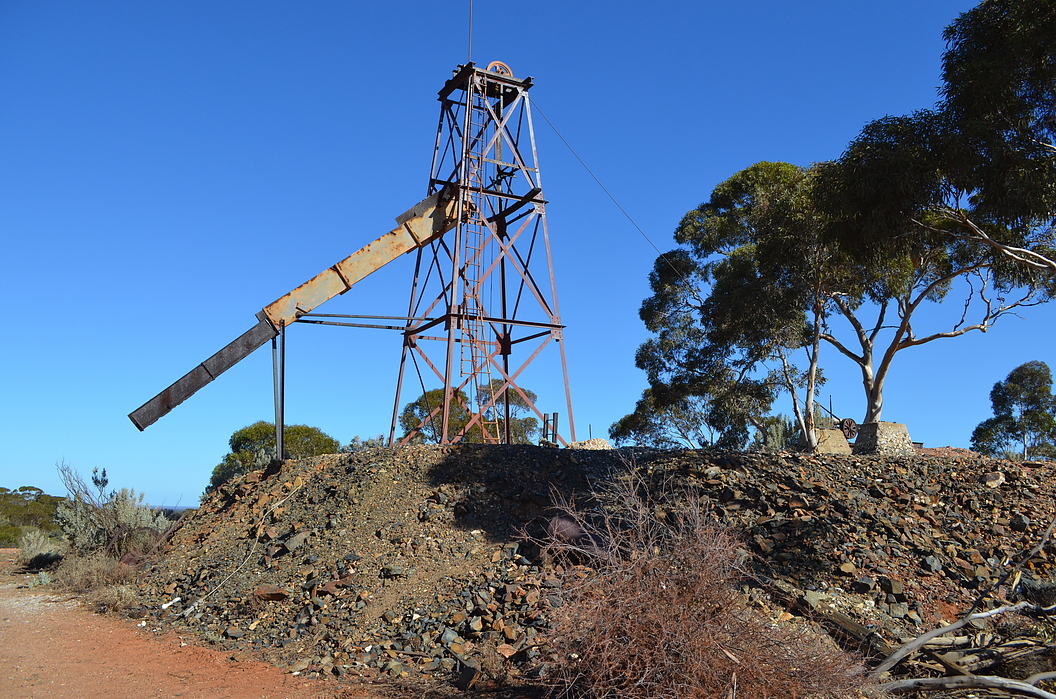
In 1894, this was the most reported mine in Australia. It caused a sensation for its fabulous richness in the upper levels. The mine turned out to be a large rich pocket near the surface, surrounded by low grade gold, and interest soon faded. The Wealth of Nations mine is at Dunnsville, 50 kilometres north-west of Coolgardie. In 1894, hundreds of men had rushed to the location, now it is a remote and little visited backwater.
John Dunn had been working for a syndicate for two years. The syndicate consisted of local politicians, no less than John Forrest (West Australian Premier), Arthur W. Hassell (M.L.A.), Alexander Forrest (Perth Mayor), W.E. Marmion (Mines Minister), Neil McNeil, C. Crossland, F. Monger (M.L.A.), the Dunn brothers- John, William and Thomas, amongst others with minor interests.
Discovery at the site is generally awarded to John Dunn. One source however states it was Indian camel driver Conick Mahomet, employed by Dunn. Within a few hours Dunn had picked up 1700 pounds
worth in 1894 sums of gold. One piece, christened 'Honest John' at 156 pounds had ounce sized pieces filling a fracture, and elsewhere was saturated with gold. The camel train contained 3000 ounces of gold worth 10 462 pounds worth of gold by 1894 standards.
Dunn soon sold his interest for 140 000 pounds. Sydney bank manager, Arthur Earle, successfully sued Dunn for one fifth of this. Three years before, Dunn and Earle had entered an agreement to form a syndicate, which was forgotten about until Dunn's find. The judge stated the agreement was never formally terminated.
Dunn's arrival in Coolgardie with camels loaded with gold, set off an immediate gold-rush to the site. Within a couple of days 600 men were at the site, in a feverish scene of activity. Dunn and some members of the syndicate arrived soon after, and tried to stop the taking of alluvial gold from the lease. It was too late as the ground was bare, but the alluvial miners proceeded to start digging. The syndicate estimated they lost 15 000 pounds worth of gold to the alluvial miners. Dunn and the syndicate were threatened with violence, and they returned to Coolgardie to obtain a police force.
Some order was restored. The syndicate began digging a prospecting shaft next to the reef, surrounded all the time by hordes of the alluvial men, crowding around to view what gold would be uncovered. It is said in 4 hours of digging, 24 000 pounds worth of gold in 1894 figures was recovered. One report states: 'The sight which met the gaze of the spectators on the reef being uncovered staggered all who saw the stone, which was one mass of gold, enormously rich'.
A company was floated in London early 1895 to develop the mine, raising 200 000 pounds. The mine produced some gold at 5 dwt, but not nearly enough for investors to re-coup their money. After the near surface riches had been exhausted, the ore body was found to be low grade, and the mine was soon let out to tributers.
In the early 1930's, the Goldfields Development Company re-opened the mine and erected a treatment plant. Norman Forrest and party is reported to have made a rich find at the mine in 1949, of specimen stone studded with gold.
To 1907 the mine had produced 6575 ounces of gold from 15 439 tonnes of ore, and across its entire mining period 1894 to 1938, 28 041 ounces of gold from 45 500 tonnes of ore.
No large scale modern mining has taken place at the site. Modern drilling has determined basic geology.. Gold is associated with north-west trending quartz veins, near the contact between basalt and shale. The quartz vein zone contains a large number of deformed, foliated, parallel, white quartz vein pods 1 to 3 metres wide, largely barren of gold. In this are also a number of narrower 10-20 cm wide laminated quartz veins with distinct haloes, and a series of mm wide veinlets, both containing gold.
Select Mineral List Type
Standard Detailed Gallery Strunz Chemical ElementsCommodity List
This is a list of exploitable or exploited mineral commodities recorded at this locality.Mineral List
2 valid minerals.
Rock Types Recorded
Note: data is currently VERY limited. Please bear with us while we work towards adding this information!
Select Rock List Type
Alphabetical List Tree DiagramDetailed Mineral List:
| ⓘ Native Gold Formula: Au |
| ⓘ Quartz Formula: SiO2 |
Gallery:
List of minerals arranged by Strunz 10th Edition classification
| Group 1 - Elements | |||
|---|---|---|---|
| ⓘ | Native Gold | 1.AA.05 | Au |
| Group 4 - Oxides and Hydroxides | |||
| ⓘ | Quartz | 4.DA.05 | SiO2 |
List of minerals for each chemical element
| O | Oxygen | |
|---|---|---|
| O | ⓘ Quartz | SiO2 |
| Si | Silicon | |
| Si | ⓘ Quartz | SiO2 |
| Au | Gold | |
| Au | ⓘ Native Gold | Au |
Other Regions, Features and Areas containing this locality
Australia
- Western Australia
- Kambalda Nickel Metallogenic ProvinceGeologic Province
- West Australian ElementCraton
- Yilgarn CratonCraton
Australian PlateTectonic Plate
- West Australian Craton
- Eastern Yilgarn CratonCraton
This page contains all mineral locality references listed on mindat.org. This does not claim to be a complete list. If you know of more minerals from this site, please register so you can add to our database. This locality information is for reference purposes only. You should never attempt to
visit any sites listed in mindat.org without first ensuring that you have the permission of the land and/or mineral rights holders
for access and that you are aware of all safety precautions necessary.

Wealth of Nations Gold Mine, Dunnsville, Dunnsville-Jaurdi Hills Goldfield, Coolgardie Shire, Western Australia, Australia