
High Down Quarry, West Buckland, North Devon, Devon, England, UKi
| Regional Level Types | |
|---|---|
| High Down Quarry | Quarry (Abandoned) |
| West Buckland | Village |
| North Devon | District |
| Devon | County |
| England | Constituent Country |
| UK | Country |
This page is currently not sponsored. Click here to sponsor this page.


Latitude & Longitude (WGS84):
51° 2' 38'' North , 3° 55' 30'' West
Latitude & Longitude (decimal):
Type:
Quarry (Abandoned) - last checked 2019
Deposit first discovered:
Before 1785
Köppen climate type:
Nearest Settlements:
| Place | Population | Distance |
|---|---|---|
| Swimbridge | 669 (2018) | 3.3km |
| Chittlehampton | 239 (2018) | 3.8km |
| South Molton | 5,108 (2018) | 7.1km |
| Goodleigh | 450 (2018) | 7.4km |
| Bratton Fleming | 928 (2018) | 8.8km |
Other/historical names associated with this locality:
Heddon Quarry
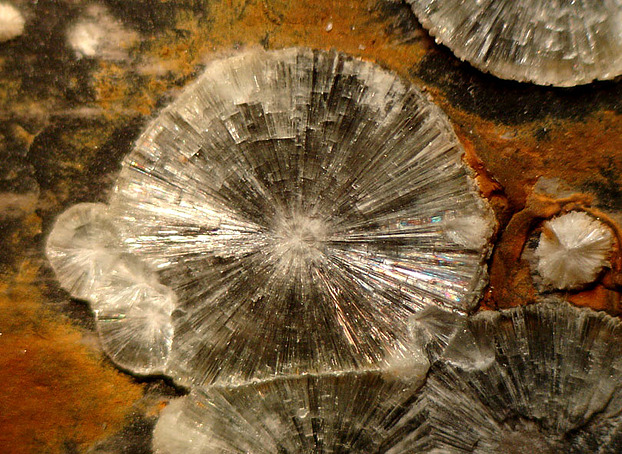
Type locality for wavellite.
'High Down Quarry' is an ancient quarry. It is one of the few type localities which, although hundreds of years old, still has the potential to provide museum quality specimens. A specimen on public display in Barnstaple Museum is claimed to have been one of the original ones collected prior to 1785 by John Hill. Another numbered specimen on display can be traced as part of the Townshend Hall Collection and is identified as one of six that came via a local Doctor and originally from Dr. Wavell himself. The quarry listed by Natural England as an SSSI is opened in the Codden Hill Cherts, and there appears to be no record of when the quarry was active.
Interestingly, this quarry, together with others, appears on a map dated about 1780 in the Fortescue archive in Exeter. No map from 1780 to the present actually names any of the quarries. The author of this [David Ifold] has been unable to find any genuinely old labels on specimens that say 'High Down Quarry'. The name High Down Quarry first appears in the literature in 1910 when Inkermann Rogers (1866-1959) led a field trip in North Devon.
It is important to note that wavellite has been recorded in recent years from at least three quarries which are covered by the geographical name High Down. Hence, this may not be the exact quarry that the type specimens came from. In fact, whilst someone was digging holes for garden fence posts nearby, broken hemispheres to 11 mm of wavellite were thrown aside. Collectors might like to think carefully about where their specimens actually came from and label them with a grid reference if appropriate. The quarry behind High Down Cottages also yields wavellite specimens, although collecting is currently not permitted.
The phosphate minerals in the High Down area appear to be present in particular beds adjacent to areas where coprolites are found. Tracing the Codden Hill Cherts west and east reveals other phosphate mineral locations where variscite, cacoxenite, crandallite and further wavellite occurs.
The quarry given Site of Special Scientific Interest (SSSI) status is close to Heddon, which would be a better and much less confusing name. As wavellite occurs so close to the surface, the old specimens in museums may have been found when the cottages were built or the local roads completed. Wavellite occurs as hemispheres and exceptionally rarely as complete spheres. The phosphate is likely to be of fossil origin.
The quarry listed as the type locality is privately owned by The Castle Hill Estate. The estate management will respond favourably to written requests to visit the quarry outside the pheasant shooting season. Collecting also requires the written consent of Natural England, who will check with the landowners. Consent for sensible non-commercial collecting may be given from 1st March to the end of August.
Devon wavellite is a classic example of how mineral 'experts' have 'corrected' labels and reduced the scientific value of their material. Old specimens are labelled Devonshire, Barnstaple, Barnstable, Filleigh or South Molton. There are numerous North Devon locations that can produce specimens, but sadly, collectors unfamiliar with the area do not recognize this. Indeed, the quarry behind High Down Cottages produces identical material to the quarry that Natural England call High Down Quarry!
Wavellite from this area is commonly strongly fluorescent in LW UV light and shows yellowish phosphorescence for several seconds on removal of the UV source.
Select Mineral List Type
Standard Detailed Gallery Strunz Chemical ElementsMineral List
6 valid minerals. 1 (TL) - type locality of valid minerals.
Rock Types Recorded
Note: data is currently VERY limited. Please bear with us while we work towards adding this information!
Select Rock List Type
Alphabetical List Tree DiagramDetailed Mineral List:
| ⓘ Evansite ? Formula: Al3(PO4)(OH)6 · 6H2O Habit: Amorphous. Colour: Milk white to creamy white, also various light to mid browns when stained by 'limonite' Description: Many fracture surfaces in the Wavellite-rich mudstones are coated with a milky-white, amorphous material, often stained with 'limonite'. No crystalline structure has been observed in this material to date. Some fractures completely infilled with this material.
Placement on the outside of wavellite balls places formation late in the mineralisation of the site.
While still wet, the texture is somewhat greasy and reminiscent of fungal growth, but on drying, a fine, earthy texture is revealed, with a hardness of around 2.5 - 3
Tentative identification requires further investigation. References: |
| ⓘ Goethite Formula: Fe3+O(OH) Habit: Massive, encrusting Colour: Brownish-black to golden-brown, often iridescent Description: Appears as brownish-black, varnish-like films,dark brown to golden-brown encrustations and as fine, iridescent, botryoidal films. References: |
| ⓘ Gypsum Formula: CaSO4 · 2H2O Habit: Euhedral, typically blocky, tabular, occasionally prismatic to 2mm. Also encrusting, anhedral. Colour: Clear white to yellowish and brownish. Description: Soft, delicate druses of fine gypsum crystals on some parts of the quarry north wall. Occasionally deposited on mosses and lichens. References: |
| ⓘ 'Limonite' Colour: Chocolate brown Description: Limonite in botryoidal apprearence is present on the matrix. References: |
| ⓘ Quartz Formula: SiO2 Habit: Druses of crystal points, otherwise massive. Colour: White, transparent. Description: Found as druses and massive veins in some fractures; A major quartz mass exists as a vein filling a fault that cuts the northern wall of the quarry - here the quartz encloses brecciated mudstones, and itself is somewhat brecciated. References: |
| ⓘ Variscite Formula: AlPO4 · 2H2O |
| ⓘ Wavellite (TL) Formula: Al3(PO4)2(OH)3 · 5H2O Type Locality: References: |

List of minerals arranged by Strunz 10th Edition classification
| Group 4 - Oxides and Hydroxides | |||
|---|---|---|---|
| ⓘ | Goethite | 4.00. | Fe3+O(OH) |
| ⓘ | Quartz | 4.DA.05 | SiO2 |
| Group 7 - Sulphates, Chromates, Molybdates and Tungstates | |||
| ⓘ | Gypsum | 7.CD.40 | CaSO4 · 2H2O |
| Group 8 - Phosphates, Arsenates and Vanadates | |||
| ⓘ | Variscite | 8.CD.10 | AlPO4 · 2H2O |
| ⓘ | Wavellite (TL) | 8.DC.50 | Al3(PO4)2(OH)3 · 5H2O |
| ⓘ | Evansite ? | 8.DF.10 | Al3(PO4)(OH)6 · 6H2O |
| Unclassified | |||
| ⓘ | 'Limonite' | - | |
List of minerals for each chemical element
| H | Hydrogen | |
|---|---|---|
| H | ⓘ Evansite | Al3(PO4)(OH)6 · 6H2O |
| H | ⓘ Goethite | Fe3+O(OH) |
| H | ⓘ Gypsum | CaSO4 · 2H2O |
| H | ⓘ Variscite | AlPO4 · 2H2O |
| H | ⓘ Wavellite | Al3(PO4)2(OH)3 · 5H2O |
| O | Oxygen | |
| O | ⓘ Evansite | Al3(PO4)(OH)6 · 6H2O |
| O | ⓘ Goethite | Fe3+O(OH) |
| O | ⓘ Gypsum | CaSO4 · 2H2O |
| O | ⓘ Quartz | SiO2 |
| O | ⓘ Variscite | AlPO4 · 2H2O |
| O | ⓘ Wavellite | Al3(PO4)2(OH)3 · 5H2O |
| Al | Aluminium | |
| Al | ⓘ Evansite | Al3(PO4)(OH)6 · 6H2O |
| Al | ⓘ Variscite | AlPO4 · 2H2O |
| Al | ⓘ Wavellite | Al3(PO4)2(OH)3 · 5H2O |
| Si | Silicon | |
| Si | ⓘ Quartz | SiO2 |
| P | Phosphorus | |
| P | ⓘ Evansite | Al3(PO4)(OH)6 · 6H2O |
| P | ⓘ Variscite | AlPO4 · 2H2O |
| P | ⓘ Wavellite | Al3(PO4)2(OH)3 · 5H2O |
| S | Sulfur | |
| S | ⓘ Gypsum | CaSO4 · 2H2O |
| Ca | Calcium | |
| Ca | ⓘ Gypsum | CaSO4 · 2H2O |
| Fe | Iron | |
| Fe | ⓘ Goethite | Fe3+O(OH) |
Other Regions, Features and Areas containing this locality
British and Irish IslesGroup of Islands
Eurasian PlateTectonic Plate
- Rheno-Hercynian BeltOrogenic Belt
EuropeContinent
UK
- England
- Cornubian mining districtMining District
This page contains all mineral locality references listed on mindat.org. This does not claim to be a complete list. If you know of more minerals from this site, please register so you can add to our database. This locality information is for reference purposes only. You should never attempt to
visit any sites listed in mindat.org without first ensuring that you have the permission of the land and/or mineral rights holders
for access and that you are aware of all safety precautions necessary.

High Down Quarry, West Buckland, North Devon, Devon, England, UK