
Copper Valley Mine, Cheshire, New Haven County, Connecticut, USAi
| Regional Level Types | |
|---|---|
| Copper Valley Mine | Mine |
| Cheshire | Town |
| New Haven County | County |
| Connecticut | State |
| USA | Country |
This page is currently not sponsored. Click here to sponsor this page.




Latitude & Longitude (WGS84):
41° 29' 7'' North , 72° 52' 5'' West
Latitude & Longitude (decimal):
Type:
Köppen climate type:
Nearest Settlements:
| Place | Population | Distance |
|---|---|---|
| Cheshire | 29,443 (2017) | 3.1km |
| Cheshire Village | 5,786 (2017) | 3.2km |
| Wallingford | 17,712 (2017) | 4.9km |
| Wallingford Center | 18,209 (2017) | 5.7km |
| Meriden | 59,988 (2017) | 7.8km |
Nearest Clubs:
Local clubs are the best way to get access to collecting localities
Local clubs are the best way to get access to collecting localities
| Club | Location | Distance |
|---|---|---|
| Lapidary and Mineral Society of Central Connecticut | Meriden, Connecticut | 8km |
| New Haven Mineral Club | New Haven, Connecticut | 20km |
| Bristol Gem & Mineral Club | Bristol, Connecticut | 22km |
| Danbury Mineralogical Society | Danbury, Connecticut | 50km |
Other/historical names associated with this locality:
Belcher's Mine, Bellamy's Mine, Munson's Mine
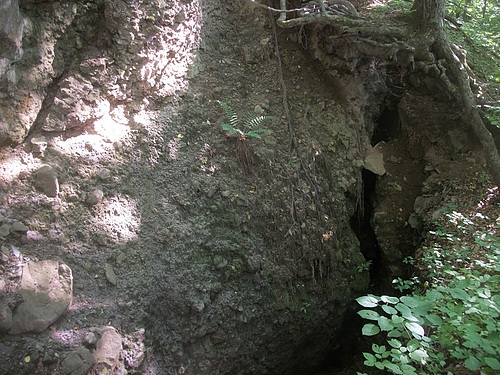
A complex of pits, adits and shafts in two clusters straddling a diabase dike. Coordinates are for the northern cluster, the southern cluster is at 41.483309 -72.869056.
Harte (1944) provides some details of its history:
In what was then a part of Wallingford, but now in the southeast corner of Cheshire, one John Parker, in 1711, was reported to have found copper and perhaps other valuable metals on his farm, which was on “Milkingyard Hill”....
Shortly after this, William Partridge of Newbury and Jonathan Belcher of Boston, merchant, both of the Province of Massachusetts Bay, entered into Articles of Agreement with the town of Wallingford for the opening of mines there, the miners, artificers and laborers connected with them to be exempted from all civil and military duties and all taxes; the lease to run eight years, with the privilege of renewal for a period “not exceeding 500 years in the whole”.
Shortly after this, William Partridge of Newbury and Jonathan Belcher of Boston, merchant, both of the Province of Massachusetts Bay, entered into Articles of Agreement with the town of Wallingford for the opening of mines there, the miners, artificers and laborers connected with them to be exempted from all civil and military duties and all taxes; the lease to run eight years, with the privilege of renewal for a period “not exceeding 500 years in the whole”.
On June 16, 1714 John Parker was given 10 shillings so that "Parker be forever hereafter quiet and contented with respect to ye mine money."
Mining continued through at least 1724, after which Harte (1944) says there are no records until:
October of 1854 Truman Bristol granted Sanderson Smith mining rights on a 30 acre tract of land at 'Copper Valley'. Smith failed to meet his obligations, and in September of 1866 Bristol gave Charles Munson and Leonard Pardee the entire and exclusive right of mining, quarrying, digging, and excavating, for minerals and metals...
There is practically nothing regarding the amount of ore raised. Munson seems to have worked the mine himself part of the time, and on other occasions to have leased the property. In 1874 Nathan Peck and Isaac Anderson, lessees, agreed to spend $25,000 'because of the increasing flow of water in shafts and levels'; to deepen the shaft somewhat for a water receiver; to extend easterly the drift on the line of the east and west vein; and to install a portable steam hoisting engine.
Munson took great interest in the mine, and personally went to great lengths to make it a success. Ore of a superior quality was obtained, but the shafts, sunk to a depth of more than one hundred feet, and the drifts run from them, encountered water in greater quantity than could be controlled. Munson is said to have sunk $50,000 of his own money in the project, and various lessees also spent substantial sums, but to no avail, and the leased property eventually reverted to Truman Bristol. However, Mr. George R. Johnson of Copper Valley said that Mr. Munson, at that time in his ninetieth year, wrote him that he had not lost faith in the mine; that he felt that they not gone down deep enough 'to remove the cover off the precious metal'.
There is practically nothing regarding the amount of ore raised. Munson seems to have worked the mine himself part of the time, and on other occasions to have leased the property. In 1874 Nathan Peck and Isaac Anderson, lessees, agreed to spend $25,000 'because of the increasing flow of water in shafts and levels'; to deepen the shaft somewhat for a water receiver; to extend easterly the drift on the line of the east and west vein; and to install a portable steam hoisting engine.
Munson took great interest in the mine, and personally went to great lengths to make it a success. Ore of a superior quality was obtained, but the shafts, sunk to a depth of more than one hundred feet, and the drifts run from them, encountered water in greater quantity than could be controlled. Munson is said to have sunk $50,000 of his own money in the project, and various lessees also spent substantial sums, but to no avail, and the leased property eventually reverted to Truman Bristol. However, Mr. George R. Johnson of Copper Valley said that Mr. Munson, at that time in his ninetieth year, wrote him that he had not lost faith in the mine; that he felt that they not gone down deep enough 'to remove the cover off the precious metal'.
However Shepard (1837) apparently fills in some of the missing years with this account of what appears from it's geographical location to be the same place:
It was commenced in 1812 [sic - he must mean 1712], by commissioners appointed by the King's bench. Tradition says that a shaft ninety feet deep was sunk, and of a size sufficient in two places to receive a large dwelling house. Two ship-loads of ore, it is also reported, were transmitted at this period to England. Some attempts were made to renew the enterprise early the present century, but were soon abandoned. The mine is at present owned by Mr. AARON BELLAMY of Otsego, N. Y., who is a descendant of the individual interested in the first exploration. This gentleman, aided by a company in Canada, commenced the clearing of the mine in 1836. The shaft was completely occupied by timbers and rubbish. A small steam-engine is made use of for lifting out the water. They had descended about twenty-five feet in August last, and among the materials brought up, good vitreous copper [chalcocite] was observed, often associated with heavy spar [barite], and occasionally in distinct crystals (578b). On the north side of the shaft, a dyke of trap is visible, having the width of three feet, in contact with which the ore seems to occur. The intersected sandstone for several feet on each side, is more or less stained with malachite.
Schairer (1931) had this to say:
Large chunks of chalcocite and bornite covered with malachite are still available both on the dumps and in the exposed vein in trap rock. Calcite crystals (dog-tooth spar) are common; talc is rare.
Select Mineral List Type
Standard Detailed Gallery Strunz Chemical ElementsCommodity List
This is a list of exploitable or exploited mineral commodities recorded at this locality.Mineral List
10 valid minerals.
Detailed Mineral List:
| ⓘ Allophane Formula: (Al2O3)(SiO2)1.3-2 · 2.5-3H2O Habit: encrustations Colour: pale blue References: |
| ⓘ Baryte Formula: BaSO4 Habit: cleavable masses Colour: white |
| ⓘ Bornite Formula: Cu5FeS4 Habit: massive Description: Large chunks of chalcocite and bornite covered with malachite (Schairer, 1931). |
| ⓘ Calcite Formula: CaCO3 Habit: scalenohedral Fluorescence: orange-red to deep pink Description: Forms much of the gangue. |
| ⓘ Chalcocite Formula: Cu2S Habit: massive and crystallized Colour: b Description: "Large chunks of chalcocite and bornite covered with malachite" (Schairer, 1931). "At Bellamy's mine in Cheshire, it is both massive and crystallized. The crystals have the form represented by figs. 461 and 462 of my Mineralogy. It is usually disseminated through sandstone-conglomerate, and is often attended by green malachite, calcareous spar [calcite] and heavy spar [barite]" (Shepard, 1837). |
| ⓘ Chrysocolla Formula: Cu2-xAlx(H2-xSi2O5)(OH)4 · nH2O, x < 1 Habit: encrustations Colour: blue-green Description: Encrustations, less abundant than malachite. References: |
| ⓘ Cuprite Formula: Cu2O Habit: encrustations Colour: maroon Description: Thin secondary crusts on other minerals but associated with the primary chalcocite and bornite. Easy to mistake for hematite. |
| ⓘ Malachite Formula: Cu2(CO3)(OH)2 Habit: encrustations Colour: green Description: Post-mine formations on bornite and chalcocite. References: |
| ⓘ 'Serpentine Subgroup' Formula: D3[Si2O5](OH)4 Habit: massive, pseudomorph after unknown mineral Colour: olive green Description: A small, 1 cm rectangular pseudomorph of serpentine after an unknown mineral in massive calcite with bornite. References: |
| ⓘ Talc Formula: Mg3Si4O10(OH)2 |
| ⓘ Willemite Formula: Zn2SiO4 Habit: aggregates of acicular crystals Colour: white Fluorescence: green Description: Solid aggregates to about 1 cm |
Gallery:
List of minerals arranged by Strunz 10th Edition classification
| Group 2 - Sulphides and Sulfosalts | |||
|---|---|---|---|
| ⓘ | Chalcocite | 2.BA.05 | Cu2S |
| ⓘ | Bornite | 2.BA.15 | Cu5FeS4 |
| Group 4 - Oxides and Hydroxides | |||
| ⓘ | Cuprite | 4.AA.10 | Cu2O |
| Group 5 - Nitrates and Carbonates | |||
| ⓘ | Calcite | 5.AB.05 | CaCO3 |
| ⓘ | Malachite | 5.BA.10 | Cu2(CO3)(OH)2 |
| Group 7 - Sulphates, Chromates, Molybdates and Tungstates | |||
| ⓘ | Baryte | 7.AD.35 | BaSO4 |
| Group 9 - Silicates | |||
| ⓘ | Willemite | 9.AA.05 | Zn2SiO4 |
| ⓘ | Talc | 9.EC.05 | Mg3Si4O10(OH)2 |
| ⓘ | Allophane | 9.ED.20 | (Al2O3)(SiO2)1.3-2 · 2.5-3H2O |
| ⓘ | Chrysocolla | 9.ED.20 | Cu2-xAlx(H2-xSi2O5)(OH)4 · nH2O, x < 1 |
| Unclassified | |||
| ⓘ | 'Serpentine Subgroup' | - | D3[Si2O5](OH)4 |
List of minerals for each chemical element
| H | Hydrogen | |
|---|---|---|
| H | ⓘ Allophane | (Al2O3)(SiO2)1.3-2 · 2.5-3H2O |
| H | ⓘ Chrysocolla | Cu2-xAlx(H2-xSi2O5)(OH)4 · nH2O, x < 1 |
| H | ⓘ Malachite | Cu2(CO3)(OH)2 |
| H | ⓘ Talc | Mg3Si4O10(OH)2 |
| H | ⓘ Serpentine Subgroup | D3[Si2O5](OH)4 |
| C | Carbon | |
| C | ⓘ Calcite | CaCO3 |
| C | ⓘ Malachite | Cu2(CO3)(OH)2 |
| O | Oxygen | |
| O | ⓘ Allophane | (Al2O3)(SiO2)1.3-2 · 2.5-3H2O |
| O | ⓘ Baryte | BaSO4 |
| O | ⓘ Calcite | CaCO3 |
| O | ⓘ Chrysocolla | Cu2-xAlx(H2-xSi2O5)(OH)4 · nH2O, x < 1 |
| O | ⓘ Cuprite | Cu2O |
| O | ⓘ Malachite | Cu2(CO3)(OH)2 |
| O | ⓘ Talc | Mg3Si4O10(OH)2 |
| O | ⓘ Willemite | Zn2SiO4 |
| O | ⓘ Serpentine Subgroup | D3[Si2O5](OH)4 |
| Mg | Magnesium | |
| Mg | ⓘ Talc | Mg3Si4O10(OH)2 |
| Al | Aluminium | |
| Al | ⓘ Allophane | (Al2O3)(SiO2)1.3-2 · 2.5-3H2O |
| Al | ⓘ Chrysocolla | Cu2-xAlx(H2-xSi2O5)(OH)4 · nH2O, x < 1 |
| Si | Silicon | |
| Si | ⓘ Allophane | (Al2O3)(SiO2)1.3-2 · 2.5-3H2O |
| Si | ⓘ Chrysocolla | Cu2-xAlx(H2-xSi2O5)(OH)4 · nH2O, x < 1 |
| Si | ⓘ Talc | Mg3Si4O10(OH)2 |
| Si | ⓘ Willemite | Zn2SiO4 |
| Si | ⓘ Serpentine Subgroup | D3[Si2O5](OH)4 |
| S | Sulfur | |
| S | ⓘ Baryte | BaSO4 |
| S | ⓘ Bornite | Cu5FeS4 |
| S | ⓘ Chalcocite | Cu2S |
| Ca | Calcium | |
| Ca | ⓘ Calcite | CaCO3 |
| Fe | Iron | |
| Fe | ⓘ Bornite | Cu5FeS4 |
| Cu | Copper | |
| Cu | ⓘ Bornite | Cu5FeS4 |
| Cu | ⓘ Chalcocite | Cu2S |
| Cu | ⓘ Chrysocolla | Cu2-xAlx(H2-xSi2O5)(OH)4 · nH2O, x < 1 |
| Cu | ⓘ Cuprite | Cu2O |
| Cu | ⓘ Malachite | Cu2(CO3)(OH)2 |
| Zn | Zinc | |
| Zn | ⓘ Willemite | Zn2SiO4 |
| Ba | Barium | |
| Ba | ⓘ Baryte | BaSO4 |
Other Regions, Features and Areas containing this locality
North AmericaContinent
North America PlateTectonic Plate
- Ganderia DomainDomain
- GranderiaPassive Margin
This page contains all mineral locality references listed on mindat.org. This does not claim to be a complete list. If you know of more minerals from this site, please register so you can add to our database. This locality information is for reference purposes only. You should never attempt to
visit any sites listed in mindat.org without first ensuring that you have the permission of the land and/or mineral rights holders
for access and that you are aware of all safety precautions necessary.

Copper Valley Mine, Cheshire, New Haven County, Connecticut, USA