
Amosite
A variety of Grunerite
This page is currently not sponsored. Click here to sponsor this page.
About Amosite
Formula:
◻{Fe2+2}{Fe2+5}(Si8O22)(OH)2
Name:
Acronym of Asbestos Mines of South Africa.
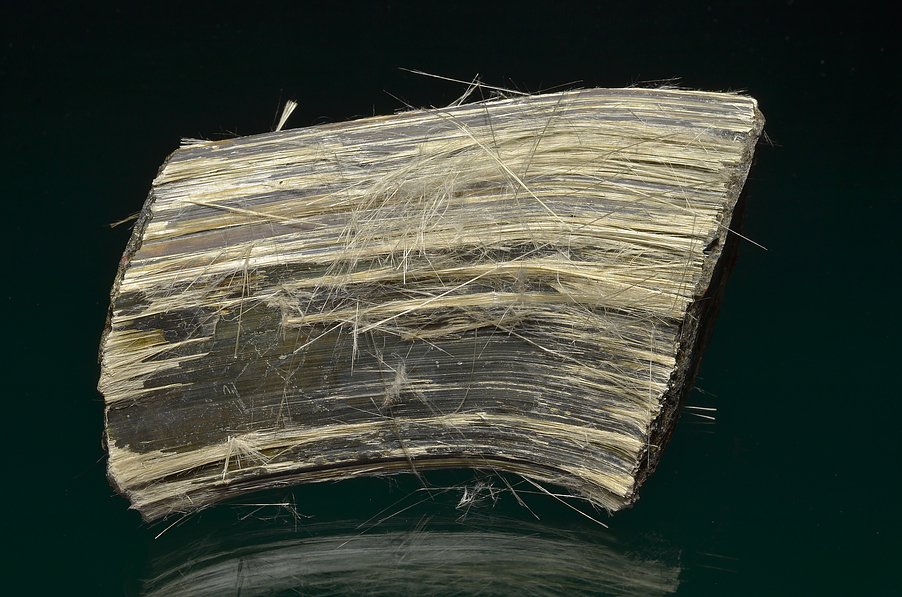
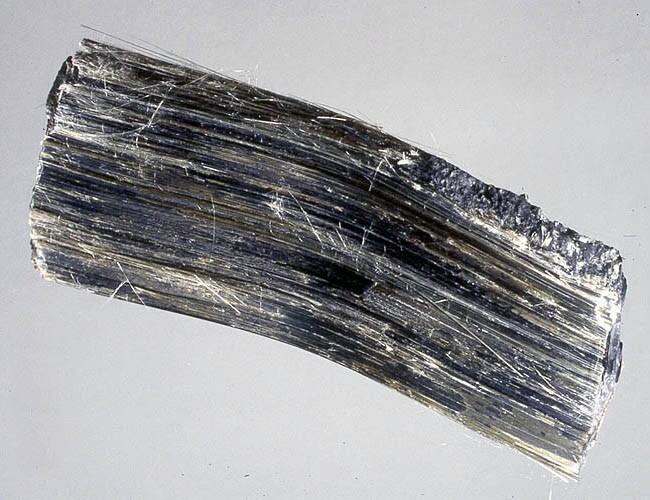
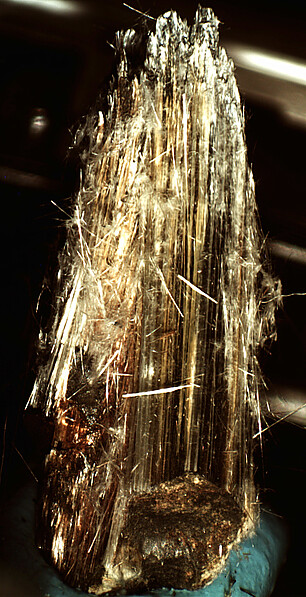
A fibrous variety of grunerite, also known as "brown asbestos". The name has also been used to refer to other asbestiform amphibole-group materials, such as cummingtonite.
According to http://en.wikipedia.org/wiki/Asbestos, "amosite" (CAS No. 12172-73-5) is a trade name for the amphiboles belonging to the cummingtonite-grunerite solid solution series, commonly from South Africa, named as an acronym from Asbestos Mines of South Africa.
Not to be confused with the serpentine-group mineral amesite.
According to http://en.wikipedia.org/wiki/Asbestos, "amosite" (CAS No. 12172-73-5) is a trade name for the amphiboles belonging to the cummingtonite-grunerite solid solution series, commonly from South Africa, named as an acronym from Asbestos Mines of South Africa.
Not to be confused with the serpentine-group mineral amesite.
Unique Identifiers
Mindat ID:
8738 (as Amosite)
1758 (as Grunerite)
1758 (as Grunerite)
Long-form identifier:
mindat:1:1:8738:0 (as Amosite)
mindat:1:1:1758:5 (as Grunerite)
mindat:1:1:1758:5 (as Grunerite)
Similar Names
| Amausit | A synonym of 'Oligoclase' | |
| Amausite | A rock subtype | |
| Amesite | A valid IMA mineral species - grandfathered | Mg2Al(AlSiO5)(OH)4 |
| Amicite | A valid IMA mineral species | K2Na2Al4Si4O16 · 5H2O |
| Lamosite | A synonym of 'Lamalginite' | |
| Ramosite | A valid IMA mineral species - pending publication | Pb25.7Sn8.3Mn3.4Sb6.4S56.2 |
Chemistry of Amosite
Mindat Formula:
◻{Fe2+2}{Fe2+5}(Si8O22)(OH)2
Element Weights:
Elements listed:
Synonyms of Amosite
Other Language Names for Amosite
Common Associates
Other Information
Health Risks:
Amosite asbestos has been banned in the UK and many other countries as the fibres and dust can cause serious lung conditions if inhaled. Any handling of material containing amosite asbestos should be done only by those who are trained and properly equipped in its handling and disposal.
Collectors who have small samples of Amosite or other asbestos minerals are advised to keep them in sealed plastic boxes where they are, of course, perfectly safe.
Ref: http://en.wikipedia.org/wiki/Asbestos
This mineral is known to be a respirable carcinogen, and is a common form of asbestos. Exposure to very dusty air or long-term exposure to low level airborne dusts containing fine fibres of chrysotile has been found to cause a high risk of serious lung disease including mesothelioma and lung cancer. Care should be taken working with samples that contain fibrous forms of this mineral, to avoid creating or inhaling dusts. Non-fibrous forms, such as in many amphibolites, are safer to handle, but can still produce potentially carcinogenic respirable fibre when crushed. Appropriate dust masks should be worn if working in areas which have dusts likely to be rich in this mineral. Storage and careful handling of specimens has little or no risk.
Collectors who have small samples of Amosite or other asbestos minerals are advised to keep them in sealed plastic boxes where they are, of course, perfectly safe.
Ref: http://en.wikipedia.org/wiki/Asbestos
This mineral is known to be a respirable carcinogen, and is a common form of asbestos. Exposure to very dusty air or long-term exposure to low level airborne dusts containing fine fibres of chrysotile has been found to cause a high risk of serious lung disease including mesothelioma and lung cancer. Care should be taken working with samples that contain fibrous forms of this mineral, to avoid creating or inhaling dusts. Non-fibrous forms, such as in many amphibolites, are safer to handle, but can still produce potentially carcinogenic respirable fibre when crushed. Appropriate dust masks should be worn if working in areas which have dusts likely to be rich in this mineral. Storage and careful handling of specimens has little or no risk.
Internet Links for Amosite
mindat.org URL:
https://www.mindat.org/min-8738.html
Please feel free to link to this page.
Please feel free to link to this page.
Search Engines:
Mineral Dealers:
References for Amosite
Reference List:
Localities for Amosite
Showing 5 localities.
 symbol to view information about a locality.
The
symbol to view information about a locality.
The Locality List
 - This locality has map coordinates listed.
- This locality has estimated coordinates.
ⓘ - Click for references and further information on this occurrence.
? - Indicates mineral may be doubtful at this locality.
- This locality has map coordinates listed.
- This locality has estimated coordinates.
ⓘ - Click for references and further information on this occurrence.
? - Indicates mineral may be doubtful at this locality.
 - Good crystals or important locality for species.
 - World class for species or very significant.
(TL) - Type Locality for a valid mineral species.
(FRL) - First Recorded Locality for everything else (eg varieties).
- World class for species or very significant.
(TL) - Type Locality for a valid mineral species.
(FRL) - First Recorded Locality for everything else (eg varieties).
All localities listed without proper references should be considered as questionable.
Bolivia | |
| Rivas et al. (1998) |
Botswana | |
| Phili et al. (2024) |
Russia | |
| Kovalev et al. (2023) |
South Africa | |
| Miyano et al. (1997) |
| www.minresco.com/syst/a.htm +2 other references |

Penge Mine, Fetakgomo Tubatse Local Municipality, Sekhukhune District Municipality, Limpopo, South Africa