
Beryllonite
A valid IMA mineral species - grandfathered
This page is currently not sponsored. Click here to sponsor this page.


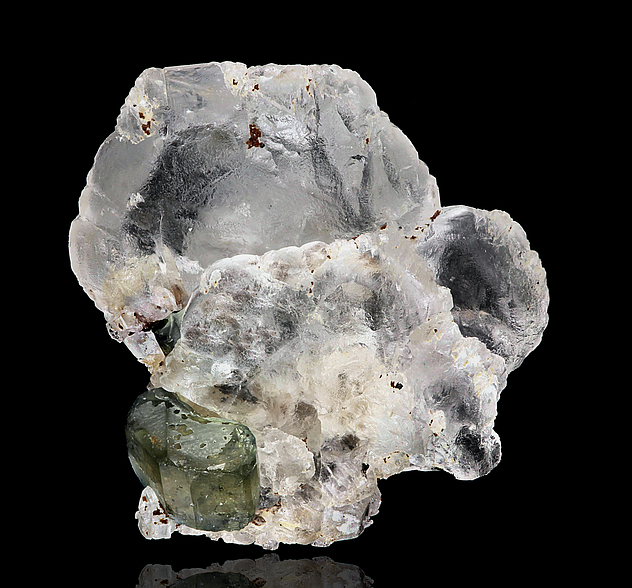
About Beryllonite
Formula:
NaBePO4
Colour:
Colourless, white, rarely pale light yellow; colourless in transmitted light.
Lustre:
Sub-Vitreous, Resinous, Waxy, Greasy
Hardness:
5½ - 6
Specific Gravity:
2.77 - 2.85
Crystal System:
Monoclinic
Name:
Named by Edward S. Dana in 1888 in allusion to its composition, containing beryllium.
Structurally closely related to trimerite.
 Visit gemdat.org for gemological information about Beryllonite.
Visit gemdat.org for gemological information about Beryllonite.Unique Identifiers
Mindat ID:
644
Long-form identifier:
mindat:1:1:644:4
Similar Names
| Berlinite | A valid IMA mineral species - grandfathered | AlPO4 |
| Borolanite | A rock subtype |
IMA Classification of Beryllonite
Approved, 'Grandfathered' (first described prior to 1959)
First published:
1888
Classification of Beryllonite
8.AA.10
8 : PHOSPHATES, ARSENATES, VANADATES
A : Phosphates, etc. without additional anions, without H2O
A : With small cations (some also with larger ones)
8 : PHOSPHATES, ARSENATES, VANADATES
A : Phosphates, etc. without additional anions, without H2O
A : With small cations (some also with larger ones)
Dana 7th ed.:
38.1.5.1
38.1.5.1
38 : ANHYDROUS NORMAL PHOSPHATES, ARSENATES, AND VANADATES
1 : ABXO4
38 : ANHYDROUS NORMAL PHOSPHATES, ARSENATES, AND VANADATES
1 : ABXO4
19.3.2
19 : Phosphates
3 : Phosphates of Be and Mg
19 : Phosphates
3 : Phosphates of Be and Mg
Mineral Symbols
As of 2021 there are now IMA–CNMNC approved mineral symbols (abbreviations) for each mineral species, useful for tables and diagrams.
Please only use the official IMA–CNMNC symbol. Older variants are listed for historical use only.
Please only use the official IMA–CNMNC symbol. Older variants are listed for historical use only.
| Symbol | Source | Reference for Standard |
|---|---|---|
| Bel | IMA–CNMNC | Warr, L.N. (2021). IMA–CNMNC approved mineral symbols. Mineralogical Magazine, 85(3), 291-320. doi:10.1180/mgm.2021.43 |
| Bll | The Canadian Mineralogist (2019) | The Canadian Mineralogist (2019) The Canadian Mineralogist list of symbols for rock- and ore-forming minerals (December 30, 2019). download |
Pronunciation of Beryllonite
Pronunciation:
| Play | Recorded by | Country |
|---|---|---|
| Jolyon Ralph | United Kingdom |
Physical Properties of Beryllonite
Sub-Vitreous, Resinous, Waxy, Greasy
Transparency:
Transparent, Translucent
Comment:
Pearly at times on {010}.
Colour:
Colourless, white, rarely pale light yellow; colourless in transmitted light.
Streak:
White
Hardness:
5½ - 6 on Mohs scale
Tenacity:
Brittle
Cleavage:
Perfect
On {010} perfect; on {100} good but interrupted; on {101} poor; on {001}, in traces.
On {010} perfect; on {100} good but interrupted; on {101} poor; on {001}, in traces.
Fracture:
Irregular/Uneven
Density:
2.77 - 2.85 g/cm3 (Measured) 2.805 g/cm3 (Calculated)
Optical Data of Beryllonite
Type:
Biaxial (-)
RI values:
nα = 1.552 nβ = 1.5579 nγ = 1.561
2V:
Measured: 68°
Birefringence:
0.009
Max. Birefringence:
δ = 0.009
Based on recorded range of RI values above.
Based on recorded range of RI values above.
Interference Colours:
The colours simulate birefringence patterns seen in thin section under crossed polars. They do not take into account mineral colouration or opacity.
Michel-Levy Bar The default colours simulate the birefringence range for a 30 µm thin-section thickness. Adjust the slider to simulate a different thickness.
Grain Simulation You can rotate the grain simulation to show how this range might look as you rotated a sample under crossed polars. Each grain retains its interference colour (retardation) while its brightness falls to black at extinction and reaches a maximum between extinction positions.
The colours simulate birefringence patterns seen in thin section under crossed polars. They do not take into account mineral colouration or opacity.
Michel-Levy Bar The default colours simulate the birefringence range for a 30 µm thin-section thickness. Adjust the slider to simulate a different thickness.
Grain Simulation You can rotate the grain simulation to show how this range might look as you rotated a sample under crossed polars. Each grain retains its interference colour (retardation) while its brightness falls to black at extinction and reaches a maximum between extinction positions.
Surface Relief:
Low (positive)
Relative to Canada balsam mounting medium (n ≈ 1.537).
Relative to Canada balsam mounting medium (n ≈ 1.537).
This shows the grain boundary and Becke line effect under plane-polarised
light, based on the contrast between this mineral's average refractive
index and the mounting medium. It does not take into account mineral
colouration.
In focus
Interference Figure:
This shows the idealized biaxial acute bisectrix (Bxa) interference figure
- the conoscopic view for a grain cut perpendicular to the acute bisectrix, using
this mineral's 2V. The two small white dots mark the melatopes - the points
where the two optic axes emerge - and are shown only when they fall within the
field of view. The coloured bands are isochromatics, and the dark bands are
isogyres.
Rotate the stage: at 0°/90° the isogyres form a cross through the melatopes; at 45° they pull apart into curved hyperbolas. That splitting on rotation - absent in a uniaxial figure - is the standard diagnostic test for telling biaxial minerals from uniaxial ones. If 2V is large, the melatopes may fall outside the field of view, as they often do at the microscope too.
Rotate the stage: at 0°/90° the isogyres form a cross through the melatopes; at 45° they pull apart into curved hyperbolas. That splitting on rotation - absent in a uniaxial figure - is the standard diagnostic test for telling biaxial minerals from uniaxial ones. If 2V is large, the melatopes may fall outside the field of view, as they often do at the microscope too.
Dispersion:
weak to distinct r < v
Optical Extinction:
XYZ = bac
Pleochroism:
Non-pleochroic
Comments:
Fluid inclusions common.
Chemistry of Beryllonite
Mindat Formula:
NaBePO4
Element Weights:
Elements listed:
Crystallography of Beryllonite
Crystal System:
Monoclinic
Class (H-M):
2/m - Prismatic
Space Group:
P21/b
Setting:
P21/c
Cell Parameters:
a = 8.178(3) Å, b = 7.818(3) Å, c = 14.114(6) Å
β = 90°
β = 90°
Ratio:
a:b:c = 1.046 : 1 : 1.805
Unit Cell V:
902.39 ų (Calculated from Unit Cell)
Z:
12
Morphology:
Crystals tabular {010} to short prismatic [010]. Crystals are frequently very complex, especially in the zones [100] and [010]. Faces in the zone [010] near {100} may be united in oscillatory combination. Crystal faces often dull or roughened, or, in some cases, delicately etched. Crystals frequently exhibit a columnar structure due to the presence of hollow canals and fluid cavities arranged parallel to [010].
Twinning:
On plane {101}, as both contact and penetration twins; repeated at times, or in pseudo-hexagonal stellate forms; also polysynthetic {110} and {100}.
Comment:
Marked orthorhombic pseudo-symmetry.
Crystallographic forms of Beryllonite
Crystal Atlas:
Image Loading
Click on an icon to view

Beryllonite no.2 - {010} - Goldschmidt (1913-1926)
3d models and HTML5 code kindly provided by
www.smorf.nl.
Toggle
Edge Lines | Miller Indices | Axes
Transparency
Opaque | Translucent | Transparent
View
Along a-axis | Along b-axis | Along c-axis | Start rotation | Stop rotation
Edge Lines | Miller Indices | Axes
Transparency
Opaque | Translucent | Transparent
View
Along a-axis | Along b-axis | Along c-axis | Start rotation | Stop rotation
Crystal Structure
Load
Unit Cell | Unit Cell Packed
2x2x2 | 3x3x3 | 4x4x4
Unit Cell | Unit Cell Packed
2x2x2 | 3x3x3 | 4x4x4
Show
Big Balls | Small Balls | Just Balls | Spacefill
Polyhedra Off | Si Polyhedra | All Polyhedra
Remove metal-metal sticks
Big Balls | Small Balls | Just Balls | Spacefill
Polyhedra Off | Si Polyhedra | All Polyhedra
Remove metal-metal sticks
Display Options
Black Background | White Background
Perspective On | Perspective Off
2D | Stereo | Red-Blue | Red-Cyan
Black Background | White Background
Perspective On | Perspective Off
2D | Stereo | Red-Blue | Red-Cyan
View
CIF File Best | x | y | z | a | b | c
CIF File Best | x | y | z | a | b | c
Rotation
Stop | Start
Stop | Start
Labels
Console Off | On | Grey | Yellow
Console Off | On | Grey | Yellow
Data courtesy of the American Mineralogist Crystal Structure Database. Click on an AMCSD ID to view structure
| ID | Species | Reference | Link | Year | Locality | Pressure (GPa) | Temp (K) |
|---|---|---|---|---|---|---|---|
| 0015544 | Beryllonite | Golovastikov N I (1962) The crystal structure of beryllonite (NaBePO4) Soviet Physics Crystallography 6 733-739 | 1962 | Stoneham, Maine, USA | 0 | 293 | |
| 0015643 | Beryllonite | Giuseppetti G, Tadini C (1973) Refinement of the crystal structure of beryllonite Tschermaks Mineralogische und Petrographische Mitteilungen 20 1-12 | 1973 | 0 | 293 |
CIF Raw Data - click here to close
X-Ray Powder Diffraction
Powder Diffraction Data:
| d-spacing | Intensity |
|---|---|
| 5.61 Å | (3) |
| 4.409 Å | (15) |
| 4.085 Å | (20) |
| 3.900 Å | (100) |
| 3.620 Å | (35) |
| 3.6104 Å | (30) |
| 3.493 Å | (12) |
| 3.214 Å | (5) |
| 3.003 Å | (7) |
| 2.867 Å | (5) |
| 2.816 Å | (55) |
| 2.681 Å | (6) |
| 2.673 Å | (7) |
| 2.664 Å | (7) |
| 2.558 Å | (2) |
| 2.528 Å | (1) |
| 2.475 Å | (3) |
| 2.367 Å | (15) |
| 2.350 Å | (5) |
| 2.337 Å | (12) |
| 2.278 Å | (4) |
| 2.264 Å | (5) |
| 2.251 Å | (35) |
| 2.205 Å | (3) |
| 2.199 Å | (3) |
| 2.192 Å | (5) |
| 2.164 Å | (5) |
| 2.097 Å | (2) |
| 2.093 Å | (3) |
| 2.031 Å | (2) |
| 2.013 Å | (6) |
| 1.9878 Å | (2) |
| 1.9770 Å | (11) |
| 1.9670 Å | (3) |
| 1.9618 Å | (3) |
| 1.9536 Å | (20) |
| 1.9484 Å | (35) |
| 1.8634 Å | (2) |
| 1.8598 Å | (2) |
| 1.8167 Å | (3) |
| 1.8105 Å | (3) |
| 1.7998 Å | (2) |
| 1.7881 Å | (1) |
| 1.7670 Å | (1) |
| 1.7494 Å | (2) |
| 1.7440 Å | (2) |
| 1.7357 Å | (2) |
| 1.7081 Å | (1) |
| 1.6227 Å | (4) |
| 1.6159 Å | (2) |
| 1.6070 Å | (1) |
| 1.5230 Å | (3) |
| 1.5186 Å | (11) |
| 1.5005 Å | (2) |
| 1.4969 Å | (2) |
| 1.4570 Å | (11) |
| 1.4486 Å | (3) |
| 1.4453 Å | (4) |
| 1.4420 Å | (3) |
| 1.4390 Å | (10) |
| 1.4063 Å | (3) |
Comments:
ICDD 33-1213 (synthetic), Powder Diffraction (1993) 8:47, also ICDD 6-443.
Geological Environment
Paragenetic Mode(s):
| Paragenetic Mode | Earliest Age (Ga) |
|---|---|
| Stage 4b: Highly evolved igneous rocks | >3.0 |
| 34 : Complex granite pegmatites | |
| 35 : Ultra-alkali and agpaitic igneous rocks | |
| Stage 7: Great Oxidation Event | <2.4 |
| 47c : [Carbonates, phosphates, borates, nitrates] |
Geological Setting:
Granitic and alkali pegmatites.
Type Occurrence of Beryllonite
General Appearance of Type Material:
Isolated crystals from about 0.5-2.5 cm in size, short prismatic or tabular showing many faces.
Place of Conservation of Type Material:
Yale University, New Haven, Connecticut, USA, number 3.1946 (type).
Geological Setting of Type Material:
Granite pegmatite.
Associated Minerals at Type Locality:
Other Language Names for Beryllonite
Dutch:Berylloniet
German:Beryllonit
Russian:Бериллонит
Simplified Chinese:磷钠铍石
Spanish:Beryllonita
Traditional Chinese:磷钠鈹石
Common Associates
Associations Based on Photo Data:
| 34 photos of Beryllonite associated with Elbaite | Na(Li1.5Al1.5)Al6(Si6O18)(BO3)3(OH)3(OH) |
| 20 photos of Beryllonite associated with Fluorapatite | Ca5(PO4)3F |
| 19 photos of Beryllonite associated with Quartz | SiO2 |
| 15 photos of Beryllonite associated with Hydroxylherderite | CaBe(PO4)(OH) |
| 13 photos of Beryllonite associated with Moraesite | Be2(PO4)(OH) · 4H2O |
| 11 photos of Beryllonite associated with Albite | Na(AlSi3O8) |
| 8 photos of Beryllonite associated with 'Cleavelandite' | Na(AlSi3O8) |
| 8 photos of Beryllonite associated with Muscovite | KAl2(AlSi3O10)(OH)2 |
| 8 photos of Beryllonite associated with Lepidolite | |
| 8 photos of Beryllonite associated with Brazilianite | NaAl3(PO4)2(OH)4 |
Related Minerals - Strunz-mindat Grouping
| 8.AA.05 | Alarsite | AlAsO4 |
| 8.AA.05 | Berlinite | AlPO4 |
| 8.AA.15 | Hurlbutite | CaBe2(PO4)2 |
| 8.AA.20 | Lithiophosphate | Li3PO4 |
| 8.AA.25 | Nalipoite | NaLi2PO4 |
| 8.AA.30 | Olympite | Na5Li(PO4)2 |
Fluorescence of Beryllonite
Not fluorescent.
Other Information
Thermal Behaviour:
Before the blowpipe it decrepitates and fuses at about 3 to a somewhat clouded glass, coloring the flame a deep yellow. A closed tube does not yield any water.
Notes:
Health Risks:
No information on health risks for this material has been entered into the database. You should always treat mineral specimens with care.
Internet Links for Beryllonite
mindat.org URL:
https://www.mindat.org/min-644.html
Please feel free to link to this page.
Please feel free to link to this page.
Search Engines:
External Links:
Mineral Dealers:
References for Beryllonite
Reference List:
Dana, Edward S.; Wells, Horace L. (1889) Beryllonit, ein neues Berylliumphosphat. Zeitschrift für Kristallographie, 15 (1-6). 275-284 doi:10.1524/zkri.1889.15.1.275
Strunz, H. (1938) Systematik und Struktur der Silikate. Zeitschrift für Kristallographie, Mineralogie und Petrographie, 98 (1-6). 60-83 doi:10.1524/zkri.1938.98.1.60p.76
Wehrenberg, John P. (1954) A corrected unit cell for beryllonite. American Mineralogist, 39 (3-4) 397-398
Giuseppetti, G., Tadini, Carla (1973) Refinement of the crystal structure of beryllonite, NaBePO4. TMPM Tschermaks Mineralogische und Petrographische Mitteilungen, 20 (1). 1-12 doi:10.1007/bf01082098
Henderson, C. M. B., Taylor, D. (1984) Thermal expansion behaviour of beryllonite [Na(BePO4)] and trimerite [CaMn(BeSiO4)3]. Mineralogical Magazine, 48 (348) 431-436 doi:10.1180/minmag.1984.048.348.14
Frevel, Ludo K.; Crowder, Cyrus E. (1993) X-ray powder diffraction data for beryllonite from Stoneham, Maine, U.S.A. Powder Diffraction, 8 (1). 47-53 doi:10.1017/s0885715600017735
Černá, I., Černý, P., Selway, J. B., Chapman, R. (2002) Paragenesis and origin of secondary beryllophosphates: beryllonite and hydroxylherderite from the BEP granitic pegmatite, southeastern Manitoba, Canada. The Canadian Mineralogist, 40 (5) 1339-1345 doi:10.2113/gscanmin.40.5.1339
Shannon, Robert D., Shannon, Ruth C., Medenbach, Olaf, Fischer, Reinhard X. (2002) Refractive Index and Dispersion of Fluorides and Oxides. Journal of Physical and Chemical Reference Data, 31 (4) 931-970 doi:10.1063/1.1497384
Tait, K. T., Yang, H., Downs, R. T., Li, C., Pinch, W. W. (2010) The crystal structure of esperite, with a revised chemical formula, PbCa2(ZnSiO4)3, isostructural with beryllonite. American Mineralogist, 95 (5) 699-705 doi:10.2138/am.2010.3415
Frost, Ray L., Xi, Yunfei, Scholz, Ricardo, Belotti, Fernanda M., Alberto Dias Menezes Filho, Luiz (2012) Raman and infrared spectroscopic characterization of beryllonite, a sodium and beryllium phosphate mineral – implications for mineral collectors. Spectrochimica Acta Part A: Molecular and Biomolecular Spectroscopy, 97. 1058-1062 doi:10.1016/j.saa.2012.07.067
Localities for Beryllonite
Showing 56 localities.
 symbol to view information about a locality.
The
symbol to view information about a locality.
The Locality List
 - This locality has map coordinates listed.
- This locality has estimated coordinates.
ⓘ - Click for references and further information on this occurrence.
? - Indicates mineral may be doubtful at this locality.
- This locality has map coordinates listed.
- This locality has estimated coordinates.
ⓘ - Click for references and further information on this occurrence.
? - Indicates mineral may be doubtful at this locality.
 - Good crystals or important locality for species.
 - World class for species or very significant.
(TL) - Type Locality for a valid mineral species.
(FRL) - First Recorded Locality for everything else (eg varieties).
- World class for species or very significant.
(TL) - Type Locality for a valid mineral species.
(FRL) - First Recorded Locality for everything else (eg varieties).
All localities listed without proper references should be considered as questionable.
Quick NavTopAbout BerylloniteUnique IdentifiersSimilar NamesIMA Classification Classification Mineral SymbolsPronunciation Physical Properties Optical Data Chemistry Crystallography Crystallographic forms Crystal StructureX-Ray Powder DiffractionGeological EnvironmentType Occurrence Other LanguagesCommon AssociatesStrunz-MindatFluorescence Other InformationInternet Links References Localities Locality List

Beryllonite locality, Sugarloaf Mountain, Stoneham, Oxford County, Maine, USA