
Bellingerite
A valid IMA mineral species - grandfathered
This page is currently not sponsored. Click here to sponsor this page.


About Bellingerite
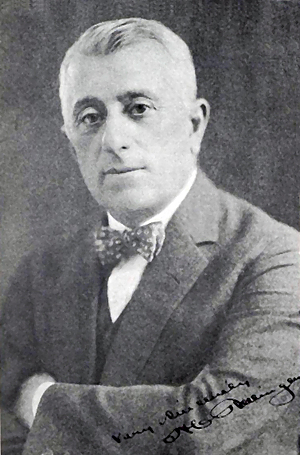
Herman Carl Bellinger
Formula:
Cu3(IO3)6 · 2H2O
Colour:
Green, light green; light bluish green in transmitted light
Hardness:
4
Specific Gravity:
4.88 - 4.9
Crystal System:
Triclinic
Name:
Named in 1940 by Harry Berman and Caleb Wroe Wolfe for Herman Carl Bellinger [April 23, 1867 Caub, Nassau, Germany - July 27, 1941 Spokane, Washington, USA], metallurgist and general manager of the Chile Exploration Company, Chuquicamata, Chile, who submitted the first specimens to the eventual describers of the species. Bellinger was the 1941 recipient of the William Lawrence Saunders Gold Medal awarded by the Society of Mining Engineers for his innovations in mining methods. Herman Bellinger's father, Emil Hugo Bellinger, was a mining engineer and his family emigrated to Nevada, USA in 1873. In the mid-1880's, Herman Bellinger worked with, the then young, Fritz Augustus Heinze, who was a founder of the Anaconda Mining Company in Butte, Montana, USA. In 1897, Bellinger established a summer residence in Spokane, Washington, USA where he was a metallugist with the Trail Smelter which processed the Le Roi Mining Company's ores from Rossland, British Columbia. In 1906, Bellinger was still working at Crofton, British Columbia, Canada. By 1913, Bellinger was manager of the Great Cobar Limited in Australia. Beginning in 1916, Bellinger worked with the Chile Exploration Company. His professional assignments were far reaching including Utah, Europe, and Africa mining areas. Herman and Bertha Mae Bellinger also maintained a home in New York City. (In 1924, Bertha Mae Atherton Bellinger inherited a home in Moran Prairie, Washington and the house is now an historical museum.)
This page provides mineralogical data about Bellingerite.
Unique Identifiers
Mindat ID:
612
Long-form identifier:
mindat:1:1:612:5
Similar Names
| Boulangerite | A valid IMA mineral species - grandfathered | Pb5Sb4S11 |
IMA Classification of Bellingerite
Approved, 'Grandfathered' (first described prior to 1959)
IMA Formula:
Cu2+3(I5+O3)6·2H2O
First published:
1940
Classification of Bellingerite
4.KC.05
4 : OXIDES (Hydroxides, V[5,6] vanadates, arsenites, antimonites, bismuthites, sulfites, selenites, tellurites, iodates)
K : Iodates: Trigonal [IO3] pyramids (mostly).
C : Iodates without additional anions, with H2O
4 : OXIDES (Hydroxides, V[5,6] vanadates, arsenites, antimonites, bismuthites, sulfites, selenites, tellurites, iodates)
K : Iodates: Trigonal [IO3] pyramids (mostly).
C : Iodates without additional anions, with H2O
Dana 7th ed.:
21.1.3.1
21.1.3.1
21 : NORMAL IODATES
1 : Miscellaneous
21 : NORMAL IODATES
1 : Miscellaneous
29.2
29 : Iodates
29 : Iodates
Mineral Symbols
As of 2021 there are now IMA–CNMNC approved mineral symbols (abbreviations) for each mineral species, useful for tables and diagrams.
| Symbol | Source | Reference for Standard |
|---|---|---|
| Blg | IMA–CNMNC | Warr, L.N. (2021). IMA–CNMNC approved mineral symbols. Mineralogical Magazine, 85(3), 291-320. doi:10.1180/mgm.2021.43 |
Physical Properties of Bellingerite
Colour:
Green, light green; light bluish green in transmitted light
Comment:
Photographs of bellingerite are frequently bluer than the natural material, similar to how the green colors of dioptase and emerald may appear in photographs.
Streak:
Very light green
Hardness:
4 on Mohs scale
Tenacity:
Brittle
Fracture:
Sub-Conchoidal
Density:
4.88 - 4.9 g/cm3 (Measured) 4.932 g/cm3 (Calculated)
Optical Data of Bellingerite
Type:
Biaxial (+)
RI values:
nα = 1.89 nβ = 1.900 nγ = 1.99
2V:
Measured: 50° , Calculated: 40°
Birefringence:
0.10
Max. Birefringence:
δ = 0.100
Based on recorded range of RI values above.
Based on recorded range of RI values above.
Interference Colours:
The colours simulate birefringence patterns seen in thin section under crossed polars. They do not take into account mineral colouration or opacity.
Michel-Levy Bar The default colours simulate the birefringence range for a 30 µm thin-section thickness. Adjust the slider to simulate a different thickness.
Grain Simulation You can rotate the grain simulation to show how this range might look as you rotated a sample under crossed polars. Each grain retains its interference colour (retardation) while its brightness falls to black at extinction and reaches a maximum between extinction positions.
The colours simulate birefringence patterns seen in thin section under crossed polars. They do not take into account mineral colouration or opacity.
Michel-Levy Bar The default colours simulate the birefringence range for a 30 µm thin-section thickness. Adjust the slider to simulate a different thickness.
Grain Simulation You can rotate the grain simulation to show how this range might look as you rotated a sample under crossed polars. Each grain retains its interference colour (retardation) while its brightness falls to black at extinction and reaches a maximum between extinction positions.
Surface Relief:
Moderate
Dispersion:
r > v strong
Optical Extinction:
X (70°,–70°); Y (38°,175°); Z (59°,34°) [with c (0°,0°) and b∗ (0°,90°) using (φ,ρ)].
Pleochroism:
Visible
Comments:
X = Light bluish green; Y = Light bluish green; Z = Blue-green
Comments:
Absorption: Z > X = Y.
Chemistry of Bellingerite
Mindat Formula:
Cu3(IO3)6 · 2H2O
Element Weights:
Elements listed:
Crystallography of Bellingerite
Crystal System:
Triclinic
Class (H-M):
1 - Pinacoidal
Space Group:
P1
Cell Parameters:
a = 7.22 Å, b = 7.82 Å, c = 7.94 Å
α = 105°, β = 96.98°, γ = 92.94°
α = 105°, β = 96.98°, γ = 92.94°
Ratio:
a:b:c = 0.923 : 1 : 1.015
Unit Cell V:
428.21 ų (Calculated from Unit Cell)
Morphology:
Crystals prismatic [001] and rather tabular {100}. {100} striated parallel to [001].
Twinning:
On {101}. Reentrant angles may, or may not, be present.
Crystal Structure
Load
Unit Cell | Unit Cell Packed
2x2x2 | 3x3x3 | 4x4x4
Unit Cell | Unit Cell Packed
2x2x2 | 3x3x3 | 4x4x4
Show
Big Balls | Small Balls | Just Balls | Spacefill
Polyhedra Off | Si Polyhedra | All Polyhedra
Remove metal-metal sticks
Big Balls | Small Balls | Just Balls | Spacefill
Polyhedra Off | Si Polyhedra | All Polyhedra
Remove metal-metal sticks
Display Options
Black Background | White Background
Perspective On | Perspective Off
2D | Stereo | Red-Blue | Red-Cyan
Black Background | White Background
Perspective On | Perspective Off
2D | Stereo | Red-Blue | Red-Cyan
View
CIF File Best | x | y | z | a | b | c
CIF File Best | x | y | z | a | b | c
Rotation
Stop | Start
Stop | Start
Labels
Console Off | On | Grey | Yellow
Console Off | On | Grey | Yellow
Data courtesy of the American Mineralogist Crystal Structure Database. Click on an AMCSD ID to view structure
| ID | Species | Reference | Link | Year | Locality | Pressure (GPa) | Temp (K) |
|---|---|---|---|---|---|---|---|
| 0009503 | Bellingerite | Ghose S, Wan C (1974) Structural chemistry of copper and zinc minerals. II. Stereochemistry of copper(II) and iodine(V) in bellingerite, 3Cu(IO3)2.2H2O Acta Crystallographica B30 965-974 |  | 1974 | Chuquicamata, Chile | 0 | 293 |
CIF Raw Data - click here to close
X-Ray Powder Diffraction
Powder Diffraction Data:
| d-spacing | Intensity |
|---|---|
| 3.72 Å | (100) |
| 3.35 Å | (90) |
| 3.17 Å | (90) |
| 3.82 Å | (70) |
| 3.07 Å | (65) |
| 3.13 Å | (60) |
| 3.57 Å | (55) |
Reference:
Comments:
Chuquicamata, Chile, ICDD 19-393.
Geological Environment
Paragenetic Mode(s):
| Paragenetic Mode | Earliest Age (Ga) |
|---|---|
| Stage 7: Great Oxidation Event | <2.4 |
| 47a : [Near-surface hydration of prior minerals] | |
| 47g : [Halogen-bearing surface weathering minerals] |
Type Occurrence of Bellingerite
General Appearance of Type Material:
Veinlets in altered granitic rock; tiny isolated crystals.
Place of Conservation of Type Material:
Harvard University, Cambridge, Massachusetts, USA, number 95026.
Associated Minerals at Type Locality:
Other Language Names for Bellingerite
Common Associates
Associations Based on Photo Data:
| 3 photos of Bellingerite associated with Leightonite | K2Ca2Cu(SO4)4 · 2H2O |
| 2 photos of Bellingerite associated with Gypsum | CaSO4 · 2H2O |
| 1 photo of Bellingerite associated with Minyulite | KAl2(PO4)2F · 4H2O |
| 1 photo of Bellingerite associated with Brochantite | Cu4(SO4)(OH)6 |
Related Minerals - Strunz-mindat Grouping
| 4.KC.10 | Brüggenite | Ca(IO3)2 · H2O |
Other Information
Notes:
Slightly soluble in hot water. Readily soluble in dilute HCl.
Health Risks:
No information on health risks for this material has been entered into the database. You should always treat mineral specimens with care.
Internet Links for Bellingerite
mindat.org URL:
https://www.mindat.org/min-612.html
Please feel free to link to this page.
Please feel free to link to this page.
Search Engines:
External Links:
Mineral Dealers:
References for Bellingerite
Localities for Bellingerite
Showing 1 localities.
 symbol to view information about a locality.
The
symbol to view information about a locality.
The Locality List
 - This locality has map coordinates listed.
- This locality has estimated coordinates.
ⓘ - Click for references and further information on this occurrence.
? - Indicates mineral may be doubtful at this locality.
- This locality has map coordinates listed.
- This locality has estimated coordinates.
ⓘ - Click for references and further information on this occurrence.
? - Indicates mineral may be doubtful at this locality.
 - Good crystals or important locality for species.
 - World class for species or very significant.
(TL) - Type Locality for a valid mineral species.
(FRL) - First Recorded Locality for everything else (eg varieties).
- World class for species or very significant.
(TL) - Type Locality for a valid mineral species.
(FRL) - First Recorded Locality for everything else (eg varieties).
All localities listed without proper references should be considered as questionable.
Chile (TL) | |
| Berman et al. (1940) +1 other reference |
Quick NavTopAbout BellingeriteUnique IdentifiersSimilar NamesIMA Classification Classification Mineral SymbolsPhysical Properties Optical Data Chemistry Crystallography Crystal StructureX-Ray Powder DiffractionGeological EnvironmentType Occurrence Other LanguagesCommon AssociatesStrunz-MindatOther InformationInternet Links References Localities Locality List

Chuquicamata Mine, Chuquicamata District, Calama, El Loa Province, Antofagasta, Chile