
Diorite
A rock classification type
This page is currently not sponsored. Click here to sponsor this page.


About Diorite
Name:
Etymol: Greek diorizein, to distinguish, in reference to the fact that the characteristic mineral, hornblende, is usually identifiable megascopically.
A dioritic rock with dominant plagioclase, significant mafic minerals, <5% quartz and <10% alkali feldspar/ total feldspar on the QAPF diagram.
Plutonic, coarse grained igneous rocks intermediate in composition between acidic and basic, characteristically more mafic than most granitic and syenitic rocks. It is typically composed mostly of intermediate to sodic plagioclase (oligoclase - andesine), dark-colored amphibole (esp. hornblende), calcic clinopyroxene, and sometimes a small amount of quartz; also, any rock in that group; the approximate intrusive equivalent of andesite. Diorite grades into monzonite with an increase in the alkali feldspar content, and gabbro with an increase in calcic plagioclase.
See also: diabase, dolerite
Compare with: dolerite, gabbro
Plutonic, coarse grained igneous rocks intermediate in composition between acidic and basic, characteristically more mafic than most granitic and syenitic rocks. It is typically composed mostly of intermediate to sodic plagioclase (oligoclase - andesine), dark-colored amphibole (esp. hornblende), calcic clinopyroxene, and sometimes a small amount of quartz; also, any rock in that group; the approximate intrusive equivalent of andesite. Diorite grades into monzonite with an increase in the alkali feldspar content, and gabbro with an increase in calcic plagioclase.
See also: diabase, dolerite
Compare with: dolerite, gabbro
Unique Identifiers
Mindat ID:
48226
Long-form identifier:
mindat:1:1:48226:4
Similar Names
| Daourite | A variety of Elbaite | |
| Deerite | A valid IMA mineral species | Fe62+Fe33+(Si6O17)O3(OH)5 |
| Dioride | A rock subtype | |
| Dioroid | A synonym of 'Foid-bearing-diorite' | |
| Doreite | A rock subtype | |
| Dorrite | A valid IMA mineral species | Ca4(Mg3Fe93+)O4(Si3Al8Fe3+O36) |
| Fiorite | A rock subtype | |
| Torite | A synonym of Thorite | |
| Turite | A synonym of 'Turgite' | |
| Tyrite | A synonym of 'Fergusonite' | |
| Yttrite | A synonym of Gadolinite-(Y) |
Classification of Diorite
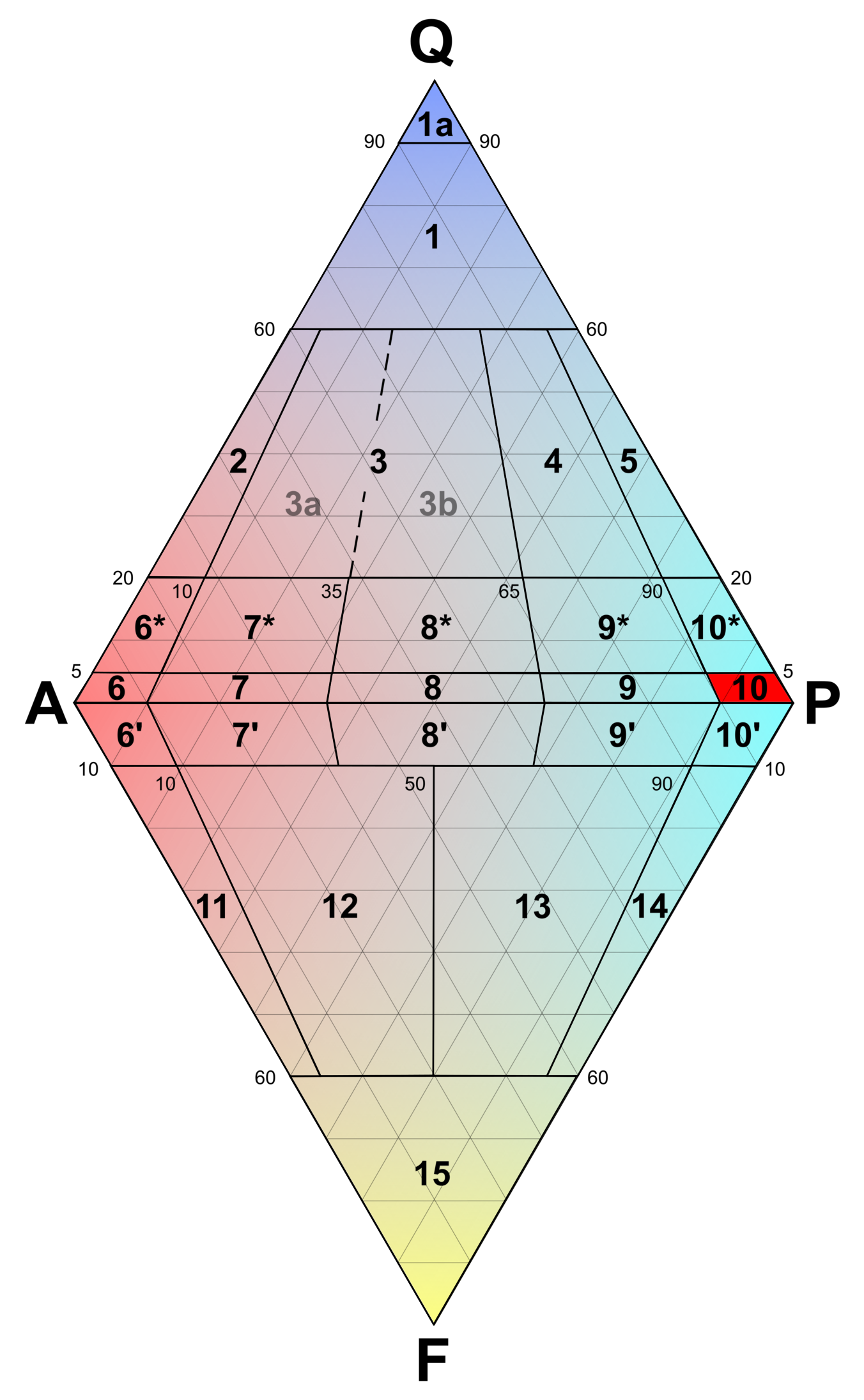
Diorite is in section 10 of the QAPF diagram.
Sub-divisions of Diorite
Mineralogy of Diorite
Essential minerals - these are minerals that are required within the classification of this rock:
| Feldspar > Plagioclase | (Na,Ca)[(Si,Al)AlSi2]O8 |
Non-essential minerals - these minerals are common, sometimes major components, but are not always present:
Age distribution
Recorded ages:
Phanerozoic : 275.2 ± 1.2 Ma to 97.0 ± 3.1 Ma - based on 7 recorded ages.
Sample ages:
| Sample ID | Recorded age | Geologic Time | Dating method |
|---|---|---|---|
| 1 | 97.0 ± 3.1 Ma | Late/Upper Cretaceous | K-Ar |
| 2 | 131.7 ± 1.4 Ma | Early/Lower Cretaceous | LA-ICP-MS zircon U-Pb |
| 3 | 185.4 ± 2.0 Ma | Early Jurassic | Rb-Sr isochron |
| 4 | 275.2 ± 1.2 Ma | Cisuralian |
Sample references:
Chemical Analysis
Oxide wt%:
| 1 | 2 | 3 | |
|---|---|---|---|
| SiO2 | 43.35 % | 45.95 % | 41.61 % |
| Al2O3 | 16.56 % | 16.47 % | 13.09 % |
| TiO2 | 3.15 % | 3.38 % | 4.39 % |
| Fe2O3 | 2.00 % | 2.00 % | 2.00 % |
| FeO | 7.87 % | 8.69 % | 12.73 % |
| MgO | 3.44 % | 4.05 % | 6.44 % |
| MnO | 0.27 % | 0.22 % | 0.19 % |
| Na2O | 6.07 % | 5.1 % | 3.89 % |
| CaO | 10.75 % | 10.17 % | 11.59 % |
| K2O | 2.8 % | 2.4 % | 2.1 % |
| P2O5 | 0.87 % | 0.6 % | 0.56 % |
| Total: | 97.13 % | 99.03 % | 98.59 % |
Sample references:
| ID | Locality | Reference | Notes |
|---|---|---|---|
| 1 | Mont Royal, Montréal, Québec, Canada | Wet chemical analysis by G. Woussen and B.M.Gunn. The Fe2O3 percentage is arbitrarily set to 2%. | |
| 2 | " " | Wet chemical analysis by G. Woussen and B.M.Gunn. The Fe2O3 percentage is arbitrarily set to 2%. | |
| 3 | " " | Wet chemical analysis by G. Woussen and B.M.Gunn. The Fe2O3 percentage is arbitrarily set to 2%. |
Other Language Names for Diorite
Irish Gaelic:Dióirít
Common Associates
Associations Based on Photo Data:
| 3 photos of Diorite associated with 'Khibinite' | |
| 3 photos of Diorite associated with Epidote | (CaCa)(AlAlFe3+)O[Si2O7][SiO4](OH) |
| 3 photos of Diorite associated with Feldspar Group | |
| 3 photos of Diorite associated with Eudialyte | Na15Ca6Fe3Zr3Si(Si25O73)(O,OH,H2O)3(Cl,OH)2 |
| 2 photos of Diorite associated with Hibonite | CaAl12O19 |
| 1 photo of Diorite associated with Amphibole Supergroup | AB2C5(T8O22)W2 |
| 1 photo of Diorite associated with Pigeonite | (CaxMgyFez)(Mgy1Fez1)Si2O6 |
| 1 photo of Diorite associated with 'Granite' |
Internet Links for Diorite
mindat.org URL:
https://www.mindat.org/min-48226.html
Please feel free to link to this page.
Please feel free to link to this page.

Teletín quarry, Krňany, Benešov District, Central Bohemian Region, Czech Republic