
Raspite
A valid IMA mineral species - grandfathered
This page is currently not sponsored. Click here to sponsor this page.

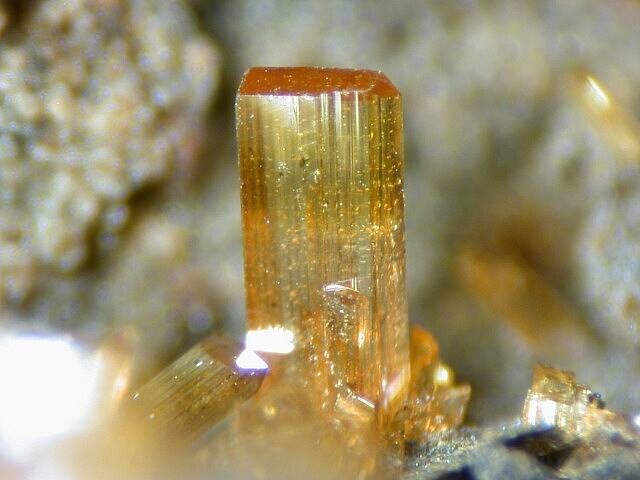
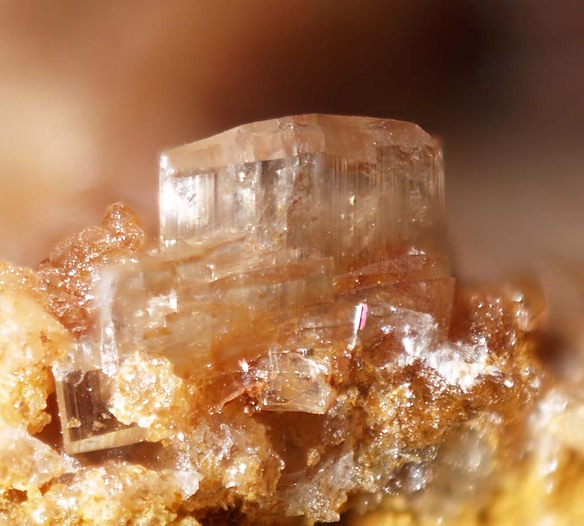

About Raspite

Charles Rasp
Formula:
Pb(WO4)
Colour:
Pale yellow, yellowish brown, gray, colorless
Lustre:
Adamantine
Hardness:
2½ - 3
Specific Gravity:
8.46
Crystal System:
Monoclinic
Name:
Named after Mr. Charles Rasp (born "Hieronymus Salvatore Lopez Freiherr von Pereira" 7 October 1846, Stuttgart, Kingdom of Württemberg (now Germany) - 22 May 1907, Adelaide, South Australia, Australia), German-Australian prospector, and discoverer of the Broken Hill deposit.
After deserting his post as an officer during the Franco-Prussian war (1870-1871), Hieronymus escaped to Australia and adopted the last name of a friend and fellow soldier who was killed in action as part of his new identity. Despite his good education and upbringing, Rasp worked doing manual labor on farms and as a gold miner before setting out as a prospector, ultimately discovering Broken Hill, one of the most famous mineral deposits, in September of 1883.
After deserting his post as an officer during the Franco-Prussian war (1870-1871), Hieronymus escaped to Australia and adopted the last name of a friend and fellow soldier who was killed in action as part of his new identity. Despite his good education and upbringing, Rasp worked doing manual labor on farms and as a gold miner before setting out as a prospector, ultimately discovering Broken Hill, one of the most famous mineral deposits, in September of 1883.
Type Locality:
Dimorph of:
Isostructural with:
The monoclinic dimorph of stolzite. Heating of raspite to 395(5)°C leads to a transformation into stolzite.
A rare secondary mineral occurring in the oxidized zones of tungsten-bearing hydrothermal base metal deposits.
An unusual Te-rich variety is described by Andrade et al. (2014). Murphyite is the mineral representing the case when Te is dominant over W (and other constituents), being the Te analogue of raspite.
A rare secondary mineral occurring in the oxidized zones of tungsten-bearing hydrothermal base metal deposits.
An unusual Te-rich variety is described by Andrade et al. (2014). Murphyite is the mineral representing the case when Te is dominant over W (and other constituents), being the Te analogue of raspite.
Unique Identifiers
Mindat ID:
3368
Long-form identifier:
mindat:1:1:3368:4
IMA Classification of Raspite
Approved, 'Grandfathered' (first described prior to 1959)
IMA Formula:
Pb2+W6+O4
Classification of Raspite
4.DG.20
4 : OXIDES (Hydroxides, V[5,6] vanadates, arsenites, antimonites, bismuthites, sulfites, selenites, tellurites, iodates)
D : Metal: Oxygen = 1:2 and similar
G : With large (+- medium-sized) cations; chains of edge-sharing octahedra
4 : OXIDES (Hydroxides, V[5,6] vanadates, arsenites, antimonites, bismuthites, sulfites, selenites, tellurites, iodates)
D : Metal: Oxygen = 1:2 and similar
G : With large (+- medium-sized) cations; chains of edge-sharing octahedra
48.1.4.1
48 : ANHYDROUS MOLYBDATES AND TUNGSTATES
1 : AXO4
48 : ANHYDROUS MOLYBDATES AND TUNGSTATES
1 : AXO4
27.4.9
27 : Sulphites, Chromates, Molybdates and Tungstates
4 : Tungstates
27 : Sulphites, Chromates, Molybdates and Tungstates
4 : Tungstates
Mineral Symbols
As of 2021 there are now IMA–CNMNC approved mineral symbols (abbreviations) for each mineral species, useful for tables and diagrams.
| Symbol | Source | Reference for Standard |
|---|---|---|
| Rsp | IMA–CNMNC | Warr, L.N. (2021). IMA–CNMNC approved mineral symbols. Mineralogical Magazine, 85(3), 291-320. doi:10.1180/mgm.2021.43 |
Physical Properties of Raspite
Adamantine
Transparency:
Transparent
Colour:
Pale yellow, yellowish brown, gray, colorless
Hardness:
2½ - 3 on Mohs scale
Cleavage:
Perfect
Perfect {100}
Perfect {100}
Density:
8.46 g/cm3 (Measured) 8.45 g/cm3 (Calculated)
Optical Data of Raspite
Type:
Biaxial (+)
RI values:
nα = 2.27 nβ = 2.27 nγ = 2.3
Max. Birefringence:
δ = 0.030
Based on recorded range of RI values above.
Based on recorded range of RI values above.
Interference Colours:
The colours simulate birefringence patterns seen in thin section under crossed polars. They do not take into account mineral colouration or opacity.
Michel-Levy Bar The default colours simulate the birefringence range for a 30 µm thin-section thickness. Adjust the slider to simulate a different thickness.
Grain Simulation You can rotate the grain simulation to show how this range might look as you rotated a sample under crossed polars. Each grain retains its interference colour (retardation) while its brightness falls to black at extinction and reaches a maximum between extinction positions.
The colours simulate birefringence patterns seen in thin section under crossed polars. They do not take into account mineral colouration or opacity.
Michel-Levy Bar The default colours simulate the birefringence range for a 30 µm thin-section thickness. Adjust the slider to simulate a different thickness.
Grain Simulation You can rotate the grain simulation to show how this range might look as you rotated a sample under crossed polars. Each grain retains its interference colour (retardation) while its brightness falls to black at extinction and reaches a maximum between extinction positions.
Surface Relief:
Very High (positive)
Relative to Canada balsam mounting medium (n ≈ 1.537).
Relative to Canada balsam mounting medium (n ≈ 1.537).
This shows the grain boundary and Becke line effect under plane-polarised
light, based on the contrast between this mineral's average refractive
index and the mounting medium. It does not take into account mineral
colouration.
In focus
Interference Figure:
This shows the idealized biaxial acute bisectrix (Bxa) interference figure
- the conoscopic view for a grain cut perpendicular to the acute bisectrix, using
this mineral's 2V. The two small white dots mark the melatopes - the points
where the two optic axes emerge - and are shown only when they fall within the
field of view. The coloured bands are isochromatics, and the dark bands are
isogyres.
Rotate the stage: at 0°/90° the isogyres form a cross through the melatopes; at 45° they pull apart into curved hyperbolas. That splitting on rotation - absent in a uniaxial figure - is the standard diagnostic test for telling biaxial minerals from uniaxial ones. If 2V is large, the melatopes may fall outside the field of view, as they often do at the microscope too.
No measured or calculated 2V is on file for this mineral, so the value used here (0°) is estimated from its recorded refractive indices and optic sign, not from a direct 2V measurement.
Rotate the stage: at 0°/90° the isogyres form a cross through the melatopes; at 45° they pull apart into curved hyperbolas. That splitting on rotation - absent in a uniaxial figure - is the standard diagnostic test for telling biaxial minerals from uniaxial ones. If 2V is large, the melatopes may fall outside the field of view, as they often do at the microscope too.
No measured or calculated 2V is on file for this mineral, so the value used here (0°) is estimated from its recorded refractive indices and optic sign, not from a direct 2V measurement.
Dispersion:
relatively strong
Optical Extinction:
Y = b; Z ∧ c ≃ 30°.
Comments:
Reflectivity 15.9-16.5% @ 546 nm in air.
Chemistry of Raspite
Mindat Formula:
Pb(WO4)
Element Weights:
Elements listed:
Crystallography of Raspite
Crystal System:
Monoclinic
Class (H-M):
2/m - Prismatic
Space Group:
P21/b
Setting:
P21/a
Cell Parameters:
a = 13.555(11) Å, b = 4.976(2) Å, c = 5.561(3) Å
β = 107.63(7)°
β = 107.63(7)°
Ratio:
a:b:c = 2.724 : 1 : 1.118
Unit Cell V:
357.47 ų (Calculated from Unit Cell)
Z:
4
Morphology:
Crystals typically tabular, flattened on {100}, which is striated parallel [010], and somewhat elongated parallel [010]; also elongated [100] or thin tabular {101}.
Twinning:
Common on {100}; also on {102}.
Comment:
Cell data from Fujita et al. (1977).
Crystallographic forms of Raspite
Crystal Atlas:
Image Loading
Click on an icon to view

Raspite no.1 - {100} - Goldschmidt (1913-1926)
Raspite no.2 - {100} - Goldschmidt (1913-1926)
Raspite no.4 - {100} - Goldschmidt (1913-1926)
3d models and HTML5 code kindly provided by
www.smorf.nl.
Toggle
Edge Lines | Miller Indices | Axes
Transparency
Opaque | Translucent | Transparent
View
Along a-axis | Along b-axis | Along c-axis | Start rotation | Stop rotation
Edge Lines | Miller Indices | Axes
Transparency
Opaque | Translucent | Transparent
View
Along a-axis | Along b-axis | Along c-axis | Start rotation | Stop rotation
Crystal Structure
Load
Unit Cell | Unit Cell Packed
2x2x2 | 3x3x3 | 4x4x4
Unit Cell | Unit Cell Packed
2x2x2 | 3x3x3 | 4x4x4
Show
Big Balls | Small Balls | Just Balls | Spacefill
Polyhedra Off | Si Polyhedra | All Polyhedra
Remove metal-metal sticks
Big Balls | Small Balls | Just Balls | Spacefill
Polyhedra Off | Si Polyhedra | All Polyhedra
Remove metal-metal sticks
Display Options
Black Background | White Background
Perspective On | Perspective Off
2D | Stereo | Red-Blue | Red-Cyan
Black Background | White Background
Perspective On | Perspective Off
2D | Stereo | Red-Blue | Red-Cyan
View
CIF File Best | x | y | z | a | b | c
CIF File Best | x | y | z | a | b | c
Rotation
Stop | Start
Stop | Start
Labels
Console Off | On | Grey | Yellow
Console Off | On | Grey | Yellow
Data courtesy of the American Mineralogist Crystal Structure Database. Click on an AMCSD ID to view structure
| ID | Species | Reference | Link | Year | Locality | Pressure (GPa) | Temp (K) |
|---|---|---|---|---|---|---|---|
| 0009580 | Raspite | Fujita T, Kawada I, Kato K (1977) Raspite from Broken Hill Acta Crystallographica B33 162-164 |  | 1977 | Broken Hill NSW, Australia | 0 | 293 |
CIF Raw Data - click here to close
X-Ray Powder Diffraction
Powder Diffraction Data:
| d-spacing | Intensity |
|---|---|
| 3.619 Å | (55) |
| 3.593 Å | (20) |
| 3.478 Å | (20) |
| 3.224 Å | (100) |
| 2.760 Å | (60) |
| 2.705 Å | (55) |
| 1.812 Å | (25) |
Comments:
Broken Hill, Australia. ICDD 16-156.
Geological Environment
Paragenetic Mode(s):
| Paragenetic Mode | Earliest Age (Ga) |
|---|---|
| Stage 7: Great Oxidation Event | <2.4 |
| 47h : [Near-surface oxidized, dehydrated minerals] |
Geological Setting:
Secondary oxidation zone of tungsten containing ores.
Type Occurrence of Raspite
Place of Conservation of Type Material:
Natural History Museum, Vienna, Austria: #G6263.
Other Language Names for Raspite
Common Associates
Associations Based on Photo Data:
| 71 photos of Raspite associated with Stolzite | Pb(WO4) |
| 37 photos of Raspite associated with Alunite Supergroup | AD3(XO4)2(OH)6 |
| 7 photos of Raspite associated with Plumbogummite | PbAl3(PO4)(PO3OH)(OH)6 |
| 7 photos of Raspite associated with 'Copper-bearing Scheelite' | (Ca,Cu)WO4 |
| 7 photos of Raspite associated with Cuprotungstite | Cu2(WO4)(OH)2 |
| 6 photos of Raspite associated with Pyromorphite | Pb5(PO4)3Cl |
| 6 photos of Raspite associated with Quartz | SiO2 |
| 5 photos of Raspite associated with 'Mimetite-Pyromorphite Series' | |
| 5 photos of Raspite associated with Chalcopyrite | CuFeS2 |
| 5 photos of Raspite associated with Carminite | PbFe3+2(AsO4)2(OH)2 |
Related Minerals - Strunz-mindat Grouping
| 4.DG.05 | Fersmite | CaNb2O6 |
| 4.DG.05 | Uranopolycrase | (U4+,Y)(Ti,Nb)2O6 |
| 4.DG.05 | Yttrocrasite-(Y) | (Y,Th,Ca,U)(Ti,Fe)2(O,OH)6 |
| 4.DG.05 | Tanteuxenite-(Y) | Y(Ta,Nb,Ti)2(O,OH)6 |
| 4.DG.05 | Loranskite-(Y) | (Y,Ce,Ca)ZrTaO6 (?) |
| 4.DG.05 | Euxenite-(Y) | (Y,Ca,Ce,U,Th)(Nb,Ta,Ti)2O6 |
| 4.DG.05 | Kobeite-(Y) | (Y,U)(Ti,Nb)2(O,OH)6 (?) |
| 4.DG.10 | Yttrotantalite-(Y) | (Y,U,Fe2+)(Ta,Nb)(O,OH)4 |
| 4.DG.10 | Clinofergusonite-(Y) | YNbO4 |
| 4.DG.10 | Clinofergusonite-(Nd) | (Nd,Ce)NbO4 |
| 4.DG.10 | Clinofergusonite-(Ce) | CeNbO4 |
| 4.DG.15 | Foordite | Sn2+Nb2O6 |
| 4.DG.15 | Thoreaulite | Sn2+Ta2O6 |
Other Information
Thermal Behaviour:
Inverts to Stolzite above 410°C.
Notes:
Decomposed by HCl with separation of yellow tungstic acid.
Health Risks:
No information on health risks for this material has been entered into the database. You should always treat mineral specimens with care.
Internet Links for Raspite
mindat.org URL:
https://www.mindat.org/min-3368.html
Please feel free to link to this page.
Please feel free to link to this page.
Search Engines:
External Links:
Mineral Dealers:
References for Raspite
Reference List:
Larsen, Esper S. (1921) The microscopic determination of the nonopaque minerals. Bulletin 679. US Geological Survey doi:10.3133/b679 p.125
Bastians, Simon; Crump, Gregory; Griffith, William P.; Withnall, Robert (2004) Raspite and studtite: Raman spectra of two unique minerals. Journal of Raman Spectroscopy, 35 (8-9). 726-731 doi:10.1002/jrs.1176
Localities for Raspite
Showing 33 localities.
 symbol to view information about a locality.
The
symbol to view information about a locality.
The Locality List
 - This locality has map coordinates listed.
- This locality has estimated coordinates.
ⓘ - Click for references and further information on this occurrence.
? - Indicates mineral may be doubtful at this locality.
- This locality has map coordinates listed.
- This locality has estimated coordinates.
ⓘ - Click for references and further information on this occurrence.
? - Indicates mineral may be doubtful at this locality.
 - Good crystals or important locality for species.
 - World class for species or very significant.
(TL) - Type Locality for a valid mineral species.
(FRL) - First Recorded Locality for everything else (eg varieties).
- World class for species or very significant.
(TL) - Type Locality for a valid mineral species.
(FRL) - First Recorded Locality for everything else (eg varieties).
All localities listed without proper references should be considered as questionable.
Australia | |
| Thorne (n.d.) +1 other reference |
| Mason (1976) +3 other references |
| Museum Victoria mineral collection | |
| Hlawatsch (1897) +1 other reference | |
| Annal.Naturhist.Hofmus. Wien (1897) +1 other reference | |
Brazil | |
| Von Hlawatsch (1905) +1 other reference |
Canada | |
| SASSANO et al. (1987) |
China | |
| Guangming Yang (1980) |
| Yuan et al. (2021) |
France | |
| Pierre Le Roch & Jean-Marc Johannet ... +1 other reference |
| Cuchet et al. (2000) | |
| Jean-Marc Johannet collection |
| GOURAULT C. (2011) |
| Mindat's pics and Philippe SAGET collection. Stolzite et al. (J.-C. Leydet, P. Leroch', J.-P. Tissier, Ph. Saget...) |
| Ansermet et al. (2010) |
| Gayraud et al. (2011) +1 other reference |
Germany | |
| Walenta (1992) +1 other reference |
Japan | |
| Fujiwara (1977) |
Mexico | |
| Megaw (1990) |
| Palache et al. (1951) |
Myanmar | |
| ミン et al. (n.d.) |
Namibia | |
| Cairncross et al. (2010) +1 other reference |
Portugal | |
| Hydrothermal tungstates from Serra de ... |
| C. Leal Gomes et al. (2011) | |
Rwanda | |
| Jedwab et al. (1979) +1 other reference |
| Dewaele et al. (2016) +1 other reference |
Turkey | |
| Powell et al. (2021) |
UK | |
| David P. Clough Collection. Collected 14 June 2013. Natural History Museum (London) |
| Neall et al. (2001) |
USA | |
| "The Accidental Pocket" talk presented ... |
| Tony Kampf identification 2011 +2 other references |
| Carnegie Museum of Natural History ... | |
| Jerry Cone Collection |
Quick NavTopAbout RaspiteUnique IdentifiersIMA Classification Classification Mineral SymbolsPhysical Properties Optical Data Chemistry Crystallography Crystallographic forms Crystal StructureX-Ray Powder DiffractionGeological EnvironmentType Occurrence Other LanguagesCommon AssociatesStrunz-MindatOther InformationInternet Links References Localities Locality List

Le Mazet vein no. 1, Le Mazet, Montmins mining district, Échassières, Vichy, Allier, Auvergne-Rhône-Alpes, France