
Clinofergusonite-(Y)
A valid IMA mineral species
This page is currently not sponsored. Click here to sponsor this page.


About Clinofergusonite-(Y)
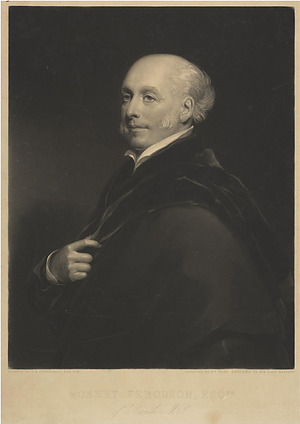
Robert Ferguson
Formula:
YNbO4
Colour:
Pale yellow
Hardness:
5½ - 6½
Specific Gravity:
5.65
Crystal System:
Monoclinic
Name:
Originally named β-fergusonite, in allusion to its dimorphous relation to fergusonite (now fergusonite-(Y)). The name was changed to fergusonite-(Y)-β, to indicate that the predominant REE is yttrium, and to differentiate it from the cerium-dominant species. Renamed again in 2022 to clinofergusonite-(Y), where the 'clino' prefix indicates that this dimorph is monoclinic. The root name honors Robert Ferguson (8 September 1769 – 3 December 1840, London, England), Scottish landowner, politician and mineral collector.
Type Locality:
Dimorph of:
This page provides mineralogical data about Clinofergusonite-(Y).
Unique Identifiers
Mindat ID:
1463
Long-form identifier:
mindat:1:1:1463:8
Similar Names
| Clinofergusonite-(Ce) | A valid IMA mineral species | CeNbO4 |
| Clinofergusonite-(Nd) | A valid IMA mineral species | (Nd,Ce)NbO4 |
IMA Classification of Clinofergusonite-(Y)
Classification of Clinofergusonite-(Y)
4.DG.10
4 : OXIDES (Hydroxides, V[5,6] vanadates, arsenites, antimonites, bismuthites, sulfites, selenites, tellurites, iodates)
D : Metal: Oxygen = 1:2 and similar
G : With large (+- medium-sized) cations; chains of edge-sharing octahedra
4 : OXIDES (Hydroxides, V[5,6] vanadates, arsenites, antimonites, bismuthites, sulfites, selenites, tellurites, iodates)
D : Metal: Oxygen = 1:2 and similar
G : With large (+- medium-sized) cations; chains of edge-sharing octahedra
8.1.2.1
8 : MULTIPLE OXIDES CONTAINING NIOBIUM,TANTALUM OR TITANIUM
1 : ABO4
8 : MULTIPLE OXIDES CONTAINING NIOBIUM,TANTALUM OR TITANIUM
1 : ABO4
18.2.2
18 : Niobates and Tantalates
2 : Niobates and tantalates containing rare earths but not U
18 : Niobates and Tantalates
2 : Niobates and tantalates containing rare earths but not U
Mineral Symbols
As of 2021 there are now IMA–CNMNC approved mineral symbols (abbreviations) for each mineral species, useful for tables and diagrams.
Please only use the official IMA–CNMNC symbol. Older variants are listed for historical use only.
Please only use the official IMA–CNMNC symbol. Older variants are listed for historical use only.
| Symbol | Source | Reference for Standard |
|---|---|---|
| Fgs-Y-β | IMA–CNMNC | Warr, L.N. (2021). IMA–CNMNC approved mineral symbols. Mineralogical Magazine, 85(3), 291-320. doi:10.1180/mgm.2021.43 |
| Fgs | The Canadian Mineralogist (2019) | The Canadian Mineralogist (2019) The Canadian Mineralogist list of symbols for rock- and ore-forming minerals (December 30, 2019). download |
Physical Properties of Clinofergusonite-(Y)
Transparency:
Translucent
Colour:
Pale yellow
Hardness:
5½ - 6½ on Mohs scale
Density:
5.65 g/cm3 (Measured) 5.63 g/cm3 (Calculated)
Optical Data of Clinofergusonite-(Y)
Type:
Biaxial (+/-)
RI values:
nα = 2.06 - 2.19 nβ = 2.06 - 2.19 nγ = 2.06 - 2.19
Surface Relief:
Very High (positive)
Relative to Canada balsam mounting medium (n ≈ 1.537).
Relative to Canada balsam mounting medium (n ≈ 1.537).
This shows the grain boundary and Becke line effect under plane-polarised
light, based on the contrast between this mineral's average refractive
index and the mounting medium. It does not take into account mineral
colouration.
In focus
Dispersion:
r < v
Chemistry of Clinofergusonite-(Y)
Mindat Formula:
YNbO4
Element Weights:
Elements listed:
Chemical Analysis
Oxide wt%:
| 1 | |
|---|---|
| CaO | 1,58 % |
| UO2 | 5,09 % |
| ThO2 | 0,31 % |
| Y2O3 | 28,46 % |
| Nd2O3 | 0,51 % |
| Sm2O3 | 1,39 % |
| Gd2O3 | 1,76 % |
| Dy2O3 | 3,09 % |
| Er2O3 | 1,04 % |
| Yb2O3 | 3,79 % |
| Lu2O3 | 1,01 % |
| Nb2O5 | 45,20 % |
| Ta2O5 | 4,44 % |
| Total: | 93 % |
Sample references:
| ID | Locality | Reference | Notes |
|---|---|---|---|
| 1 | Atagoyama, Koriyama City, Fukushima Prefecture, Japan |
Crystallography of Clinofergusonite-(Y)
Crystal System:
Monoclinic
Class (H-M):
2/m - Prismatic
Cell Parameters:
a = 5.292 Å, b = 10.94 Å, c = 5.069 Å
β = 94.6°
β = 94.6°
Ratio:
a:b:c = 0.484 : 1 : 0.463
Unit Cell V:
292.52 ų (Calculated from Unit Cell)
Z:
4
Comment:
Non-standard space group I2/a. Cell in C2/c setting is: a = 7.6454(3), 10.9994(5), 5.3172(2) Å, β = 138.42° (Weitzel & Schröcke, 1980).
X-Ray Powder Diffraction
Powder Diffraction Data:
| d-spacing | Intensity |
|---|---|
| - Å | () |
Comments:
No published powder XRD data.
Geological Environment
Paragenetic Mode(s):
| Paragenetic Mode | Earliest Age (Ga) |
|---|---|
| Stage 4b: Highly evolved igneous rocks | >3.0 |
| 34 : Complex granite pegmatites |
Type Occurrence of Clinofergusonite-(Y)
General Appearance of Type Material:
Crystals 0.05-0.2 mm in cross section.
Place of Conservation of Type Material:
Fersman Mineralogical Museum, Moscow, Russia, 66756.
Geological Setting of Type Material:
Apical parts of microcline granite stocks.
Synonyms of Clinofergusonite-(Y)
Other Language Names for Clinofergusonite-(Y)
Dutch:Clinofergusoniet-(Y)
German:Klinofergusonit-(Y)
Common Associates
Associations Based on Photo Data:
| 7 photos of Clinofergusonite-(Y) associated with Microcline | K(AlSi3O8) |
| 6 photos of Clinofergusonite-(Y) associated with Albite | Na(AlSi3O8) |
| 6 photos of Clinofergusonite-(Y) associated with Chamosite | Fe2+5Al(AlSi3O10)(OH)8 |
| 4 photos of Clinofergusonite-(Y) associated with Zircon | Zr(SiO4) |
| 3 photos of Clinofergusonite-(Y) associated with Quartz | SiO2 |
| 2 photos of Clinofergusonite-(Y) associated with Allanite-(Ce) | (CaCe)(AlAlFe2+)O[Si2O7][SiO4](OH) |
| 1 photo of Clinofergusonite-(Y) associated with Aegirine | NaFe3+Si2O6 |
| 1 photo of Clinofergusonite-(Y) associated with Xenotime-(Y) | Y(PO4) |
| 1 photo of Clinofergusonite-(Y) associated with Kainosite-(Y) | Ca2Y2(SiO3)4(CO3) · H2O |
| 1 photo of Clinofergusonite-(Y) associated with Gadolinite-(Y) | Y2Fe2+Be2Si2O10 |
Related Minerals - Strunz-mindat Grouping
| 4.DG.05 | Fersmite | CaNb2O6 |
| 4.DG.05 | Uranopolycrase | (U4+,Y)(Ti,Nb)2O6 |
| 4.DG.05 | Yttrocrasite-(Y) | (Y,Th,Ca,U)(Ti,Fe)2(O,OH)6 |
| 4.DG.05 | Tanteuxenite-(Y) | Y(Ta,Nb,Ti)2(O,OH)6 |
| 4.DG.05 | Loranskite-(Y) | (Y,Ce,Ca)ZrTaO6 (?) |
| 4.DG.05 | Euxenite-(Y) | (Y,Ca,Ce,U,Th)(Nb,Ta,Ti)2O6 |
| 4.DG.05 | Kobeite-(Y) | (Y,U)(Ti,Nb)2(O,OH)6 (?) |
| 4.DG.10 | Yttrotantalite-(Y) | (Y,U,Fe2+)(Ta,Nb)(O,OH)4 |
| 4.DG.10 | Clinofergusonite-(Nd) | (Nd,Ce)NbO4 |
| 4.DG.10 | Clinofergusonite-(Ce) | CeNbO4 |
| 4.DG.15 | Foordite | Sn2+Nb2O6 |
| 4.DG.15 | Thoreaulite | Sn2+Ta2O6 |
| 4.DG.20 | Raspite | Pb(WO4) |
Other Information
Health Risks:
No information on health risks for this material has been entered into the database. You should always treat mineral specimens with care.
Internet Links for Clinofergusonite-(Y)
mindat.org URL:
https://www.mindat.org/min-1463.html
Please feel free to link to this page.
Please feel free to link to this page.
Search Engines:
External Links:
Mineral Dealers:
References for Clinofergusonite-(Y)
Reference List:
Weitzel, H.; Schröcke, H. (1980) Kristallstrukturverfeinerungen von Euxenit, Y(Nb0,5Ti0,5)2O6, und M-Fergusonit, YNbO4. Zeitschrift für Kristallographie, 152 (1-2). p.69-82. doi:10.1524/zkri.1980.152.1-2.69
Localities for Clinofergusonite-(Y)
Showing 22 localities.
 symbol to view information about a locality.
The
symbol to view information about a locality.
The Locality List
 - This locality has map coordinates listed.
- This locality has estimated coordinates.
ⓘ - Click for references and further information on this occurrence.
? - Indicates mineral may be doubtful at this locality.
- This locality has map coordinates listed.
- This locality has estimated coordinates.
ⓘ - Click for references and further information on this occurrence.
? - Indicates mineral may be doubtful at this locality.
 - Good crystals or important locality for species.
 - World class for species or very significant.
(TL) - Type Locality for a valid mineral species.
(FRL) - First Recorded Locality for everything else (eg varieties).
- World class for species or very significant.
(TL) - Type Locality for a valid mineral species.
(FRL) - First Recorded Locality for everything else (eg varieties).
All localities listed without proper references should be considered as questionable.
Argentina | |
| Colombo et al. (2011) |
China | |
| Zhang Peishan et al. (1996) |
| Zhang Peishan et al. (1996) |
Finland | |
| Vorma et al. (1966) |
Germany | |
| Witzke et al. (2013) |
| Witzke et al. (2013) | |
Italy | |
| Guastoni (2009) +2 other references |
| Orlandi (2011) |
Japan | |
| The Mineral Species of Japan (5th ed) |
| Nishio-Hamane et al. (2024) |
| The Mineral Species of Japan (5th ed) | |
| - (n.d.) +1 other reference | |
| Matsubara et al. (2013) |
Mongolia | |
| Pavel M. Kartashov (n.d.) |
| Pavel M. Kartashov (n.d.) | |
Norway | |
| RRUFF ID: R070600 +1 other reference |
| Husdal (2019) |
Poland | |
| Evans et al. (2018) +1 other reference |
Sweden | |
| in the exhibition of Riksmuseet ... |
Switzerland | |
| Cuchet et al. (2014) |
Tajikistan (TL) | |
| Pekov (1998) |
USA | |
| Rocks and Minerals +1 other reference |
Quick NavTopAbout Clinofergusonite-(Y)Unique IdentifiersSimilar NamesIMA Classification Classification Mineral SymbolsPhysical Properties Optical Data Chemistry Chemical AnalysisCrystallography X-Ray Powder DiffractionGeological EnvironmentType Occurrence SynonymsOther LanguagesCommon AssociatesStrunz-MindatOther InformationInternet Links References Localities Locality List

Neprimetnyi pegmatite, Mount Ulyn Khuren, Khaldzan Buragtag massif, Myangad District, Khovd Province, Mongolia