
Paramelaconite
A valid IMA mineral species - grandfathered
This page is currently not sponsored. Click here to sponsor this page.
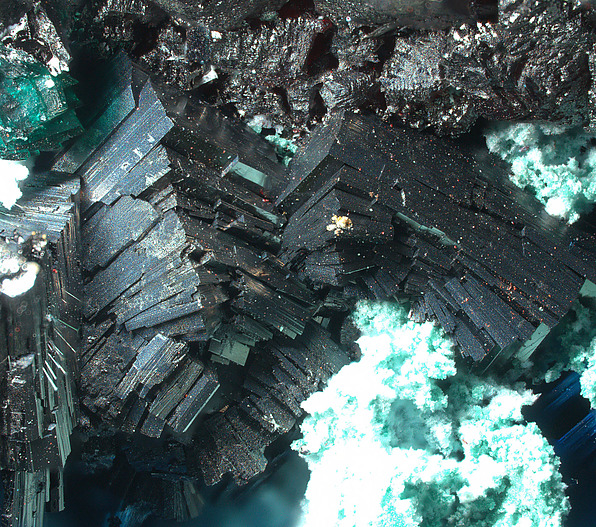
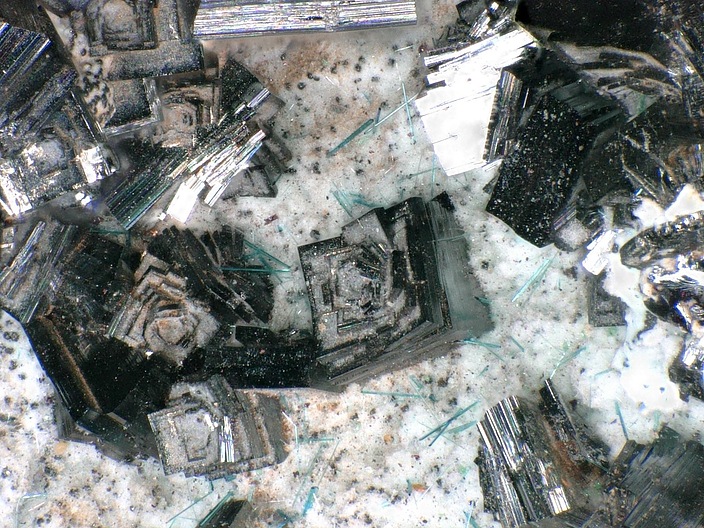


About Paramelaconite
Formula:
Cu+2Cu2+2O3
Colour:
Black, commonly with a slight purple tint
Lustre:
Sub-Adamantine, Greasy, Sub-Metallic
Hardness:
4½
Specific Gravity:
5.9 - 6.04
Crystal System:
Tetragonal
Name:
Named by George Augustus Koenig in 1891 from the Greek παρά (para), near, and melaconite, because it is near "melaconite" (= tenorite) in composition.
Unique Identifiers
Mindat ID:
3098
Long-form identifier:
mindat:1:1:3098:0
IMA Classification of Paramelaconite
Approved, 'Grandfathered' (first described prior to 1959)
IMA Formula:
Cu1+2Cu2+2O3
Classification of Paramelaconite
4.AA.15
4 : OXIDES (Hydroxides, V[5,6] vanadates, arsenites, antimonites, bismuthites, sulfites, selenites, tellurites, iodates)
A : Metal: Oxygen = 2:1 and 1:1
A : Cation:Anion (M:O) = 2:1 (and 1.8:1)
4 : OXIDES (Hydroxides, V[5,6] vanadates, arsenites, antimonites, bismuthites, sulfites, selenites, tellurites, iodates)
A : Metal: Oxygen = 2:1 and 1:1
A : Cation:Anion (M:O) = 2:1 (and 1.8:1)
4.6.4.1
4 : SIMPLE OXIDES
6 : Miscellaneous
4 : SIMPLE OXIDES
6 : Miscellaneous
7.3.3
7 : Oxides and Hydroxides
3 : Oxides of Cu
7 : Oxides and Hydroxides
3 : Oxides of Cu
Mineral Symbols
As of 2021 there are now IMA–CNMNC approved mineral symbols (abbreviations) for each mineral species, useful for tables and diagrams.
| Symbol | Source | Reference for Standard |
|---|---|---|
| Pml | IMA–CNMNC | Warr, L.N. (2021). IMA–CNMNC approved mineral symbols. Mineralogical Magazine, 85(3), 291-320. doi:10.1180/mgm.2021.43 |
Physical Properties of Paramelaconite
Sub-Adamantine, Greasy, Sub-Metallic
Transparency:
Opaque
Colour:
Black, commonly with a slight purple tint
Streak:
Brown-black
Hardness:
4½ on Mohs scale
Tenacity:
Brittle
Cleavage:
None Observed
Fracture:
Conchoidal
Density:
5.9 - 6.04 g/cm3 (Measured) 6.106 g/cm3 (Calculated)
Optical Data of Paramelaconite
Anisotropism:
Strong
Colour in reflected light:
White with pinkish brown tint.
Pleochroism:
Weak
Chemistry of Paramelaconite
Mindat Formula:
Cu+2Cu2+2O3
Elements listed:
Crystallography of Paramelaconite
Crystal System:
Tetragonal
Class (H-M):
4/mmm(4/m2/m2/m) - Ditetragonal Dipyramidal
Space Group:
I41/amd
Cell Parameters:
a = 5.83 Å, c = 9.88 Å
Ratio:
a:c = 1 : 1.695
Unit Cell V:
335.81 ų (Calculated from Unit Cell)
Morphology:
massive, rarely as stout prismatic [001] and {010} striated [100] crystals.
Crystal Structure
Load
Unit Cell | Unit Cell Packed
2x2x2 | 3x3x3 | 4x4x4
Unit Cell | Unit Cell Packed
2x2x2 | 3x3x3 | 4x4x4
Show
Big Balls | Small Balls | Just Balls | Spacefill
Polyhedra Off | Si Polyhedra | All Polyhedra
Remove metal-metal sticks
Big Balls | Small Balls | Just Balls | Spacefill
Polyhedra Off | Si Polyhedra | All Polyhedra
Remove metal-metal sticks
Display Options
Black Background | White Background
Perspective On | Perspective Off
2D | Stereo | Red-Blue | Red-Cyan
Black Background | White Background
Perspective On | Perspective Off
2D | Stereo | Red-Blue | Red-Cyan
View
CIF File Best | x | y | z | a | b | c
CIF File Best | x | y | z | a | b | c
Rotation
Stop | Start
Stop | Start
Labels
Console Off | On | Grey | Yellow
Console Off | On | Grey | Yellow
Data courtesy of the American Mineralogist Crystal Structure Database. Click on an AMCSD ID to view structure
| ID | Species | Reference | Link | Year | Locality | Pressure (GPa) | Temp (K) |
|---|---|---|---|---|---|---|---|
| 0000614 | Paramelaconite | O'Keeffe M, Bovin J O (1978) The crystal structure of paramelaconite, Cu4O3 American Mineralogist 63 180-185 |  | 1978 | 0 | 293 |
CIF Raw Data - click here to close
X-Ray Powder Diffraction
Powder Diffraction Data:
| d-spacing | Intensity |
|---|---|
| 3.17 Å | (100) |
| 2.92 Å | (40) |
| 2.48 Å | (10) |
| 1.89 Å | (20) |
| 1.88 Å | (10) |
| 1.73 Å | (20) |
| 1.59 Å | (10) |
| 1.54 Å | (10) |
Comments:
ICDD 33-480
Geological Environment
Paragenetic Mode(s):
| Paragenetic Mode | Earliest Age (Ga) |
|---|---|
| Stage 10a: Neoproterozoic oxygenation/terrestrial biosphere | <0.6 |
| 50 : Coal and/or oil shale minerals | <0.36 |
| Stage 10b: Anthropogenic minerals | <10 Ka |
| 54 : Coal and other mine fire minerals (see also #51 and #56) |
Type Occurrence of Paramelaconite
Geological Setting of Type Material:
Oxidized zone of copper sulfide deposit
Associated Minerals at Type Locality:
Other Language Names for Paramelaconite
Common Associates
Associations Based on Photo Data:
| 7 photos of Paramelaconite associated with Cuprite | Cu2O |
| 7 photos of Paramelaconite associated with Malachite | Cu2(CO3)(OH)2 |
| 4 photos of Paramelaconite associated with Calcite | CaCO3 |
| 3 photos of Paramelaconite associated with Brochantite | Cu4(SO4)(OH)6 |
| 2 photos of Paramelaconite associated with Chrysocolla | Cu2-xAlx(H2-xSi2O5)(OH)4 · nH2O, x < 1 |
| 2 photos of Paramelaconite associated with Buttgenbachite | Cu19(NO3)2(OH)32Cl4 · 2H2O |
| 1 photo of Paramelaconite associated with Chalcanthite | CuSO4 · 5H2O |
| 1 photo of Paramelaconite associated with Euchlorine | KNaCu3(SO4)3O |
| 1 photo of Paramelaconite associated with Indialite | Mg2Al3(AlSi5O18) |
| 1 photo of Paramelaconite associated with Hematite | Fe2O3 |
Related Minerals - Strunz-mindat Grouping
Fluorescence of Paramelaconite
Not fluorescent
Other Information
Health Risks:
No information on health risks for this material has been entered into the database. You should always treat mineral specimens with care.
Internet Links for Paramelaconite
mindat.org URL:
https://www.mindat.org/min-3098.html
Please feel free to link to this page.
Please feel free to link to this page.
Search Engines:
External Links:
Mineral Dealers:
References for Paramelaconite
Reference List:
Frondel, Clifford (1941) Paramelaconite: a tetragonal oxide of copper. American Mineralogist, 26 (11) 657-672
O'Keeffe, M., Bovin, J. O. (1978) The crystal structure of paramelaconite, Cu4O3. American Mineralogist, 63 (1-2) 180-185
Morgan, P.E.D., Partin, D.E., Chamberland, B.L., O'Keeffe, M. (1996) Synthesis of Paramelaconite: Cu4O3. Journal of Solid State Chemistry, 121. 33-37 doi:10.1006/jssc.1996.0005
Richthofen, A. v., Domnick, R., Cremer, Rainer (1997) Preparation of cuprite (Cu2O), paramelaconite (Cu32+Cu21+O4) and tenorite (CuO) with magnetron sputtering ion plating: characterization by EPMA, XRD, HEED and SEM. Fresenius' Journal of Analytical Chemistry, 358. 312-315 doi:10.1007/s002160050415
Whangbo, M.-H., Koo, H.-J. (2002) Spin Dimer Analysis of the Spin Exchange Interactions in Paramelaconite Cu4O3 and Its Analogue Ag2Cu2O3 and the Spin Ordering of the Cu2O3 Spin Lattice Leading to Their Magnetic Phase Transitions. Inorganic Chemistry, 41 (13). 3570-3577 doi:10.1021/ic020141x
Blobaum, K. J., Van Heerden, D., Wagner, A. J., Fairbrother, D. H., Weihs, T. P. (2003) Sputter-deposition and characterization of paramelaconite. Journal of Materials Research, 18 (7) 1535-1542 doi:10.1557/jmr.2003.0212
Pinsard-Gaudart, L., Rodríguez-Carvajal, J., Gukasov, A., Monod, P. (2004) Magnetic properties of paramelaconite (Cu4O3): A pyrochlore lattice with S=12. Physical Review B, 69 (10). doi:10.1103/physrevb.69.104408
Pierson, J.F., Duverger, E., Banakh, O. (2007) Experimental and theoretical contributions to the determination of optical properties of synthetic paramelaconite. Journal of Solid State Chemistry, 180. 968-973 doi:10.1016/j.jssc.2006.12.028
Debbichi, L., Marco de Lucas, M. C., Pierson, J. F., Krüger, P. (2012) Vibrational Properties of CuO and Cu4O3 from First-Principles Calculations, and Raman and Infrared Spectroscopy. The Journal of Physical Chemistry C, 116 (18). 10232-10237 doi:10.1021/jp303096m
Debbichi, Lamjed, Marco de Lucas, Maria C., Krüger, Peter (2014) Electronic structure, lattice dynamics and thermodynamic stability of paramelaconite Cu4O3. Materials Chemistry and Physics, 148. 293-298 doi:10.1016/j.matchemphys.2014.07.046
Živković, Aleksandar, Sheehama, Jacobina, Warwick, Michael E. A., Jones, Daniel R., Mitchel, Claire, Likius, Daniel, Uahengo, Veikko, Dzade, Nelson Y., Meenakshisundaram, Sankar, Dunnill, Charles W., de Leeuw, Nora H. (2021) Structural and electronic properties of Cu4O3 (paramelaconite): the role of native impurities. Pure and Applied Chemistry, 93 (10) 1229-1244 doi:10.1515/pac-2021-0114
Localities for Paramelaconite
Showing 18 localities.
 symbol to view information about a locality.
The
symbol to view information about a locality.
The Locality List
 - This locality has map coordinates listed.
- This locality has estimated coordinates.
ⓘ - Click for references and further information on this occurrence.
? - Indicates mineral may be doubtful at this locality.
- This locality has map coordinates listed.
- This locality has estimated coordinates.
ⓘ - Click for references and further information on this occurrence.
? - Indicates mineral may be doubtful at this locality.
 - Good crystals or important locality for species.
 - World class for species or very significant.
(TL) - Type Locality for a valid mineral species.
(FRL) - First Recorded Locality for everything else (eg varieties).
- World class for species or very significant.
(TL) - Type Locality for a valid mineral species.
(FRL) - First Recorded Locality for everything else (eg varieties).
All localities listed without proper references should be considered as questionable.
Australia | |
| Alan Melbourne |
Austria | |
| Meixner+Paar (1979) |
Cyprus | |
| Constantinou (1975) |
DR Congo | |
| Louis Verschueren collection |
| Personal communication from Jasun ... |
| Joy Desor (Raman analysis) +1 other reference | |
Germany | |
| Färber (n.d.) |
Greece | |
| |
| |
Mexico | |
| Id by M. Origlieri 2012 |
Poland | |
| Ł. Kruszewski (PXRD data) |
UK | |
| Technical Report TR-02-09 (March 2002) |
USA | |
| Graeme (1993) |
| Dana 6: 1093. +6 other references |
| Dana 6:1093. | |
| 79:124-5 +2 other references |
| Heinrich et al. (2004) |
Quick NavTopAbout ParamelaconiteUnique IdentifiersIMA Classification Classification Mineral SymbolsPhysical Properties Optical Data Chemistry Crystallography Crystal StructureX-Ray Powder DiffractionGeological EnvironmentType Occurrence Other LanguagesCommon AssociatesStrunz-MindatFluorescence Other InformationInternet Links References Localities Locality List

Tenke Mine, Tenke-Fungurume area, Lualaba, DR Congo