
Gerstleyite
A valid IMA mineral species - grandfathered
This page is currently not sponsored. Click here to sponsor this page.




About Gerstleyite

James M. Gerstley
Formula:
Na2(Sb,As)8S13 · 2H2O
Colour:
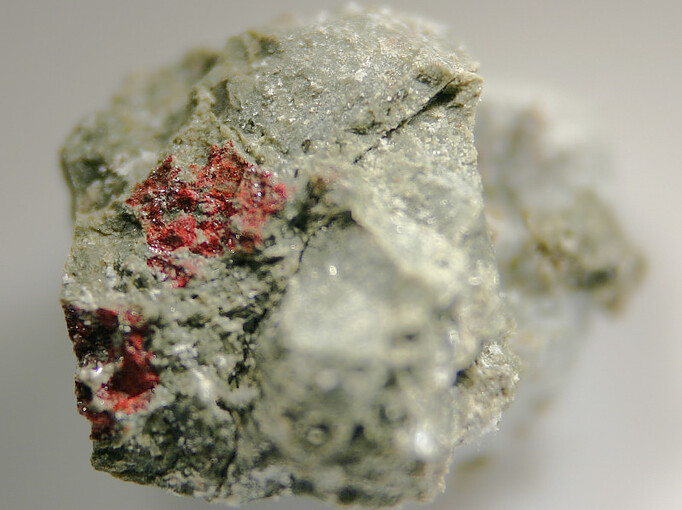
Cinnabar red, darkening on exposure
Lustre:
Sub-Adamantine
Hardness:
2½
Specific Gravity:
3.62
Crystal System:
Monoclinic
Name:
Named in honor of James Mack Gerstley (11 November 1907, London, England - 2 June 2007, San Francisco, California, USA), president of the Pacific Coast Borax Company (later the United States Borax & Chemical Corporation) from 1933-1961. He was inducted into the US National Mining Hall of Fame in 2003.
Homeotypic with gerstleyite and gillulyite.
Occurs as red spherules with fibrous to platy structure up to 2.5 cm in clay with borates. This was the first known sodium sulfosalt.
Occurs as red spherules with fibrous to platy structure up to 2.5 cm in clay with borates. This was the first known sodium sulfosalt.
Unique Identifiers
Mindat ID:
1684
Long-form identifier:
mindat:1:1:1684:7
IMA Classification of Gerstleyite
Approved, 'Grandfathered' (first described prior to 1959)
IMA Formula:
Na2(Sb,As)8S13·2H2O
First published:
1956
Classification of Gerstleyite
2.HE.05
2 : SULFIDES and SULFOSALTS (sulfides, selenides, tellurides; arsenides, antimonides, bismuthides; sulfarsenites, sulfantimonites, sulfbismuthites, etc.)
H : Sulfosalts of SnS archetype
E : With alkalies, H2O
2 : SULFIDES and SULFOSALTS (sulfides, selenides, tellurides; arsenides, antimonides, bismuthides; sulfarsenites, sulfantimonites, sulfbismuthites, etc.)
H : Sulfosalts of SnS archetype
E : With alkalies, H2O
3.8.8.1
3 : SULFOSALTS
8 : 1 < ø < 2
3 : SULFOSALTS
8 : 1 < ø < 2
5.0.1
5 : Sulphosalts - Sulpharsenites and Sulphobismuthites (those containing Sn, Ge,or V are in Section 6)
0 : Sulpharsenites etc. of the alkali metals
5 : Sulphosalts - Sulpharsenites and Sulphobismuthites (those containing Sn, Ge,or V are in Section 6)
0 : Sulpharsenites etc. of the alkali metals
Mineral Symbols
As of 2021 there are now IMA–CNMNC approved mineral symbols (abbreviations) for each mineral species, useful for tables and diagrams.
| Symbol | Source | Reference for Standard |
|---|---|---|
| Gst | IMA–CNMNC | Warr, L.N. (2021). IMA–CNMNC approved mineral symbols. Mineralogical Magazine, 85(3), 291-320. doi:10.1180/mgm.2021.43 |
Physical Properties of Gerstleyite
Sub-Adamantine
Transparency:
Translucent
Colour:
Cinnabar red, darkening on exposure
Streak:
Bright cinnabar red
Hardness:
2½ on Mohs scale
Hardness Data:
Measured
Tenacity:
Brittle
Cleavage:
Perfect
Perfect on {010} and {100}; poor on {001}.
Perfect on {010} and {100}; poor on {001}.
Fracture:
None observed
Density:
3.62 g/cm3 (Measured) 3.723 g/cm3 (Calculated)
Optical Data of Gerstleyite
Type:
Biaxial
Dispersion:
r < v extreme
Pleochroism:
Weak
Comments:
X = salmon red, Y = Z = deep blood red.
Comments:
Refractive indices > 2.0
Chemistry of Gerstleyite
Mindat Formula:
Na2(Sb,As)8S13 · 2H2O
Element Weights:
Common Impurities:
Li
Crystallography of Gerstleyite
Crystal System:
Monoclinic
Class (H-M):
m - Domatic
Space Group:
Bm
Setting:
Cm
Cell Parameters:
a = 9.911(8) Å, b = 23.05(2) Å, c = 7.097(8) Å
β = 127.85(7)°
β = 127.85(7)°
Ratio:
a:b:c = 0.43 : 1 : 0.308
Unit Cell V:
1,280.21 ų (Calculated from Unit Cell)
Z:
2
Morphology:
Fibrous and platy
Crystal Structure
Load
Unit Cell | Unit Cell Packed
2x2x2 | 3x3x3 | 4x4x4
Unit Cell | Unit Cell Packed
2x2x2 | 3x3x3 | 4x4x4
Show
Big Balls | Small Balls | Just Balls | Spacefill
Polyhedra Off | Si Polyhedra | All Polyhedra
Remove metal-metal sticks
Big Balls | Small Balls | Just Balls | Spacefill
Polyhedra Off | Si Polyhedra | All Polyhedra
Remove metal-metal sticks
Display Options
Black Background | White Background
Perspective On | Perspective Off
2D | Stereo | Red-Blue | Red-Cyan
Black Background | White Background
Perspective On | Perspective Off
2D | Stereo | Red-Blue | Red-Cyan
View
CIF File Best | x | y | z | a | b | c
CIF File Best | x | y | z | a | b | c
Rotation
Stop | Start
Stop | Start
Labels
Console Off | On | Grey | Yellow
Console Off | On | Grey | Yellow
Data courtesy of the American Mineralogist Crystal Structure Database. Click on an AMCSD ID to view structure
| ID | Species | Reference | Link | Year | Locality | Pressure (GPa) | Temp (K) |
|---|---|---|---|---|---|---|---|
| 0012197 | Gerstleyite | Nakai I, Appleman D E (1981) The crystal structure of gerstleyite Na2(Sb,As)8S13*2H2O: the first sulfosalt mineral of sodium Chemistry Letters 1981 1327-1330 | 1981 | Baker mine, Kern County, Boron, California, USA | 0 | 293 |
CIF Raw Data - click here to close
X-Ray Powder Diffraction
Powder Diffraction Data:
| d-spacing | Intensity |
|---|---|
| 11.85 Å | (100) |
| 3.05 Å | (90) |
| 5.64 Å | (70) |
| 4.03 Å | (70) |
| 2.81 Å | (50) |
| 2.739 Å | (40) |
| 1.934 Å | (40) |
Locality:
Reference:
Comments:
From type material at Baker Mine, Kern Co., Ca., USA
Geological Environment
Paragenetic Mode(s):
| Paragenetic Mode | Earliest Age (Ga) |
|---|---|
| High-? alteration and/or metamorphism | |
| 33 : Minerals deposited by hydrothermal metal-rich fluids (see also [#12]) | |
| Stage 10a: Neoproterozoic oxygenation/terrestrial biosphere | <0.6 |
| 53 : Other minerals with taphonomic origins | <0.4 |
Geological Setting:
As above
Type Occurrence of Gerstleyite
General Appearance of Type Material:
Cinnabar-red platy-fibrous spherules, up to 2.5 cm, with a crudely radial fibrous structure, in clay. Also occurs as fine-granular aggregates and as groups of small, thick plates with rough surfaces. The individual crystals of the aggregates are warped an
Place of Conservation of Type Material:
Harvard University, Cambridge, Massachusetts, USA, 111307.
National Museum of Natural History, Washington, D.C., USA, 106916.
National Museum of Natural History, Washington, D.C., USA, 106916.
Geological Setting of Type Material:
Low temperature borate evaporite.
Associated Minerals at Type Locality:
Other Language Names for Gerstleyite
Common Associates
Associations Based on Photo Data:
| 8 photos of Gerstleyite associated with Kernite | Na2[B4O6(OH)2] · 3H2O |
| 7 photos of Gerstleyite associated with Probertite | NaCa[B5O7(OH)4] · 3H2O |
| 4 photos of Gerstleyite associated with Pararealgar | As4S4 |
| 1 photo of Gerstleyite associated with 'Clay' |
Related Minerals - Strunz-mindat Grouping
| 2.HE.10 | Ambrinoite | [K,(NH4)]2(As,Sb)6(Sb,As)2S13 · H2O |
Other Information
Notes:
Fuses at 2.
Completely soluble in dilute alkalies, and is decomposed by dilute HCl with the evolution of H2S and the separation of a yellow residue.
Completely soluble in dilute alkalies, and is decomposed by dilute HCl with the evolution of H2S and the separation of a yellow residue.
Health Risks:
No information on health risks for this material has been entered into the database. You should always treat mineral specimens with care.
Industrial Uses:
none
Internet Links for Gerstleyite
mindat.org URL:
https://www.mindat.org/min-1684.html
Please feel free to link to this page.
Please feel free to link to this page.
Search Engines:
External Links:
Mineral Dealers:
References for Gerstleyite
Reference List:
Frondel, Clifford, Morgan, Vincent (1956) Inderite and gerstleyite from the Kramer borate district, Kern County, California. American Mineralogist, 41 (11-12) 839-843
Nakai, Izumi, Appleman, Daniel E (1981) The crystal structure of gerstleyite Na2(Sb.As)8S13·2H2O: the first sulfosalt mineral of sodium. Chemistry Letters, 10 (10). 1327-1330 doi:10.1246/cl.1981.1327
Localities for Gerstleyite
Showing 6 localities.
 symbol to view information about a locality.
The
symbol to view information about a locality.
The Locality List
 - This locality has map coordinates listed.
- This locality has estimated coordinates.
ⓘ - Click for references and further information on this occurrence.
? - Indicates mineral may be doubtful at this locality.
- This locality has map coordinates listed.
- This locality has estimated coordinates.
ⓘ - Click for references and further information on this occurrence.
? - Indicates mineral may be doubtful at this locality.
 - Good crystals or important locality for species.
 - World class for species or very significant.
(TL) - Type Locality for a valid mineral species.
(FRL) - First Recorded Locality for everything else (eg varieties).
- World class for species or very significant.
(TL) - Type Locality for a valid mineral species.
(FRL) - First Recorded Locality for everything else (eg varieties).
All localities listed without proper references should be considered as questionable.
USA | |
| www.mineralsocal.org (1999) |
| U.S. Borax | |
| Frondel et al. (1956) +1 other reference | |
| Frondel et al. (1956) |
| collected by Rock Currier |
Quick NavTopAbout GerstleyiteUnique IdentifiersIMA Classification Classification Mineral SymbolsPhysical Properties Optical Data Chemistry Crystallography Crystal StructureX-Ray Powder DiffractionGeological EnvironmentType Occurrence Other LanguagesCommon AssociatesStrunz-MindatOther InformationInternet Links References Localities Locality List

Baker Mine, Rio Tinto Borax Mine, Kramer Borate deposit, Boron, Kern County, California, USA