
Probertite
A valid IMA mineral species - grandfathered
This page is currently not sponsored. Click here to sponsor this page.

About Probertite
Formula:
NaCa[B5O7(OH)4] · 3H2O
Colour:
Colourless, white; colourless in transmitted light
Lustre:
Vitreous
Hardness:
3½
Specific Gravity:
2.135 - 2.141
Crystal System:
Monoclinic
Name:
Named in honor of Frank Holman Probert (13 June 1876, London, England – 7 May 1940, Berkeley, California, USA), Dean of the Mining College, University of California, Berkeley, California, USA, who provided the first specimens.
The structure is based on the pentaborate polyanion, of 5(2Δ + 3T) topology. It comprises oxygen-sharing B-bearing tetrahedra and B-bearing triangular groups. The polyanion comprises 5 geometrical components: BO3, BO2(OH), BO4, BO3(OH), and BO2(OH)2. The polyanions are joined, thus forming chains || [100]. Calcium forms clusters comprising distorted Ca polyhedra, CaO5(OH)3(OH2). Sodium exists as NaO(OH)2(OH2)3 polyhedra, that are connected via edge-sharing. Hydrogen bonding is present, too.
Unique Identifiers
Mindat ID:
3285
Long-form identifier:
mindat:1:1:3285:4
IMA Classification of Probertite
Approved, 'Grandfathered' (first described prior to 1959)
IMA Formula:
NaCaB5O7(OH)4·3H2O
First published:
1929
Type description reference:
Classification of Probertite
6.EB.15
6 : BORATES
E : Pentaborates
B : Ino-pentaborates
6 : BORATES
E : Pentaborates
B : Ino-pentaborates
26.5.12.1
26 : HYDRATED BORATES CONTAINING HYDROXYL OR HALOGEN
5 : Pentaborates
26 : HYDRATED BORATES CONTAINING HYDROXYL OR HALOGEN
5 : Pentaborates
9.3.20
9 : Borates
3 : Borates of Ca and Sr
9 : Borates
3 : Borates of Ca and Sr
Mineral Symbols
As of 2021 there are now IMA–CNMNC approved mineral symbols (abbreviations) for each mineral species, useful for tables and diagrams.
| Symbol | Source | Reference for Standard |
|---|---|---|
| Pbr | IMA–CNMNC | Warr, L.N. (2021). IMA–CNMNC approved mineral symbols. Mineralogical Magazine, 85(3), 291-320. doi:10.1180/mgm.2021.43 |
Physical Properties of Probertite
Vitreous
Transparency:
Transparent, Translucent
Comment:
Satiny
Colour:
Colourless, white; colourless in transmitted light
Streak:
White
Hardness:
3½ on Mohs scale
Tenacity:
Brittle
Cleavage:
Perfect
On {110}.
On {110}.
Density:
2.135 - 2.141 g/cm3 (Measured) 2.132 g/cm3 (Calculated)
Optical Data of Probertite
Type:
Biaxial (+)
RI values:
nα = 1.514 - 1.517 nβ = 1.524 - 1.525 nγ = 1.543 - 1.544
2V:
Measured: 73° , Calculated: 74°
Max. Birefringence:
δ = 0.027 - 0.029
Based on recorded range of RI values above.
Based on recorded range of RI values above.
Interference Colours:
The colours simulate birefringence patterns seen in thin section under crossed polars. They do not take into account mineral colouration or opacity.
Michel-Levy Bar The default colours simulate the birefringence range for a 30 µm thin-section thickness. Adjust the slider to simulate a different thickness.
Grain Simulation You can rotate the grain simulation to show how this range might look as you rotated a sample under crossed polars. Each grain retains its interference colour (retardation) while its brightness falls to black at extinction and reaches a maximum between extinction positions.
The colours simulate birefringence patterns seen in thin section under crossed polars. They do not take into account mineral colouration or opacity.
Michel-Levy Bar The default colours simulate the birefringence range for a 30 µm thin-section thickness. Adjust the slider to simulate a different thickness.
Grain Simulation You can rotate the grain simulation to show how this range might look as you rotated a sample under crossed polars. Each grain retains its interference colour (retardation) while its brightness falls to black at extinction and reaches a maximum between extinction positions.
Surface Relief:
None to Very Low
Relative to Canada balsam mounting medium (n ≈ 1.537).
Relative to Canada balsam mounting medium (n ≈ 1.537).
This shows the grain boundary and Becke line effect under plane-polarised
light, based on the contrast between this mineral's average refractive
index and the mounting medium. It does not take into account mineral
colouration.
In focus
Interference Figure:
This shows the idealized biaxial acute bisectrix (Bxa) interference figure
- the conoscopic view for a grain cut perpendicular to the acute bisectrix, using
this mineral's 2V. The two small white dots mark the melatopes - the points
where the two optic axes emerge - and are shown only when they fall within the
field of view. The coloured bands are isochromatics, and the dark bands are
isogyres.
Rotate the stage: at 0°/90° the isogyres form a cross through the melatopes; at 45° they pull apart into curved hyperbolas. That splitting on rotation - absent in a uniaxial figure - is the standard diagnostic test for telling biaxial minerals from uniaxial ones. If 2V is large, the melatopes may fall outside the field of view, as they often do at the microscope too.
Rotate the stage: at 0°/90° the isogyres form a cross through the melatopes; at 45° they pull apart into curved hyperbolas. That splitting on rotation - absent in a uniaxial figure - is the standard diagnostic test for telling biaxial minerals from uniaxial ones. If 2V is large, the melatopes may fall outside the field of view, as they often do at the microscope too.
Dispersion:
Relatively weak.
Optical Extinction:
Y = b; Z ∧ c = 12°–13°.
Chemistry of Probertite
Mindat Formula:
NaCa[B5O7(OH)4] · 3H2O
Element Weights:
Crystallography of Probertite
Crystal System:
Monoclinic
Class (H-M):
2/m - Prismatic
Space Group:
P21/b
Setting:
P21/a
Cell Parameters:
a = 13.428(2) Å, b = 12.560(2) Å, c = 6.588(1) Å
β = 99.97(1)°
β = 99.97(1)°
Ratio:
a:b:c = 1.069 : 1 : 0.525
Unit Cell V:
1,094.32 ų (Calculated from Unit Cell)
Z:
4
Morphology:
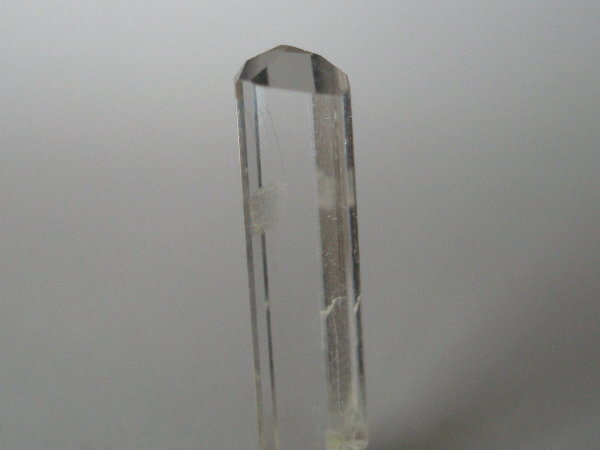
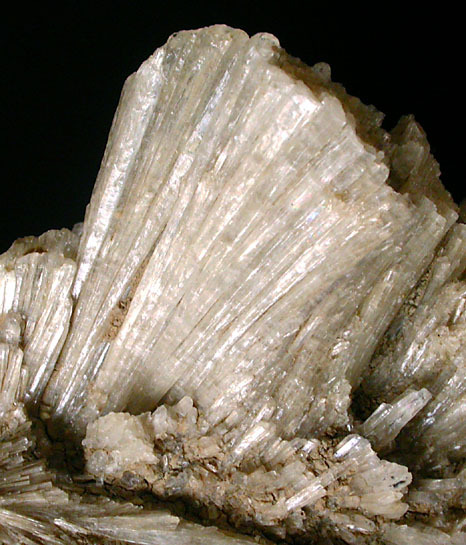
Crystals aggregated into rosettes or radial groups of needles or laths. Spherulitic; as tough, compactly reticulated aggregates. Single crystals rare. Crystals acicular [001], commonly flattened {100} (slightly to considerably); also flattened {110}, rare. Faces "b," "a," and "m" usually striated [001] and rounded.
Twinning:
Doubtful under the microscope.
Crystal Structure
Load
Unit Cell | Unit Cell Packed
2x2x2 | 3x3x3 | 4x4x4
Unit Cell | Unit Cell Packed
2x2x2 | 3x3x3 | 4x4x4
Show
Big Balls | Small Balls | Just Balls | Spacefill
Polyhedra Off | Si Polyhedra | All Polyhedra
Remove metal-metal sticks
Big Balls | Small Balls | Just Balls | Spacefill
Polyhedra Off | Si Polyhedra | All Polyhedra
Remove metal-metal sticks
Display Options
Black Background | White Background
Perspective On | Perspective Off
2D | Stereo | Red-Blue | Red-Cyan
Black Background | White Background
Perspective On | Perspective Off
2D | Stereo | Red-Blue | Red-Cyan
View
CIF File Best | x | y | z | a | b | c
CIF File Best | x | y | z | a | b | c
Rotation
Stop | Start
Stop | Start
Labels
Console Off | On | Grey | Yellow
Console Off | On | Grey | Yellow
Data courtesy of the American Mineralogist Crystal Structure Database. Click on an AMCSD ID to view structure
| ID | Species | Reference | Link | Year | Locality | Pressure (GPa) | Temp (K) |
|---|---|---|---|---|---|---|---|
| 0009784 | Probertite | Menchetti S, Sabelli C, Trosti-Ferroni R (1982) Probertite, CaNa[B5O7(OH)4]*3H2O: a refinement Acta Crystallographica B38 3072-3075 |  | 1982 | 0 | 293 |
CIF Raw Data - click here to close
X-Ray Powder Diffraction
Loading XRD data...
Data courtesy of RRUFF project at University of Arizona, used with permission.
Powder Diffraction Data:
| d-spacing | Intensity |
|---|---|
| 9.12 Å | (100) |
| 2.807 Å | (35) |
| 6.62 Å | (20) |
| 3.52 Å | (20) |
| 2.935 Å | (20) |
| 2.884 Å | (20) |
| 2.172 Å | (20) |
Comments:
Boron, California, USA. Data from Clark and Christ (1959).
Geological Environment
Paragenetic Mode(s):
| Paragenetic Mode | Earliest Age (Ga) |
|---|---|
| Stage 3b: Earth’s earliest hydrosphere | >4.45 |
| 14 : Hot springs, geysers, and other subaerial geothermal minerals | |
| Near-surface Processes | |
| 25 : Evaporites (prebiotic) |
Type Occurrence of Probertite
General Appearance of Type Material:
Acicular to elongated.
Place of Conservation of Type Material:
National Museum of Natural History, Washington, D.C., USA, 95832–95833.
Geological Setting of Type Material:
Lake-bed deposits.
Associated Minerals at Type Locality:
Synonyms of Probertite
Other Language Names for Probertite
Common Associates
Associations Based on Photo Data:
| 9 photos of Probertite associated with Ulexite | NaCa[B5O6(OH)6] · 5H2O |
| 7 photos of Probertite associated with Gerstleyite | Na2(Sb,As)8S13 · 2H2O |
| 4 photos of Probertite associated with Native Arsenic | As |
| 4 photos of Probertite associated with Arsenolite | As2O3 |
Related Minerals - Strunz-mindat Grouping
| 6.EB.05 | Larderellite | (NH4)B5O7(OH)2 · H2O |
| 6.EB.05 | Yarzhemskiite | K[B5O7(OH)2] · H2O |
| 6.EB.10 | Ezcurrite | Na4B10O17 · 7H2O |
| 6.EB.20 | Tertschite | Ca4B10O19 · 20H2O |
| 6.EB.25 | Priceite | Ca2B5O7(OH)5 · H2O |
Other Information
Notes:
Readily soluble in dilute acids. Partially decomposed in hot or cold water, with Na being leached relative to Ca.
Health Risks:
No information on health risks for this material has been entered into the database. You should always treat mineral specimens with care.
Internet Links for Probertite
mindat.org URL:
https://www.mindat.org/min-3285.html
Please feel free to link to this page.
Please feel free to link to this page.
Search Engines:
External Links:
Mineral Dealers:
References for Probertite
Reference List:
Foshag, William Frederick (1931) Probertite from Ryan, Inyo County, California. American Mineralogist, 16 (8) 338-341
Barnes, William (1949) The unit cell and space group of probertite. American Mineralogist, 34 (1-2) 19-25
Barnes, William H. (1949) Corrections to recent papers on probertite and lindgrenite. American Mineralogist, 34 (7-8) 611-613
Clark, J. R., Christ, C. L. (1959) Studies of borate minerals (V): Reinvestigation of X-ray crystallography of ulexite and probertite. American Mineralogist, 44 (7-8) 712-719
Localities for Probertite
Showing 36 localities.
 symbol to view information about a locality.
The
symbol to view information about a locality.
The Locality List
 - This locality has map coordinates listed.
- This locality has estimated coordinates.
ⓘ - Click for references and further information on this occurrence.
? - Indicates mineral may be doubtful at this locality.
- This locality has map coordinates listed.
- This locality has estimated coordinates.
ⓘ - Click for references and further information on this occurrence.
? - Indicates mineral may be doubtful at this locality.
 - Good crystals or important locality for species.
 - World class for species or very significant.
(TL) - Type Locality for a valid mineral species.
(FRL) - First Recorded Locality for everything else (eg varieties).
- World class for species or very significant.
(TL) - Type Locality for a valid mineral species.
(FRL) - First Recorded Locality for everything else (eg varieties).
All localities listed without proper references should be considered as questionable.
Quick NavTopAbout ProbertiteUnique IdentifiersIMA Classification Classification Mineral SymbolsPhysical Properties Optical Data Chemistry Crystallography Crystal StructureX-Ray Powder DiffractionGeological EnvironmentType Occurrence SynonymsOther LanguagesCommon AssociatesStrunz-MindatOther InformationInternet Links References Localities Locality List

Kohnstein Quarry, Niedersachswerfen, Harztor, Nordhausen District, Thuringia, Germany