
Rio Morteo, Albenga, Savona Province, Liguria, Italyi
| Regional Level Types | |
|---|---|
| Rio Morteo | Outcrop |
| Albenga | Commune |
| Savona Province | Province |
| Liguria | Region |
| Italy | Country |
This page is currently not sponsored. Click here to sponsor this page.



Latitude & Longitude (WGS84):
44° 5' 35'' North , 8° 11' 21'' East
Latitude & Longitude (decimal):
Area:
1.0 km2
Type:
Köppen climate type:
Nearest Settlements:
| Place | Population | Distance |
|---|---|---|
| Peagna | 222 (2014) | 1.4km |
| Salea | 379 (2014) | 1.5km |
| Faro | 107 (2014) | 1.5km |
| Piamboschi | 219 (2014) | 2.3km |
| Campochiesa | 1,239 (2014) | 2.6km |
Other/historical names associated with this locality:
Case Morteo
The deepening of the Ligurian-Piedmontese ocean basin, in the late Jurassic age, has generated episodes of submarine breccia (Monte Galero breccia) deposited in a slope or slope-to-basin enviroment.
In these breccia depositions, two very altered effusive events are locally recorded (Case Morteo rhyodacites, Cortesogno et al. 1981).
The first submarine acid lava effusion has a thickness of about 4 meters while the second has a maximum thickness of 5 to 6 meters.
The original mineralogical composition of these two lava bodies was interpreted (Cortesogno et al. 1981) to be formed by plagioclase, amphibole, biotite and quartz and thus considered to be an alteration product of a rhyolite/dacite.
A radiolaritic deposition (Arnasco radiolarites) follows the deposition of breccias and rhyodacites (Nasino sandstone si absent in this outcrop). Radiolarite is represented by pelitic and siliceous facies with yellowish, red/purple, greenish colors.
The radiolarite along the crest of the hill just west of Rio Morteo are intensively tectonized, which has led to the formation of numerous small quartz geodes. Radiolarites with a strong red color and sub-conchoid fracture are those with the highest radiolar content, clearly visible in thin section.
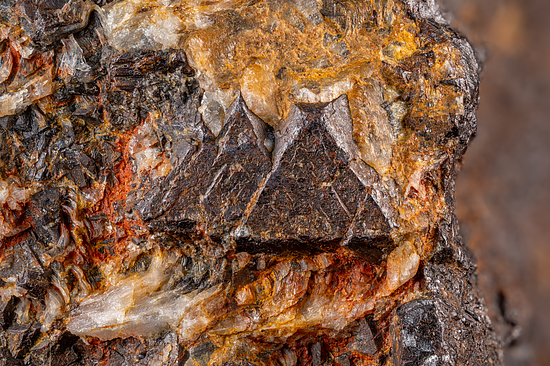
Hematite var. martite concretions formed inside gray-yellowish shale of Arnasco radiolarite's group, and they were first discover by chance by Matteo Azili in 2024. Although rare, these concretions can be found both along the path that crosses this facies of Arnasco radiolarite and inside the original host rock, a strong sign of their presence is Fe oxide (hematite) that make the shale of a deep red colour. The concretions are sometimes covered by a thin quartz envelope (formed due to the changing volume of the host rock) that always present slickensides.
In these breccia depositions, two very altered effusive events are locally recorded (Case Morteo rhyodacites, Cortesogno et al. 1981).
The first submarine acid lava effusion has a thickness of about 4 meters while the second has a maximum thickness of 5 to 6 meters.
The original mineralogical composition of these two lava bodies was interpreted (Cortesogno et al. 1981) to be formed by plagioclase, amphibole, biotite and quartz and thus considered to be an alteration product of a rhyolite/dacite.
A radiolaritic deposition (Arnasco radiolarites) follows the deposition of breccias and rhyodacites (Nasino sandstone si absent in this outcrop). Radiolarite is represented by pelitic and siliceous facies with yellowish, red/purple, greenish colors.
The radiolarite along the crest of the hill just west of Rio Morteo are intensively tectonized, which has led to the formation of numerous small quartz geodes. Radiolarites with a strong red color and sub-conchoid fracture are those with the highest radiolar content, clearly visible in thin section.
Hematite var. martite concretions formed inside gray-yellowish shale of Arnasco radiolarite's group, and they were first discover by chance by Matteo Azili in 2024. Although rare, these concretions can be found both along the path that crosses this facies of Arnasco radiolarite and inside the original host rock, a strong sign of their presence is Fe oxide (hematite) that make the shale of a deep red colour. The concretions are sometimes covered by a thin quartz envelope (formed due to the changing volume of the host rock) that always present slickensides.
Select Mineral List Type
Standard Detailed Gallery Strunz Chemical ElementsDetailed Mineral List:
| ⓘ Hematite Formula: Fe2O3 References: Matteo Azili CollectionIdentified by Matteo Azili: Visual Identification |
| ⓘ Hematite var. Martite Formula: Fe2O3 References: Matteo Azili CollectionIdentified by Matteo Azili: Visual Identification |
| ⓘ Quartz Formula: SiO2 References: Matteo Azili CollectionIdentified by Matteo Azili: Visual Identification |
Gallery:

List of minerals arranged by Strunz 10th Edition classification
| Group 4 - Oxides and Hydroxides | |||
|---|---|---|---|
| ⓘ | Hematite | 4.CB.05 | Fe2O3 |
| ⓘ | var. Martite | 4.CB.05 | Fe2O3 |
| ⓘ | Quartz | 4.DA.05 | SiO2 |
List of minerals for each chemical element
| O | Oxygen | |
|---|---|---|
| O | ⓘ Hematite | Fe2O3 |
| O | ⓘ Hematite var. Martite | Fe2O3 |
| O | ⓘ Quartz | SiO2 |
| Si | Silicon | |
| Si | ⓘ Quartz | SiO2 |
| Fe | Iron | |
| Fe | ⓘ Hematite | Fe2O3 |
| Fe | ⓘ Hematite var. Martite | Fe2O3 |
Other Regions, Features and Areas containing this locality
This page contains all mineral locality references listed on mindat.org. This does not claim to be a complete list. If you know of more minerals from this site, please register so you can add to our database. This locality information is for reference purposes only. You should never attempt to
visit any sites listed in mindat.org without first ensuring that you have the permission of the land and/or mineral rights holders
for access and that you are aware of all safety precautions necessary.

Rio Morteo, Albenga, Savona Province, Liguria, Italy