


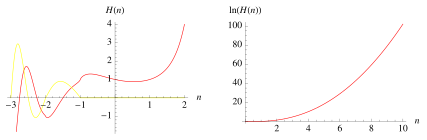
The hyperfactorial (Sloane and Plouffe 1995) is the function defined for a nonnegative integer  by
 |  |  |
(1)
|
 |  |  |
(2)
|
where  is the K-function.
The hyperfactorial is implemented in the Wolfram Language as Hyperfactorial[n].
For positive integers  , 2, ..., the hyperfactorial values are 1, 4, 108,
27648, 86400000, 4031078400000, 3319766398771200000, ... (OEIS A002109).
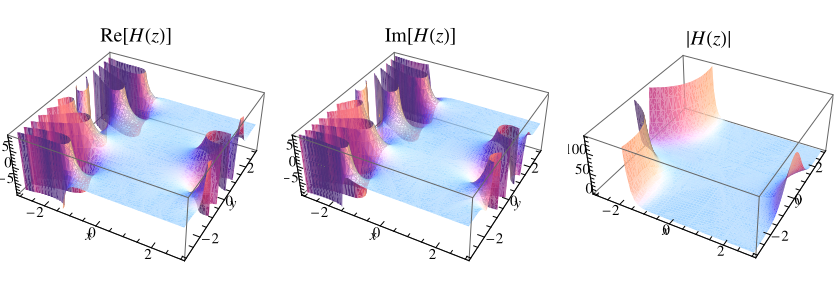
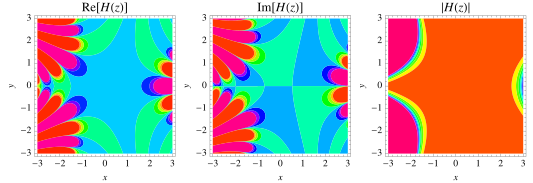
The hyperfactorial can also be generalized to complex numbers, as illustrated above. This continuation has a branch
cut along the real ray ![(-infty,-1]](https://mathworld.wolfram.com/images/equations/Hyperfactorial/Inline10.svg) .
The Barnes G-function and hyperfactorial  satisfy the relation
 |
(3)
|
for  . Here
 denotes the analytic logarithm
of the gamma function that is real for positive
real arguments, as implemented by LogGamma[z],
rather than the principal value of the natural
logarithm of
 .
For  , the hyperfactorial is given by the integral
 |
(4)
|
using the same analytic logarithm along the straight segment from 0 to  . It also has the closed-form
expression
 |
(5)
|
for  , where
 is the Riemann zeta
function,
 its derivative,
 is the Hurwitz
zeta function, and
 |
(6)
|
As  on the real axis,
 has the asymptotic series
 |
(7)
|
 has the special value
 |  |  |
(8)
|
 |  |  |
(9)
|
 |  |  |
(10)
|
where  is the Euler-Mascheroni constant and
 is the Glaisher-Kinkelin
constant.
For real  , the derivative
is given by
 |
(11)
|

