
November 2026, Issue 557 D J Taylor on Saki * Joanna Kavenna on Camus’s love letters * Charles Darwent on Krasner and Pollock * Michele Pridmore-Brown on having children * Barbara J King on animals’ inner lives * Kirsten Tambling on miniatures * Tim Bale on the rise of Reform * Olivia Potts on London restaurants * Nick Groom on Edgar Allan Poe * Richard Smyth on Northern cities * Jennifer Potter on gardens * Richard Vinen on nation-states * Jane Yager on Nazi women * Rana Mitter on the Declaration of Independence * Sara Wheeler on Paul Theroux * Tim Hornyak on the yakuza * Adam Sisman on Edith Tudor-Hart * Edward Short on Granville Sharp * Sara Lodge on the first detectives * Robert Colls on English football * Nigel Andrew on smells * Diane Purkiss on Oxford monuments * Andrew Hill on shorthand * Paul Genders on Tom McCarthy * and much, much more…
The Current Issue
D J Taylor
Super-Beast: The Mysterious Life of Saki
By Oliver Soden
In some ways all you really need to know about Hector Hugh Munro (1870–1916) can be gleaned from the short story ‘Sredni Vashtar’, first published in the Westminster Gazette in the summer of 1910. Conradin – Munro’s heroes nearly always have these hifalutin names – is a sickly small boy quartered on a tyrannical guardian called Mrs de Ropp. Denied much in the way of freedom or material comfort, in particular the hot buttered toast he craves, Conradin makes a fetish out of a savage polecat-ferret hidden in the garden shed... read more
More Articles from this Issue
Joanna Kavenna
Letters: 1944–1959
By Albert Camus & Maria Casarès (Edited by Béatrice Vaillant, translated from French by Sandra Smith & Cory Stockwell)
What an amazing behemoth of a book! I’ve been lugging it around for weeks. Nearly a thousand letters: the intimate correspondence of Albert Camus and Maria Casarès. When they first met in Paris – on D-Day, 1944 – Camus had already published L’Etranger (1942; The Outsider). Born and raised in Algeria, he was in Paris when the Second World War broke out, and later joined the French Resistance... read more
Charles Darwent
Krasner and Pollock: Past Continuous
By David Breslin & Brinda Kumar
In the first weeks of 1946, Lee Krasner and Jackson Pollock started work on a new project. The couple, in their mid-thirties, had moved from New York City to a modest farmhouse in the Long Island hamlet of Springs a few months before. Each was fleeing something. Krasner, in the mid-1940s, had gone through a creative block that resulted in the works she was to call her ‘gray slabs’ – flat, lifeless canvases from which she had tried, and failed, to coax an image. ... read more
Michele Pridmore-Brown
Generation Maybe: Why We’re Having Fewer Children, and What It Means for Us All
By Camilla Cavendish
Who Gets to Have Kids?: Creating a Family in an Age of Uncertainty
By Anna Louie Sussman
In Mexico City, where I write this, the birth rate is significantly less than one child per woman (0.79), lower even than in South Korea (0.80). In the city’s upscale borough of Benito Juárez, full of urban professionals and historic sites, the dearth of children is especially striking... read more
Barbara J King
Minds I’ve Met: From Denying to Embracing the Inner Lives of Animals
By Frans de Waal
Some years ago, a prominent animal-behaviour scientist hosted a colleague at his field station devoted to the study of chimpanzees. Talking together on top of the observation tower, the pair glanced at the apes but mostly stayed absorbed in conversation. Then a female chimpanzee named Thai began to scream and hit herself in dramatic fashion. In response to her outburst, other chimpanzees rushed to embrace, hold and kiss her. Now the colleagues’ attention was riveted on the primates below. ... read more
Kirsten Tambling
The Portrait Miniature: A New History
By Damiët Schneeweisz, Rosalind McKever & Adriana Concin
In 1828, American artist Sarah Goodridge sent the recently widowed senator Daniel Webster a self-portrait miniature – apparently ‘in an attempt to seduce him’. Carefully concealed in a small box and intricately rendered in watercolour over a luminous ivory surface, it depicted nothing but the artist’s bare, delicately stippled, carefully individualised breasts. As private in form as it was intimate in subject, the painting was a significant departure from Goodridge’s public-facing output... read more
Tim Hornyak
Yakuza: A 400-Year History of the Japanese Underworld
By Andrew Rankin
In the Western mind, Japan is often reduced to a set of stereotypes, of which one is the yakuza, the criminal syndicates known for their harsh codes of loyalty. They continue to be romanticised in films, video games and comics even though they are a spent force: their ranks fell to 17,600 last year, a record low, from more than 80,000 some twenty years ago. They are ageing, squeezed by antigang laws and edged out by tokuryū, criminals who operate through the internet on an ad hoc basis. In 2022, the Tokyo-based group Anegasaki-kai... read more
Most Read
moreJessica Mann
March 2010 Crime Round-up
David Bodanis
Prize Fight: The Race and the Rivalry to be the First in Science
By Morton A Meyers
Adrian Weale
Black Hearts: One Platoon’s Descent Into Madness in Iraq’s Triangle of Death
By Jim Frederick
D J Taylor
Super-Beast: The Mysterious Life of Saki
By Oliver Soden
Charles Darwent
Krasner and Pollock: Past Continuous
By David Breslin & Brinda Kumar
From the Archives
moreFrom the March 2020 issue
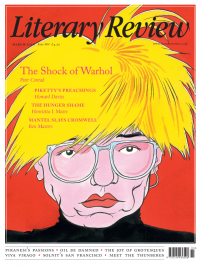
Peter Conrad
Warhol: A Life as Art
By Blake Gopnik
From the August 1995 issue
Syrie Johnson
Small Holdings
By Nicola Barker

From the June 1999 issue
Christopher Hitchens
Some Times in America
By Alexander Chancellor
Back Issues
more
October 2026

September 2026


Sign Up to our newsletter
Receive free articles, highlights from the archive, news, details of prizes, and much more.@Lit_Review
Follow Literary Review on Twitter
Twitter Feed
Literary Review
@Lit_Review ·Twenty-six men were raised by Napoleon to the rank of marshal of France; only six fought with him at Waterloo.
Jonathan Boff asks whether the marshals’ eventual betrayal was really disloyalty, or simply self-preservation learned at Napoleon's own school.
Jonathan Boff - Winner Takes It All
Jonathan Boff: Winner Takes It All - Napoleon and his Marshals: Victory, Rivalry, Betrayal by Andrew Roberts
literaryreview.co.uk
Stephen Smith
@StephenSmithWDS ·Another great cover by @chrisriddell50 announces the latest @Lit_Review incl my piece on a gripping account of a true crime story by James Lasdun
#upthefreelancers
Literary Review
@Lit_Review ·Small, useless and endlessly loved, lap dogs have stood for frivolous femininity and the witch’s familiar hidden in her lap.
Diane Purkiss wonders what our relationships to these animals say about us.
Diane Purkiss - Fur from Reasonable
Diane Purkiss: Fur from Reasonable - Yap!: A Short History of Small Dogs by Stephanie Howard-Smith
literaryreview.co.uk