
Gray-necked Rockfowl Picathartes oreas Scientific name definitions
- NT Near Threatened
- Names (25)
- Monotypic
Revision Notes
Sign in to see your badges
Species names in eBird-supported languages
| Language | Common name |
|---|---|
| Bulgarian | Конгоанска плешива сврака |
| Catalan | picatarta collgrís |
| Chinese (SIM) | 灰颈岩鹛 |
| Croatian | plavočela gologlavka |
| Czech | vranule šedokrká |
| Danish | Rødhovedet Kragedrossel |
| Dutch | Grijsnekkaalkopkraai |
| English | Gray-necked Rockfowl |
| English (AVI) | Grey-necked Rockfowl |
| English (United States) | Gray-necked Rockfowl |
| Estonian | punakukal-kaljukark |
| Finnish | punapääkaljukas |
| French | Picatharte du Cameroun |
| German | Buntkopf-Felsenhüpfer |
| Japanese | ズアカハゲチメドリ |
| Norwegian | blåpannegrottefugl |
| Polish | sępowronka kameruńska |
| Russian | Красноголовая лысая сорока |
| Serbian | Sivovrata gologlavka |
| Slovak | holohlavec skalný |
| Spanish | Picatartes cuelligrís |
| Spanish (Spain) | Picatartes cuelligrís |
| Swedish | rödskallig kråktrast |
| Turkish | Gri Boyunlu Mağarasaksağanı |
| Ukrainian | Гологолов східний |
Revision Notes
Panshak S. Kumdet and Adams A. Chaskda revised the account as part of a partnership with APLORI. The account was copyedited by JoAnn Hackos, Linda A. Hensley, Robin K. Murie, and Daphne R. Walmer. Hugo Keil curated the media.
Picathartes oreas Reichenow, 1899
Definitions
- PICATHARTES
- oreas
The Key to Scientific Names
Legend Overview
Content Partner

Full content is available exclusively to Birds of the World subscribers. Sign in Learn more
Introduction
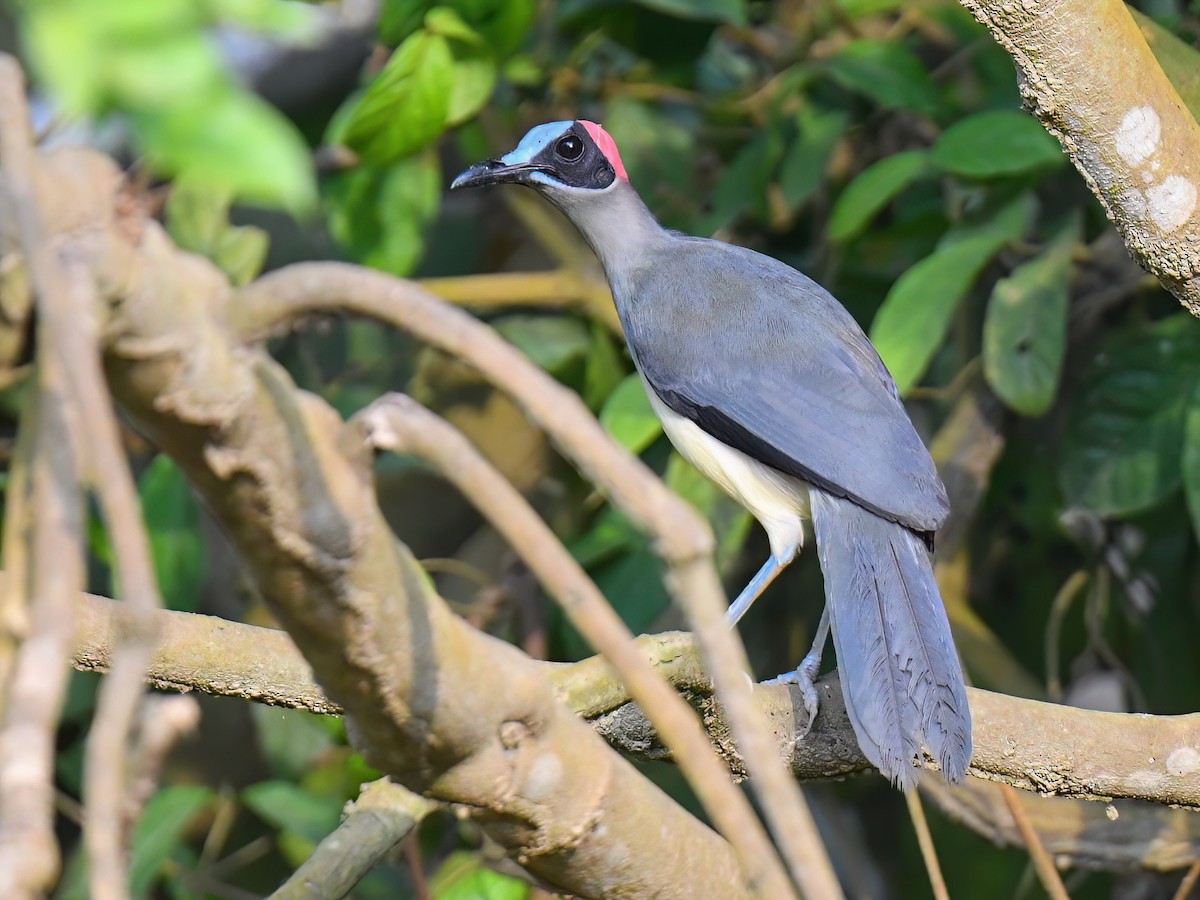
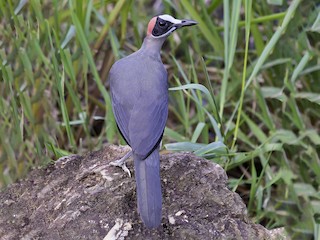
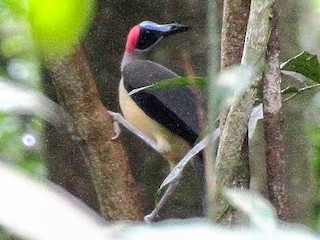
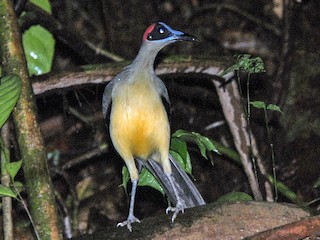
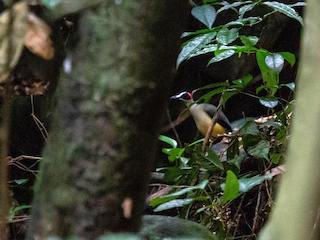
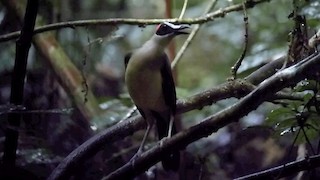
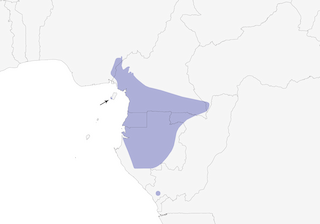
The Gray-necked Rockfowl is a unique ground-dwelling bird that is characterized by its bare, colorful head, long legs, and specialized nesting habits. Its distribution is restricted to southwestern Cameroon, southeastern Nigeria, northeastern Gabon, and Equatorial Guinea, with recent records from the Republic of Congo and the Central African Republic. The species inhabits rugged, rocky terrain within lowland and submontane rainforests, where it forages on the forest floor for a variety of invertebrates and small vertebrates.
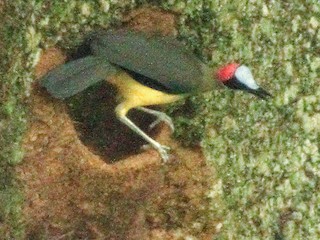
This rockfowl is notable for its highly specific habitat requirements, particularly for nesting. It constructs mud nests on vertical surfaces in caves, on rock overhangs, or large boulders, often in small colonies. This nesting behavior sets it apart from many other passerine species and has made it a subject of interest for researchers and conservationists. Breeding typically occurs during the wet season, with a clutch size of two eggs. The species shows some evidence of cooperative breeding behaviors, with colony members potentially assisting in incubation and chick-rearing.
The Gray-necked Rockfowl is classified as Near Threatened on the IUCN Red List. Its specialized habitat requirements and limited range make it vulnerable to forest degradation and clearance. In some areas, the species also faces pressure from hunting for food and for the caged bird trade. While it occurs in a few protected areas, such as Korup National Park in Cameroon, further conservation measures are needed to ensure its long-term survival. Despite its intriguing uniqueness, much remains to be learned about its ecology, behavior, and population dynamics. Research on this elusive species has been limited, partly due to the challenging nature of its habitat.
- Year-round
- Migration
- Breeding
- Non-Breeding