
Hostname: page-component-5d84bcc8dc-m899x Total loading time: 0 Render date: 2026-09-08T13:57:08.642Z Has data issue: false hasContentIssue false

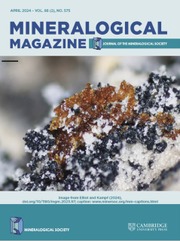
Yellowcatite, KNaFe3+2(Se4+O3)2(V5+2O7)·7H2O, the first selenite-vanadate

Published online by Cambridge University Press:  14 January 2025

Anthony R. Kampf*
Affiliation:
Mineral Sciences Department, Natural History Museum of Los Angeles County, Los Angeles, CA, USA
Travis Olds
Affiliation:
Section of Minerals and Earth Sciences, Carnegie Museum of Natural History, Pittsburgh, PA, USA
Chi Ma
Affiliation:
Division of Geological and Planetary Sciences, California Institute of Technology, Pasadena, CA, USA
Joe Marty
Affiliation:
Mineral Sciences Department, Natural History Museum of Los Angeles County, Los Angeles, CA, USA
*
Corresponding author: Anthony Kampf; Email: akampf@nhm.org

Abstract

The new mineral yellowcatite (IMA2024-030), KNaFe3+2(Se4+O3)2(V5+2O7)·7H2O, was found underground in the School Section #32 mine, Grand County, Utah, USA, where it is a secondary, post-mining phase occurring on montroseite-corvusite-asphaltite-mica-bearing sandstone in association with barnesite, gypsum and mandarinoite. Crystals are thin hexagonal plates, up to ∼0.2 mm in diameter. Crystals are yellow and transparent, with vitreous to pearly lustre and pale-yellow streak. The mineral is brittle with curved fracture and two cleavages: perfect on {001} and good on {100}. The Mohs hardness is ∼2. The measured density is 2.79(2) g·cm–3. Optically, yellowcatite is uniaxial (–) with ω = 1.910(5) and ε = 1.740(5) (white light). The mineral is pleochroic with O yellow and E colourless; O > E. The empirical formula is (K0.650.35)Σ1.00(Na0.66Mg0.30)Σ0.96Fe3+2.02Se4+1.99V5+2.01O20H14.02. Yellowcatite is hexagonal, space group P$\bar 6$m2, with cell parameters: a = 5.4966(7), c = 17.2109(16) Å, V = 450.31(13) Å3 and Z = 1. In the crystal structure of yellowcatite (R1 = 5.12% for 281 I > 2σI reflections), Fe3+O6 octahedra, Se4+O3 pyramids and V5+O4 tetrahedra link by corner-sharing to form sheets similar to those in the well-known merwinite structure, but with the apices of the Se4+O3 pyramids in the ‘pinwheels’ pointing in the same direction as the V5+O4 tetrahedra. The unshared vertices of the V5+O4 tetrahedra in adjacent sheets link to one another to form divanadate groups, thereby joining two sheets into a double-sheet slab structural unit. Between adjacent slabs is a layer of unlinked Na(H2O)6 coordinations that are presumed to represent octahedra exhibiting rotational disorder.

Information

Type
Article
Copyright
© The Author(s), 2025. Published by Cambridge University Press on behalf of The Mineralogical Society of the United Kingdom and Ireland.

Access options

Get access to the full version of this content by using one of the access options below. (Log in options will check for institutional or personal access. Content may require purchase if you do not have access.)

Article purchase

Temporarily unavailable

Supplementary material: File

Kampf et al. supplementary material

Kampf et al. supplementary material
Download Kampf et al. supplementary material(File)
File 145.2 KB