© 2003 - 2015 Adrienne E. Gusoff/Bubbygram.com All rights reserved
New York Metro Area's Oldest, Funniest and Best
Party Entertainment Company...
Bringing You Hilarity Since 1982!
Now Nationwide!
Great prices -- Huge variety -- Unique and unusual specialty acts.
Friendly, helpful, impeccable service with a smile
for every client, regardless of budget.
Pin It

|
 

|
|
Have a suggestion? Correction? Question? Please let us know!
HOWEVER..please remember, this is a labor of love, done in my spare time.
Please do not ask for definitions of words already in this list!
(I get several of those requests per week!) Nu? You can't, maybe, read?
If you don't see it in the glossary, try spelling it slightly differently
(i.e. "Oi!" instead of "Oy!" "Shlep" vs "Schlep" Also, please be respectful of my time and ask nice!!
I'm happy to help where I can, but please do not attempt
to use me as a free translation or editing service!
If you know the English word, and want the Yiddish, you can either use
the "Find on This Page" function in your browser (usually under the EDIT menu) or go to THIS SITE
or to translate from English to Yiddish
(with results in Hebrew letters) go to http://www.yiddishdictionary.co.il
Please note:
Just because this is a Yiddish website, hardly
makes me an expert on all things Jewish! I do not answer questions
about religion, customs, holidays, various sects, the Talmud,
laws of Kashruth, etc. I suggest a very excellent book called The Jewish Book of Why. There are also many other websites
geared more toward religious Judaism and Judaic studies
(vs. language alone) which will probably have all the answers you seek. |
Listen to Adrienne talking about Yiddish
on Andrew Poretz's Talk Radio show
book Adrienne to speak at your organization!
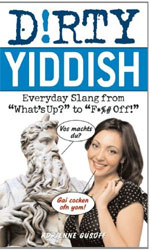
Order my new book!!!
(It's funny! I promise!!!)
(click to order)
Dear Ms. Gusoff:
Thanks for sending me your book, “Dirty Yiddish Slang.” It's hilarious and I will probably break out some of the sayings
at my Passover Seder in the spring. Best of luck to you!!
--Joan Rivers
|
 |
Wacky Fun Stuff
Page
Test your Yiddish
Zen Jewish Humor
Have a listen: Aaron Lebedeff: Rumania (betcha can't sit still!)
Bubby's Yiddish/Yinglish Glossary
Yiddish is a wonderful, rich, descriptive, often onomatopoetic language. It has words for nearly every personality type known to humankind. Yiddish offers more ways of identifying various kinds of "idiots" (with all their subtle variations) than Eskimos have for different kinds of snow. It has a bountiful tradition of literature, film, theater and poetry, which reflect the collective Jewish experience in Europe, over centuries.
Yiddish arose around one thousand years ago from Middle High German, and spread throughout the ghettos of central and eastern Europe, borrowing words from the countries in which the Jews lived. Thus, it incorporates words from Hebrew, Russian, Polish and other Slavic languages, Romance languages, and later, English. Before WWII, Yiddish was spoken by more than 11 million people. Today, it is spoken by perhaps one tenth that many. Many assimilated Ashkenazi American Jews, whose grandparents or greatgrandparents only spoke Yiddish, or who spoke it as a first language, barely know any words at all. This is a shonda! (a shame, a pity.) Many Yiddish words have entered the American-English lexicon. You will find maven (expert) and gonif (thief) in most dictionaries. Words such as shlep, shmata, nosh are regularly used in film, on TV and in books and magazines, without translation. The addition of a rhyme beginning with "shm" to denote something of little consequence ("Hospital, shmospital...So long as you're healthy!") is a purely "Yinglish" construct.
Inflection, too, is an important aspect to Yiddish. This from Leo Rosten's wonderful book "The Joys of Yiddish": (The questioner as asking whether he/she should attend a concert being given by a niece. The meaning of the same sentence changes completely, depending on where the speaker places the emphasis:)
I should buy two tickets for her concert?--meaning:, "After what she did to me?"
I should buy two tickets for her concert?--meaning: "What, you're giving me a lesson in ethics?"
I should buy two tickets for her concert?--meaning: I wouldn't go even if she were giving out free passes!
I should buy two tickets for her concert?--meaning: I'm having enough trouble deciding whether it's worth one.
I should buy two tickets for her concert?--She should be giving out free passes, or the hall will be empty.
I should buy two tickets for her concert?--Did she buy tickets to our daughter's recital?
I should buy two tickets for her concert?--You mean, they call what she does a "concert"?
According to Rosten, there are other linguistic devices in English, derived from Yiddish syntax, which subtly "convey nuances of affection, compassion, displeasure, emphasis, disbelief, skepticism, ridicule, sarcasm, and scorn."
Mordant syntax: "Smart, he isn't."
Sarcasm through innocuous diction: "He only tried to shoot himself."
Scorn through reversed word order: "Already you're discouraged?"
Contempt through affirmation: "My partner, he wants to be."
Fearful curses sanctioned by nominal cancellation: "May all your teeth fall out except one, so that you can have a toothache, God forbid."
Derisive dismissal disguised an innocent interrogation: "I should pay him for such devoted service?"
It's a pity to let such a rich language die. Help keep Yiddish alive by learning new words and making them a part of your everyday conversation. This list is by no means complete, but it's enough to get you started sounding like a Member of the Tribe.
Notes:
"ch" is pronounced like the "ch" in the Scottish "loch," as if you're cleaning a phlegm from your throat, unless otherwise specified..
"r" is gently rolled, as the single "r" in Spanish or French.
(pronunciation guide added only to words whose pronunciation might be questionable from the spelling. If no guide is given, it's pronounced as it looks.)
Note, too, that Yiddish is actually written with Hebrew letters, therefore, when used in English, words are transliterated, or spelled as they sound (as we write Chinese or Arabic words in English.) Since Yiddish was spoken by Jews all over Europe, accents and inflexions varied greatly. This leads to variations in spellings. For example, "ferdrayed" is the same as "fardrayed" is the same as "tsedrayd" etc. "Sh" words are often spelled with an "sch" and words which end in "er" might also be spelled with an "eh" "ah" etc. When there might be a question of a slight change of spelling giving a totally different meaning (i.e. "kibbitz" vs. "kibbutz") it has been noted.
Also, some of the words herein are linked to Bubby's Zen Jewish Humor page. Once on the new page, use your back button to return to the glossary. |
This glossary is only Romanized Yiddish to English
If you know the English word, and want the Yiddish
either use
the "Find on This Page"or "Search" function in your web browser (usually under the EDIT menu)
or go to THIS SITE |
If you enjoy this glossary, please send your friends to this page.
DO NOT copy and forward. That's stealing!!

A bei gesunt: (ah bee geh-zunt) As long as you're healthy. "Hospital, shmospital. A bei gesunt!"
Agita: this is NOT Yiddish. It's totally Italian, but for some reason many people seem to think it's Yiddish and have asked me what it means. If you're looking it up here, know that it's not Yiddish, but I'm going to tell you what it means, anyway, because hey, that's the kind of girl I am: agitation, stress, heartburn, acid stomach, the gastro-intestinal manifestations of stress. It's used the way Yiddish speakers use "tsooris" (meaning trouble, worries, grief.) Tsooris is perhaps more serious than mere agita, but in many sentences they can be used interchangeably.
Alevai: (a-lev-eye) It should only happen! May it come to pass! "We're saving our money so when our daughter gets married, alevai, we can make her a nice wedding."
Alev Ha Sholem (olive-a-show-lem) May he/she rest in peace. "Benji is starting to look just like his grandpa Max, alev ha sholem."
Alta Kocker: literally, an old shit; or as we say in English, an old fart. (sometimes called, simply, AK) Years ago, my mother was trying to convince my then 8-year old nephew that he actually knew quite a bit more Yiddish than he realized. "For instance, you know what an alta kocker is," she said, knowing she'd used the word around him often. His face lit up. "Yes! I know that one! It means a 'slow driver!'"
Alrightnik: (Yinglish) somebody who's done OK for themselves financially, i.e. nouveau riche.
America gonif: literally, "America the Thief" which has both positive and negative connotations. On one hand, it referred to the New Land which robbed early immigrants of their culture, their language, sometimes their families and their fortunes. But the expression was also used as an an interjection, expressing admiration for the wonders, joys, possibilities of America. "Wow! What a country! Look what can happen here!" or "What'll they think of next!" or "Damn clever, these goyim!" "Imagine that! Only in America!"
Aroisgevarfeneh: (uh-roys-geh-varf-en-uh) Thrown out, wasted. "They're giving that klutz ballet lessons? Aroigevofeneh gelt!" (wasted money)  (see varf)
Azoy vert dus kukhl tsekrokhen - literally, "That's the way the cookie crumbles!"
© 2003 - 2024 Adrienne E. Gusoff/Bubbygram.com All rights reserved - It's not nice to steal!!!
Baleboos: boss (masculine). Here's a mouthful for you: "Shtayzich for a kurtzeh fer a vintmill. Di plukhen drayen zich, un ER is der balaboos." Translation: "There stands a little man in front of a windmill. The blades turn, and HE thinks he's the boss of them." In my family, a "kurtzeh" refers to anyone who thinks they're in control when clearly they have no influence over the outcome at all.
Baleboosteh: (bal-a-boo-stah) an organized, efficient, praise-worthy homemaker. Also the boss-lady or boss's wife; a bossy woman.
Balgoof: a fat person, someone with a groyseh tuchis (fat ass)
Batamt: taste. delicious. Usually refers to food, but can be used to describe a "tasty little lady."
Bashert: (beh-sheert) destined, fated, meant to be. "Beshert is beshert" is the Yiddish equivalent of "Que sera, sera." When used as a noun, it means "soul mate" or the one with whom you were destined to be.
Beryiah: (berr-yah) a baleboosteh squared; a regular Martha Stewart. A homemaker who puts the rest of us to shame.
Beytsim: (bates-seem) testicles. When someone gets too wistful, sentimental and/or regretful imaging how things could be/have been "if only...", a frustrated listener might interject a dose of reality with: "As di bubbe volt gehat beytsim volt zi gevain mayn zaidah." (i.e. "If my grandmother had balls, she'd be my grandfather.") It's the more sarcastic equivalent of the English expression "...and if I had wings, I would fly." (A less "blue" version is "If my grandmother had wheels, she'd be a trolley car.")
Billig: cheap, inexpensive. My great-grandmother used to say "billig es teier" (teier = expensive, dear, pricey) meaning cheap things are actually expensive in the long run, because they fall apart or break, whereas "when you buy good, you have forever."
Bissel: (bis-sel) A little. "Give me a bissel lox on my bagel, would you, darling?" A biselleh is even less.
Bitteh: please (as in German) Yes, this is a word in Yiddish although I've never actually heard it spoken! :D
Boorivka: (burr-if-kah) literally, a blueberry. Colloquially used to refer to a large, dark mole. "That Robert Redford is so handsome, but oi! All those boorivkas!" This is a word my grandmother used to use, and for decades, we all thought it was Yiddish for skin mole. Years later, long after she was gone, I was traveling in eastern Europe and learned this is the word for blueberry in many Slavic languages (as well as in Yiddish). I don't know if my grandmother made up the alternate usage or if it was something she heard. Either way, it's apt and funny. 
Borsht: a soup made of beets, often served cold.
© 2003 - 2024 Adrienne E. Gusoff/Bubbygram.com All rights reserved - It's not nice to steal!!!
Borsht Belt: Another name for the Catskill hotel and kuchelyn (bungalow colony) circuit, during the 1930's-1970's. Most of the Jewish (and some gentile) comics of the older generation got their starts or worked here, including Jerry Lewis, Joan Rivers, Robert Klein, Rodney Dangerfield, Shecky Greene, Woody Allen, Morey Amsterdam, Lenny Bruce, Don Rickles, Henny Youngman, Mel Brooks, Carl Reiner, Milton Berle, Buddy Hackett, Shelley Berman, Alan King, Jonathan Winters and many, many more. The hotels included The Concord, Grossingers, Kutchers, Browns, Granit, The Nevele -- mainly centered around the Monticello - Fallsburg, NY area (Sullivan -- aka "Solomon" -- County.) Sadly, almost all of them are now gone. I recently read that New York area firefighters are training at The Concord by purposely setting rooms ablaze! (Oi! Like a knife through the heart!! Buddy Hackett is spinning in his grave!) The bunglalow colonies are too numerous to mention but my and my husband's personal faves are Pancrest Lodge (South Fallsburg) and Mountainview near Monticello. Ahhh! Those were the days!!! And Wisteria Lane could not hold a candle to the intrigues that went on in those places, especially since the husbands often stayed in the city to work during the week and only joined their families upstate on the weekends. Let's just say the itinerant knish man wasn't just selling knishes! (A wonderful movie on this subject is "A Walk on the Moon" with Diane Lane and Viggo Mortensen.)
Brech: (rhymes with "yechhh!" which should make it easy to learn) to gag; to vomit. "Meh keyn brechen!" means "You can vomit from this!" "Go to your sister's house for dinner? Forget it! I don't know which makes me brech more… her food or her décor!"
Broisten: breasts. (as in boobs or chicken breasts)
Brokh: (don't forget the gutteral KH) misfortune, disaster, calamity, said when the shit hits the fan. (Never to be confused with brokheh, which is a "blessing"
Brokheh - blessing or blessed. Often used to mean "prayer" as it's the first words of most Hebrew prayers: Baruch Atah Adonoi... "Blessed are you, our G-d) For example, "You'd better say the brokheh for the shabbos candles...it's getting late!" (NOT to be confused with "brokh" above! (Sometimes pronounced "broo-kheh")See also: motsi
Broygis: (BROY-gas) angry, pissed off, with a mad-on, having a shit-fit, mad at someone, on the outs with someone, not on speaking terms. "I just asked her if she was going wear that trampy outfit, and she got all broygis."
Bubba Meisah: (bubba meye-seh) literally, a "grandmother's story," or old wives' tale, such as "You'd better stop making that face! I knew a girl whose face froze like that!" Basically, a story of dubious truth, often based on rumor, gossip or stemming from a desire to impress others or keep the kids in line. Real B.S.. The original urban legend.
Bubbellah: (the "u" is pronounced like the "oo" in book) an affectionate way of refering to someone, much like "darling" or "sweetheart." Bubbies call their grandchildren "bubbellah." Close friends and long-time business partners might call each other "bubbellah," or boubbie, for short. (pronounced like "bookie" vs. the shorter "u" in Bubby, below.) Also, the nickname of a kosher-for-Passover pancake made with matzoh meal and eggs.
Bubby: (rhymes with cubby) (also spelled Bubbe, Bubbeh) Grandmother (you needed me to tell you this, after spending time on my website!?)
Bulvan: (bull-vahn) an ox; a strong, but unrefined man. Such a man might be a prize fighter or a piano mover.
Bupkis: (bup-kiss) literally, goat turds. Colloquially, nothing. "You're gonna sue me?! You know what you'll get!!?? Bupkis!"
© 2003 - 2024 Adrienne E. Gusoff/Bubbygram.com All rights reserved - It's not nice to steal!!!
Chai kock: (impolite) literally "18 pieces of shit". Something that is worthless, beneath consideration. "She's divorcing me and she thinks she's going to get the house and half my money!? She'll get chai kock from me!" There's an interesting explanation of the origins of this expression in my book, which you should by immediately!
Chaim Yankel (khai-yam Yonk-l) a country bumpkin; the guy who just fell off the turnip truck; an ineffectual nobody; a fool. Also, Mr. Anyone; the man on the street; any Tom, Dick or Heshie. "Ask any Chaim Yankel and they'll tell you that George Bush really kocked it up in Iraq."
Chaleria (khal-air-re-ah) A nasty, shrewish, somewhat psychotic woman, prone to wild outbursts of anger. Basically, a bitch.
Challah: (khal-lah) a delicious bread made with lots of eggs, usually braided, and served at Sabbath dinner or other holidays meals (except Passover where no bread is allowed). Has the consistency of an Italian panetone (without the add-ins) or French brioche. Makes the absolute BEST French toast. OK, my eyes are rolling back in my head just thinking about it!! Mmmmm!
Challish: (khall-ish) faint, usually from hunger. "I haven't eaten in hours! If that waiter doesn't bring our dinner soon, I'm going to challish!"
Chalushes (khal-ush-ess) Nausea or a feeling of sickness. Also, nauseating. "Did you see that dress she was wearing?! It was positively chalushes!"
Chamalyiah: (kham-al-yah) a mega-zetz. A real whack, a Joe Lewis punch. "If that kid upstairs doesn't stop practicing his drums, I'm gonna go up there and give him such a chamalyiah!"
Chap (khop, with the gutteral KH) - grab, catch. "Chap a gang" means "catch a road" (or path or way) or, as we'd say in English, "Hit the road!" "Get lost!" Also used to imply snarfing. "I just put out that bowl of nuts and you chapped them all up, already? You chazzer!"
Chap nicht!: literally "don't grab!" but also, colloquially, "Hey, slow down! Take it easy! Not so fast, buddy!"
Chassen: (khaz-zen) groom (also Chusn)
Chasseneh: (kha-zen-eh) Wedding
Chavver - friend, pal, buddy, colleague.
© 2003 - 2024 Adrienne E. Gusoff/Bubbygram.com All rights reserved - It's not nice to steal!!!
Chazzer: (khaz-zeh) a pig or anyone who behaves like one, either in their eating, financial or personal grooming habits. "Oi! What a chazzer! I don't think he's bathed in a week." "No wonder that chazzer went out of business. He kept all the profits and paid his employees bupkis."
Chazzerai: (khaz-zer-rye) literally, pig slop. Any kind of garbage, whether it's junk food, shoddy merchandise or stuff of little or no value. "No wonder my grandson is fat! All my daughter-in-law feeds him is chazzerai!" "I went to that big estate sale, but all they had was chazzerai." "I never watch TV any more. All they play is chazzerai."
Chinik: (chi-nik; the "ch" in this case is pronouced as in the English "church") a tea kettle. (see "hock meir en chinik") "Chai" means tea throughout most of Asia (that's all kinds of tea; not just that spiced, sweet stuff you get at Starbucks!) So a "chai-nik" is the thing into which the tea is put. "Nik" is a Slavic suffix which turns the root word into a new word generally meaning "one who does or is affiliated with [the root word]" This ending is used often to create Yinglish words such as "nogoodnik" "beatnik" "peacenik" "alrightnik" "neatnik." Usually a "so-and-so-nik" refers to a person who is an adherent or practitioner of something; and there is generally something mildly derisive about such coined words. Chinik is one of the few exceptions. Years ago, when my husband and I visiting Uzbekistan, we were greatly amused to be offered tea in a "chinik." (It was one of the very, very few Russian words we understood!) ** This, from reader MG: "In my family, chinik was defined as a "teacup" (a small piece of china). People without manners would bang a spoon around in the teacup while they were stirring and then clatter it down on the saucer when done, creating a lot of annoying, unnecessary, rude noise, apparently much like my sisters and I made a lot of rude, unnecessary, and annoying noise on occasion. My bubby (from Warsaw, not Kishev) wouldn't have known from chai if it was slopped on her."
© 2003 - 2024 Adrienne E. Gusoff/Bubbygram.com All rights reserved - It's not nice to steal!!!
Chrain: (khrain) horseradish. "Whew! That fresh chrain on my gefilte fish really cleared out my sinuses!"
Chruppen: to snore.
Chumitz (khum-itz) Anything not kosher for Passover; i.e. bread, anything with leavening, anything that can be made into flour. Some people/sects also forbid rice and corn products as well. The list goes on... (and on...) (and on...) Technically, a Jewish home should be searched for and cleaned of all chumitz before the holiday begins. For more in this, go here.
Chuppah: (khup-ah, rhymes with "cuppa") Wedding canopy, under which the bride and groom and rabbi (and close family members) stand, during the ceremony. See shtup
Chutzpah - Unmitigated gall, brazenness beyond imagination. Contrary to popular current usage, it does not mean merely "brass balls" -- although there is certainly an element of that. It's not chutzpah without the gall, the cheek, audacity, the NERVE! Chutzpeniks don't believe the rules apply to them. They have a lack of respect for authority or common convention or polite norms. It goes beyond mere risk taking or living life on the edge. Just because a guy works on the bomb squad or puts out forest fires doesn't mean he has chutzpah. It may take real cojones to go fight in a war, but it was chutzpah that made David think he could take down the giant Goliath with only his slingshot. It's chutzpah that prompts the guy to call the tech desk for help with pirated software. It's chutzpah that makes a woman think it's OK to buy a dress, wear it to a special occasion, and return it for full price. The classic example is the boy who kills both his parents, then throws himself on the mercy of the court because he's an orphan. Also, anyone who lifts this entire dictionary and puts it on their site (with or without credit!) If you see this entry anywhere other than on Bubbygram.com...that person is a content-stealing gonif! (Please let me know!)
Chutzpenik: some with chutzpah, audacity, nerve. (see above)
Cooch: [kootsch] tactile shopping. OK, honestly? This word isn't really Yiddish. My Aunt Marion made it up. But it sounds Yiddish and it's become a favorite of all who've heard it because there is no other word like it. Cooching is a form of hands-on examination of the merchandise, almost a caress as it were, before deciding whether or not to buy. One might cooch at a yard sale, a flea market, at a dollar store or even an upscale shop. It isn't necessary to actually BUY something for a cooching expedition to be successful however it is different than merely window shopping or "just having a look." It's more about exploring and accessing the physical attributes of the merchandise -- feeling the fabric; picking up a tchotchkah to feel its heft; turning an object over in your hand to see where or how it was made. "I went to a few yard sales and cooched around, but I didn't find anything good." (Note from a reader: "The way you describe [this word] it, it seems like it might be in some roundabout way related to the Welsh word cwtch [which is pronounced the same way], meaning 'to pat/caress/squeeze/cuddle.'" My reply: That's a funny and interesting bit of etymology however I can pretty much guarantee my aunt never heard the Welsh word. I think, however, there IS something rather onomatopoeic about it. My guess it was made up spontaneously by some unknown Welsh person and my aunt.) (Can anyone confirm this? Cwtch doesn't come up in Google Translator)
© 2003 - 2024 Adrienne E. Gusoff/Bubbygram.com All rights reserved - It's not nice to steal!!!
Darf min gen en kollej? [gen with a hard G]: "For THIS I went to college?" When I used to do the Bubbygrams, I'd often find myself shlepping around, in full drag...I'd catch a glimpse of myself in a mirror and I'd ask myself that very question!
Das hartz hat mir gezoght: "My heart told me" In other words, "I had a feeling it would come to this." "I KNEW this would happen!" "I predicted it!"
Daven: (dah-ven) a rhythmic, rocking motion done while praying. Which reminds me of joke: Ruthie marries Moishe, a very religious but sexually inexperienced young man. On their honeymoon night, he climbs on top of her then just lays there like lox. Ruthie, in frustration, finally cries out: "Daven, Moishe! Daven!"
Dershticht zolstu veren!: "You should choke on it!" In other words, I hope you don't have a moment's enjoyment out of what you just bought/won/received/achieved.
Dibbuk: a folkloric creature -- the evil soul of a dead person which resides in the body of a living human being. The story of the Dibbuk is the Jewish version of "The Exorcist."
Draycup: literally, a turned around head. ("dray" means "turn" as in "draydl," a spinning top used at Hanukkah) Someone who's perpetually confused. "That draycup didn't just lose her keys this time. She lost the whole car!"
© 2003 - 2024 Adrienne E. Gusoff/Bubbygram.com All rights reserved - It's not nice to steal!!!
Drek: ca-ca, both literally and in the same way we use the word in English, to denote crap. Somewhat stronger than chazzerai, but often used the same way. "A real designer bag? Yeah right! Look at this drek! Not only is the zipper already broken, but Vuitton is spelled "V-o-o-t-o-n!"
Drek mit leber: [LAY-ber] literally, "shit with liver" What's worse than shit? Shit with liver, of course! "Less than nothing." When my husband was a kid and he'd whine and complain that he didn't like what his mother made for dinner, she'd say, "You know what you'll get to eat? Drek mit leber!" The worst choice. The worst crap. "I went to that sale. They had drek mit leber."
Drek oif dem teller: literally, "shit on a plate" Worthless crap, slightly dressed up. Shit on a shingle.
Du kanst nicht oif meinem fus pishen und mir sagen klass es regen ist. - Judge Judy uses this one all the time, and in fact it's the title of one of her books) "Don't pee on my foot and tell me it's raining!" In other words, don't try to bullshit me.
© 2003 - 2024 Adrienne E. Gusoff/Bubbygram.com All rights reserved - It's not nice to steal!!!
Eckveldt: lit, the end of the earth. The last town, before you fall off the edge of the planet. Nowheresville. "They bought a house in the country. Not even the Catskills! Seven hours we drove! I'm tell you, it's in eckveldt!" (Basically the same as yenemsvelt)
Eingeshparht: (ayn-geh-shpart) stubborn. "He is so eingeshparht, getting him to do anything is like trying to get a donkey up a ladder!"
Ekel: nausea, disgust, revulsion. Often used in Yinglish as: "I've got the ekels" meaning, "I'm totally grossed out."
Emmes: (em-mess) truth. Used often in the context of "I swear it's true" or "Really? Is that true? "Barbra Streisand was at that bar mitzvah I went to last week." "Emmes?" "Emmes!"
Eppes: (ep-pess) something. "You must be hungry. Ess a bisel eppis, tatelleh." (Eat a little something, my darling boy.)
Es is nit dayn gesheft - literally, It is not your business. Colloquially, "Mind your own business."
Es is nit mayn gesheft - see above. Essentially, "Not my circus, not my monkeys." (Nit meyn tsirk, nit meyn mangkiz, which is not a Yiddish expression but still, it's fun to say it literally in Yiddish.)
Ess: eat. Often used invitationally. "Ess! Ess! The food is getting cold." (see also Fress)
Ess vi ein faygl, sheisse vi ein ferde! - Eat like a bird; shit like a horse! (Or, as my mother says, "He eats like he has three assholes.") (note: in this expression, "sheisse" --the German word for "shit" -- is used. In Yiddish, generally the word for "shit" is "kock" or "cak.")
Farbissenah: (Fer-biss-en-uh) sour, bitter. Generally used to refer to people (hence Frau Ferbissenah in the Austin Powers films.) "No wonder she's not married. With a ferbissenah punim (sour face) like that, a man should be afraid to talk to her!" Or "His wife ran off with his partner and he's been ferbissenah ever since."
Farblongjid (far-blunge-jed) completely lost and confused, either in one's head or on the ground. "God forbid you should ask for directions! Now we're completely farblongjid!"
© 2003 - 2024 Adrienne E. Gusoff/Bubbygram.com All rights reserved - It's not nice to steal!!!
Farcockt: All crapped up. (see Alta Kocker) "It used to be a nice neighborhood, but now it's all farcockt." As an adjective, it's "farcockteh." "This is a farcockteh neighborhood."
Fardrai zich deyn kop!: literally, "go turn your own head around." In other words, "Leave me alone and go make yourself crazy!" "Quit bugging me and get lost."
Farfaln: hopeless; doomed, spiritually lost
Farfel: crumbled up, broken matzoh bits put in soup or mixed with egg to make a sort of matzoh omelet called a matzoh brie. (br-eye) Topped with some sugar, maybe a bissel frucht, not too awful.
Farfoilt: (fur-foiled) spoilt, mildewed, rotten, decayed. "Marvin, you're 36 years old already. Time to get rid of that ferfoilteh shmata!" (rotten rag, or in this instance, lousy security blanket.)
Fargenign (far-gan-ee-gan): joy, delight, pleasure. "Mit groise fargenign" means "with great pleasure."
Farklempt: all choked up, overwrought (all "clamped up" emotionally)
Farkrimpteh: twisted, crimped up. A "farkrimpteh punim" is a twisted up, scowling face.
Farmach dos moyl! - literally "shut your mouth" Colloquially, "Shut up!" "Put a lid on it!"
© 2003 - 2024 Adrienne E. Gusoff/Bubbygram.com All rights reserved - It's not nice to steal!!!
Farpootzt: (fur-pootzt) all dressed up and/or all made up, often overly so. "Where do you think you're going, young lady, all ferpootzt? Wipe that makeup off! Take off that sequined dress! You're only 12 years old!"
Farprishteh punim: zit-face, pizza face
Farshikkert: drunk as a skunk, three sheets to the wind, s**t-faced. (a Shikker is a drunk)
Farshlepteh krenk: (far-shlep-tah krenk) literally, a chronic illness. Used colloquially to mean something that just doesn't end. A long, drawn out issue, usually without resolve, rather like the Whitewater hearings.
Farshimmelt: (far-shim-elt) literally, rotten, moldy, often referringn to food. When you say a person is "farshimmelt" it means they are confused, mixed up (i.e. their mind is old and moldy.)
Farshluggineh: (far-shlug-in-ah) literally, shaken or mixed. Crazy mixed up, wacky and worthless, silly/goofy. Mad Magazine's website proclaims: "This entire farshlugginer site is brought to you courtesy of www.HeritageComics.com"
Farshtaist? (far-shtayst) Understand? You got that? You dig, man? Comprende? Capisce?
Farshtunkeneh: (far-shtunk-en-eh) stinky, smelly, fetid, rotten. Used literally as well as figuratively. "This Iraq thing is a big, farshtunkeneh mess!" To misquote both "Treasure of Sierra Madre" and "Scarface" -- "Badges? We dun need no farshtunkeneh badges!"
Farshvitzt: (far-shvitzed) "shvitz" is sweat, also steambath. All sweated up.
Fartik: finished, ready, done. Often used as a question: Fartik? ("Are you finished yet?") or exclamation, "Fartik!" (I'm done with THIS!) "I've had enough of your narishkeit! Fartik! I want a divorce!"
Fartootst - mixed up, confused, bewildered.
Faygelah: (fay-geh-lah) literally, a little bird. Colloquially used to refer to a gay man. Depending upon its use, can be derogatory or affectionate. "My hairdresser, the faygelah, sure gave me a beautiful haircut!" (Its similarity to 'fag" is purely coincidental.)
Feh! A visceral expression of disgust, either physical or emotional.
Fliegel: (rhymes with sea gull) a chicken or turkey wing, as in "Buffalo fliegels
© 2003 - 2024 Adrienne E. Gusoff/Bubbygram.com All rights reserved - It's not nice to steal!!!
Folg mikh a gayng: literally means, "follow me on my path/my way" or "that's quite a long way" but colloquially implies "that's far too much effort!" or "That's no small task!' or "That's a lot to ask!" and used sarcastically used to say "Yeah, like THAT'S gonna happen!" or "Right... in your DREAMS!" or "Yeah, I'll get right on it...NOT!"
Forshpise: (for-shpeyes) hors d'ouvres, appetizers. The nosh you get when you first arrive so you don't challish before dinner is served.
Fonfer: to mumble, speak incoherently, to talk through the nose.
For gezinteh hait (or gay gezinteh hait): "go in good health" And of course, is often used sarcastically. For instance, when someone walks out on you angrily, slamming the door behind them, you might call after them, "for gezinteh hait!" (the subtext being, "you should go in good health, but drop dead before you get to the bottom of the stairs!") Also used to imply: "Go! Do whatever you want! You're not going to listen to me anyway."
Fortzn zoffer:- A really nasty, malodorous fart which leaves a miasma of methane that could knock a buzzard off a dung heap
Frailech: (fray-lich) Happy, merry, joyful (frailecheh is the adjective) The Hanukkah song refers to the holiday as "a lichtekeh, a frailecheh" -- "light/joyful and happy" (It just occurred to me that "frolic" probably comes from the same root.)
Fress: eat, referring to an animal, or a human who eats like one. "My last blind date was an animal! He fressed up his entire dinner before I even took a bite of mine!"
Frosk: a sharp slap in the face.
Frucht: fruit
Frum: religious, observant
Fuftzikeh: fifty or $50. "I wanted a good table so I shmeared the maitre'd with a fuftzikeh."
© 2003 - 2024 Adrienne E. Gusoff/Bubbygram.com All rights reserved - It's not nice to steal!!!
Ganeydn - Garden of Eden
Gantseh Makher - Big shot, big man on campus. Usually sarcastic. Also, gantseh k'nocker.
Gay avek: - literally, Go away. Get lost! "Gay" means "go." In Blazing Saddles, Mel Brooks, dressed as the Indian chief, holds up his arm to stop his warriors from attacking, and allows Cleavon Little et al to pass. Brooks cries out, "Loysem gayn!" which means "Let them go..." (i.e. "Allow them to pass.")
Gay kocken offen yom: literally, go shit in the ocean. Get lost; hit the road; beat it; piss off.
Gay shlog dayn kup en vant! - Go beat your head against the wall!
Gebrenteh tsoores - abject misery; grief like you wouldn't believe! Tsooris squared.
Gedaingst: (guh-dayngst) remember. "I told you he was no good! Gedaingst?!"
Gehockteh leber: (ge-hock-teh lay-beh) Chopped liver, both literally and in the sense of someone or something unworthy; beneath consideration. "She shook hands with everyone in the room except for me. What am I, gehockteh leber?" "She spent the whole night bragging about her jewelry. And what does she think I'm wearing? Gehockteh leber?" "What a bar mitzvah! They spared no expense! There was even a sculpture of their son made from gehockteh leber!"
© 2003 - 2024 Adrienne E. Gusoff/Bubbygram.com All rights reserved - It's not nice to steal!!!
Gelt: literally gold. Money. Hanukkah gelt are the chocolate gold-foiled coins traditionally given at the holiday.
Genug: (guh-nug) enough. "Genug es genug! (Enough is enough!) Stop with the kvitchering already!"
Geshmak: tasty, delicious.
Geshrie: (geh-shreye) a scream. "It was just a little bug, but from the geshrie she let out, you'd think it was Alien."
Get: A Jewish divorce, separate from a civil divorce, which must be granted to the wife by the husband. Jewish women who have not been given a get, cannot be remarried in the Jewish faith, even though, according to civil law, they are divorced. Many a man has held this over a woman's head on spite or as a negotiating tool in civil court for custody or alimony. Dat's why you gotta getta get. (The Hebrew word for a woman without a get is
Agunah, literally "chained.")
Gib a kick: literally, give a look. Check it out; take a gander; get a load of that.
Glick: luck "A glick ahf dir!" means "good luck to you" As usual, this phrase is often used sarcastically to mean "Big deal." or "THIS you call luck?"
Glitsch: (Oh, come on! This is practically English!) A bug in the ointment; an error in calculation; a screw-up that makes your plans go awry. A glitch, for G-d's sake!
Goldeneh hendts: (gold-en-eh hentz) literally, golden hands. Not to be confused with the "Midas Touch," this refers to able, talented, skillful hands. My husband is one of those guys who can make, build or fix anything. Whenever he successfully completes a chore for his mother or mine, inevitably they cluck approvingly, and say, with great respect, "Goldeneh hanz!" (i.e. "Oi! Such talent! He can do anything!")
Goldeneh medina: literally, City of Gold. The Land of Opportunity and Promise. America, (usually New York) for early Jewish immigrants.
Golem: A Jewish folk character -- an animate creature created out of inanimate material (the way God created Adam,) who acts as a rescuer or savior. Such creatures can only be created by the most holy and learned men, because the power to do so is God-like. There are many such stories in Jewish literature, the most famous of which is probably the Golem of Rabbi Judah Loew ben Bezalel who supposedly created his Golem to save the Jews of the Prague Ghetto from anti-Semitic attack. It is said that the original Frankenstein, by Mary Shelley, was based on tales of golem. For further reading, go Here and Here.
Gonif: (gon-niff) thief, dishonest person, embezzler, unscrupulous businessman. "That gonif cooked my books and walked away with half a million dollars from my business!" Also, the kind of person who lifts this entire dictionary and puts it on their own website (with or without credit!) If you see this entry anywhere other than on Bubbygram.com...that person is a content-stealing gonif! (Please let me know!)
Gornisht: nothing, zero, zilch, nada.
Goyim: (goy-im) Gentiles, in general. One gentile is a goy. See also, shiksa
Goyishe kup (goy-ish-eh kup) literally, a gentile head. Said about someone who doesn't "think like a Jew." Jews, for example, tend to think ahead, analyzing each situation, postulating contingency plans for every possible tragic outcome. This way, they're prepared for any horrible consequence. Considering the way Jews have been treated by the world throughout history, anticipating and planning for the worst case scenario is definitely a wise idea.
Goyishe nachas: The kind of pleasure that only non-Jews could enjoy. For example, bagging a 7 point buck deer, being elected president of the Hell's Angels, winning a lifetime supply of mayonnaise.
Gotkes: (got-kiss) long johns; warm winter underwear ("Shpatziring in Our Gotkes" is the Yiddish version of that favorite goyishe holiday carol, "Walking in Our Winter Underwear.")
Greps: belch. A mother burps her baby by patting him on the back and saying, "Greps, tatellah, greps." If the author of "Portnoy's Complaint" drank his seltzer too quickly, you might hear "The Greps of Roth." Greps vasser is "burp water," aka, seltzer.
