
Menilite
A rock subtype
This page is currently not sponsored. Click here to sponsor this page.
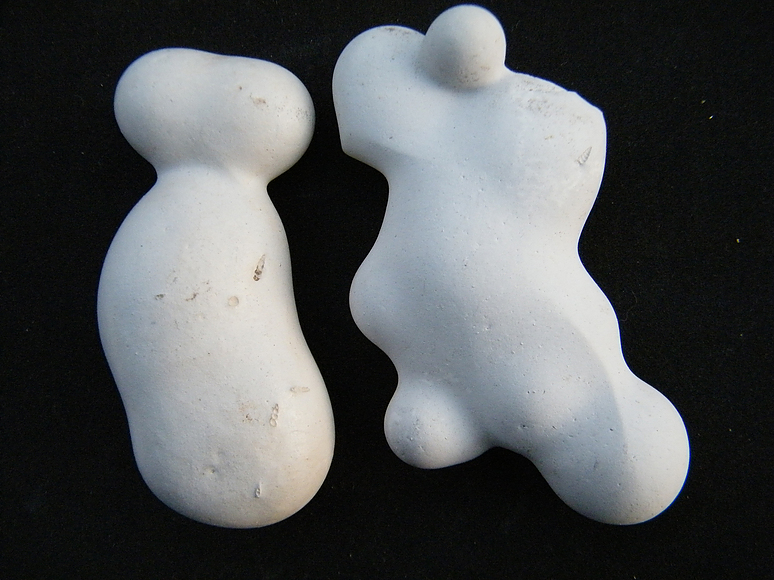


About Menilite
Name:
Named after locality.
Opaline concretions found in marls, gypsums and shales. Sometimes considered a variety of opal but probably impure and really just young Flint nodules which haven’t recrystallised to quartz yet; thus really a rock rather than a mineral.
Originally reported from Ménilmontant, Paris, Ile-de-France, France as nodules in the shale (Menilite formation?) (de Saussure, 1795). The analysis gives 10% water/organic matter.
Note: The name is also used informally for a bituminous shale with chert beds from the Menilite Formation (Eocene/Oligocene).
Jameson's System of Mineralogy from 1816 says that Menilite was divided by Hoffmann into two sub-species - "Brown Menilite" and "Grey Menilite":
Brown Menilite = Leberopal (liver opal)
Color: Chestnut-brown, sometimes inclines to liver brown. On the surface it has sometimes a bluish colour.
Always occurs tuberose, seldom larger than a fist, often smaller. External surface rough and dull.
The Spanish "menilitas", which are by far the most abundant ones in collections, occur in a diatomaceous earth deposit. The nodules consist of light toffee-brown to pale grey massive opal, with abundant inclusions of diatoms (themselves composed of opal) from the host rock, with a white chalky exterior of powdery opal, so three "varieties" of opal in a single nodule. The interiors are hard and compact and take a good polish, so sometimes used for opaque lapidary work.
Grey Menilite = Grauer Menilite (of Hoffmann)
Yellowish-grey sometimes inclining to wood-brown.
Tuberose but more compressed than the brown subspecies, and the external surface is smoother.
Occurs at Argenteuil near Paris embedded in clayey marl and gypsum.
Originally reported from Ménilmontant, Paris, Ile-de-France, France as nodules in the shale (Menilite formation?) (de Saussure, 1795). The analysis gives 10% water/organic matter.
Note: The name is also used informally for a bituminous shale with chert beds from the Menilite Formation (Eocene/Oligocene).
Jameson's System of Mineralogy from 1816 says that Menilite was divided by Hoffmann into two sub-species - "Brown Menilite" and "Grey Menilite":
Brown Menilite = Leberopal (liver opal)
Color: Chestnut-brown, sometimes inclines to liver brown. On the surface it has sometimes a bluish colour.
Always occurs tuberose, seldom larger than a fist, often smaller. External surface rough and dull.
The Spanish "menilitas", which are by far the most abundant ones in collections, occur in a diatomaceous earth deposit. The nodules consist of light toffee-brown to pale grey massive opal, with abundant inclusions of diatoms (themselves composed of opal) from the host rock, with a white chalky exterior of powdery opal, so three "varieties" of opal in a single nodule. The interiors are hard and compact and take a good polish, so sometimes used for opaque lapidary work.
Grey Menilite = Grauer Menilite (of Hoffmann)
Yellowish-grey sometimes inclining to wood-brown.
Tuberose but more compressed than the brown subspecies, and the external surface is smoother.
Occurs at Argenteuil near Paris embedded in clayey marl and gypsum.
Unique Identifiers
Mindat ID:
9796
Long-form identifier:
mindat:1:1:9796:9
Similar Names
| Melilite | A synonym of Melilite Group | |
| Minohlite | A valid IMA mineral species | (Cu,Zn)7(SO4)2(OH)10 · 8H2O |
Classification of Menilite
Crystallography of Menilite
Morphology:
Concretionary
Other Language Names for Menilite
Common Associates
Associations Based on Photo Data:
| 6 photos of Menilite associated with Opal | SiO2 · nH2O |
| 2 photos of Menilite associated with 'Hydrophane' | SiO2 · nH2O |
| 2 photos of Menilite associated with Gypsum | CaSO4 · 2H2O |
| 1 photo of Menilite associated with Nontronite | Na0.3Fe2((Si,Al)4O10)(OH)2 · nH2O |
| 1 photo of Menilite associated with 'Chalcedony' | SiO2 |
Internet Links for Menilite
mindat.org URL:
https://www.mindat.org/min-9796.html
Please feel free to link to this page.
Please feel free to link to this page.
References for Menilite
Reference List:
Localities for Menilite
Showing 16 localities.
 symbol to view information about a locality.
The
symbol to view information about a locality.
The Locality List
 - This locality has map coordinates listed.
- This locality has estimated coordinates.
ⓘ - Click for references and further information on this occurrence.
? - Indicates mineral may be doubtful at this locality.
- This locality has map coordinates listed.
- This locality has estimated coordinates.
ⓘ - Click for references and further information on this occurrence.
? - Indicates mineral may be doubtful at this locality.
 - Good crystals or important locality for species.
 - World class for species or very significant.
(TL) - Type Locality for a valid mineral species.
(FRL) - First Recorded Locality for everything else (eg varieties).
- World class for species or very significant.
(TL) - Type Locality for a valid mineral species.
(FRL) - First Recorded Locality for everything else (eg varieties).
All localities listed without proper references should be considered as questionable.
Algeria | |
| Rocks & Min.: 17:243. |
France | |
| Belot (1978) |
| Delamétherie (1795) | |
| Belot (1978) |
Japan | |
| Hiroaki Tano specimens. |
| Hiroaki Tano's specimen | |
Morocco | |
| Jewel Tunnel specimens obtained by Rock ... +1 other reference |
Poland | |
| Personally collected by Zając Piotr in ... |
Spain | |
| Calvo Rebollar (2016) |
| Calvo Rebollar (2016) |
| Juan Miguel Casanova Honrubia ... |
| found by Frank de Wit 2008 |
| INTAN specimens (Barcelona) | |
| Calvo Rebollar (2016) | |
| MTI Mineralogía Topográfica Ibérica | |
| Joaquim Mollfulleda +1 other reference |

Albacete, Castile-La Mancha, Spain