
Obsidian
A rock classification type
This page kindly sponsored by Gary Umphrey

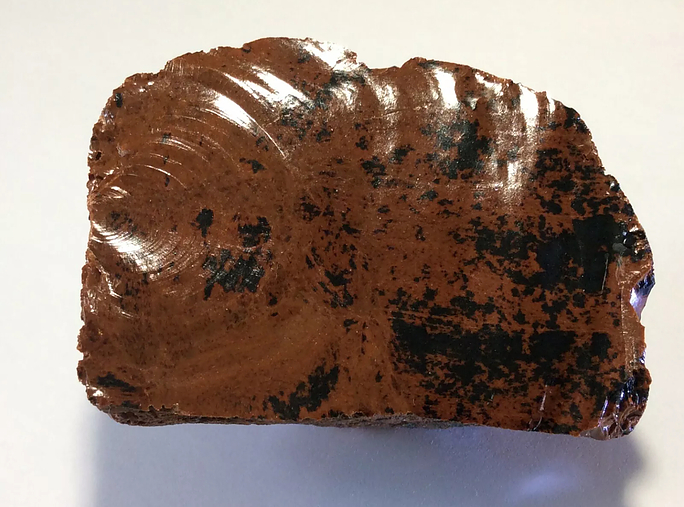
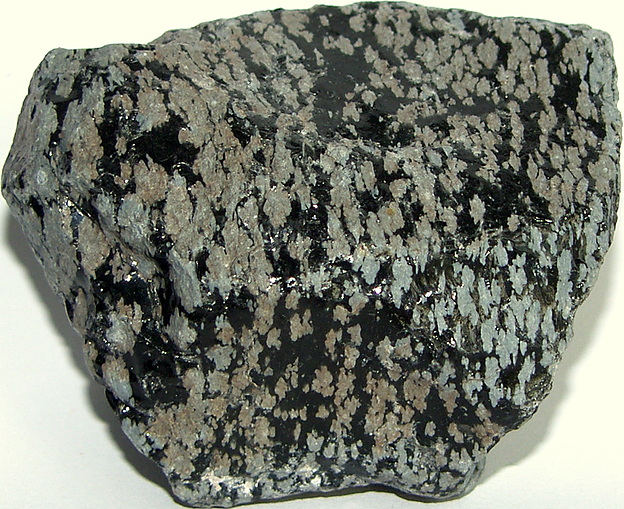

About Obsidian
Colour:
Black, bluish, mahogany, golden, peacock, grey-green, brown-green etc. - the colors due largely to refraction by microscopic bubbles (and microscopic mineral inclusions such as magnetite in "Rainbow Obsidian").
Lustre:
Vitreous
Glassy, fresh igneous rocks with a high silica content and conchoidal fracture.
The earliest manufactured mirrors were pieces of polished obsidian.
Volcanic glass - a rock rather than a mineral, it is a mixture of cryptocrystalline grains of silica minerals in a glass-like suspension, a super-cooled liquid. Obsidian is formed in the latest stage of volcanic eruptions, the silica left over after most of the other elements and water have been used up are ejected or flow out and rapidly chilled at surface temperatures.
Some varieties resemble tektites and are therefore considered as "pseudotektites".
NOTE on "Transparent/Translucent Obsidian":
A lot of gem-quality water-clear variously coloured 'obsidian' has been offered for sale on the internet (in particular on auction websites) with a variety of sources listed. The material offered for sale is, in fact, an artificial glass mass-produced in places such as Indonesia.
 Visit gemdat.org for gemological information about Obsidian.
The earliest manufactured mirrors were pieces of polished obsidian.
Volcanic glass - a rock rather than a mineral, it is a mixture of cryptocrystalline grains of silica minerals in a glass-like suspension, a super-cooled liquid. Obsidian is formed in the latest stage of volcanic eruptions, the silica left over after most of the other elements and water have been used up are ejected or flow out and rapidly chilled at surface temperatures.
Some varieties resemble tektites and are therefore considered as "pseudotektites".
NOTE on "Transparent/Translucent Obsidian":
A lot of gem-quality water-clear variously coloured 'obsidian' has been offered for sale on the internet (in particular on auction websites) with a variety of sources listed. The material offered for sale is, in fact, an artificial glass mass-produced in places such as Indonesia.
Visit gemdat.org for gemological information about Obsidian.Unique Identifiers
Mindat ID:
8519
Long-form identifier:
mindat:1:1:8519:5
Classification of Obsidian
Sub-divisions of Obsidian
Mineralogy of Obsidian
Essential minerals - these are minerals that are required within the classification of this rock:
| Glass | A non-crystalline, amorphous, relatively homogeneous solid material with a random liquid-like structure generally ... |
Physical Properties of Obsidian
Vitreous
Transparency:
Translucent
Colour:
Black, bluish, mahogany, golden, peacock, grey-green, brown-green etc. - the colors due largely to refraction by microscopic bubbles (and microscopic mineral inclusions such as magnetite in "Rainbow Obsidian").
Fracture:
Conchoidal
Synonyms of Obsidian
Other Language Names for Obsidian
Common Associates
Associations Based on Photo Data:
| 102 photos of Obsidian associated with Cristobalite | SiO2 |
| 32 photos of Obsidian associated with 'Apache Tear' | |
| 20 photos of Obsidian associated with Fayalite | Fe2+2(SiO4) |
| 12 photos of Obsidian associated with 'Perlite' | |
| 9 photos of Obsidian associated with Sanidine | K(AlSi3O8) |
| 7 photos of Obsidian associated with Pyroxene Group | ADSi2O6 |
| 7 photos of Obsidian associated with Hematite | Fe2O3 |
| 6 photos of Obsidian associated with 'Snowflake Obsidian' | |
| 5 photos of Obsidian associated with Magnetite | Fe2+Fe3+2O4 |
| 4 photos of Obsidian associated with 'Enstatite-Ferrosilite Series' |
Internet Links for Obsidian
mindat.org URL:
https://www.mindat.org/min-8519.html
Please feel free to link to this page.
Please feel free to link to this page.
References for Obsidian
Reference List:
Stevenson, R.J., Dingwell, D.B., Webb, S.L., Bagdassarov, N.S. (1995) The equivalence of enthalpy and shear stress relaxation in rhyolitic obsidians and quantification of the liquid-glass transition in volcanic processes. Journal of Volcanology and Geothermal Research, 68 (4) 297-306 doi:10.1016/0377-0273(95)00015-1
Gimeno, D (2003) Devitrification of natural rhyolitic obsidian glasses: petrographic and microstructural study (SEM+EDS) of recent (Lipari island) and ancient (Sarrabus, SE Sardinia) samples. Journal of Non-Crystalline Solids, 323 (1) 84-90 doi:10.1016/s0022-3093(03)00294-1
Zotov, N (2003) Structure of natural volcanic glasses: diffraction versus spectroscopic perspective. Journal of Non-Crystalline Solids, 323 (1) 1-6 doi:10.1016/s0022-3093(03)00289-8
Cañón-Tapia, E., Cárdenas, K. (2012) Anisotropy of magnetic susceptibility and magnetic properties of obsidians: volcanic implications. International Journal of Earth Sciences, 101 (3) 649-670 doi:10.1007/s00531-011-0687-6
Donato, P., Barba, L., De Rosa, R., Niceforo, G., Pastrana, A., Donato, S., Lanzafame, G., Mancini, L., Crisci, G.M. (2018) Green, grey and black: A comparative study of Sierra de las Navajas (Mexico) and Lipari (Italy) obsidians. Quaternary International, 467. 369-390 doi:10.1016/j.quaint.2017.11.021
Flude, Stephanie, Tuffen, Hugh, Sherlock, Sarah C. (2018) Spatially heterogeneous argon-isotope systematics and apparent 40Ar/39Ar ages in perlitised obsidian. Chemical Geology, 480. 44-57 doi:10.1016/j.chemgeo.2017.05.018
Donato, Paola, Donato, Sandro, Barba, Luis, Crisci, Gino Mirocle, Crocco, Maria Caterina, Davoli, Mariano, Filosa, Raffaele, Formoso, Vincenzo, Niceforo, Giancarlo, Pastrana, Alejandro, Solano, Andrea, De Rosa, Rosanna (2022) Influence of Chemical Composition and Microvesiculation on the Chromatic Features of the Obsidian of Sierra de las Navajas (Hidalgo, Mexico) Minerals, 12 (2) 177 doi:10.3390/min12020177

Lipari, Eolie Islands, Metropolitan City of Messina, Sicily, Italy