
Kerstenite
A discredited species name
This page is currently not sponsored. Click here to sponsor this page.


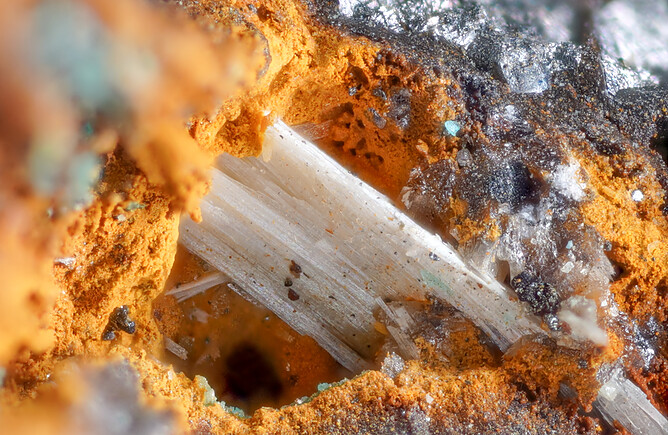
About Kerstenite
Lustre:
Vitreous
Crystal System:
Orthorhombic
Name:
For Karl Moritz Kersten (19 July 1803, Zöblitz, Erzgebirgskreis, Saxony, Germany - 10 November 1850, Colditz, Leipzig, Saxony, Germany), Professor of Chemistry, Freiberg School of Mines.
Karl Moritz Kersten studied chemistry and related sciences at the Bergakademie Freiberg, with Friedrich Stromeyer at the University of Göttingen and with Joseph Louis Gay-Lussac and Pierre Berthier in Paris. In 1821, he became a member of the Corps (similar to a fraternity) Montania Freiberg.
After his return to Freiberg in 1829, he became senior ironworks assessor in 1830 and professor of analytical and practical chemistry at the Mining Academy in 1836. Since 1829 he taught the second and from 1837 the first course in analytical chemistry. In 1842, he became acting successor to Wilhelm August Lampadius, but had to interrupt his teaching work, which had already been impaired by a mental disorder, from 1843 to 1846 before he was finally released as mentally ill in 1847. He died in the Colditz Castle mental asylum in 1848. 1850.
Kersten's numerous publications are evidence of his intensive and well-founded work in the fields of analytical chemistry, mineralogy, and geology. In 1830, he first discovered selenium in the pitchblende of the magnesium-carbonate-pitchblende formation (mgu formation) in the Schneeberg district. In 1844, he was the first to describe chapmanite from the Neue Hoffnung Gottes mine in Bräunsdorf (Oberschöna), which he characterized as a “hypochlorite-like mineral”.
Karl Moritz Kersten studied chemistry and related sciences at the Bergakademie Freiberg, with Friedrich Stromeyer at the University of Göttingen and with Joseph Louis Gay-Lussac and Pierre Berthier in Paris. In 1821, he became a member of the Corps (similar to a fraternity) Montania Freiberg.
After his return to Freiberg in 1829, he became senior ironworks assessor in 1830 and professor of analytical and practical chemistry at the Mining Academy in 1836. Since 1829 he taught the second and from 1837 the first course in analytical chemistry. In 1842, he became acting successor to Wilhelm August Lampadius, but had to interrupt his teaching work, which had already been impaired by a mental disorder, from 1843 to 1846 before he was finally released as mentally ill in 1847. He died in the Colditz Castle mental asylum in 1848. 1850.
Kersten's numerous publications are evidence of his intensive and well-founded work in the fields of analytical chemistry, mineralogy, and geology. In 1830, he first discovered selenium in the pitchblende of the magnesium-carbonate-pitchblende formation (mgu formation) in the Schneeberg district. In 1844, he was the first to describe chapmanite from the Neue Hoffnung Gottes mine in Bräunsdorf (Oberschöna), which he characterized as a “hypochlorite-like mineral”.
Originally assumed to be PbSeO4. Discredited in 2006 - in part molybdomenite (PbSeO3) or olsacherite.
Originally reported from Friedrichsglück Mine, Hildburghausen, Suhl, Thuringian Forest, Thuringia, Germany.
Originally reported from Friedrichsglück Mine, Hildburghausen, Suhl, Thuringian Forest, Thuringia, Germany.
Unique Identifiers
Mindat ID:
7134
Long-form identifier:
mindat:1:1:7134:1
Similar Names
| Karstenite | A synonym of Anhydrite |
| Kerstenite (of Haidinger) | A synonym of 'Cheleutite' |
IMA Classification of Kerstenite
Discredited
Physical Properties of Kerstenite
Vitreous
Crystallography of Kerstenite
Crystal System:
Orthorhombic
Synonyms of Kerstenite
Lead selenate (in part)
Other Language Names for Kerstenite
Common Associates
Associations Based on Photo Data:
| 1 photo of Kerstenite associated with Chalcomenite | CuSeO3 · 2H2O |
| 1 photo of Kerstenite associated with Kruťaite | CuSe2 |
Other Information
Health Risks:
No information on health risks for this material has been entered into the database. You should always treat mineral specimens with care.
Internet Links for Kerstenite
mindat.org URL:
https://www.mindat.org/min-7134.html
Please feel free to link to this page.
Please feel free to link to this page.
Search Engines:
Mineral Dealers:
References for Kerstenite
Localities for Kerstenite
Showing 5 localities.
 symbol to view information about a locality.
The
symbol to view information about a locality.
The Locality List
 - This locality has map coordinates listed.
- This locality has estimated coordinates.
ⓘ - Click for references and further information on this occurrence.
? - Indicates mineral may be doubtful at this locality.
- This locality has map coordinates listed.
- This locality has estimated coordinates.
ⓘ - Click for references and further information on this occurrence.
? - Indicates mineral may be doubtful at this locality.
 - Good crystals or important locality for species.
 - World class for species or very significant.
(TL) - Type Locality for a valid mineral species.
(FRL) - First Recorded Locality for everything else (eg varieties).
- World class for species or very significant.
(TL) - Type Locality for a valid mineral species.
(FRL) - First Recorded Locality for everything else (eg varieties).
All localities listed without proper references should be considered as questionable.
Argentina | |
| Paar et al. (2004) |
| Sarp et al. (1987) |
Bolivia | |
| Schnorrer-Köhler et al. (1990) |
France | |
| Agrinier et al. (1967) |
Germany | |
| Dana's System of Mineralogy 7:II:640. |

El Dragón mine, Porco Municipality, Antonio Quijarro Province, Potosí, Bolivia