
Concretion
A rock classification type
This page is currently not sponsored. Click here to sponsor this page.
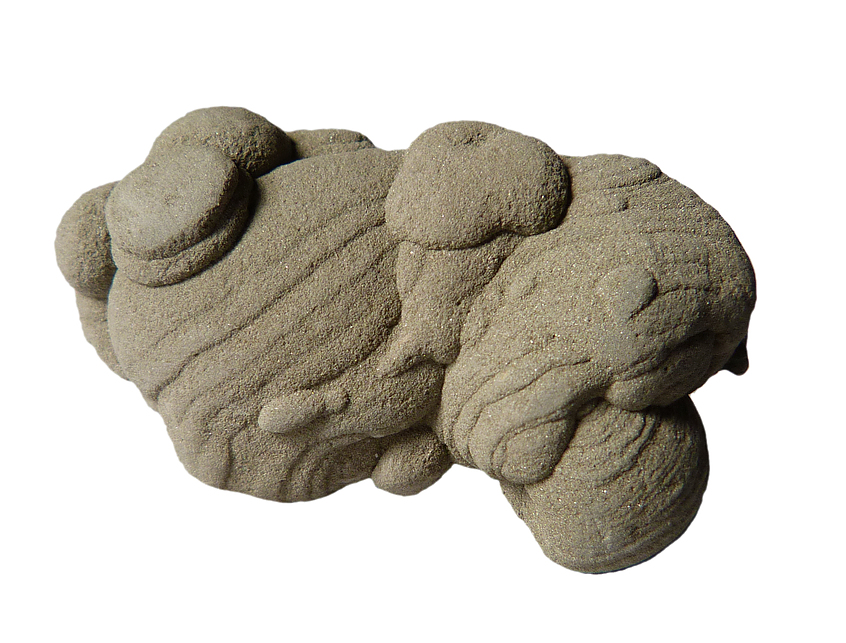


About Concretion
A hard compact mass found in sediments or sedimentary rocks formed by precipitation of a mineral cement, often nucleating around a pebble, fossil or piece of organic matter.

Common cements include calcium carbonate (mostly calcite, e.g. 'Claystones', 'Clay Dogs'), siderite, silica (e.g. flint), iron oxides (e.g. 'Moqui Marbles' and 'Indian paint pots'), iron sulfides (especially pyrite) or various phosphates.
i. A hard, compact mass or aggregate of mineral matter, normally subspherical, but commonly oblate, disk-shaped, elongate or irregular with odd or fantastic outlines; formed by precipitation from aqueous solution about a nucleus or centre, such as a leaf, shell, bone, or fossil, in the pores of a sedimentary or fragmental volcanic rock, and usually of a composition widely different from that of the rock in which it is found and from which it is rather sharply separated. It represents a concentration of some minor constituent of the enclosing rock or of cementing material, such as quartz (chert), calcite, dolomite, iron oxides, pyrite, or gypsum, and it ranges in size from a small pellet-like object to a large spheroidal body as much as 3 m in diameter. Most concretions were formed during diagenesis, and many (esp. in limestone and shale) shortly after sediment deposition.
Compare with: nodule
ii. A collective term applied loosely to various primary and secondary mineral segregations of diverse origin, including irregular nodules, spherulites, crystalline aggregates, geodes, septaria (see singular septarium), and related bodies. Not recommended usage.
This large sandstone concretion, over one meter in length, and shaped like a “dumbbell” is eroding from the bentonite clay. Larry Maltby.
Common cements include calcium carbonate (mostly calcite, e.g. 'Claystones', 'Clay Dogs'), siderite, silica (e.g. flint), iron oxides (e.g. 'Moqui Marbles' and 'Indian paint pots'), iron sulfides (especially pyrite) or various phosphates.
i. A hard, compact mass or aggregate of mineral matter, normally subspherical, but commonly oblate, disk-shaped, elongate or irregular with odd or fantastic outlines; formed by precipitation from aqueous solution about a nucleus or centre, such as a leaf, shell, bone, or fossil, in the pores of a sedimentary or fragmental volcanic rock, and usually of a composition widely different from that of the rock in which it is found and from which it is rather sharply separated. It represents a concentration of some minor constituent of the enclosing rock or of cementing material, such as quartz (chert), calcite, dolomite, iron oxides, pyrite, or gypsum, and it ranges in size from a small pellet-like object to a large spheroidal body as much as 3 m in diameter. Most concretions were formed during diagenesis, and many (esp. in limestone and shale) shortly after sediment deposition.
Compare with: nodule
ii. A collective term applied loosely to various primary and secondary mineral segregations of diverse origin, including irregular nodules, spherulites, crystalline aggregates, geodes, septaria (see singular septarium), and related bodies. Not recommended usage.
Unique Identifiers
Mindat ID:
55281
Long-form identifier:
mindat:1:1:55281:9
Classification of Concretion
Sub-divisions of Concretion
Common Associates
Associations Based on Photo Data:
| 3 photos of Concretion associated with Calcite | CaCO3 |
| 1 photo of Concretion associated with 'Sandstone' |
Internet Links for Concretion
mindat.org URL:
https://www.mindat.org/min-55281.html
Please feel free to link to this page.
Please feel free to link to this page.
References for Concretion
Reference List:
Warkentin, B. P. (1967) CARBONATE CONTENT OF CONCRETIONS IN VARVED SEDIMENTS. Canadian Journal of Earth Sciences, 4 (2) 333 doi:10.1139/e67-016
Berner, Robert A. (1968) Rate of concretion growth. Geochimica et Cosmochimica Acta, 32 (5) 477-483 doi:10.1016/0016-7037(68)90040-9
Voigt, Ehrhard (1968) Über Hiatus-Konkretionen (dargestellt an Beispielen aus dem Lias) Geologische Rundschau, 58 (1) 281-296 doi:10.1007/bf01820609
JACOB, ARTHUR F. (1973) Elongate Concretions as Paleochannel Indicators, Tongue River Formation (Paleocene), North Dakota. Geological Society of America Bulletin, 84 (6) 2127 doi:10.1130/0016-7606(1973)84<2127:ecapit>2.0.co;2
Boles, J. R., Landis, C. A., Dale, P. (1985) The Moeraki Boulders--Anatomy of Some Septarian Concretions. SEPM Journal of Sedimentary Research, Vol. 55. doi:10.1306/212f86e3-2b24-11d7-8648000102c1865d
Astin, T. R. (1986) Septarian crack formation in carbonate concretions from shales and mudstones. Clay Minerals, 21 (4) 617-631 doi:10.1180/claymin.1986.021.4.12
Peter S. Mozley (1989) Complex Compositional Zonation in Concretionary Siderite: Implications for Geochemical Studies. SEPM Journal of Sedimentary Research, Vol. 59. doi:10.1306/212f907a-2b24-11d7-8648000102c1865d
Peter S. Mozley, Stephen J. Burns (1993) Oxygen and Carbon Isotopic Composition of Marine Carbonate Concretions: An Overview. SEPM Journal of Sedimentary Research, 63. 73-83 doi:10.1306/d4267a91-2b26-11d7-8648000102c1865d
Coleman, Max L. (1993) Microbial processes: Controls on the shape and composition of carbonate concretions. Marine Geology, 113 (1) 127-140 doi:10.1016/0025-3227(93)90154-n
Peter S. Mozley, Stephen J. Burns (1993) Oxygen and Carbon Isotopic Composition of Marine Carbonate Concretions: An Overview. SEPM Journal of Sedimentary Research, 63. 73-83 doi:10.1306/d4267a91-2b26-11d7-8648000102c1865d
Sellés-Martínez, J. (1996) Concretion morphology, classification and genesis. Earth-Science Reviews, 41 (3) 177-210 doi:10.1016/s0012-8252(96)00022-0
Mozley, Peter S. (1996) The internal structure of carbonate concretions in mudrocks: a critical evaluation of the conventional concentric model of concretion growth. Sedimentary Geology, 103 (1) 85-91 doi:10.1016/0037-0738(95)00087-9
Leśniak, P.M., Łącka, B., Hladı́kova, J., Zieliński, G. (1999) Origin of barite concretions in the West Carpathian flysch, Poland. Chemical Geology, 158 (1) 155-163 doi:10.1016/s0009-2541(99)00010-8
Davis, J. Matthew (1999) Oriented carbonate concretions in a paleoaquifer: Insights into geologic controls on fluid flow. Water Resources Research, 35 (6). 1705-1711 doi:10.1029/1999wr900042
RAISWELL, R., FISHER, Q. J. (2000) Mudrock‐hosted carbonate concretions: a review of growth mechanisms and their influence on chemical and isotopic composition. Journal of the Geological Society, 157 (1) 239-251 doi:10.1144/jgs.157.1.239
Bréhéret, Jean-G., Brumsack, Hans-J. (2000) Barite concretions as evidence of pauses in sedimentation in the Marnes Bleues Formation of the Vocontian Basin (SE France) Sedimentary Geology, 130 (3) 205-228 doi:10.1016/s0037-0738(99)00112-8
RAISWELL, R., FISHER, Q. J. (2000) Mudrock‐hosted carbonate concretions: a review of growth mechanisms and their influence on chemical and isotopic composition. Journal of the Geological Society, 157 (1) 239-251 doi:10.1144/jgs.157.1.239
Seilacher, Adolf (2001) Concretion morphologies reflecting diagenetic and epigenetic pathways. Sedimentary Geology, 143 (1) 41-57 doi:10.1016/s0037-0738(01)00092-6
Abdel-Wahab, A., McBride, E. F. (2001) Origin of Giant Calcite-Cemented Concretions, Temple Member, Qasr El Sagha Formation (Eocene), Faiyum Depression, Egypt. Journal of Sedimentary Research, 71 (1) 70-81 doi:10.1306/031700710070
Raiswell, R., Bottrell, S. H., Dean, S. P., Marshall, J. D., Carr, A., Hatfield, D. (2002) Isotopic constraints on growth conditions of multiphase calcite-pyrite-barite concretions in Carboniferous mudstones. Sedimentology, 49 (2). 237-254 doi:10.1046/j.1365-3091.2002.00439.x
Mârza, Ioan, Constantina, Ciprian, Pârlea, Horea (2002) Arenite concretions with axial channel from the Badenian deposits of Cheia (Turda) - a new type of concretions. Studia Universitatis Babes-Bolyai, Geologia, 47 (1) 85-92 doi:10.5038/1937-8602.47.1.6
Mozley, Peter S.; Davis, J. Matthew (2005) Internal structure and mode of growth of elongate calcite concretions: Evidence for small-scale, microbially induced, chemical heterogeneity in groundwater. Geological Society of America Bulletin, 117 (11). 1400-1412 doi:10.1130/b25618.1
Chan, Marjorie A., Johnson, Clark M., Beard, Brian L., Bowman, John R., Parry, W.T. (2006) Iron isotopes constrain the pathways and formation mechanisms of terrestrial oxide concretions: A tool for tracing iron cycling on Mars? Geosphere, 2 (7). 324-332 doi:10.1130/ges00051.1
Goldberg, Tatiana, Mazumdar, Aninda, Strauss, Harald, Shields, Graham (2006) Insights from stable S and O isotopes into biogeochemical processes and genesis of Lower Cambrian barite–pyrite concretions of South China. Organic Geochemistry, 37 (10). 1278-1288 doi:10.1016/j.orggeochem.2006.04.013
CHAN, M. A., ORMÖ, J., PARK, A. J., STICH, M., SOUZA‐EGIPSY, V., KOMATSU, G. (2007) Models of iron oxide concretion formation: field, numerical, and laboratory comparisons. Geofluids, 7 (3). 356-368 doi:10.1111/j.1468-8123.2007.00187.x
Parry, W.T. (2011) Composition, nucleation, and growth of iron oxide concretions. Sedimentary Geology, 233 (1) 53-68 doi:10.1016/j.sedgeo.2010.10.009
LOOPE, DAVID B., KETTLER, RICHARD M., WEBER, KARRIE A., HINRICHS, NATHAN L., BURGESS, DEREK T. (2012) Rinded iron-oxide concretions: hallmarks of altered siderite masses of both early and late diagenetic origin. Sedimentology, 59 (6). 1769-1781 doi:10.1111/j.1365-3091.2012.01325.x
Marshall, Jim D., Pirrie, Duncan (2013) Carbonate concretions-explained. Geology Today, 29 (2) 53-62 doi:10.1111/gto.12002
Gaines, Robert R., Vorhies, John S. (2016) Growth mechanisms and geochemistry of carbonate concretions from the Cambrian Wheeler Formation (Utah, USA). Sedimentology, 63 (3). 662-698 doi:10.1111/sed.12234
Loyd, S. J. (2016) Preservation of overmature, ancient, sedimentary organic matter in carbonate concretions during outcrop weathering. Geobiology, 15 (1). 146-157 doi:10.1111/gbi.12194
Hodgson, David M., Kane, Ian A., Flint, Stephen S., Brunt, Rufus L., Ortiz-Karpf, Andrea (2016) Time-Transgressive Confinement On the Slope and the Progradation of Basin-Floor Fans: Implications For the Sequence Stratigraphy of Deep-Water Deposits. Journal of Sedimentary Research, 86 (2) 73-86 doi:10.2110/jsr.2016.3
Baumann, Lydia M. F., Birgel, Daniel, Wagreich, Michael, Peckmann, Jörn (2016) Microbially-driven formation of Cenozoic siderite and calcite concretions from eastern Austria. Austrian Journal of Earth Sciences, 109 (2). doi:10.17738/ajes.2016.0016
Yoshida, Hidekazu, Yamamoto, Koshi, Minami, Masayo, Katsuta, Nagayoshi, Sin-ichi, Sirono, Metcalfe, Richard (2018) Generalized conditions of spherical carbonate concretion formation around decaying organic matter in early diagenesis. Scientific Reports, 8 (1). 6308 doi:10.1038/s41598-018-24205-5
He, Qing, An, Yanfei, Sun, Fangji, Lai, Chunkit (2019) Genesis of Pyrite Concretions: Constraints from Mineral and Geochemical Features of Longtan Formation in Anhui Province, Eastern China. Minerals, 9 (8) 467 doi:10.3390/min9080467
Grice, Kliti, Holman, Alex I., Plet, Chloe, Tripp, Madison (2019) Fossilised Biomolecules and Biomarkers in Carbonate Concretions from Konservat-Lagerstätten. Minerals, 9 (3) 158 doi:10.3390/min9030158
Yoshida, Hidekazu, Yamamoto, Koshi, Ohe, Toshiaki, Katsuta, Nagayoshi, Muramiya, Yusuke, Metcalfe, Richard (2020) Diffusion controlled formation of spherical carbonate concretion in muddy sedimentary matrices. GEOCHEMICAL JOURNAL, 54 (4) 233-242 doi:10.2343/geochemj.2.0593
Localities for Concretion
Showing 499 localities.
 symbol to view information about a locality.
The
symbol to view information about a locality.
The Locality List
 - This locality has map coordinates listed.
- This locality has estimated coordinates.
ⓘ - Click for references and further information on this occurrence.
? - Indicates mineral may be doubtful at this locality.
- This locality has map coordinates listed.
- This locality has estimated coordinates.
ⓘ - Click for references and further information on this occurrence.
? - Indicates mineral may be doubtful at this locality.
 - Good crystals or important locality for species.
 - World class for species or very significant.
(TL) - Type Locality for a valid mineral species.
(FRL) - First Recorded Locality for everything else (eg varieties).
- World class for species or very significant.
(TL) - Type Locality for a valid mineral species.
(FRL) - First Recorded Locality for everything else (eg varieties).
All localities listed without proper references should be considered as questionable.

Sharon, Windsor County, Vermont, USA