
Bakerite
A variety of Datolite
This page is currently not sponsored. Click here to sponsor this page.


About Bakerite
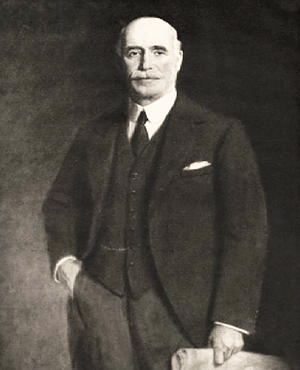
Richard Charles Baker
Formula:
Ca4(H5B5Si3O20)
Colour:
Colourless, White
Lustre:
Vitreous, Dull
Hardness:
4½
Specific Gravity:
2.88
Crystal System:
Monoclinic
Name:
Named in 1903 by William Brantingham Giles in honor of Richard Charles Baker (1858 Islington, London, England, UK - 1937 California, USA), who discovered the species, then president of the Borax Consolidated Company (formerly the Borax Company Limited) of San Bernardino County, California, USA, and for whom Baker, California, USA is also named. (Earlier, Richard C. Baker was also president of the Pacific Coast Borax Company, a company probably related to his later business interests.)
A microcrystalline, boron-rich variety of datolite. Occurs in various genetic environments among them diabase spilites.
Unique Identifiers
Mindat ID:
490 (as Bakerite)
1340 (as Datolite)
1340 (as Datolite)
Long-form identifier:
mindat:1:1:490:5 (as Bakerite)
mindat:1:1:1340:2 (as Datolite)
mindat:1:1:1340:2 (as Datolite)
Similar Names
IMA Classification of Bakerite
Discredited
Approval history:
Discredited: IMA 16-A. See Hålenius et al. (2016) and Bačík et al. (2017).
Classification of Bakerite
54.2.1b.1
54 : NESOSILICATES Borosilicates and Some Beryllosilicates
2 : Borosilicates and Some Beryllosilicates with B in [4] coordination
54 : NESOSILICATES Borosilicates and Some Beryllosilicates
2 : Borosilicates and Some Beryllosilicates with B in [4] coordination
17.5.13
17 : Silicates Containing other Anions
5 : Borosilicates
17 : Silicates Containing other Anions
5 : Borosilicates
Physical Properties of Bakerite
Vitreous, Dull
Transparency:
Translucent
Colour:
Colourless, White
Hardness:
4½ on Mohs scale
Density:
2.88 g/cm3 (Measured) 2.94 g/cm3 (Calculated)
Optical Data of Bakerite
Type:
Biaxial (-)
RI values:
nα = 1.624 nβ = 1.635 nγ = 1.654
2V:
Measured: 87° to 88°
Birefringence:
Moderate
Max. Birefringence:
δ = 0.030
Based on recorded range of RI values above.
Based on recorded range of RI values above.
Interference Colours:
The colours simulate birefringence patterns seen in thin section under crossed polars. They do not take into account mineral colouration or opacity.
Michel-Levy Bar The default colours simulate the birefringence range for a 30 µm thin-section thickness. Adjust the slider to simulate a different thickness.
Grain Simulation You can rotate the grain simulation to show how this range might look as you rotated a sample under crossed polars. Each grain retains its interference colour (retardation) while its brightness falls to black at extinction and reaches a maximum between extinction positions.
The colours simulate birefringence patterns seen in thin section under crossed polars. They do not take into account mineral colouration or opacity.
Michel-Levy Bar The default colours simulate the birefringence range for a 30 µm thin-section thickness. Adjust the slider to simulate a different thickness.
Grain Simulation You can rotate the grain simulation to show how this range might look as you rotated a sample under crossed polars. Each grain retains its interference colour (retardation) while its brightness falls to black at extinction and reaches a maximum between extinction positions.
Surface Relief:
High (positive)
Relative to Canada balsam mounting medium (n ≈ 1.537).
Relative to Canada balsam mounting medium (n ≈ 1.537).
This shows the grain boundary and Becke line effect under plane-polarised
light, based on the contrast between this mineral's average refractive
index and the mounting medium. It does not take into account mineral
colouration.
In focus
Interference Figure:
This shows the idealized biaxial acute bisectrix (Bxa) interference figure
- the conoscopic view for a grain cut perpendicular to the acute bisectrix, using
this mineral's 2V. The two small white dots mark the melatopes - the points
where the two optic axes emerge - and are shown only when they fall within the
field of view. The coloured bands are isochromatics, and the dark bands are
isogyres.
Rotate the stage: at 0°/90° the isogyres form a cross through the melatopes; at 45° they pull apart into curved hyperbolas. That splitting on rotation - absent in a uniaxial figure - is the standard diagnostic test for telling biaxial minerals from uniaxial ones. If 2V is large, the melatopes may fall outside the field of view, as they often do at the microscope too.
Rotate the stage: at 0°/90° the isogyres form a cross through the melatopes; at 45° they pull apart into curved hyperbolas. That splitting on rotation - absent in a uniaxial figure - is the standard diagnostic test for telling biaxial minerals from uniaxial ones. If 2V is large, the melatopes may fall outside the field of view, as they often do at the microscope too.
Dispersion:
weak
Chemistry of Bakerite
Mindat Formula:
Ca4(H5B5Si3O20)
Element Weights:
Crystallography of Bakerite
Crystal System:
Monoclinic
Class (H-M):
2/m - Prismatic
Space Group:
P21/b
Cell Parameters:
a = 4.85 Å, b = 7.627 Å, c = 9.659 Å
β = 90.255°
β = 90.255°
Ratio:
a:b:c = 0.636 : 1 : 1.266
Unit Cell V:
357.29 ų (Calculated from Unit Cell)
Z:
1
Morphology:
Dense and microcrystalline, resembling unglazed porcelain. Nodules and veins. Stout rhombic prisms
X-Ray Powder Diffraction
Loading XRD data...
Data courtesy of RRUFF project at University of Arizona, used with permission.
Geological Environment
Geological Setting:
Veins in altered volcanics.
First Recorded Occurrence of Bakerite
Associated Minerals at First Recorded Locality:
Other Language Names for Bakerite
Common Associates
Associations Based on Photo Data:
| 7 photos of Bakerite associated with Datolite | CaB(SiO4)(OH) |
| 5 photos of Bakerite associated with Imayoshiite | Ca3Al(CO3)[B(OH)4](OH)6 · 12H2O |
| 3 photos of Bakerite associated with Calcite | CaCO3 |
| 3 photos of Bakerite associated with Tobermorite Group | Ca4+x(AlySi6-y)O15+2x-y · 5H2O |
| 3 photos of Bakerite associated with Grossular | Ca3Al2(SiO4)3 |
| 2 photos of Bakerite associated with Bultfonteinite | Ca2(HSiO4)F · H2O |
| 1 photo of Bakerite associated with Shinichengite | Ca5[BSi2O7(OH)2]2 · 6H2O |
| 1 photo of Bakerite associated with Fluorapophyllite-(K) | KCa4(Si8O20)(F,OH) · 8H2O |
| 1 photo of Bakerite associated with Andradite | Ca3Fe3+2(SiO4)3 |
| 1 photo of Bakerite associated with Tatarinovite | Ca3Al(SO4)[B(OH)4](OH)6 · 12H2O |
Other Information
Health Risks:
No information on health risks for this material has been entered into the database. You should always treat mineral specimens with care.
Internet Links for Bakerite
mindat.org URL:
https://www.mindat.org/min-490.html
Please feel free to link to this page.
Please feel free to link to this page.
Search Engines:
Mineral Dealers:
References for Bakerite
Reference List:
Giles, W. B. (1903) Bakerite (a new borosilicate of calcium) and howlite from California. Mineralogical Magazine and Journal of the Mineralogical Society, 13 (62) 353-355 doi:10.1180/minmag.1903.013.62.12
Kramer, Henry, Allen, Robert D. (1956) A restudy of bakerite, priceite, and veatchite. American Mineralogist, 41 (9-10) 689-700
Perchiazzi, N., Gualtieri, A.F., Merlino, S., Kampf, A.R. (2004) The atomic structure of bakerite and its relationship to datolite. American Mineralogist, 89 (5) 767-776 doi:10.2138/am-2004-5-610
Localities for Bakerite
Showing 23 localities.
 symbol to view information about a locality.
The
symbol to view information about a locality.
The Locality List
 - This locality has map coordinates listed.
- This locality has estimated coordinates.
ⓘ - Click for references and further information on this occurrence.
? - Indicates mineral may be doubtful at this locality.
- This locality has map coordinates listed.
- This locality has estimated coordinates.
ⓘ - Click for references and further information on this occurrence.
? - Indicates mineral may be doubtful at this locality.
 - Good crystals or important locality for species.
 - World class for species or very significant.
(TL) - Type Locality for a valid mineral species.
(FRL) - First Recorded Locality for everything else (eg varieties).
- World class for species or very significant.
(TL) - Type Locality for a valid mineral species.
(FRL) - First Recorded Locality for everything else (eg varieties).
All localities listed without proper references should be considered as questionable.
Canada | |
| Perchiazzi et al. (2004) |
China | |
| Möhn et al. (05/2021) |
Italy | |
| |
| 415 (360) +1 other reference |
Japan | |
| Kusachi et al. (1994) +1 other reference |
Mexico | |
| |
| Panczner (1987) | |
| Panczner (1987) | |
| Panczner (1987) | |
New Zealand | |
| Ansin (1970) +1 other reference |
Spain | |
| Calvo Rebollar (2018) |
Turkey | |
| Helvaci et al. (2000) +1 other reference |
| Helvaci et al. (2000) +2 other references |
| Perchiazzi et al. (2004) |
USA | |
| Murdoch et al. (1966) |
| Giles (1903) +1 other reference |
| Larsen (1921) +1 other reference |
| Perchiazzi et al. (2004) | |
| Murdoch (1962) +6 other references |
| Harvard Museum of Natural History ... | |
| Palache et al. (1951) |
| Giles (1903) +1 other reference | |
| Dunn (1995) |
Quick NavTopAbout BakeriteUnique IdentifiersSimilar NamesIMA Classification Classification Physical Properties Optical Data Chemistry Crystallography X-Ray Powder DiffractionGeological EnvironmentFirst Recorded Occurrence Other LanguagesCommon AssociatesOther InformationInternet Links References Localities Locality List

Rio Gavottino, Casarza Ligure, Genoa, Liguria, Italy