
Rapakivi granite
A rock subtype
This page is currently not sponsored. Click here to sponsor this page.


About Rapakivi granite
A term, used as both an adjective and noun, for a variety of granite usually containing amphibole and/or biotite and characterized by the presence of large oval grains (ovoids) of orthoclase phenocrysts which are usually mantled by plagioclase (typically oligoclase). Two generations of quartz are often present. From the Finnish word for "rotten stone."
Rapakivi granite is a fairly uncommon type of granite. Most occurrences are within Proterozoic metamorphic belts, although both Archaean and Phanerozoic examples are known. Rapakivi granite form in shallow (a few km deep) sills of up to 10 km thickness. They are often associated with intrusions of anorthosite, norite, charnockite and mangerite. It was suggested that the entire suite results from the fractional crystallization of a single parental magma (summarised from Wikipedia, accessed 9 July 2026).
Rapakivi granites have relatively high fluoride contents (0.04–1.53%), as well as elevated uranium contents (up to 24 ppm) (Wikipedia, accessed 9 July 2026).
Many of the classical buildings in St Petersburg, Russia, are clad with Rapakivi granite imported from Finland.
Rapakivi granite is a fairly uncommon type of granite. Most occurrences are within Proterozoic metamorphic belts, although both Archaean and Phanerozoic examples are known. Rapakivi granite form in shallow (a few km deep) sills of up to 10 km thickness. They are often associated with intrusions of anorthosite, norite, charnockite and mangerite. It was suggested that the entire suite results from the fractional crystallization of a single parental magma (summarised from Wikipedia, accessed 9 July 2026).
Rapakivi granites have relatively high fluoride contents (0.04–1.53%), as well as elevated uranium contents (up to 24 ppm) (Wikipedia, accessed 9 July 2026).
Many of the classical buildings in St Petersburg, Russia, are clad with Rapakivi granite imported from Finland.
Unique Identifiers
Mindat ID:
48152
Long-form identifier:
mindat:1:1:48152:0
Classification of Rapakivi granite
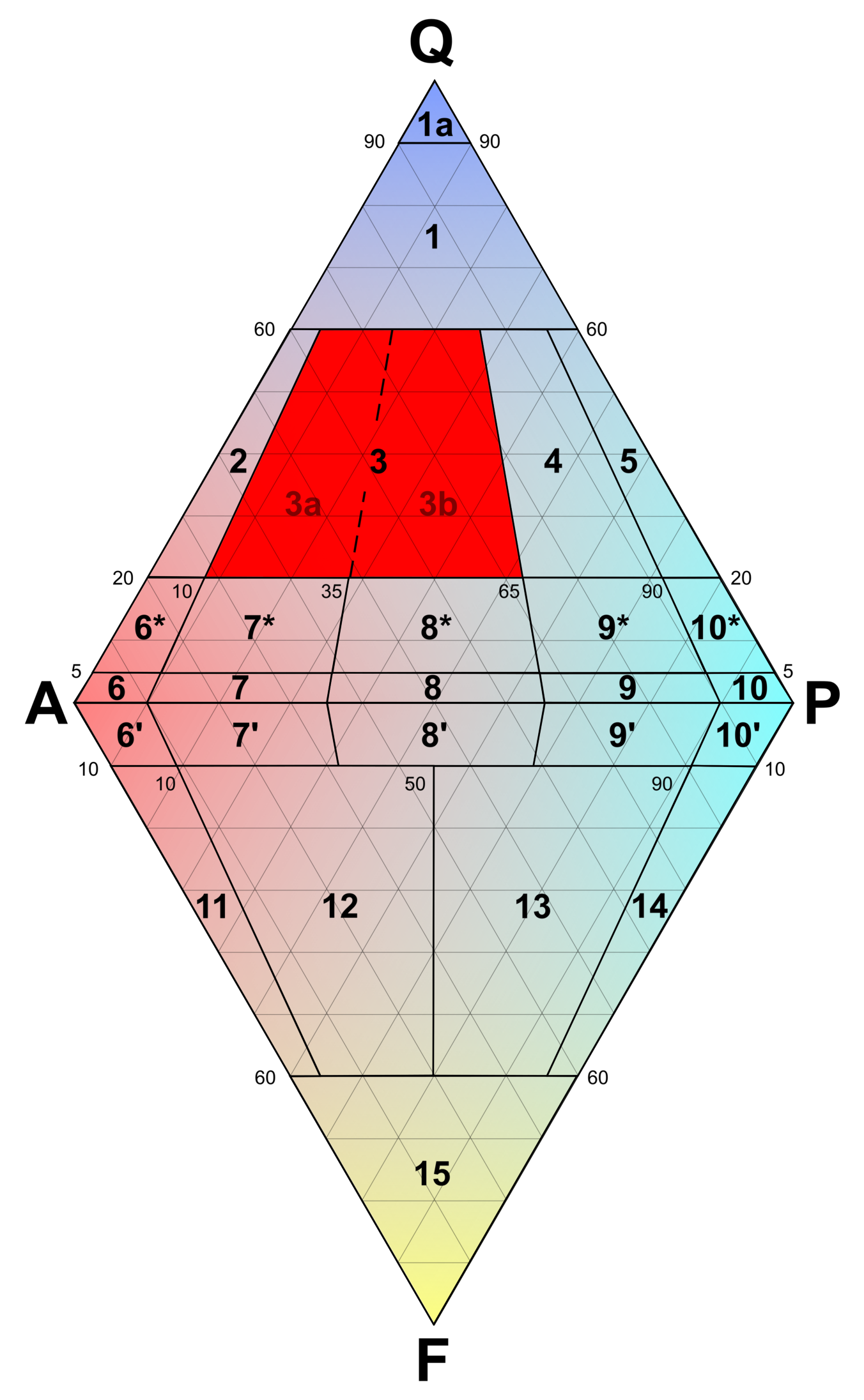
Granite is in section 3 of the QAPF diagram.
Sub-divisions of Rapakivi granite
- Rapakivi granite
Mineralogy of Rapakivi granite
Essential minerals - these are minerals that are required within the classification of this rock:
| Amphibole | A petrological term for Amphibole Supergroup. |
| Feldspar > Alkali Feldspar > Orthoclase | K(AlSi3O8) |
| Feldspar > Plagioclase | (Na,Ca)[(Si,Al)AlSi2]O8 |
| Mica > Biotite | K(Fe2+/Mg)2(Al/Fe3+/Mg/Ti)([Si/Al/Fe]2Si2O10)(OH/F)2 |
| Silica > Quartz | SiO2 |
Synonyms of Rapakivi granite
Common Associates
Associations Based on Photo Data:
| 7 photos of Rapakivi granite associated with Orthoclase | K(AlSi3O8) |
| 7 photos of Rapakivi granite associated with 'Oligoclase' | (Na,Ca)[Al(Si,Al)Si2O8] |
| 7 photos of Rapakivi granite associated with Biotite | K(Fe2+/Mg)2(Al/Fe3+/Mg/Ti)([Si/Al/Fe]2Si2O10)(OH/F)2 |
| 7 photos of Rapakivi granite associated with Amphibole Supergroup | AB2C5(T8O22)W2 |
| 6 photos of Rapakivi granite associated with Quartz | SiO2 |
Internet Links for Rapakivi granite
mindat.org URL:
https://www.mindat.org/min-48152.html
Please feel free to link to this page.
Please feel free to link to this page.
Search Engines:
References for Rapakivi granite
Reference List:
Sederholm, J.J. (1928) On orbicular granites, spotted and nodular granites etc. and on the rapakivi texture. Bulletin de la Commission Géologique de Finlande Vol. 83. Geological Survey of Finland
Nekvasil, Hanna (1991) Ascent of felsic magmas and formation of rapakivi. American Mineralogist, 76 (7-8) 1279-1290
Salonsaari, P. T., Haapala, I. (1994) The Jaala-Iitti rapakivi complex. An example of bimodal magmatism and hybridization in the Wiborg rapakivi batholith, southeastern Finland. Mineralogy and Petrology, 50 (1) 21-34 doi:10.1007/bf01160136
Eklund, O.; Fröjdö, S.; Lindberg, B. (1994) Magma mixing, the petrogenetic link between anorthositic suites and rapakivi granites, Åland, SW Finland. Mineralogy and Petrology, 50 (1-3). p.3-19. doi:10.1007/bf01160135
Andersson, Ulf B.; Eklund, Olav (1994) Cellular plagioclase intergrowths as a result of crystal-magma mixing in the Proterozoic Åland rapakivi batholith, SW Finland. Contributions to Mineralogy and Petrology, 117 (2). p.124-136. doi:10.1007/bf00286837
Rämö, O. T.; Haapala, I. (1995) One hundred years of rapakivi granite. Mineralogy and Petrology, 52 (3-4). p.129-185. doi:10.1007/bf01163243
Haapala, I (1999) Rapakivi granites and related rocks: an introduction. Precambrian Research, 95 (1) 1-7 doi:10.1016/s0301-9268(98)00124-7
Lindh, Anders (2001) Microgranular enclaves in the Nordingrå rapakivi granite, east central Sweden - the early rapakivi development. Neues Jahrbuch für Mineralogie - Abhandlungen, 176 (3). 299-322 doi:10.1127/njma/176/2001/299
Müller, Axel (2007) Rapakivi granites. Geology Today, 23 (3) 114-120 doi:10.1111/j.1365-2451.2007.00616.x
Larin, A. M. (2009) Rapakivi granites in the geological history of the earth. Part 1, magmatic associations with rapakivi granites: Age, geochemistry, and tectonic setting. Stratigraphy and Geological Correlation, 17 (3). 235-258 doi:10.1134/s0869593809030010

Vehmaa, Southwest Finland, Finland