
Zebra stone
A rock subtype
This page is currently not sponsored. Click here to sponsor this page.
About Zebra stone
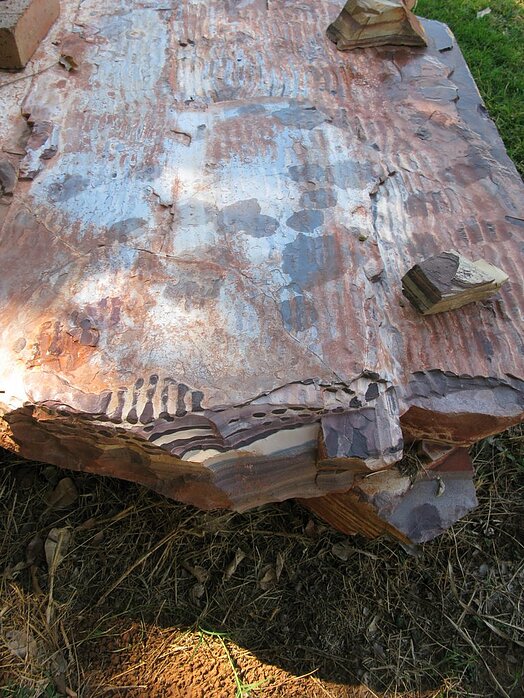
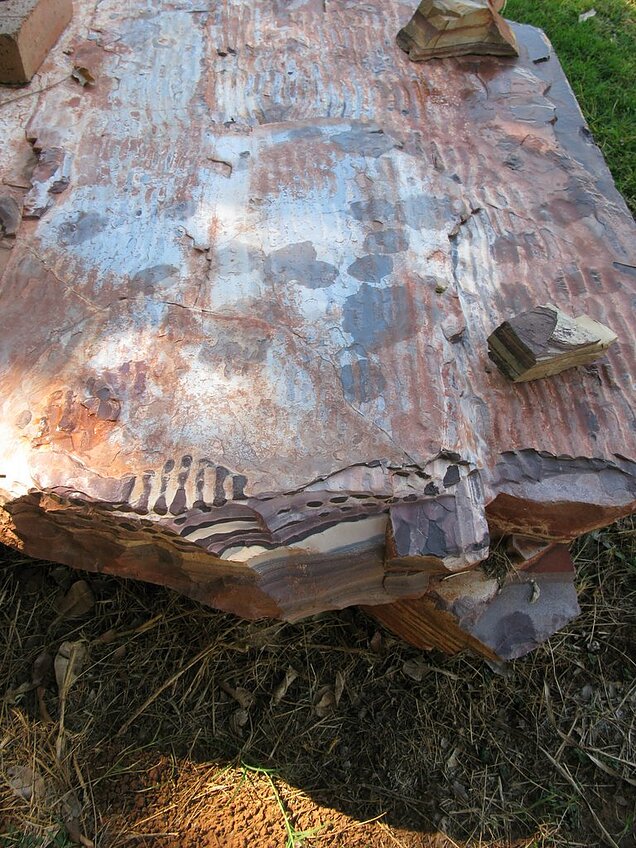
Zebra Stone (also known as Zebra Rock) is a distinctive sedimentary rock characterized by its reddish-brown and white banding. This rock is predominantly found in the east Kimberley region of Western Australia (see Zebra stone deposits). It primarily consists of quartz particles and sericite, a fine-grained white mica. Additionally, zebra rock contains minerals such as kaolinite, dickite, and alunite. The matrix is white, with distinct red patches of hematite-infused rock, with discontinuous sheet and tubular structures to a centimetre or two thick.
Note that zebra rock is also a term used in the Colville district of NE Washington State for a dolostone ('zebra dolomite') that shows narrow banding consisting of black layers (indicative of organic matter) alternating with white, slightly coarse-grained, and somewhat vuggy layers.
The known deposits of Australian zebra stone are situated in or near Lake Argyle, near Kununurra, specifically within the Johnny Cake Shale Member of the Ranford Formation. These formations are dated to the late Precambrian era, approximately 670 million years ago. Zebra stone is observed forming lenses and seams, a few cm thick, some of which extend over several kilometres.
The rock's characteristic colour banding is attributed to the rhythmic precipitation of iron oxide (hematite) rich bands, a process influenced by the alteration of the rock through the movement of fluids within it. It has red described an interpreted by Loughnan and Roberts, (1990) and Retallack, (2021), with a possible Leisegang-style origin, but this remains contentious.
Zebra rock has primarily been utilized as an ornamental stone. It has found applications in carving, costume jewellery, inlays, paperweights, and figurines. Unique hollow ware items, including decorative vases and lidded pots, have also been crafted from this rock. These items are occasionally combined with local Kimberley woods for enhanced aesthetic appeal.
One miner (Tom Kapitany) has a website with photos and information: https://www.crystalworld.com.au/2020/07/01/mining-zebra-stone/
See also Zebra rock
Note that zebra rock is also a term used in the Colville district of NE Washington State for a dolostone ('zebra dolomite') that shows narrow banding consisting of black layers (indicative of organic matter) alternating with white, slightly coarse-grained, and somewhat vuggy layers.
The known deposits of Australian zebra stone are situated in or near Lake Argyle, near Kununurra, specifically within the Johnny Cake Shale Member of the Ranford Formation. These formations are dated to the late Precambrian era, approximately 670 million years ago. Zebra stone is observed forming lenses and seams, a few cm thick, some of which extend over several kilometres.
The rock's characteristic colour banding is attributed to the rhythmic precipitation of iron oxide (hematite) rich bands, a process influenced by the alteration of the rock through the movement of fluids within it. It has red described an interpreted by Loughnan and Roberts, (1990) and Retallack, (2021), with a possible Leisegang-style origin, but this remains contentious.
Zebra rock has primarily been utilized as an ornamental stone. It has found applications in carving, costume jewellery, inlays, paperweights, and figurines. Unique hollow ware items, including decorative vases and lidded pots, have also been crafted from this rock. These items are occasionally combined with local Kimberley woods for enhanced aesthetic appeal.
One miner (Tom Kapitany) has a website with photos and information: https://www.crystalworld.com.au/2020/07/01/mining-zebra-stone/
See also Zebra rock
Unique Identifiers
Mindat ID:
470976
Long-form identifier:
mindat:1:1:470976:9
Classification of Zebra stone
Mineralogy of Zebra stone
Essential minerals - these are minerals that are required within the classification of this rock:
Non-essential minerals - these minerals are common, sometimes major components, but are not always present:
Internet Links for Zebra stone
mindat.org URL:
https://www.mindat.org/min-470976.html
Please feel free to link to this page.
Please feel free to link to this page.
References for Zebra stone
Reference List:
Loughnan, F. C., Roberts, F. I. (1990) Composition and origin of the ‘zebra rock’ from the East Kimberley region of Western Australia. Australian Journal of Earth Sciences, 37 (2) 201-205 doi:10.1080/08120099008727920
Localities for Zebra stone
Showing 8 localities.
 symbol to view information about a locality.
The
symbol to view information about a locality.
The Locality List
 - This locality has map coordinates listed.
- This locality has estimated coordinates.
ⓘ - Click for references and further information on this occurrence.
? - Indicates mineral may be doubtful at this locality.
- This locality has map coordinates listed.
- This locality has estimated coordinates.
ⓘ - Click for references and further information on this occurrence.
? - Indicates mineral may be doubtful at this locality.
 - Good crystals or important locality for species.
 - World class for species or very significant.
(TL) - Type Locality for a valid mineral species.
(FRL) - First Recorded Locality for everything else (eg varieties).
- World class for species or very significant.
(TL) - Type Locality for a valid mineral species.
(FRL) - First Recorded Locality for everything else (eg varieties).
All localities listed without proper references should be considered as questionable.
Australia | |
| Fetherston et al. (2013) |
| Fetherston et al. (2013) | |
| Fetherston et al. (2013) |
| Fetherston et al. (2013) | |
| Fetherston et al. (2013) | |
| Fetherston et al. (2013) | |
| Loughnan et al. (1990) | |
Spain | |
| Perona et al. (2018) |

Zebra stone deposits, Australia