
Iris Quartz
A variety of Quartz
This page is currently not sponsored. Click here to sponsor this page.
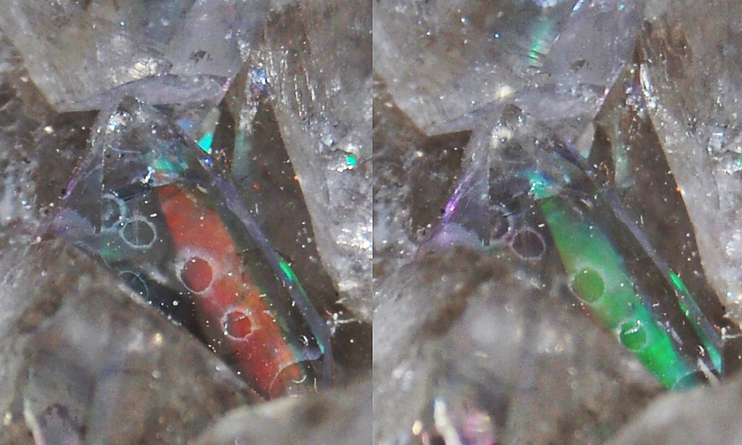
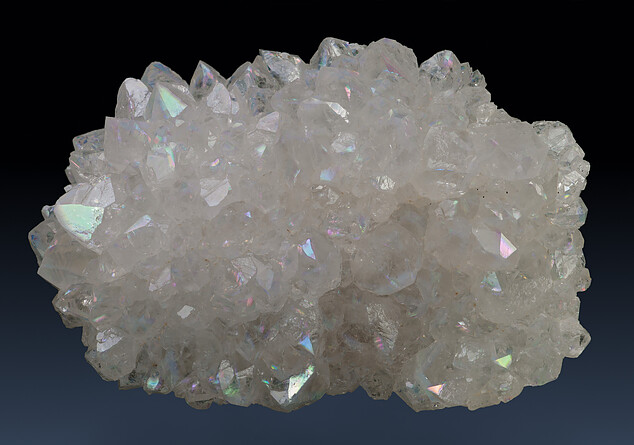

About Iris Quartz
Formula:
SiO2
Quartz crystals displaying internal spectral colours under minor rhombohedral faces. This interference phenomenon is due to reflection and refraction on extremely thin parallel Brazil-law twinning lamellae or periodic etching of defects on z faces, resulting in a diffraction grating (Lin & Heaney, 2017). The quartz crystals themselves are generally colourless or faintly amethystine or citrine, and almost always from vugs in basalt or other trap rock.
http://www.mindat.org/article.php/1335/Iris+Quartz
 Visit gemdat.org for gemological information about Iris Quartz.
http://www.mindat.org/article.php/1335/Iris+Quartz
Visit gemdat.org for gemological information about Iris Quartz.Unique Identifiers
Mindat ID:
42133 (as Iris Quartz)
3337 (as Quartz)
3337 (as Quartz)
Long-form identifier:
mindat:1:1:42133:3 (as Iris Quartz)
mindat:1:1:3337:0 (as Quartz)
mindat:1:1:3337:0 (as Quartz)
Pronunciation of Iris Quartz
Pronunciation:
| Play | Recorded by | Country |
|---|---|---|
| Jolyon Ralph | United Kingdom |
Chemistry of Iris Quartz
Mindat Formula:
SiO2
Elements listed:
Synonyms of Iris Quartz
Other Language Names for Iris Quartz
Common Associates
Associations Based on Photo Data:
| 4 photos of Iris Quartz associated with Quartz | SiO2 |
| 2 photos of Iris Quartz associated with 'Ferruginous Quartz' | SiO2 |
| 1 photo of Iris Quartz associated with 'Amethyst' | SiO2 |
Other Information
Health Risks:
No information on health risks for this material has been entered into the database. You should always treat mineral specimens with care.
Internet Links for Iris Quartz
mindat.org URL:
https://www.mindat.org/min-42133.html
Please feel free to link to this page.
Please feel free to link to this page.
Search Engines:
Mineral Dealers:
References for Iris Quartz
Reference List:
Localities for Iris Quartz
Showing 5 localities.
ⓘ - Click for references and further information on this occurrence.
? - Indicates mineral may be doubtful at this locality.
 - Good crystals or important locality for species.
 - World class for species or very significant.
(TL) - Type Locality for a valid mineral species.
(FRL) - First Recorded Locality for everything else (eg varieties).
- World class for species or very significant.
(TL) - Type Locality for a valid mineral species.
(FRL) - First Recorded Locality for everything else (eg varieties).
Struck out - Mineral was erroneously reported from this locality.
Faded * - Never found at this locality but inferred to have existed at some point in the past (e.g. from pseudomorphs).
All localities listed without proper references should be considered as questionable.
- Good crystals or important locality for species.
- World class for species or very significant.
(TL) - Type Locality for a valid mineral species.
(FRL) - First Recorded Locality for everything else (eg varieties).
All localities listed without proper references should be considered as questionable.
Germany | |
| Klaus Schäfer specimen |
India | |
| Kazuhiro Yoshida |
| British Museum of Natural History |
Morocco | |
| Specimen in Spirifer Society Collection |
Uruguay | |
| Jack Lowell specimens |

Burhanpur District, Madhya Pradesh, India