
Nephrite
A rock classification type
This page kindly sponsored by Alex Homenuke

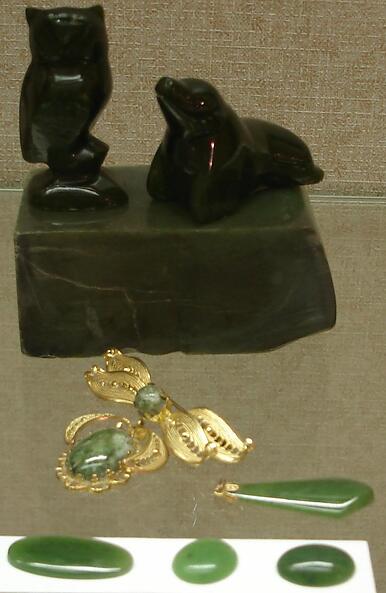
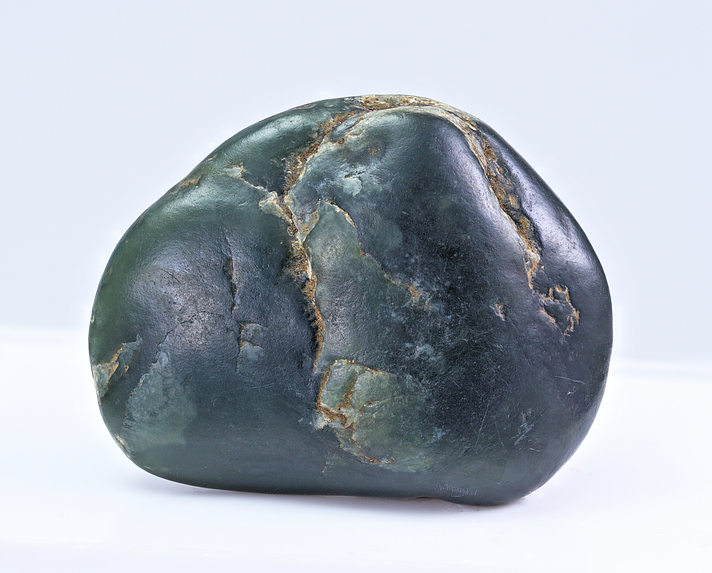
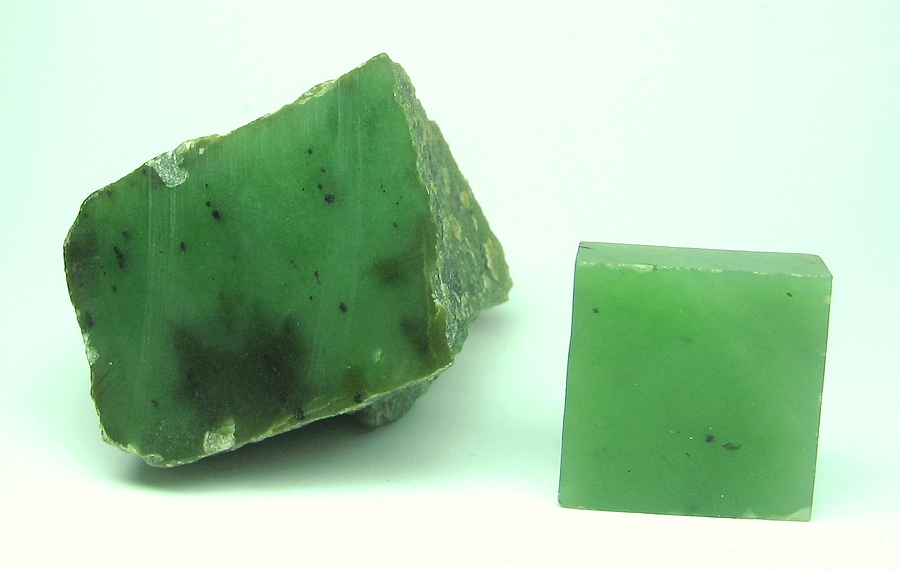
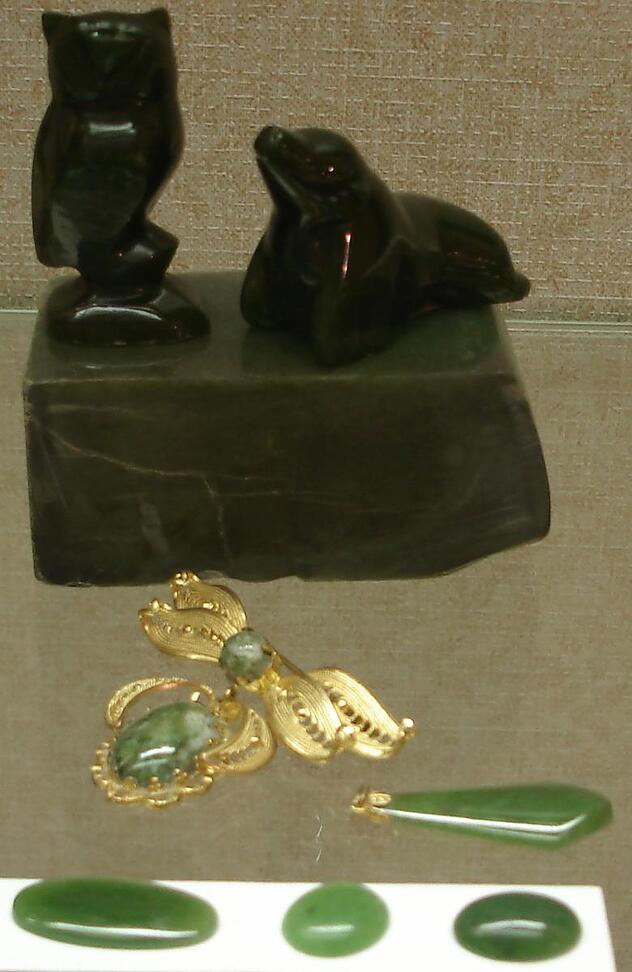
About Nephrite
Colour:
green, yellow green,
Name:
"The name nephrite is derived from lapis nephriticus, which in turn is derived from Greek λίθος νεφριτικός; νεφρός λίθος, which means 'kidney stone' and is the Latin and Greek version of the Spanish piedra de ijada (the origin of jade and jadeite). Accordingly, nephrite jade was once believed to be a cure for kidney stones." (Wikipedia)
Nephrite is a rock comprising mostly massive microcrystalline to cryptocrystalline felted amphiboles of the actinolite-tremolite series.
Nephrite is one of the two rocks termed as jade, the other being jadeitite = jadeite jade, consisting mostly of jadeite (although the term fei cui jade is now preferred as the pyroxene composition may also include omphacite and/or kosmochlor). Both are extremely tough and resistant to fracture, such that they have been used for making choppers and blades since Neolithic times.
In addition to amphibole, nephrite can contain minor to trace amounts of diopside, grossularitic garnet, magnetite, chromite, graphite, apatite, rutile, pyrite, datolite, vesuvianite, prehnite, talc, the serpentine polymorphs and titanite.
White nephrite, termed white jade or mutton-fat jade, is nearly pure tremolite, while most nephrite is green owing to the Fe content in actinolite. Trace to very minor amounts of chromium (Cr3+) colours nephrite emerald-green (via a Na+-Cr3+ vs. Ca2+-Mg2+ substitution) and yellow to brown nephrite is stained by iron oxides and hydroxides introduced along grain boundaries.
Nephrite can be subdivided into a D-type and S-type depending on the origin, i.e., D-type nephrite formed at the contact of dolomitic marble with granitoid intrusion, whereas S-type forms at the contact of serpentinized peridotite with acidic to intermediate intrusion or metasediments. Typical D-type nephrite mainly occurs in Asia, Russia, and Australia, with some newly found occurrences in Europe, whereas S-type nephrite is more widely distributed worldwide. Typical D-type nephrite deposits occur in West Kunlun and Altyn Tagh in Xinjiang, East Kunlun in Qinghai, and in Liaoning, NE China; Chuncheon, South Korea; Vitim in Siberia, Russia; Cowell, Australia; and Złoty Stok, Poland. Renowned and representative deposits of S-type nephrite are distributed in East Sayan in Siberia, Russia; British Columbia, Canada; Taiwan; Manasi in Xinjiang, China; New Zealand; Poland; and Bulgaria. The world’s largest D-type nephrite deposit belt is located in West Kunlun along the southern end of the Tarim Basin and extends to the northeast to the Altyn Tagh. It spans >1300 km and includes tens of sporadically distributed nephrite deposits. Compared with the recent, but limited, studies of nephrites in West Kunlun, nephrite deposits in the Altyn Tagh (including the areas of Tashisayi, Tatelekesu, Hadalikeqitai, and Tuokebulake) are even more poorly understood, despite the presence of >10 deposits there.
 Visit gemdat.org for gemological information about Nephrite.
Nephrite is one of the two rocks termed as jade, the other being jadeitite = jadeite jade, consisting mostly of jadeite (although the term fei cui jade is now preferred as the pyroxene composition may also include omphacite and/or kosmochlor). Both are extremely tough and resistant to fracture, such that they have been used for making choppers and blades since Neolithic times.
In addition to amphibole, nephrite can contain minor to trace amounts of diopside, grossularitic garnet, magnetite, chromite, graphite, apatite, rutile, pyrite, datolite, vesuvianite, prehnite, talc, the serpentine polymorphs and titanite.
White nephrite, termed white jade or mutton-fat jade, is nearly pure tremolite, while most nephrite is green owing to the Fe content in actinolite. Trace to very minor amounts of chromium (Cr3+) colours nephrite emerald-green (via a Na+-Cr3+ vs. Ca2+-Mg2+ substitution) and yellow to brown nephrite is stained by iron oxides and hydroxides introduced along grain boundaries.
Nephrite can be subdivided into a D-type and S-type depending on the origin, i.e., D-type nephrite formed at the contact of dolomitic marble with granitoid intrusion, whereas S-type forms at the contact of serpentinized peridotite with acidic to intermediate intrusion or metasediments. Typical D-type nephrite mainly occurs in Asia, Russia, and Australia, with some newly found occurrences in Europe, whereas S-type nephrite is more widely distributed worldwide. Typical D-type nephrite deposits occur in West Kunlun and Altyn Tagh in Xinjiang, East Kunlun in Qinghai, and in Liaoning, NE China; Chuncheon, South Korea; Vitim in Siberia, Russia; Cowell, Australia; and Złoty Stok, Poland. Renowned and representative deposits of S-type nephrite are distributed in East Sayan in Siberia, Russia; British Columbia, Canada; Taiwan; Manasi in Xinjiang, China; New Zealand; Poland; and Bulgaria. The world’s largest D-type nephrite deposit belt is located in West Kunlun along the southern end of the Tarim Basin and extends to the northeast to the Altyn Tagh. It spans >1300 km and includes tens of sporadically distributed nephrite deposits. Compared with the recent, but limited, studies of nephrites in West Kunlun, nephrite deposits in the Altyn Tagh (including the areas of Tashisayi, Tatelekesu, Hadalikeqitai, and Tuokebulake) are even more poorly understood, despite the presence of >10 deposits there.
Visit gemdat.org for gemological information about Nephrite.Unique Identifiers
Mindat ID:
2881
Long-form identifier:
mindat:1:1:2881:9
Similar Names
| Nephrite (of Bowen) | A synonym of 'Bowenite' |
| Tephrite | A rock classification type |
Classification of Nephrite
Sub-divisions of Nephrite
Physical Properties of Nephrite
Colour:
Green, yellow green,
Comment:
Results show that the color is mainly due to Fe3+ charge transfer (300–400 nm absorption band) and Fe2+→Fe3+ transitions (600–630 nm absorption band). Raman spectroscopy analysis, which determined the intensity of the M-OH vibration peak (3651 cm−1) and quantitative analysis of FeO and Fe2O3, confirmed the key role of Fe3+ occupancy in the tremolitic lattice for color regulation. Furthermore, the formation environment of magnesian marble ore in Ruoqiang, characterized by high oxygen fugacity, was found to be the main factor controlling Fe3+ enrichment and the formation of the yellow-green hue, offering new theoretical insights into the color genesis of yellow-green nephrite.
Synonyms of Nephrite
Other Language Names for Nephrite
Common Associates
Associations Based on Photo Data:
| 13 photos of Nephrite associated with Quartz | SiO2 |
| 7 photos of Nephrite associated with Chromite | Fe2+Cr3+2O4 |
| 6 photos of Nephrite associated with 'Jade' | |
| 6 photos of Nephrite associated with Tremolite | ◻Ca2Mg5(Si8O22)(OH)2 |
| 5 photos of Nephrite associated with Opal | SiO2 · nH2O |
| 5 photos of Nephrite associated with 'Ferro-actinolite-Tremolite Series' | |
| 3 photos of Nephrite associated with Magnetite | Fe2+Fe3+2O4 |
| 2 photos of Nephrite associated with Actinolite | ◻Ca2(Mg4.5-2.5Fe0.5-2.5)Si8O22(OH)2 |
| 2 photos of Nephrite associated with 'Williamsite' | Mg3(Si2O5)(OH)4 |
| 1 photo of Nephrite associated with 'Grossular-Uvarovite Series' |
Internet Links for Nephrite
mindat.org URL:
https://www.mindat.org/min-2881.html
Please feel free to link to this page.
Please feel free to link to this page.
References for Nephrite
Reference List:
Bradt, Richard C., Newnham, Robert E., Biggers, and J. V. (1973) The toughness of jade. American Mineralogist, 58 (7-8) 727-732
Harlow, G. E., Sorensen, S. S. (2005) Jade (Nephrite and Jadeitite) and Serpentinite: Metasomatic Connections. International Geology Review, 47 (2) 113-146 doi:10.2747/0020-6814.47.2.113
[1]Liu, Xifeng; Gil, Grzegorz; Liu, Yan; He, Xuemei; Syczewski, Marcin; Bagiński, Bogusław; Fang, Ting; Shu, Xiaochao (2021) Timing of formation and cause of coloration of brown nephrite from the Tiantai Deposit, South Altyn Tagh, northwestern China. Ore Geology Reviews, 131. doi:10.1016/j.oregeorev.2020.103972
Su, Yue, Yang, Mingxing (2022) Combining Rare Earth Element Analysis and Chemometric Method to Determine the Geographical Origin of Nephrite. Minerals, 12 (11) 1399 doi:10.3390/min12111399
Zhang, Cun, Yang, Fan, Yu, Xiaoyan, Liu, Jinhai, Carranza, Emmanuel John M., Chi, Jie, Zhang, Peng (2023) Spatial-temporal distribution, metallogenic mechanisms and genetic types of nephrite jade deposits in China. Frontiers in Earth Science, 11. doi:10.3389/feart.2023.1047707
Localities for Nephrite
Showing 224 localities.
 symbol to view information about a locality.
The
symbol to view information about a locality.
The Locality List
 - This locality has map coordinates listed.
- This locality has estimated coordinates.
ⓘ - Click for references and further information on this occurrence.
? - Indicates mineral may be doubtful at this locality.
- This locality has map coordinates listed.
- This locality has estimated coordinates.
ⓘ - Click for references and further information on this occurrence.
? - Indicates mineral may be doubtful at this locality.
 - Good crystals or important locality for species.
 - World class for species or very significant.
(TL) - Type Locality for a valid mineral species.
(FRL) - First Recorded Locality for everything else (eg varieties).
- World class for species or very significant.
(TL) - Type Locality for a valid mineral species.
(FRL) - First Recorded Locality for everything else (eg varieties).
All localities listed without proper references should be considered as questionable.

Onot river, Irkutsk Oblast, Russia