
Molybdomenite
A valid IMA mineral species - grandfathered
This page is currently not sponsored. Click here to sponsor this page.


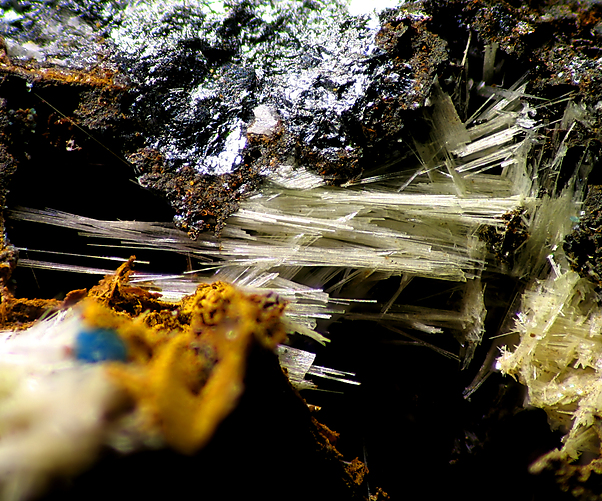


About Molybdomenite
Formula:
PbSeO3
Colour:
Colorless to white, yellowish white.
Lustre:
Adamantine, Greasy, Pearly
Hardness:
3½
Specific Gravity:
7.07
Crystal System:
Monoclinic
Name:
From the Greek μόλυβδος for "lead" and μήυη for "moon", where the element selenium is named for the moon.
Type Locality:
Dimorph of:
Compare also olsacherite.
The P21/c polymorph is called paramolybdomenite; it is analogous to synthetic α-PbSe4+O3.
The P21/c polymorph is called paramolybdomenite; it is analogous to synthetic α-PbSe4+O3.
Unique Identifiers
Mindat ID:
2733
Long-form identifier:
mindat:1:1:2733:1
IMA Classification of Molybdomenite
Approved, 'Grandfathered' (first described prior to 1959)
IMA Formula:
Pb2+Se4+O3
Classification of Molybdomenite
4.JF.05
4 : OXIDES (Hydroxides, V[5,6] vanadates, arsenites, antimonites, bismuthites, sulfites, selenites, tellurites, iodates)
J : Arsenites, antimonites, bismuthites, sulfites, selenites, tellurites; iodates
F : Selenites without additional anions, without H2O
4 : OXIDES (Hydroxides, V[5,6] vanadates, arsenites, antimonites, bismuthites, sulfites, selenites, tellurites, iodates)
J : Arsenites, antimonites, bismuthites, sulfites, selenites, tellurites; iodates
F : Selenites without additional anions, without H2O
Dana 7th ed.:
34.1.1.1
34.1.1.1
34 : SELENITES, TELLURITES AND SULFITES
1 : A(XO3)
34 : SELENITES, TELLURITES AND SULFITES
1 : A(XO3)
28.1.5
28 : Selenites, Selenates, Tellurites, and Tellurates
1 : Selenites
28 : Selenites, Selenates, Tellurites, and Tellurates
1 : Selenites
Mineral Symbols
As of 2021 there are now IMA–CNMNC approved mineral symbols (abbreviations) for each mineral species, useful for tables and diagrams.
| Symbol | Source | Reference for Standard |
|---|---|---|
| Mdm | IMA–CNMNC | Warr, L.N. (2021). IMA–CNMNC approved mineral symbols. Mineralogical Magazine, 85(3), 291-320. doi:10.1180/mgm.2021.43 |
Physical Properties of Molybdomenite
Adamantine, Greasy, Pearly
Transparency:
Transparent
Colour:
Colorless to white, yellowish white.
Hardness:
3½ on Mohs scale
Cleavage:
Distinct/Good
On {001} and {h0l}, good.
On {001} and {h0l}, good.
Density:
7.07 g/cm3 (Measured) 7.12 g/cm3 (Calculated)
Optical Data of Molybdomenite
Type:
Biaxial (-)
RI values:
nα = 2.12 nγ = 2.14
2V:
Measured: 80°
Max. Birefringence:
δ = 0.020
Based on recorded range of RI values above.
Based on recorded range of RI values above.
Interference Colours:
The colours simulate birefringence patterns seen in thin section under crossed polars. They do not take into account mineral colouration or opacity.
Michel-Levy Bar The default colours simulate the birefringence range for a 30 µm thin-section thickness. Adjust the slider to simulate a different thickness.
Grain Simulation You can rotate the grain simulation to show how this range might look as you rotated a sample under crossed polars. Each grain retains its interference colour (retardation) while its brightness falls to black at extinction and reaches a maximum between extinction positions.
The colours simulate birefringence patterns seen in thin section under crossed polars. They do not take into account mineral colouration or opacity.
Michel-Levy Bar The default colours simulate the birefringence range for a 30 µm thin-section thickness. Adjust the slider to simulate a different thickness.
Grain Simulation You can rotate the grain simulation to show how this range might look as you rotated a sample under crossed polars. Each grain retains its interference colour (retardation) while its brightness falls to black at extinction and reaches a maximum between extinction positions.
Surface Relief:
Moderate
Dispersion:
r < v
Chemistry of Molybdomenite
Mindat Formula:
PbSeO3
Element Weights:
Elements listed:
Crystallography of Molybdomenite
Polytype:
Formula:
Crystal System:
Class (H-M)
Space Group:
Space Group Setting:
Cell Parameters:
Ratio:
Unit Cell Volume (calc):
Z:
Comment:
| Molybdomenite-P21/c | Molybdomenite-P21/m |
|---|---|
| PbSeO3 | PbSeO3 |
| Monoclinic | Monoclinic |
| 2/m - Prismatic | 2/m - Prismatic |
| P21/b | P21/m |
| P21/c | P1121/m |
| a = 9.154(8) Å, b = 8.071(6) Å, c = 8.780(7) Å β = 103.15(8)° | a = 6.86 Å, b = 5.48 Å, c = 4.50 Å β = 112.75° |
| a:b:c = 1.134 : 1 : 1.088 | a:b:c = 1.252 : 1 : 0.821 |
| V 631.66 ų | V 156.01 ų (Calculated from Unit Cell) |
| 2 | |
| from the original description (Mandarino 1965); beta angle given as 122 deg. 45' |
Crystal Structure
Load
Unit Cell | Unit Cell Packed
2x2x2 | 3x3x3 | 4x4x4
Unit Cell | Unit Cell Packed
2x2x2 | 3x3x3 | 4x4x4
Show
Big Balls | Small Balls | Just Balls | Spacefill
Polyhedra Off | Si Polyhedra | All Polyhedra
Remove metal-metal sticks
Big Balls | Small Balls | Just Balls | Spacefill
Polyhedra Off | Si Polyhedra | All Polyhedra
Remove metal-metal sticks
Display Options
Black Background | White Background
Perspective On | Perspective Off
2D | Stereo | Red-Blue | Red-Cyan
Black Background | White Background
Perspective On | Perspective Off
2D | Stereo | Red-Blue | Red-Cyan
View
CIF File Best | x | y | z | a | b | c
CIF File Best | x | y | z | a | b | c
Rotation
Stop | Start
Stop | Start
Labels
Console Off | On | Grey | Yellow
Console Off | On | Grey | Yellow
Data courtesy of the American Mineralogist Crystal Structure Database. Click on an AMCSD ID to view structure
| ID | Species | Reference | Link | Year | Locality | Pressure (GPa) | Temp (K) |
|---|---|---|---|---|---|---|---|
| 0014923 | Molybdomenite | Pasero M, Rotiroti N (2003) The crystal structure of molybdomenite, PbSeO3 Neues Jahrbuch fur Mineralogie, Monatshefte 2003 145-152 | 2003 | El Dragon mine, Potosi, Bolivia | 0 | 293 |
CIF Raw Data - click here to close
X-Ray Powder Diffraction
Powder Diffraction Data:
| d-spacing | Intensity |
|---|---|
| 2.756 Å | (10) |
| 3.32 Å | (9) |
| 3.43 Å | (7) |
| 3.17 Å | (7) |
| 4.15 Å | (6) |
| 2.090 Å | (6b) |
| 2.99 Å | (5) |
Geological Environment
Paragenetic Mode(s):
| Paragenetic Mode | Earliest Age (Ga) |
|---|---|
| Stage 7: Great Oxidation Event | <2.4 |
| 47d : [Arsenates, antimonates, selenates, bismuthinates] | |
| 47h : [Near-surface oxidized, dehydrated minerals] |
Type Occurrence of Molybdomenite
Place of Conservation of Type Material:
Natural History Museum, Paris, France, 98293.
Geological Setting of Type Material:
oxidized zone of selenium-bearing hydrothermal base metal
deposits.
deposits.
Associated Minerals at Type Locality:
Synonyms of Molybdomenite
Lead selenate (in part)
Other Language Names for Molybdomenite
Dutch:Molybdomeniet
French:Selenite de plomb
Russian:Молибдоменит
Simplified Chinese:白硒铅矿
Spanish:Molybdomenita
Traditional Chinese:白硒鉛礦
Common Associates
Associations Based on Photo Data:
| 15 photos of Molybdomenite associated with Kruťaite | CuSe2 |
| 11 photos of Molybdomenite associated with Chalcomenite | CuSeO3 · 2H2O |
| 9 photos of Molybdomenite associated with Clausthalite | PbSe |
| 8 photos of Molybdomenite associated with Olsacherite | Pb2(Se6+O4)(SO4) |
| 7 photos of Molybdomenite associated with Goethite | Fe3+O(OH) |
| 7 photos of Molybdomenite associated with Klockmannite | CuSe |
| 6 photos of Molybdomenite associated with Native Selenium | Se |
| 5 photos of Molybdomenite associated with Chalcopyrite | CuFeS2 |
| 4 photos of Molybdomenite associated with Petříčekite | CuSe2 |
| 2 photos of Molybdomenite associated with Quartz | SiO2 |
Related Minerals - Strunz-mindat Grouping
| 4.JF. | Paramolybdomenite | PbSeO3 |
Other Information
Notes:
Raman data: just a single strong peak centered at 790 cm−1, attributable to the Se4+–O symmetric stretching vibrations of the selenite groups, occurs in "normal" molybdomenite, whereas two such strong peaks, at 788 cm−1 and 804 cm−1, occur in molybdomenite-P21/c.
Health Risks:
No information on health risks for this material has been entered into the database. You should always treat mineral specimens with care.
Internet Links for Molybdomenite
mindat.org URL:
https://www.mindat.org/min-2733.html
Please feel free to link to this page.
Please feel free to link to this page.
Search Engines:
External Links:
Mineral Dealers:
References for Molybdomenite
Reference List:
Bertrand, Emile (1882) Sur la molybdoménite (sélénite de plomb), la cobaltoménite (sélénite de cobalt) et l'acide sélénieux de Cacheuta (La Plata) Bulletin de Minéralogie, 5 (4) 90-92 doi:10.3406/bulmi.1882.1713
Fischer, R. (1972) Die Kristallstruktur von Molybdomenit, PbSeO3. TMPM Tschermaks Mineralogische und Petrographische Mitteilungen, 17 (3). 196-207 doi:10.1007/bf01085993
Mandarino, Joseph A. (1994) Natural and synthetic selenites and selenates and their Gladstone-Dale compatibility. European Journal of Mineralogy, 6 (3) 337-350 doi:10.1127/ejm/6/3/0337
Pasero, Marco, Rotiroti, Nicola (2003) The crystal structure of molybdomenite, PbSeO3. Neues Jahrbuch für Mineralogie - Monatshefte, 2003 (4) 145-152 doi:10.1127/0028-3649/2003/2003-0145
Zhang, Jingnan; Yang, Hexiong; Gibbs, Ronald B. (2024) Molybdomenite-P21/c, Polymorphous with Molybdomenite and the Natural Analogue of Synthetic α-PbSe4+O3, from the El Dragón Mine, Potosí, Bolivia. The Canadian Journal of Mineralogy and Petrology, 62 (4). 643-652 doi:10.3749/2400004(= Paramolybdomenite)
Localities for Molybdomenite
Showing 22 localities.
 symbol to view information about a locality.
The
symbol to view information about a locality.
The Locality List
 - This locality has map coordinates listed.
- This locality has estimated coordinates.
ⓘ - Click for references and further information on this occurrence.
? - Indicates mineral may be doubtful at this locality.
- This locality has map coordinates listed.
- This locality has estimated coordinates.
ⓘ - Click for references and further information on this occurrence.
? - Indicates mineral may be doubtful at this locality.
 - Good crystals or important locality for species.
 - World class for species or very significant.
(TL) - Type Locality for a valid mineral species.
(FRL) - First Recorded Locality for everything else (eg varieties).
- World class for species or very significant.
(TL) - Type Locality for a valid mineral species.
(FRL) - First Recorded Locality for everything else (eg varieties).
All localities listed without proper references should be considered as questionable.
Argentina | |
| Paar et al. (2004) |
| Márquez-Zavalía et al. (2021) | |
| de Brodtkorb +3 other references | |
| Sarp et al. (1987) |
| Grundmann et al. (2018) |
| Ahlfeld Friedrich and Angelelll ... +4 other references |
Bolivia | |
| Schnorrer-Köhler et al. (1990) +4 other references |
| Smith et al. (2001) |
Canada | |
| Richard Gunter Collection. |
| Mandarino (1965) |
| In the collection of Brent Thorne. ... |
| In the collection of Brent Thorne. ... | |
| Collected and analyzed by Gunnar Farber. | |
Czech Republic | |
| Sejkora et al. (2004) +1 other reference |
Germany | |
| Wittern (2001) |
| Kersten (1839) |
Mexico | |
| Braith et al. (2001) |
| M Kampf collection | |
Russia | |
| Serafimova et al. (1994) |
| Kalinin (2021) |
UK | |
| Technical Report TR-02-09 (March 2002) +1 other reference |
USA | |
| Eckel et al. (1997) |
Quick NavTopAbout MolybdomeniteUnique IdentifiersIMA Classification Classification Mineral SymbolsPhysical Properties Optical Data Chemistry Crystallography Crystal StructureX-Ray Powder DiffractionGeological EnvironmentType Occurrence SynonymsOther LanguagesCommon AssociatesStrunz-MindatOther InformationInternet Links References Localities Locality List

Virgen de Surumi mine, Pakajake Canyon, Colquechaca Municipality, Chayanta Province, Potosí, Bolivia