
Lautarite
A valid IMA mineral species - grandfathered
This page is currently not sponsored. Click here to sponsor this page.

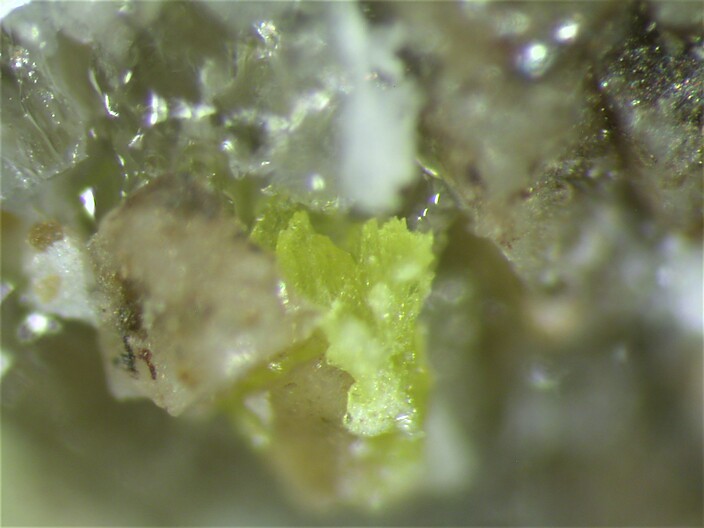


About Lautarite
Formula:
Ca(IO3)2
Colour:
Colourless; yellowish
Hardness:
3½ - 4
Specific Gravity:
4.59
Crystal System:
Monoclinic
Name:
After the type locality Oficina Lautaro, Antofagasta, Chile. (Lautaro is also the name of the Mapuche leader who resisted the Spanish conquest of Chile.)
Unique Identifiers
Mindat ID:
2346
Long-form identifier:
mindat:1:1:2346:3
Similar Names
| Laterite | A rock classification type |
| Lotrite | A synonym of Pumpellyite Subgroup |
IMA Classification of Lautarite
Approved, 'Grandfathered' (first described prior to 1959)
IMA Formula:
Ca(I5+O3)2
First published:
1891
Classification of Lautarite
4.KA.05
4 : OXIDES (Hydroxides, V[5,6] vanadates, arsenites, antimonites, bismuthites, sulfites, selenites, tellurites, iodates)
K : Iodates: Trigonal [IO3] pyramids (mostly).
A : Iodates without additional anions, without H2O
4 : OXIDES (Hydroxides, V[5,6] vanadates, arsenites, antimonites, bismuthites, sulfites, selenites, tellurites, iodates)
K : Iodates: Trigonal [IO3] pyramids (mostly).
A : Iodates without additional anions, without H2O
Dana 7th ed.:
21.1.1.1
21.1.1.1
21 : NORMAL IODATES
1 : Miscellaneous
21 : NORMAL IODATES
1 : Miscellaneous
29.3
29 : Iodates
29 : Iodates
Mineral Symbols
As of 2021 there are now IMA–CNMNC approved mineral symbols (abbreviations) for each mineral species, useful for tables and diagrams.
| Symbol | Source | Reference for Standard |
|---|---|---|
| Ltr | IMA–CNMNC | Warr, L.N. (2021). IMA–CNMNC approved mineral symbols. Mineralogical Magazine, 85(3), 291-320. doi:10.1180/mgm.2021.43 |
Physical Properties of Lautarite
Transparency:
Transparent
Colour:
Colourless; yellowish
Streak:
White
Hardness:
3½ - 4 on Mohs scale
Cleavage:
Distinct/Good
On {011} good; on {100} and {110} in traces.
On {011} good; on {100} and {110} in traces.
Density:
4.59 g/cm3 (Measured) 4.48 g/cm3 (Calculated)
Optical Data of Lautarite
Type:
Biaxial (+)
RI values:
nα = 1.792 nβ = 1.84 nγ = 1.888
2V:
Measured: 90° , Calculated: 86°
Max. Birefringence:
δ = 0.096
Based on recorded range of RI values above.
Based on recorded range of RI values above.
Interference Colours:
The colours simulate birefringence patterns seen in thin section under crossed polars. They do not take into account mineral colouration or opacity.
Michel-Levy Bar The default colours simulate the birefringence range for a 30 µm thin-section thickness. Adjust the slider to simulate a different thickness.
Grain Simulation You can rotate the grain simulation to show how this range might look as you rotated a sample under crossed polars. Each grain retains its interference colour (retardation) while its brightness falls to black at extinction and reaches a maximum between extinction positions.
The colours simulate birefringence patterns seen in thin section under crossed polars. They do not take into account mineral colouration or opacity.
Michel-Levy Bar The default colours simulate the birefringence range for a 30 µm thin-section thickness. Adjust the slider to simulate a different thickness.
Grain Simulation You can rotate the grain simulation to show how this range might look as you rotated a sample under crossed polars. Each grain retains its interference colour (retardation) while its brightness falls to black at extinction and reaches a maximum between extinction positions.
Surface Relief:
Moderate
Dispersion:
r > v perceptible
Optical Extinction:
Y = b; Z ∧ c = 25°.
Chemistry of Lautarite
Mindat Formula:
Ca(IO3)2
Element Weights:
Elements listed:
Crystallography of Lautarite
Crystal System:
Monoclinic
Class (H-M):
2/m - Prismatic
Space Group:
P21/b
Cell Parameters:
a = 7.28 Å, b = 11.3 Å, c = 7.14 Å
β = 106.36°
β = 106.36°
Ratio:
a:b:c = 0.644 : 1 : 0.632
Unit Cell V:
563.58 ų (Calculated from Unit Cell)
Morphology:
Crystals short prismatic along [001]. Faces in zone [001] rounded and striated [001]. Stellate aggregates common. Forms include {110}, {120}, {010}, {001}, small {011}, {101}, {101}.
Crystal Structure
Load
Unit Cell | Unit Cell Packed
2x2x2 | 3x3x3 | 4x4x4
Unit Cell | Unit Cell Packed
2x2x2 | 3x3x3 | 4x4x4
Show
Big Balls | Small Balls | Just Balls | Spacefill
Polyhedra Off | Si Polyhedra | All Polyhedra
Remove metal-metal sticks
Big Balls | Small Balls | Just Balls | Spacefill
Polyhedra Off | Si Polyhedra | All Polyhedra
Remove metal-metal sticks
Display Options
Black Background | White Background
Perspective On | Perspective Off
2D | Stereo | Red-Blue | Red-Cyan
Black Background | White Background
Perspective On | Perspective Off
2D | Stereo | Red-Blue | Red-Cyan
View
CIF File Best | x | y | z | a | b | c
CIF File Best | x | y | z | a | b | c
Rotation
Stop | Start
Stop | Start
Labels
Console Off | On | Grey | Yellow
Console Off | On | Grey | Yellow
Data courtesy of the American Mineralogist Crystal Structure Database. Click on an AMCSD ID to view structure
| ID | Species | Reference | Link | Year | Locality | Pressure (GPa) | Temp (K) |
|---|---|---|---|---|---|---|---|
| 0009623 | Lautarite | Ghose S, Wan C (1978) The crystal structure of synthetic lautarite, Ca(IO3)2 Acta Crystallographica B34 84-88 |  | 1978 | synthetic | 0 | 293 |
CIF Raw Data - click here to close
X-Ray Powder Diffraction
Powder Diffraction Data:
| d-spacing | Intensity |
|---|---|
| 3.156 Å | (100) |
| 3.428 Å | (85) |
| 3.493 Å | (65) |
| 4.360 Å | (50) |
| 3.336 Å | (40) |
| 2.840 Å | (35) |
| 3.318 Å | (30) |
Comments:
Synthetic. The data are from Morris et al. (1977).
Geological Environment
Paragenetic Mode(s):
| Paragenetic Mode | Earliest Age (Ga) |
|---|---|
| Near-surface Processes | |
| 25 : Evaporites (prebiotic) |
Type Occurrence of Lautarite
General Appearance of Type Material:
Crystals coating fractures or embedded in gypsum bands.
Place of Conservation of Type Material:
No designated type material.
Geological Setting of Type Material:
Sedimentary nitrate deposits.
Associated Minerals at Type Locality:
Synonyms of Lautarite
Other Language Names for Lautarite
Common Associates
Associations Based on Photo Data:
Other Information
Notes:
Slightly soluble in water. Readily soluble in HCl with evolution of Cl.
Health Risks:
Emits toxic chlorine gas when placed in contact with HCl.
Internet Links for Lautarite
mindat.org URL:
https://www.mindat.org/min-2346.html
Please feel free to link to this page.
Please feel free to link to this page.
Search Engines:
External Links:
Mineral Dealers:
References for Lautarite
Reference List:
Dietze, August (1891) Einige neue chilenische Mineralien. Zeitschrift für Kristallographie, Mineralogie und Petrographie, 19 (1). 445-451 doi:10.1524/zkri.1891.19.1.445
Osann, Α. (1894) Krystallographische Untersuchung einiger neuer chilenischer Mineralien. Zeitschrift für Krystallographie und Mineralogie, 23 (1-6). 584-589 doi:10.1524/zkri.1894.23.1.584p.586
Goßner, B.; Mußgnug, F. (1930) Über Krokoit, Lautarit und Dietzeit und deren kristallographische Beziehungen. Zeitschrift für Kristallographie, 75 (1). 410-420 doi:10.1515/zkri-1930-0131
Larsen, E.S.; Berman, H. (1934) The microscopic determination of the nonopaque minerals. Bulletin of the US Geological Survey Vol. 848. US Geological Survey p.1-266. doi:10.3133/b848 p.140
Ghose, S., Wan, C., Wittke, O. (1978) The crystal structure of synthetic lautarite, Ca(IO3)2. Acta Crystallographica Section B, 34 (1). 84-88 doi:10.1107/s0567740878002344
Localities for Lautarite
Showing 4 localities.
 symbol to view information about a locality.
The
symbol to view information about a locality.
The Locality List
 - This locality has map coordinates listed.
- This locality has estimated coordinates.
ⓘ - Click for references and further information on this occurrence.
? - Indicates mineral may be doubtful at this locality.
- This locality has map coordinates listed.
- This locality has estimated coordinates.
ⓘ - Click for references and further information on this occurrence.
? - Indicates mineral may be doubtful at this locality.
 - Good crystals or important locality for species.
 - World class for species or very significant.
(TL) - Type Locality for a valid mineral species.
(FRL) - First Recorded Locality for everything else (eg varieties).
- World class for species or very significant.
(TL) - Type Locality for a valid mineral species.
(FRL) - First Recorded Locality for everything else (eg varieties).
All localities listed without proper references should be considered as questionable.
Australia | |
| De Waele et al. (2026) |
Chile (TL) | |
| Palache et al. (1951) +1 other reference |
| |
| Marta et al. (1996) |
Quick NavTopAbout LautariteUnique IdentifiersSimilar NamesIMA Classification Classification Mineral SymbolsPhysical Properties Optical Data Chemistry Crystallography Crystal StructureX-Ray Powder DiffractionGeological EnvironmentType Occurrence SynonymsOther LanguagesCommon AssociatesOther InformationInternet Links References Localities Locality List

Yumbes Mine, Paposo, Reventon District, Taltal, Antofagasta Province, Antofagasta, Chile