
Lapis lazuli
A rock subtype
This page is currently not sponsored. Click here to sponsor this page.

About Lapis lazuli
Lustre:
Sub-Vitreous, Greasy
Name:
Lapis-lazuli was known in ancient times and was highly prized. The earliest published use of the name lapis-lazuli appears to be from 1636 by Anselmus Boetus de Boodt in Gemmarum et Lapidum Historia. page 273. The name is said to be derived from the Latin 'Lapis' and the Persian 'Lazhward', meaning Blue. The name should be pronounced 'Lap-is Laz-u-lee'.
An uncommon metamorphic rock originally designated as having lazurite as an essential component. Believed to be meta-evaporites recrystallized during high-grade regional metamorphism.
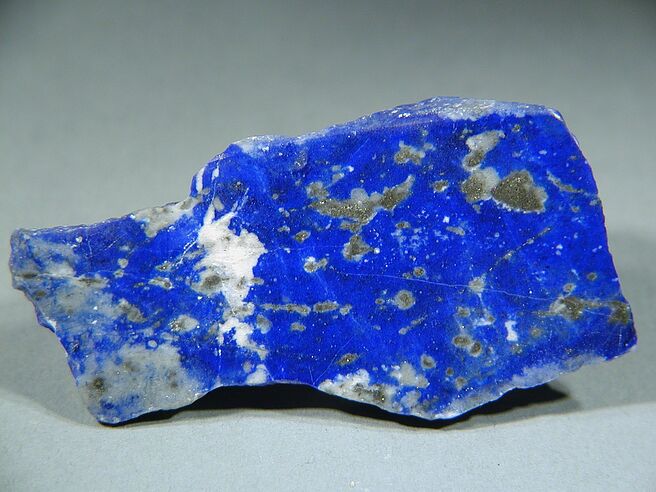
The name Lapis Lazuli has been used both to describe the blue mineral previously known as lazurite (but in most cases is actually a S-rich variety of haüyne) and the rock that is made up predominantly of this mineral plus calcite, pyrite and other minerals. In general today the name Lapis Lazuli is used to describe the material used as a decorative stone (ie, the rock) rather than the mineral component. The localities listed here are localities where this decorative stone has been reported.
Many of the properties listed here are for the blue mineral (an opaque sulfur bearing gem Hauyne) in the rock.
Worldwide, virtually all of the lapis-lazuli occurrences have haüyne, vladimirivanovite, afghanite, etc., rather than the species lazurite, which is actually ultra-rare and virtually no valid specimens of lapis lazuli are known to contain true lazurite. By far, the greatest number of lapis-lazuli specimens contain haüyne as the deep blue component.
Lapis-lazuli is mined and carved as a decorative stone, as this rock has a distinctive blue colour. Lapis Lazuli historically came from Lapis-lazuli mines and occurrences, near Sar-e-Sang, Badakhshan (Badakshan; Badahsan) Province, Afghanistan.
 Visit gemdat.org for gemological information about Lapis lazuli.
The name Lapis Lazuli has been used both to describe the blue mineral previously known as lazurite (but in most cases is actually a S-rich variety of haüyne) and the rock that is made up predominantly of this mineral plus calcite, pyrite and other minerals. In general today the name Lapis Lazuli is used to describe the material used as a decorative stone (ie, the rock) rather than the mineral component. The localities listed here are localities where this decorative stone has been reported.
Many of the properties listed here are for the blue mineral (an opaque sulfur bearing gem Hauyne) in the rock.
Worldwide, virtually all of the lapis-lazuli occurrences have haüyne, vladimirivanovite, afghanite, etc., rather than the species lazurite, which is actually ultra-rare and virtually no valid specimens of lapis lazuli are known to contain true lazurite. By far, the greatest number of lapis-lazuli specimens contain haüyne as the deep blue component.
Lapis-lazuli is mined and carved as a decorative stone, as this rock has a distinctive blue colour. Lapis Lazuli historically came from Lapis-lazuli mines and occurrences, near Sar-e-Sang, Badakhshan (Badakshan; Badahsan) Province, Afghanistan.
Visit gemdat.org for gemological information about Lapis lazuli.Unique Identifiers
Mindat ID:
2330
Long-form identifier:
mindat:1:1:2330:2
Classification of Lapis lazuli
- Rock
- Metamorphic rock
- Metasedimentary rock
- Meta-evaporite
- Lapis lazuli
- Meta-evaporite
- High-grade metamorphic rock
- Lapis lazuli
- Metasedimentary rock
- Metamorphic rock
Mineralogy of Lapis lazuli
Essential minerals - these are minerals that are required within the classification of this rock:
| Feldspathoid > Haüyne | Na3Ca(Si3Al3)O12(SO4) |
| Feldspathoid > Lazurite | Na7Ca(Al6Si6O24)(SO4)(S3) · H2O |
Non-essential minerals - these minerals are common, sometimes major components, but are not always present:
| Calcite | CaCO3 |
| Pyrite | FeS2 |
| Pyroxene > Clinopyroxene > Diopside | CaMgSi2O6 |
Physical Properties of Lapis lazuli
Geological Environment
Geological Setting:
In marble skarns
Synonyms of Lapis lazuli
Varieties of Lapis lazuli
| Chilean Lapis | From Chile |
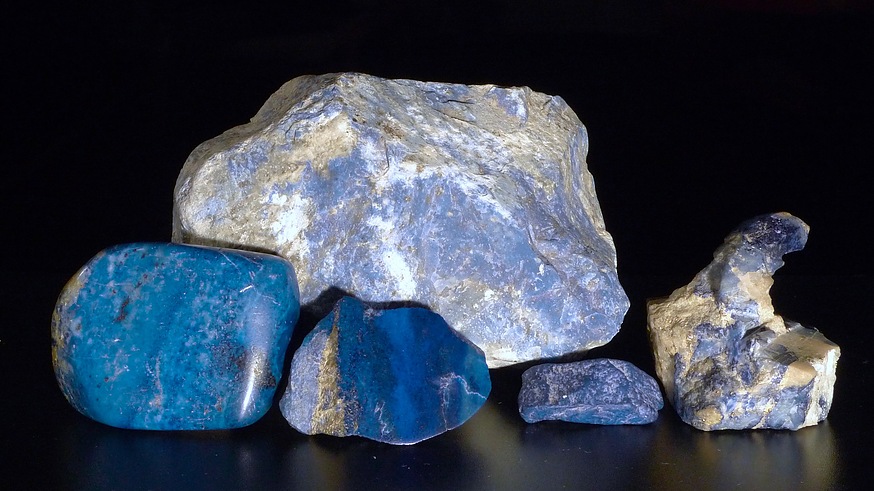
| Denim Lapis | A paler blue variety of Lapis Lazuli, the colour difference is caused by a greater calcite content. Essentially, this is low-grade Lapis Lazuli with a new dealer-friendly name. |
Common Associates
Associations Based on Photo Data:
| 9 photos of Lapis lazuli associated with Pyrite | FeS2 |
| 7 photos of Lapis lazuli associated with Lazurite | Na7Ca(Al6Si6O24)(SO4)(S3) · H2O |
| 4 photos of Lapis lazuli associated with Calcite | CaCO3 |
| 3 photos of Lapis lazuli associated with Albite | Na(AlSi3O8) |
| 1 photo of Lapis lazuli associated with Afghanite | (Na,K)22Ca10(Si24Al24O96)(SO4)6Cl6 |
| 1 photo of Lapis lazuli associated with 'Blue Quartz' | SiO2 |
Internet Links for Lapis lazuli
mindat.org URL:
https://www.mindat.org/min-2330.html
Please feel free to link to this page.
Please feel free to link to this page.
References for Lapis lazuli
Reference List:

Ladjuar Medam, Sar-e-Sang, Kuran wa Munjan District, Badakhshan, Afghanistan